In my Fidelity account, I own 48 stocks. I should have received 48 printed annual reports in the mail. I got two — Berkshire Hathaway and the Bank of Montreal — BMO. I called Fidelity. What happened to the other 46?
“If the company sends us annual reports, we send them out. If they don’t, we’ don’t. If you want one, contact the company.”
I raise this because sending an annual report suggests a commitment to shareholders that few companies, it seems, are prepared to make.
Warren Buffett’s annual report is a joy to report, riddled with unbridled optimism, including a lecture for fellow CEOs:
A thought for my fellow CEOs: Of course, the immediate future is uncertain; America has faced the unknown since 1776. It’s just that sometimes people focus on the myriad of uncertainties that always exist while at other times they ignore them (usually because the recent past has been uneventful).
American business will do fine over time. And stocks will do well just as certainly, since their fate is tied to business performance. Periodic setbacks will occur, yes, but investors and managers are in a game that is heavily stacked in their favor. (The Dow Jones Industrials advanced from 66 to 11,497 in the 20th Century, a staggering 17,320% increase that materialized despite four costly wars, a Great Depression and many recessions. And don’t forget that shareholders received substantial dividends throughout the century as well.)
Since the basic game is so favorable, Charlie and I believe it’s a terrible mistake to try to dance in and out of it based upon the turn of tarot cards, the predictions of “experts,” or the ebb and flow of business activity. The risks of being out of the game are huge compared to the risks of being in it. My own history provides a dramatic example: I made my first stock purchase in the spring of 1942 when the U.S. was suffering major losses throughout the Pacific war zone. Each day’s headlines told of more setbacks. Even so, there was no talk about uncertainty; every American I knew believed we would prevail.
The country’s success since that perilous time boggles the mind: On an inflation-adjusted basis, GDP per capita more than quadrupled between 1941 and 2012. Throughout that period, every tomorrow has been uncertain. America’s destiny, however, has always been clear: ever-increasing abundance.
If you are a CEO who has some large, profitable project you are shelving because of short-term worries, call Berkshire. Let us unburden you.
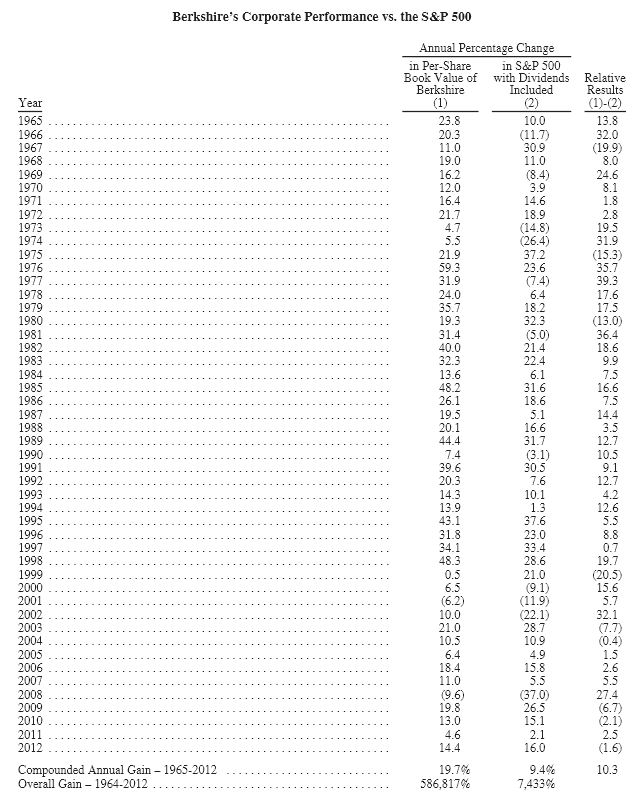
Reading Buffett’s 24-page Chairman’s letter makes me wonder why, when I sold my business in 1997, instead of chasing every “perfect investment” that came along (and losing millions in the process) I hadn’t simply taken every nickel I received and bought Berkshire Hathaway stock. After all his gains have been spectacular. Here’s page two of his report:
I could also have avoided reading the rubbish that spooks us out. Typical:
This weekend’s New York Times Sunday Review led off with a piece by David Stockman (President Reagan’s budget director from 1981 to 1985) that was emblazoned with a gigantic image — 14″ long by 10″ wide — large enough for framing.

Who wants to open their newspaper on a nice Spring Sunday morning and read this gross negativity? The piece included these choice words:
+ So the Main Street economy is failing while Washington is piling a soaring debt burden on our descendants, unable to rein in either the warfare state or the welfare state or raise the taxes needed to pay the nation’s bills. By default, the Fed has resorted to a radical, uncharted spree of money printing. But the flood of liquidity, instead of spurring banks to lend and corporations to spend, has stayed trapped in the canyons of Wall Street, where it is inflating yet another unsustainable bubble.
+ Under his successor, the lapsed hero Alan Greenspan, the Fed dropped Friedman’s penurious rules for monetary expansion, keeping interest rates too low for too long and flooding Wall Street with freshly minted cash. What became known as the “Greenspan put” – the implicit assumption that the Fed would step in if asset prices dropped, as they did after the 1987 stock-market crash – was reinforced by the Fed’s unforgivable 1998 bailout of the hedge fund Long-Term Capital Management.
That Mr. Greenspan’s loose monetary policies didn’t set off inflation was only because domestic prices for goods and labor were crushed by the huge flow of imports from the factories of Asia. By offshoring America’s tradable-goods sector, the Fed kept the Consumer Price Index contained, but also permitted the excess liquidity to foster a roaring inflation in financial assets. Mr. Greenspan’s pandering incited the greatest equity boom in history, with the stock market rising fivefold between the 1987 crash and the 2000 dot-com bust.
Soon Americans stopped saving and consumed everything they earned and all they could borrow. The Asians, burned by their own 1997 financial crisis, were happy to oblige us. They – China and Japan above all – accumulated huge dollar reserves, transforming their central banks into a string of monetary roach motels where sovereign debt goes in but never comes out. We’ve been living on borrowed time – and spending Asians’ borrowed dimes.
This dynamic reinforced the Reaganite shibboleth that “deficits don’t matter” and the fact that nearly $5 trillion of the nation’s $12 trillion in “publicly held” debt is actually sequestered in the vaults of central banks. The destruction of fiscal rectitude under Ronald Reagan – one reason I resigned as his budget chief in 1985 – was the greatest of his many dramatic acts. It created a template for the Republicans’ utter abandonment of the balanced-budget policies of Calvin Coolidge and allowed George W. Bush to dive into the deep end, bankrupting the nation through two misbegotten and unfinanced wars, a giant expansion of Medicare and a tax-cutting spree for the wealthy that turned K Street lobbyists into the de facto office of national tax policy. In effect, the G.O.P. embraced Keynesianism – for the wealthy.
The explosion of the housing market, abetted by phony credit ratings, securitization shenanigans and willful malpractice by mortgage lenders, originators and brokers, has been well documented. Less known is the balance-sheet explosion among the top 10 Wall Street banks during the eight years ending in 2008. Though their tiny sliver of equity capital hardly grew, their dependence on unstable “hot money” soared as the regulatory harness the Glass-Steagall Act had wisely imposed during the Depression was totally dismantled.
Within weeks of the Lehman Brothers bankruptcy in September 2008, Washington, with Wall Street’s gun to its head, propped up the remnants of this financial mess in a panic-stricken melee of bailouts and money-printing that is the single most shameful chapter in American financial history.
There was never a remote threat of a Great Depression 2.0 or of a financial nuclear winter, contrary to the dire warnings of Ben S. Bernanke, the Fed chairman since 2006. The Great Fear – manifested by the stock market plunge when the House voted down the TARP bailout before caving and passing it – was purely another Wall Street concoction. Had President Bush and his Goldman Sachs adviser (a k a Treasury Secretary) Henry M. Paulson Jr. stood firm, the crisis would have burned out on its own and meted out to speculators the losses they so richly deserved. The Main Street banking system was never in serious jeopardy, ATMs were not going dark and the money market industry was not imploding.
Instead, the White House, Congress and the Fed, under Mr. Bush and then President Obama, made a series of desperate, reckless maneuvers that were not only unnecessary but ruinous. The auto bailouts, for example, simply shifted jobs around – particularly to the aging, electorally vital Rust Belt – rather than saving them. The “green energy” component of Mr. Obama’s stimulus was mainly a nearly $1 billion giveaway to crony capitalists, like the venture capitalist John Doerr and the self-proclaimed outer-space visionary Elon Musk, to make new toys for the affluent.
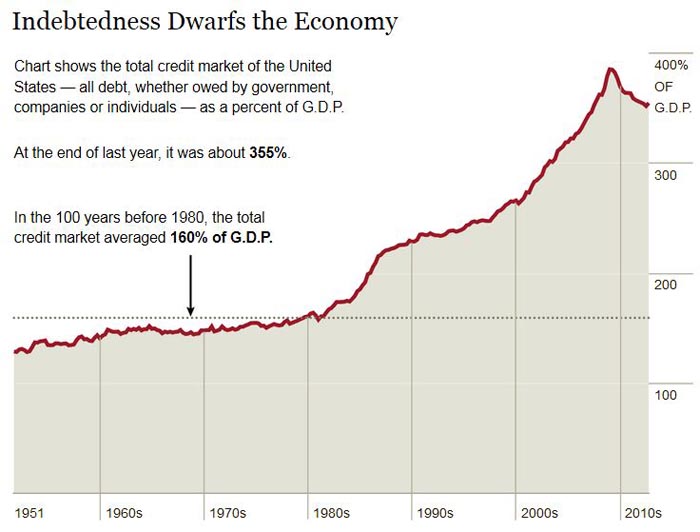
What’s disturbing about Stockman’s words is that I agree with him. Bankruptcy is the reward for failure in our capitalist society. Those big banks should have gone, not been saved. It was their own incompetence that got them into trouble. There are over 7,000 banks in the U.S. And new ones are being formed all the time. I know. I’m a shareholder in a new one called First Commons Bank — it’s in Boston. Our 7,000+ banks could easily have taken the slack had we not wasted taxpayer money saving the banks that are allegedly, “too big to fail.” . There was no reason to print the money and run up huge debts, as shown in Stockman’s chart:
You can read Stockman’s entire piece here.
But, to feel good, you’d be much better off reading Warren Buffett’s annual report. Click here. And then book yourself an airline ticket to his May 4 annual meeting in Omaha. He calls it an annual meeting. Actually it’s a weekend to shop Berkshire goods, chattels and services (8% discount on Geico insurance) with Warren playing jewelry salesman at one of the counters — replete with his own personal sales target– $2 million — for the weekend.
I loved reading his report especially this bit:
Berkshire Hathaway Inc.
Acquisition Criteria
We are eager to hear from principals or their representatives about businesses that meet all of the following criteria:
(1) Large purchases (at least $75 million of pre-tax earnings unless the business will fit into one of our existing units),
(2) Demonstrated consistent earning power (future projections are of no interest to us, nor are “turnaround” situations),
(3) Businesses earning good returns on equity while employing little or no debt,
(4) Management in place (we can’t supply it),
(5) Simple businesses (if there’s lots of technology, we won’t understand it),
(6) An offering price (we don’t want to waste our time or that of the seller by talking, even preliminarily, about a transaction when price is unknown).
The larger the company, the greater will be our interest: We would like to make an acquisition in the $5-20 billion range. We are not interested, however, in receiving suggestions about purchases we might make in the general stock market.
We will not engage in unfriendly takeovers. We can promise complete confidentiality and a very fast answer – customarily within five minutes – as to whether we’re interested. We prefer to buy for cash, but will consider issuing stock when we receive as much in intrinsic business value as we give. We don’t participate in auctions.
Charlie and I frequently get approached about acquisitions that don’t come close to meeting our tests: We’ve found that if you advertise an interest in buying collies, a lot of people will call hoping to sell you their cocker spaniels. A line from a country song expresses our feeling about new ventures, turnarounds, or auction-like sales: “When the phone don’t ring, you’ll know it’s me.”
By the way the only other company that sent me an annual report — BMO — is doing just fine. It’s up a few percent since I bought it and it’s paying a handsome 4.62% dividend yield. I can’t imagine not sending your shareholders an annual report.
Useful new gadget:
+ The Roku 3 Internet streaming TV box is the best they’ve made. the Roku is a little box that connects between an Internet connection (WiFi or wired) and your big flat wonderful wall TV set. It lets you watch movies from Netflix, Amazon, Hulu Plus and HBO. You don’t need a Roku if you only watch movies on your laptop or desktop. But if you want to watch them on the big screen you ned Roku. It’s $99 and worth every penny. I bet you can get it a big cheaper if you Google Roku and scrounge around.
Jewish Haiku
In Passover we
Opened the door for Elijah.
Now our dog is gone.
Jewish Buddhism:
If there is no self,
Whose arthritis is this?
Beyond Valium,
Peace is knowing one’s child
Is an internist.
Her lips near my ear,
Aunt Sadie whispers the name
Of her friend’s disease.
The same kimono
The top geishas are wearing:
I got it at Loehmann’s.
Mom, please! There is no
Need to put that dinner roll
In your pocketbook.
Sorry I’m not home
To take your call. At the tone,
Please state your bad news.
Is one Nobel Prize
So much to ask from a child
After all I’ve done?
A lovely nose ring,
Excuse me while I put my
Head in the oven.
Wherever you go, there you are.
Your luggage is another story.
Accept misfortune as a blessing.
Do not wish for perfect health, or a life without problems.
What would you talk about?
The journey of a thousand miles
Begins with a single Oy.
Zen is not easy.
It takes effort to attain nothingness.
And then what do you have?
Bupkis.
Breathe in, Breathe out.
Forget this and attaining Enlightenment will
Be the least of your problems.

Harry Newton who laid all the contents of his wallet on his flat-bed scanner and made a picture.
When his wallet gets stolen, the image will be useful. Earlier this morning I published the scan. Everyone told me to take it off the site. It would be scammed. It’s gone…

Hey Harry,,,,, amazing how you don’t want to realize what is happening all around us,,,,,,,,, just read the good stuff are you kidding????? please……..life is difficult and sometimes you need the truth and unfortunately the truth is not spoken in the main stream media…….. it’s a shame that the truth might hurt or be depressing but it’s still the truth……… how long do you think we will last running trillion dollar deficits……… come on geezer……..go watch the movie a few good men and the last scene on the witness stand with Jack Nicholson is what you need………….
Love the Haiku, Harry. Do not trust Buffet since he is so enamered of Obamanism — counter to everything he did to make his fortune in America