Harry’s Health thoughts:
+ Procrastination is stupid. I had something on my leg. I finally got it cut off yesterday and sent to pathology. I should have done it earlier. It took ten seconds to remove it. The leg feels better. The last time a friend delayed with “something” on his back, it turned out to be melanoma and he was dead in nine months. The doc said mine looked OK and I won’t be dead in nine months.
Rachel’s check to her doctor bounced.
The doctor called, “Rachel, your check came back.”
Rachel, “So did my arthritis.”
+ From the New York Times, advice that’s obvious, but ignored:
After a Heart Attack, Eat Your Fiber
It is never too late to increase your consumption of dietary fiber, a new study suggests.
It is well known that fiber reduces the risk of cardiovascular disease. Now a study published in BMJ has found that it also decreases the risk of death after surviving a heart attack.
Researchers analyzed pre- and post-heart attack dietary and medical information on 4,098 people. In a nine-year follow-up, there were 1,133 deaths – 558 from cardiovascular disease.
After adjusting for age, medication use, smoking and other factors, they found that after a first heart attack, those who increased their fiber intake the most had a 31 percent lower risk of dying from any cause, and a 35 percent lower risk of cardiovascular death, than those who increased their intake the least. Only cereal fiber, not fiber from fruits or vegetables, was associated with the lowered risk.
The researchers were unable to control for how reliably people took their medicines.
But the lead author, Shanshan Li of Harvard, said that fewer than 5 percent of Americans eat the recommended 14 grams a day for each 1,000 calories consumed.
+ Napping saves your sanity and improves your decision-making. But my friends tell me they “can’t” nap. Nonsense, everyone can learn to nap. Lie flat on your back. Bury your head in a pillow so your ears are covered. Cross your hands over your chest, Pharaoh-style. Close your eyes. Concentrate on your hands. Concentrate on making one not feel the other. Soon they will float. And you’ll be asleep.
+ Every clothing retailer (except Amazon) is offering 25% off. If you don’t see it, ask for it. Discounts make you feel good.
Love this quote:
+ Famed Investor’s Contrarian Bet. “Gazprom is by acclimation the world’s worst company managed by the worst kleptocrats ever assembled on one continent,” said Jim Grant to Bloomberg TV’s Stephanie Ruhle. Grant thinks the Russian energy behemoth is an attractive buy for investors with no time horizon constraints. “[T]he beginning, middle and end of the bull case on Gazprom is that good things happen to cheap stocks.”
I have no idea how to buy Gazprom stock. Nor do I want to find out.
Russia is a kleptocracy. So are most underdeveloped countries of the world, like Laos, Cambodia, Vietnam, and most in Africa.
Gilead is Zacks’ Bull of the Day. Read the Seeking Alpha piece here.
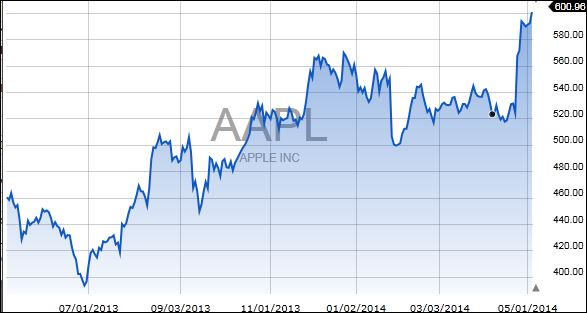
Apple is above $600. I don’t know why. I do know the play in Apple seems to buy cheap (like $400) and sell high (like $600).
Former Wall Street Journal writer, Yukari Kane has written a book on Apple called “Haunted Empire — Apple After Steve Jobs.” His conclusion is pessimistic. Some quotes from the New York Times review of the book:
+ The book is confidently written and contains a few reporting gems for committed Apple watchers. But ultimately it falls under the weight of the unanswerable question that it poses at the start: “Can a great company stay great without its visionary leader?” Analysts, investors and Apple fans may be reserving judgment, but Kane’s answer is a pretty conclusive no. The post-Jobs Apple of her estimation is hapless, lost without its iconic chief executive, and ricocheting between disasters like the worker suicides at its Chinese manufacturing partner Foxconn and the embarrassing shortcomings of new products like Apple Maps.
+ At the center of Kane’s account is Tim Cook, Jobs’s handpicked successor, a fiercely analytical executive so skilled in the combat art of supply-chain economics that he called himself the “Attila the Hun of inventory.” Kane traces Cook’s story back to Robertsdale, Ala., the small rural town where he grew up. He was a standout student and a trombone player in the school band. After studying industrial engineering at Auburn University, he was recruited by IBM and fell into the computer revolution, even though he had never been a PC enthusiast.
The portrait that emerges is hazy and somewhat colorless, because Cook, a workaholic, has himself disclosed so few personal details to colleagues and appears to have no close friends willing to enhance the picture. In one anecdote Kane relates, Jobs asks his executives to go home and try out Apple’s new iMovie software. Some make films of their kids. Cook, unable or unwilling to reveal personal details, returns with a movie about the tribulations of Palo Alto real estate. “The new C.E.O. was a cipher, a blank slate,” Kane writes. And later: “He was an unreadable mystery.”
Cook is unfailingly rational, except when it comes to dealing with Apple’s suppliers, at which point he apparently channels his inner Khrushchev to obtain the best deal terms. Kane charts the ramifications of that strategy: brutal, dehumanizing conditions in the factories of Apple’s Chinese manufacturing partners.
+ Apple’s problem, if it can really be called that, is that it has always been limited by its own orthodoxies. It wants to make beautiful products that people love, as Cook is fond of saying in interviews. It also wants to control every aspect of its products, which means it exerts strict control over its software and hardware and usually declines to let other companies license its designs. That philosophy allows Apple to produce meticulously constructed, high-end devices and to set its prices accordingly. The strategy also opened the door for Microsoft with its Windows operating system running on PCs in the late 1980s, and the same dynamic is now recurring with Google’s Android operating system running on phones and tablets from Samsung and others. Android’s popularity around the world, particularly in low-income countries, is less the result of Tim Cook’s lack of imagination than of Steve Jobs’s core philosophy and unwavering aesthetic.
In fact, “Haunted Empire” reminds one of just how many problems Apple’s co-founder handed off to his successor. It was Jobs, furious at his putative allies at Google, who steered Apple into its endless patent battle with Samsung over Android. And it was Jobs, aiming to dethrone Jeff Bezos as the king of digital books, who clumsily herded book publishers into a pricing scheme that attracted the attention of the Justice Department, and which a judge later found to be unlawful. In a sense, Cook is still cleaning up messes left by the man whom the world roundly crowned, in a period of understandable mourning, as an unparalleled business genius.
Jobs set an unmatchable standard for Tim Cook and for all future Apple C.E.O.s. But he haunts the empire in more ways than that.
I dropped by my local Apple store on the weekend. Why could I buy? There’s nothing in the store that I don’t already own — from iPads (big and small) to iPhones (all the family has them), to laptops (most have them; some don’t use them any longer — Susan loves her iPhone). What could I buy? I walked out of the attractive Apple store with my shopping bag empty.
You can read the New York Times book review here.
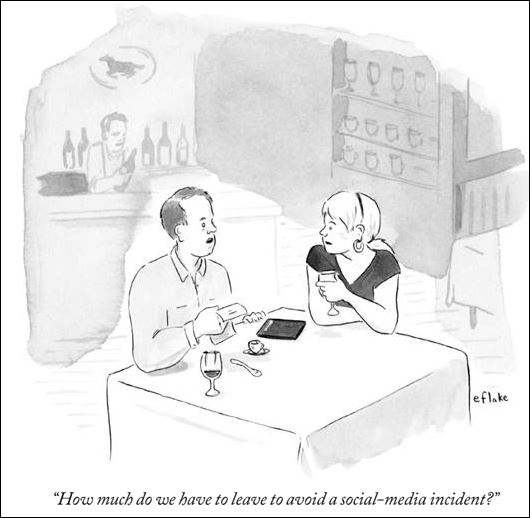
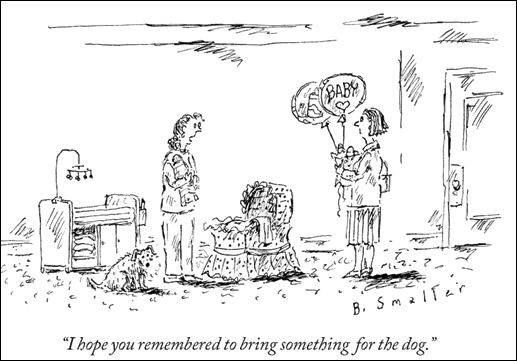
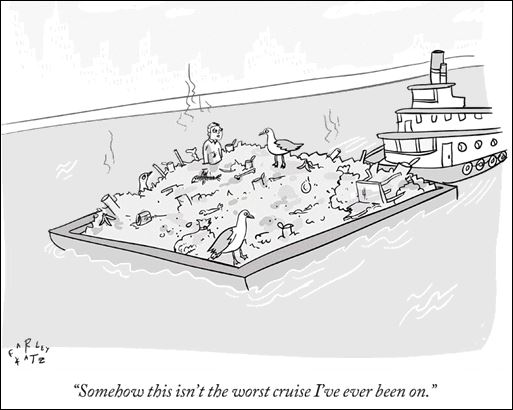
Favorite recent New Yorker cartoons:

Harry Newton who remains cautiously optimistic, but fears for further nonsense from Putin (e.g. a full-blown war in eastern Ukraine) and its affect on our stockmarket — to wit, a nasty one-day decline. Today there are lot of ideas to digest, including some startups. Hint: If you’re looking at a startup idea for your own family, look in your own backyard. Look at frustrations your family has had with products they’ve been using. Then invent a better one.

apple has products coming in the healthcare (wearable) and digital currency. Much more to come from Apple.
If God created Christians to pay retail, does that mean that he also made Jews to rip them off? Such a stupid joke…always insulting to the Goyim arent you Harry?