A few things I learned in 2012.
+ Life is wonderful without the “pleasures” of investing.
+ Everyone has a theory on investing, including me. They’re all right, that day.
+ If it goes up, that’s good. If it goes parabolic (like going up super fast), get out instantly — if not sooner.
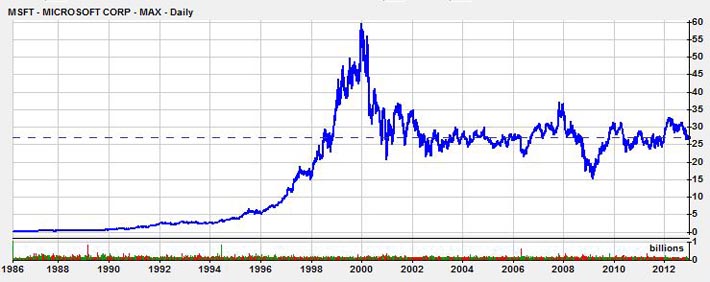
+ Everything hot gets cold. See Microsoft chart above. No one can continue to release one blockbuster product after another.
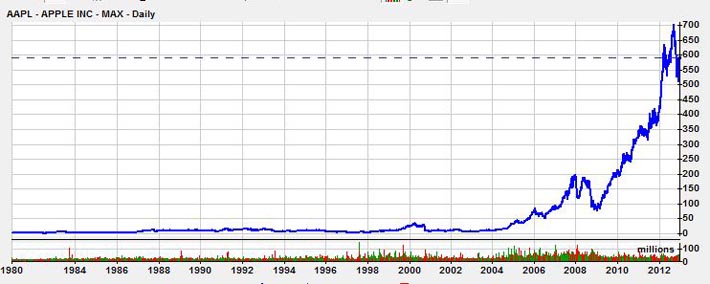
+ Our inviolate 15% Stop Loss Rule still works. Look at Apple.
+ All new software sucks. Some more than other. The software industry markets new, improved stuff, because it’s expected to. But the stuff usually isn’t. Certainly not improved.
+ CHECK. CHECK. CHECK. While we were in New York, our Christmas tree in the country fell over. The installer didn’t tighten the screws. CHECK. CHECK. CHECK.
+ If you’re still alive, you’re doing great.
+ Everything takes five minutes — the second time.
+ As things get “better,” they get more unreliable. There’s nothing you can do — except don’t buy anything with a computer in it. That includes boilers, toasters and cars.
+ Contractors design everything so complex that they’ll be called back when what they designed breaks. As it will.
+ All the family is nuts, except me. But they all I got. And I should try to be less nuts. I’m seeing them all this weekend. It will be fun, if they can stand me. Wait till they see the amazing stuff I bought for them.
The disasters at Apple. My friend is a supplier to them. Has been for a while. His take: No one can replace Steve, certainly not Tim Cook. Since Steve died,
+ Management has been infighting, backbiting and exiting. Not good.
+ Apple released two half-baked products — Siri and Maps. Steve never believed in releasing crappy, half-baked products. He was obsessed with perfection. (Read Walt Isaacson’s biography.)
Now look at Apple’s stock and look above at the Microsoft chart. Mmmmm. I bet Apple’s chart soon will look like Microsoft’s.
If you’re a bond investor, read this. I’ve said all this before, but this piece from the New York Times is worth reading. The moral is: Don’t buy long-term bonds today.
Risk Creeps Up in Long-Term Bonds
By FLOYD NORRIS
THE Federal Reserve Board’s Open Market Committee this week gave the first hint of what would cause it to allow interest rates to rise. It promised to maintain low rates until the unemployment rate – at 7.7 percent last month – fell to 6.5 percent, so long as inflation also remained quiet.
Fed officials do not think that will happen until late 2015, but they could be overly pessimistic. A year ago, they thought that the rate would not get as low as it is now until 2014.
The prolonged low level of interest rates – both short-term rates that are administered by the Fed and longer-term rates that are more subject to market forces – has caused many investors to search for yield by purchasing longer-term bonds.
That has provided a bonanza for companies in the United States and in many emerging markets, where the amounts of newly issued bonds have risen rapidly.
“Almost any kind of corporate activity is acceptable to the bond market,” said Michael Shaoul, the chief executive of Marketfield Asset Management. “That is really a sign the bond market is becoming indiscriminate.”
For a bond investor, there are two things that can go wrong. The first is credit quality, when bonds either default or at least fall in market value because a default seems more likely. The second is interest rate risk – the risk that market interest rates will rise significantly.
Mr. Shaoul said he thought investors in emerging market bonds were more likely to run into credit problems, while American bond buyers were more likely to face interest rate problems as the American economy improved.
“Five years down the road,” he said, “you are likely to have significantly higher interest rates.”
For a bond market investor now, the choice is to stick to shorter-term bonds, and get very low yields, or to move to longer-term ones that pay higher interest rates but that could lose market value if the interest rate offered on new bonds rose.
Much of the recent issuance in bonds has been because of refinancing, in which companies repay existing bonds with money borrowed on better terms. For holders, it can seem the worst of both worlds: if rates rise, they have old bonds that have lost value. If rates fall, their old bonds are redeemed by the company, depriving them of the yield they expected.
As can be seen in the accompanying graphic, corporate bond issuance in the United States has risen to record levels this year, and the average interest rate on high-yield bonds, also known as junk bonds because they are rated below investment grade, has fallen even more rapidly than have rates on higher-quality bonds.
Martin Fridson, the chief executive of FridsonVision and a veteran high-yield market analyst, said he thought high-yield investors were likely to lose money in 2013, as declines in prices offset the interest income realized from the bonds.
His model says the yield spread between the Bank of America Merrill Lynch High Yield Master II index and similar Treasury securities should now be around 6.5 percentage points, based on historical spreads as well as economic conditions, current default rates and the relative availability of bank credit. The actual difference, as shown by the chart, is about 5.3 percentage points, which he thinks is not enough to offset the risk.
Tomorrow the comet will hit the Earth and we’ll all be dead. But meantime…
In a dark and hazy room, peering into a crystal ball, the Mystic delivered grave news:
“There’s no easy way to tell you this, so I’ll just be blunt. Prepare yourself to be a widow. Your husband will die a violent and horrible death this year.”
Visibly shaken, Laura stared at the woman’s lined face, then at the single flickering candle, then down at her hands.
She took a few deep breaths to compose herself and to stop her mind racing. She simply had to know.
She met the Fortune Teller’s gaze, steadied her voice and asked, “Will I be acquitted?”
Delicious Christmas quotes.
“Santa Claus has the right idea. Visit people once a year.” – Victor Borge
“I once bought my kids a set of batteries for Christmas with a note on it saying, toys not included.” – Bernard Manning
“I stopped believing in Santa Claus when I was six. Mother took me to see him in a department store and he asked for my autograph.” – Shirley Temple
“You know you’re getting old, when Santa starts looking younger.” – Robert Paul
“Oh, for the good old days when people would stop Christmas shopping when they ran out of money.” – Unknown Author”
“What I don’t like about office Christmas parties is looking for a job the next day.” – Phyllis Diller
“The one thing women don’t want to find in their stockings on Christmas morning is their husband.” – Joan Rivers
“Christmas at my house is always at least six or seven times more pleasant than anywhere else. We start drinking early. And while everyone else is seeing only one Santa Claus, we’ll be seeing six or seven.” – W.C. Fields
“Mail your packages early so the post office can lose them in time for Christmas.” – Johnny Carson
“The worst gift is a fruitcake. There is only one fruitcake in the entire world, and people keep sending it to each other.” – Johnny Carson
“Aren’t we forgetting the true meaning of Christmas? You know… the birth of Santa.” – Bart Simpson, The Simpsons
“The proper behavior all through the holiday season is to be drunk. This drunkenness culminates on New Year’s Eve, when you get so drunk you kiss the person you’re married to.” – P.J. O’Rouke

Harry Newton, who will return on Wednesday, December 26 — the day after Christmas, if the family hasn’t killed him by then.
Real estate syndications look increasingly interesting. Two syndications recently financed their purchases of a commercial office complexes with bank money at 3.47% and 3.48% for seven years at interest only. No paying down of the principal. That sort of deal means bigger returns for the investors (like me). Why the banks do deals like this — no repayment of principal for seven years — is beyond my tiny brain.

Give each of your children a full 4 year scholarship to a major university for their children… that expires if not claimed within 12 months.
That would be a record acceleration from conception to high school graduation to claim those scholarships unless the goal is to get them busy trying to have children. In that case, some booze would be more effective than the scholarships. 🙂
Wishing Harry and all his readers a wonderful season of reflection and celebration with your loved ones.
Have a nice Christmas, Harry…I will miss you between now and December 26th…that is the day our reservations are confirmed for our stay at the Calistoga mineral baths in January.
Harry, your quotes on things you learned are as good as the quotes from Phyllis Diller, Johnny Carson, Joan Rivers, etc. I love these two:
+ If you’re still alive, you’re doing great. (LOL)
+ Everything takes five minutes — the second time. (yes, lol!)
+ All new software sucks. Some more than other. The software industry markets new, improved stuff, because it’s expected to. But the stuff usually isn’t. Certainly not improved.
AMEN, Harry. I’m in the software business. Complicated software is not intelligent software. Software that is simple and WORKS is intelligent software. AMAZON is so easy. I hope they don’t get too complicated. Oh, and don’t off-shore your software development to India. They are not as good as the USA team. Invest in companies who have USA development teams. Companies that move development off-shore are probably cashing out.