The price you pay. That’s the single biggest determinant of how much you’ll make on your investment.
That’s the most important investment lesson I’ve ever learned.
There are obvious implications:
1. Don’t fall in love with it before you buy it. Sellers see your love and jack your price up. This apples to everything from art to real estate.
2. Offer your price. Stick to it. Don’t be afraid to walk.
3. The moment you lose the best deal in the world, an even better one will come along. Trust me on this one. God opens windows, when he closes doors.
4. The biggest mistake sellers make is spending the money before they actually close the deal and get the money. This happens often in real estate. Hence it’s a good idea to say words like “That’s my price. Sorry, I can’t go higher. I understand you have a higher offer. If something happens, I’ll be here and I can close — for an all cash deal — within three days.”
5. Most prices are negotiable — especially in markets which aren’t an auction. The stockmarket is an auction. Treasuries are an auction. But muni bonds and art at your local gallery reflect prices dragged from someone’s tushy, based on how big a sucker you look.
6. There is no shame in offering a lower price. Everyone will bargain, including the poshest retail stories. Trust me. I’ve done it. You can often find discount coupons under the cash register at checkout. If bargaining price doesn’t work, try bargaining add-ons, like room upgrades, free breakfast, extended warranty, free Internet service.
Should you trust me, or anyone else?
You shouldn’t. The only person to trust is yourself. Financial writers and performers (e.g. Jim Cramer) have different goals than you do. You want to invest your money and profit. These people have deadlines to meet and space and time to fill. Great stock picks don’t conform to deadlines. They might also be dead by the time the column or the program appears. We writers do our best.
As a reader or viewer, your job is to jot down the ideas. Review them. Reject 99% of them. Or as this article from the latest Economist suggests, do the exact opposite — aka be a contrarian.
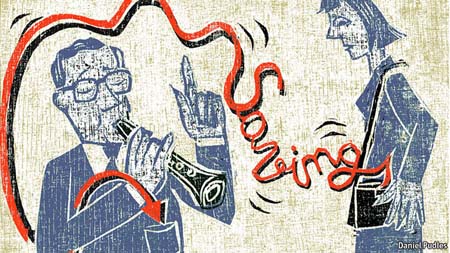
Ghastly gurus
The best advice is to keep your wallet closed
Pound Foolish: Exposing the Dark Side of the Personal Finance Industry. By Helaine Olen. Portfolio; 292 pages; $27.95 and £17.99. Buy from Amazon.com, Amazon.co.uk
Market Sense and Nonsense: How the Markets Really Work (and How They Don’t). By Jack Schwager. Wiley; 343 pages; $40 and £26.99. Buy from Amazon.com, Amazon.co.uk
In this section
HAVE you ever met anyone who has grown rich just by saving? Probably not. But you may well have met someone who has grown rich looking after other people’s savings. That dark secret lies at the heart of “Pound Foolish”, Helaine Olen’s excellent book, a contemptuous exposé of the American personal-finance industry.
With icy logic, Ms Olen, a journalist, demonstrates that much of the advice given by moneymaking gurus on television or in print is either fatuous or based on ridiculously optimistic assumptions about future investment returns. Take the idea that saving the cost of a daily latte and investing the proceeds in the stockmarket would make you rich. Saving $3 a day, or $1,100 a year, might be a sensible economy measure but it won’t build a fortune.
Such faddish ideas are the financial equivalent of miracle diets. A belief in instant riches lured millions into buying internet stocks in the late 1990s or overpriced houses in the middle of the past decade, when any personal-finance adviser worth his salt should have been advising clients to run in the opposite direction. But optimism sells, and realism tends not to.
As well as bad advice, the gurus have plenty of expensive products to flog-from courses that teach people how to become better real-estate investors to branded goods like a $49.99 canvas laptop bag or a $34.98 silver leather wallet. By the time clients have bought all the books, attended the courses and stocked up on the accessories, someone has definitely become rich, though probably not the saver.
Savers make all sorts of rookie mistakes-from following the stock tips touted on television to paying through the nose for complex financial products when simple low-cost alternatives (like index-tracking funds) are available. And debtors are similarly foolish, running up big bills on high-charging credit cards. Perhaps such lessons could be rammed home by financial-literacy courses but Ms Olen is cynical, noting that many courses are sponsored by financial-services companies, creating an obvious conflict of interest.
Indeed, this is one of the central problems of personal finance-how to get advice to apathetic consumers. The unwillingness of consumers to pay for advice has led to hard-selling, high-charging salesmen taking over the industry. Britain has just reformed its payment system for financial advice and if Ms Olen’s book has a fault, it is the lack of an international perspective offering such examples. The personal-finance pages of British newspapers are doughty champions of consumer rights. While she rightly attacks the high-cost annuities sold to American consumers, she might have reflected that the kind of low-cost annuities sold in Britain ensure that retirees do not outlive their savings.
But Ms Olen is right to home in on the biggest problem that personal-finance gurus neglect; people earning $20,000 a year will struggle to pay for the basics in life and will simply not be able to save their way to a life of comfort, let alone riches. As Ms Olen concludes, “We do not live in an economic environment that will permit mass personal-financial progress, no matter how well meant the guidance or advice.”
Like Ms Olen, the latest book from Jack Schwager, best known for his “Market Wizards” books based on interviews with traders and fund managers, takes a potshot at TV stockmarket tipsters. A four-year analysis of the share recommendations by Jim Cramer, star of CNBC’s “Mad Money”, shows that while the stocks rose on the day he mentioned them, they underperformed the market over longer periods. The experts polled by Louis Rukeyser on “Wall Street Week” (a programme on public television) proved to be almost perfect contrarian indicators; they were most bullish in December 1999, at the peak of the dotcom bubble.
Mr Schwager’s book starts off with plenty of sound, basic advice-beware of assuming that past high returns can be maintained, for example-before expertly demonstrating that a leveraged exchange- traded fund (a fund that promises to deliver an enhanced market return) is a dreadful investment because of its structure, being almost bound to disappoint.
He then moves on to more sophisticated measures of risk, rightly pointing out that “faulty risk measurement is worse than no risk measurement at all, because it may give investors an unwarranted sense of security.” As the book develops, beginners may start to struggle with mathematical concepts, such as Sortino and Calmar ratios, that regularly get trotted out.
Oddly, this curate’s egg of a book then veers off in a different direction-a lengthy description and defence of the hedge-fund industry. Mr Schwager demonstrates that hedge funds are less risky than many mutual funds, but he does not really deal with the central issue; that their fees are too high for the returns they deliver. One suspects that Ms Olen would respond to his conclusion that “hedge funds are a desirable investment even for unsophisticated, lower-net-worth individuals” with a loud, and well-deserved, raspberry.
How important is your credit card’s expiration date? I wish I knew. I have several monthly bills which get automatically paid by my Visa credit card. When my card expires, all hell breaks out. Today Visa is sending me new cards with new, longer expiration dates. Often I just extend my card’s expiration date by two years. Sometimes it works. Anyone know more?
Favorite business card. Side 1:
Other wide:

The Australian Tennis Open is on. The previous day’s matches are on the Tennis channel during the day. It’s playing live on ESPN2 beginning at 9 PM. Australia is 16 hours ahead of EST in the U.S. It’s 13 hours ahead of the west coast.

Harry Newton, who is happy he’s completely out of Apple and recommended to his readers to do also. Many “gurus” are now predicting a bounce from here based on Apple being “oversold.” I don’t know what that means. And I’m not into gambling. To me, Apple’s long-term fundamentals suck: No Steve, Management in disarray. Another senior one left in the past couple of days. No new products, etc.

I’m not sure I agree with the “fact” that a low income person can’t modestly save in today’s world and over time build a sizable nest egg, perhaps for retirement or emergencies. That is really bad advice and highly consistent with Liberal beliefs of the necessity of taxing the “rich” to support the “poor”. There are few honestly poor in America today: they have cars, TV’s, cellphones, subsidized housing, medical coverage, food credit cards and many other things my middle class parents and we children never had. But we were taught to work hard and to save, even if only a few dollars/month. Over time, it added up. That’s how I got my start.
Years ago a NYCity subway toll collector passed away leaving over a million dollars, equivalent to 4-5 million today, in savings behind.
I was on the fence about APPL at these prices. Harry’s down on it, time to call the broker and make a large purchase.
Good contrary thinking.. Short term you may be very right. I’m not a gambler,. Hence I’m not prepared to make guesses, especially since I feel the long-term fundamentals are poor.
CREDIT CARD EXPIRATION DATES…consider switching your utility bills and other everyday essentials to ACH “Auto-Pay” from your checking account…it only expires if you fail to keep enough money in your bank account…overdraft protection helps here. Works for me, been doing it for years.
Yes, I know about ACH and I use it for some things. But using a credit card brings airline miles. And that’s useful. ACH doesn’t.
I do the same…I guess you will just have to keep a list of all the accounts that you pay by credit card and manually go in and update them when your credit cards expire…a pain in the ass but that is the only way you get your cake (air miles) and eat it too. You might check to see if your various accounts have the ability to “alert” you when the date is no longer valid, much the same as the credit card companies do with charges. I just bought new tires on my AMEX card and received an alert that a large (over $500) charge had been made. You set the alert level to ward off fraud.