Is RadioShack about to go “broke,” again? I don’t know. But the stock seems way overpriced.
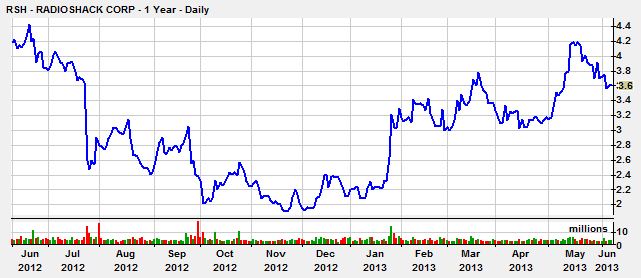
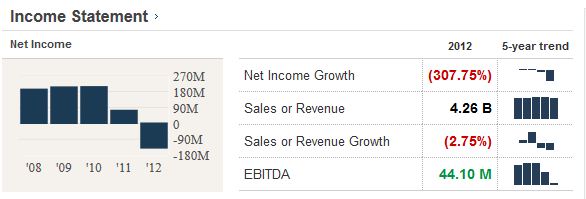
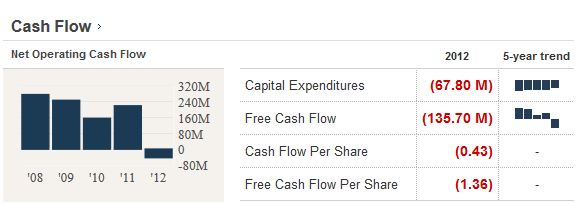
Look at their horrible finances, which are falling off a cliff. Time is running out for RadioShack.From the Wall Street Journal’s site:
Harry Dent’s organization agrees with me. Dent Research recently wrote:
If you drove by a shopping plaza or walked through a mall lately, you’ve seen Radio Shack [NYSE: RSH] before.
You’ve probably bought something from them in the past. It’s been a vital cog in our economy for over 90-years, and has over 4,400 locations in the United States alone. As such, it’s one of the largest com- panies in America, with operations in all 50 states and over 34,000 employees.
But today it faces the ever growing threat of bankruptcy.
Why? Two words: Unpayable Debt.
On August 1 st , Radio Shack has a $375 million loan that comes due and there’s a good chance it won’t be able to pay it back.
Already over the last year its money woes have begun to come to light. The company eliminated its dividend in July 2012. It has replaced its Chief Executive Officer. its Executive Vice President of Operations. and its Executive Vice President of Strategy.
It has negative net profit margins. negative free cash-flow. and earnings that don’t even cover interest expenses.
Coming up with the money it needs to repay that loan by August 1 is a tall order. Whether it succeeds in making a deal with its creditor or not, Radio Shack’s stock is likely to suffer.
Surprisingly, analysts from Merrill Lynch rate it a “buy.” Analysts at Zach’s recently upgraded its stock.
Its demise could even ripple through to some of America’s most well-known brands, including AT&T, Bose, Verizon, Apple, Hewlett Packard, Energizer and Intel (to name a few). That’s because Radio Shack is a distributor for all these firms. Without its massive distribution channel, it could spell trouble for many of the biggest companies in America.
But beyond Radio Shack’s loan coming due on August 1 and the implications non-payment could mean to shareholders, there are two other shakeout victims you should SELL NOW.
Apple’s Developer Conference opens today. Personally, I think it will disappoint. Here’s what Goldman Sachs wants Apple to unveil at the conference. Click here.
Want a great local business? How about designer hamburgers? Come to New York and line up for Shake Shack’s burgers. From the weekend’s Economist:
Posh fast food. On a roll
Britons are flipping out for fancy burgers
ON FRIDAY evenings diners seeking a table at MeatLiquor, a fashionable burger restaurant in central London, can expect to queue for an hour. For big groups the wait doubles. At nearby Patty & Bun the decor is less alarming but the queues are no shorter. Britons are in the greasy grip of burger mania.
Byron, a chain of posh burger diners, opened in 2007 on Kensington High Street, a ritzy bit of west London. It now has 32 branches and will soon open new ones in Liverpool and Manchester. Gourmet Burger Kitchen, another fast-expanding chain, has 59 restaurants from Brighton to Edinburgh.
In a slow economy few can stretch to the finest caviar, but they can afford top-notch ground beef. Byron attracts people who would not dream of going to McDonald’s, says Tom Byng, its founder.
Britons’ appetite for fancy burgers reflects broader shifts. Since the financial crisis consumption of fish, fruit and vegetables has dropped; ready meals, particularly meaty ones, are up. Yet people are still eating out. It has consistently topped spending priorities after utility bills, says Helen Spicer, an analyst at Mintel, a market researcher. At restaurants people want reliable treats that are gentle on the wallet. Burgers are nostalgic and comforting, says Mr Byng. And dinner at Byron costs just £15 ($23).
Many of the posh burger outfits started as pop-ups, allowing restaurateurs to test their products and build a customer base before renting an expensive property. Yianni Papoutsis, one of MeatLiquor’s founders, started selling burgers from a van in south-east London. Even the restaurants are frugal. They have short menus, which are easier to do well. Fewer ingredients means less waste and heftier buying power. Restaurants can keep prices low while still turning a tasty profit. People eat fast, so turnover is high. Honest Burger, in London, can turn its tables as many as five times at lunch and seven or eight times at dinner. Full-service restaurants might manage one turnover at lunch and two at dinner.
Investors are now tempted by another meat, says David Campbell, head of the restaurants and bars team at BDO, a consultancy. There is little in the way of an upmarket Kentucky Fried Chicken. Might posh chicken have wings?
Weekend reading:
+ Crazy Eddie fraudster says the SEC can’t keep up.
Corporate audits don’t work, give investors false sense of security. Excerpt:
MW: You’ve noted that the largest chunk of frauds is found by tipsters. The SEC has beefed up its whistleblower program and is offering greater rewards for tips. Is that positive?
S.A.: I agree with that. I can tell you that the last thing any criminal wants is an adversary with a profit motive. That’s why short sellers do a very good job, and a lot of times they do a better job than the auditors.
MW: What do you think about short sellers in general?
S.A.: There are good ones, and there are bad ones. The good short sellers know what they are doing, and they do a very good job at ferreting out fraud. That’s just the way it is. It just seems that short sellers uncover more fraud than the auditors that have access to the books and records.
MW: What do you think of the situation with Carl Icahn battling with Bill Ackman over Herbalife?
S.A.: America’s capital markets need lively debate. That’s what capitalism is about. So when Bill Ackman can get on the air with Carl Icahn, and they can both debate their positions, irrespective of which one is right and which one is wrong, I think that is great. We have debate in politics, [so] why can’t we have it with public companies?
MW: Are insider-trading laws effective?
S.A.: No. The problem with insider trading is it is very difficult to police. Most of it is basically invisible. Meanwhile, the Securities and Exchange Commission basically abrogated its obligation to prosecute sophisticated financial fraud where companies, financial or nonfinancial, have manipulated their books and records.
MW: Is your point that the SEC is allocating its resources to big insider-trading cases involving hedge funds and missing accounting-fraud cases and smaller insider-trading incidents?
S.A.: The big [insider trading] cases, once the SEC gets the tips and information, are relatively easier to prosecute than accounting-fraud cases. I’m not saying that insider-trading cases are easy to prosecute, but they are easier to prosecute than financial-fraud cases. The SEC is not doing enough on financial cases involving accounting fraud. The SEC doesn’t have the resources: only 4,000 people at the SEC, [while] there are 35,000 cops in New York fighting blue-collar crime. (My emphasis.)
MW: You teach a class?
S.A.: l teach about white-collar crime. One thing that comes with the turf of being an effective white-collar criminal is that you have to be a good bullshit artist. You have to be a good communicator, which means I can be a good teacher, too. I’ve lectured at Stanford’s business and law schools, I taught at the College of New Jersey, I taught the FBI at their economic-crimes division, and I’ve taught the U.S. Justice Department at their training campus. I’ve talked to dozens of government agencies.
MW: I’ve heard a lot of concern from consumer-advocate groups about regulation under consideration by the SEC that would permit “crowdfunding,” which allows people to go online and invest in small businesses with very little SEC oversight or disclosure.
S.A.: The JOBS Act makes me want to reconsider my retirement from crime – ha-ha. It is a license to steal. Any time you take away a layer of oversight, a layer of checks and balances, the criminals are going to take advantage of it.
MW: Does the Internet make fraud easier?
S.A.: Just like regular people adapt to technology, criminals also adapt to technology and take advantage of it to commit different types of crimes or to help them commit even more crimes.
Somebody put out fake Twitter accounts for noted short sellers. We have identity fraud, and phony Facebook emails. So crime evolves. It is never going to go away. We are not going to structure our economy in a way that will eliminate crime. It is as old as the Bible.
MW: Is jail time a deterrent?
S.A.: No. I’ll give you a perfect example: Bernie Madoff. You think he read the papers every day? Watched TV ? He had to see other people being carted off to jail – did it stop him? No. Somebody else going to jail is not going to help me find God. It’s not going to help me find morality. It is not going to stop any crimes in progress. Most white-collar criminals are not going to be deterred because someone else got caught. White-collar criminals take precautions, so the possibility of jail time is not going to deter them.
For the full article, click here.
+ How the U.S. Uses Technology to Mine More Data More Quickly.
WASHINGTON – When American analysts hunting terrorists sought new ways to comb through the troves of phone records, e-mails and other data piling up as digital communications exploded over the past decade, they turned to Silicon Valley computer experts who had developed complex equations to thwart Russian mobsters intent on credit card fraud.
The partnership between the intelligence community and Palantir Technologies, a Palo Alto, Calif., company founded by a group of inventors from PayPal, is just one of many that the National Security Agency and other agencies have forged as they have rushed to unlock the secrets of “Big Data.”
Today, a revolution in software technology that allows for the highly automated and instantaneous analysis of enormous volumes of digital information has transformed the N.S.A., turning it into the virtual landlord of the digital assets of Americans and foreigners alike. The new technology has, for the first time, given America’s spies the ability to track the activities and movements of people almost anywhere in the world without actually watching them or listening to their conversations.
New disclosures that the N.S.A. has secretly acquired the phone records of millions of Americans and access to e-mails, videos and other data of foreigners from nine United States Internet companies have provided a rare glimpse into the growing reach of the nation’s largest spy agency.
For the full article, click here. To repeat what I wrote in Friday’s column:
If you think our government isn’t listening in on all our voice and email conversations, you’re wrong. Be careful what you say and write. No joking about serious stuff. Remember those signs at the airports about not making jokes as you pass through Security. Heed them in your everyday life. I am not joking.
+ Comedian Jackie Mason-Who Turns 82 Sunday-Is Still Really, Really Funny.
In an interview with Tablet Magazine, he also gets serious about Israel, anti-Semitism, and why Italians love him
For the full fascinating interview, click here.
SEX
Condoms don’t guarantee safe sex anymore. A friend of mine was wearing one when he was shot by the woman’s husband.
Poor Lance Armstrong –
I think it is just terrible and disgusting how everyone has treated Lance Armstrong, especially after what he achieved, winning seven Tour de France races while on drugs.
When I was on drugs, I couldn’t even find my frig’n bike.
Drive By Shooting
A guy broke into my apartment last week.
He didn’t take my TV, just the remote.
Now he drives by and randomly changes the channels.
Sick Bastard!!
The Agony of Aging
On the morning that Daylight Savings Time ended I stopped in to visit my aging friend.
He was busy covering his penis with black shoe polish.
I said to him, “You better get your hearing checked – You’re supposed to turn your clock back”.
EASYJET logic
Paddy calls EASYJET to book a flight.
The operator asks, “How many people are flying with you?”
Paddy replies “How should I know? It’s your plane.”

Harry Newton who’s celebrating a birthday today by playing tennis at 7:00 AM in an idyllic country setting in Old Chatham, New York. The family is well, happily pursuing their lives and their careers. We’ll be together at the end of this month to celebrate Susan’s birthday.
CBS has piece this evening at 11 PM on avoiding skin cancer. Should be worth watching. My keys are (1) Stay out of the sun, and (2) Visit a dermatologist every six months.

Happy Birthday from me too Harry…seems like you get closer to me every year! Now in residence at our summer cottage in coooool Nova Scotia…it was 110 when we left Phoenix a week ago last Sunday.
Happy Birthday Harry! From a long time reader.
May your first serves go in, and may the net balls fall in your favor.
Roderic
Happy b’day, Harry. Page looks good. Two stories about sex? Yeah, the years do that to a guy.
hbd
Happy Birthday, Harry, and thank you for all of the interesting reading in the past year.
I don’t always agree, but it’s still stimulating and interesting…!
Mike Y
Dallas, Texas
Happy Birthday and best wishes for health and happiness.
Happy Birthday Harry!
I hope you get everything you want for your birthday. Enjoy your tennis.
Steve
Happy Birthday, Harry!
Love Birthdays, Enjoy your special day……..
You make a good case on Radio Shack, but I wouldn’t plan the funeral yet.
Serious changes in management, upgrading brand, showcase in Hong Kong and
Shanghai, name still has alot of goodwill. Who knows you might get a pop on
a short squeeze.
Happy Birthday Harry
Happy birthday to you! Etc… It is great to see you vigorous and electric.
Isn’t the Apple Store the new Radio Shack store? What Radio Shack USED to be; A place for exciting technology? It’s just buggy whip makers all over again. Actually, in its defense, Radio Shack tried to adapt by becoming mostly a phone store with multiple carriers, but the carrier loyalty became prime.