The last few days have been ultra-painful. But, put in a greater concept, they’re really a blip. Here’s the Dow charted weekly:
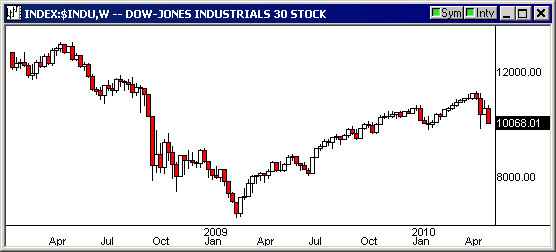
I’m not arguing stocks will continue the big march upward that we’ve seen since March last year. If anything, this could be The Big Painful Pause.
And the lesson is Be Wary. Keep those 15% stops oiled.
In fact, be ultra-wary of everything. This world has become ultra-scary, with Black Swans popping up here, there and everywhere. The Senate has passed some new financial regs, which I’m sure will screw things up, but at least make the tax lawyers rich figuring ways around the rules.
The BIG concern for everyone remains What to do with their cash? The answer is no one knows. If you do something desperate, you’ll do something dumb. The BIG KEY is to keep lots in boring, old cash — enough to live on for five years.
What’s most interesting about the last few days (and yesterday in particular) is that investors didn’t flea to gold as a safe haven. In fact, look at this chart of yesterday’s movements. Don’t you get the idea that day traders (also called high frequency traders) just watched the opening trend, then jumped on it, exacerbating it?
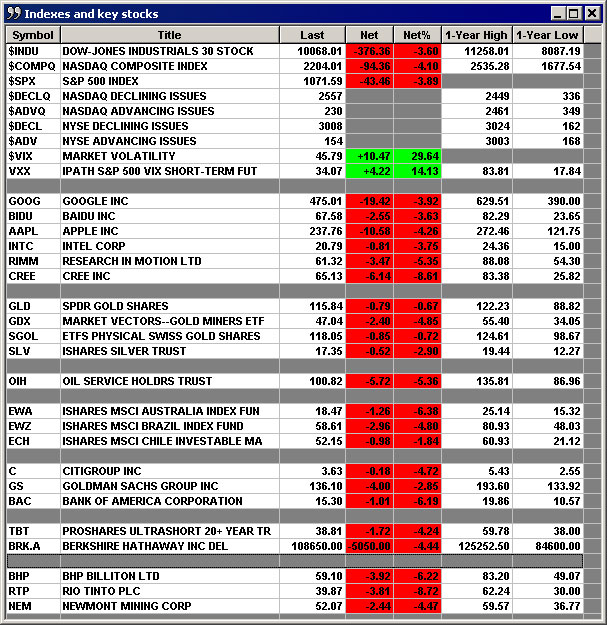
Look at the gold price. They didn’t fall percentagewise as much as stocks. But they still fell. That confirms to me even more that it’s been day trading and those cursed computers that are determining the market’s movements — not fundamentals. The global stuff that’s happening is simply providing the trigger. In short, unless you can play this daily, don’t.
Global Disunion is The Big Explanation. If you are a brokerage firm and have clients, it’s important to tell them what’s going on, and why. Even if you really have no idea. This came out of Deutsche Bank yesterday:
Over the past two weeks financial markets have been driven by fear mainly attributed to uncertainty surrounding the survival of the Euro and the broad European Union. Although the IMF and European Union have announced an aggressive aid package, the lack of clarity since the announcement was made has escalated public uproar and investor uncertainty over the plan’s success. In addition in recent months there has been a plethora of negative headlines for investors to dwell upon especially pertaining to political uncertainty (e.g. financial reform, elections, unilateral ban on short selling financial stocks in Germany), public unrest (e.g. Greece, Thailand), geopolitical fears (e.g. failed terrorist attack in NY, North/South Korea), technology mishaps (e.g. “flash crash”), environment disasters (e.g. BP oil spill and volcanic ash) and uncertainty surrounding tighter monetary policy (e.g. emerging markets).
The anxiety created by recent events is overriding any positive fundamentals and resulting in a sharp sell-off of risky assets. In fact, the S&P 500 has entered its first correction in this bull market rally that has been ongoing for 13 months. The correction has also been broad based not only at the sector level (8 out of the 10 S&P 500 sectors) but globally (e.g. Japan, Hong Kong, UK, France). We warned investors in our past publications that this crisis in confidence may persist
in the near term and that lower prices and attractive valuations may not necessarily attract buyers.
Since our last publication, investors have absorbed more of a disunion than a union regarding Europe. While the aggressive aid package eased concerns temporarily, confidence has slipped as the ECB’s credibility has been called into question and political officials continue to baffle investors as to their commitment to the concept of the European Union. The distaste among fellow EU countries for the package signals the European Union may no longer truly be a Union. In addition, signs of cracks in the globally synchronized procedures have emerged as countries that are granting funds to the IMF as a part of the aid package have voiced speculation and objection.
This sentiment of heightened disagreements and failure of resolutions has exacerbated weakness in an already fragile market. In addition, mixed economic data (e.g. jobless claims and manufacturing in U.S., confidence in Germany) has fueled speculation that the global economic recovery is at risk and credit indicators are showing signs of distress (e.g. LIBOR rising, credit spreads widening).
In the current environment it becomes increasingly difficult to make short-term tactical recommendations. There is little way to quantify how far fear and panic can drive a market lower and how quickly sentiment can rebound. We do not recommend selling equities at this time because valuations are compelling (S&P 500 at 12.8x NTM versus 16x 20-year average), technicals (e.g. RSI at 30) are signaling oversold conditions, upward earnings revisions are not justifying a breakdown of equity prices and for each weak fundamental we are presented with a positive one. For example, ongoing sovereign debt concerns, vulnerability in the credit markets and recent deflation fears will likely keep the Fed on hold longer which should be supportive of equities and economic growth. Our Chief U.S. Economist has pushed out Fed rate hikes to at least November (from August) while Fed funds futures are pricing in more than a 50% probability that the Fed
will not raise rates at all this year (up from a 35% probability a month ago).
While fundamentals and valuations, especially in the U.S. and emerging markets, continue to favor risky assets it is important to be patient and vigilant in the current environment. Instead of hastily adding exposure we are comfortable with our current allocation to risky assets and will wait for further clarity from Europe before making changes. Tomorrow the German Parliament will vote on Germany’s contribution to the $1 trillion aid package and also propose an international tax on financial markets which should keep volatility heightened. It is important in this environment to focus on long-term investment objectives and to rebalance portfolios if they have deviated from their long-term goals.
Investors are buying failed or failing banks, thinking they’re a good deal. And like all deals, if the price is cheap, the deal might be right. The New York Times ran a piece “Investors Ease Strain on F.D.I.C.” It concluded, “We are not in any danger of running out of failed banks,” said Wilbur L. Ross, a prominent bank investor. “The only question is how much investor demand there will be.”
Google TV Unites Web and TV in One Experience. The idea is for your TV set to grab programs directly off the Internet and play them on your TV (possibly in 3D) — without the need for a PC. Neat. Read more.
One thousand American service men and women have now lost their lives in Afghanistan, . The suicide bomber who struck in Kabul on Tuesday killed four high-ranking NATO officers who had been on a brief visit. The victims included two full colonels, an American and a Canadian, and two American lieutenant colonels. The total toll was 18. Meantime, this is what we ‘re dealing with in Afghanistan, which we trying to turn into a functioning democracy
Sign found recently in the bathroom of the Dubai-Kabul flight.

The cost of phoning.
George Bush, Queen Elizabeth, and Vladimir Putin all die and go to hell. While there, they spy a red phone and ask what the phone is for. The devil tells them it is for calling back to Earth.
Putin asks to call Russia and talks for 5 minutes. When he is finished the devil informs him that the cost is a million dollars. Putin writes him a check.
Next Queen Elizabeth calls England and talks for 30 minutes. When she is finished the devil informs her that the cost is 6 million dollars. She writes him a check.
Finally George Bush gets his turn and talks for 4 hours. When he is finished the devil informs him that the cost is a quarter.
When Putin hears this he goes ballistic. He asks the devil why Bush got to call the USA so cheaply.
The devil smiles and replies: “Since Obama took over, the country has gone to hell, so it’s a local call.”

Harry Newton, who is looking forward to a great wonderful weekend, knowing that he’s only a little poorer after this week. He’s been heavily in cash and dividend-paying bonds. It’s amazing what’s happened to Google and Apple. See the chart above.

Have you ever taken an “upper decker.” This is when #2 goes in the tank, at least according to McGruber.
Harry – How's VectorVest working for you in this volatile market? Do you still recommend it?
Not sure, yet.
Gold isn't a “safe haven,” it's a hedge. It has fluctuated wildly over time. If you're looking for safety, or some form thereof, buy Treasuries. “Day traders” aren't creating the volatility; they don't have the needed volume to drive the VIX beyond 40. With the VIX above 40, and with options expiration in the mix, there are huge computer-driven moves–flash trading, HFT, etc. Volume has been extraordinary of late, which means the big players, such as pension funds, are taking gains. Mutual funds, meanwhile are buying–yes, buying. They also are trading around their positions and hedging. The Euro swamis are for the most part playing a guessing game, and many of them are looking for any excuse to sell. Talk of having enough cash on hand to last five years is just a wee bit extreme and feeds into the VIX. By all means hold about 1/3 cash and stay as liquid as possible in other investments. Please keep in mind that today's buy-and-hold means buying and holding for weeks or even days. And if you're not comfortable with our brave new tech-driven markets, stay out of equities and consider short CDs, selected commodities (silver looks OK) or stick with the old standbys, such as GIS, CL, and other consumer non-discretionary stocks.
Sound advice. Mr. Trupp was once a very successful daytrader. Now he writes books. He's just finished one about the auction rate preferreds disaster that will be published by John Wiley in the fall.
Thanks Harry.
That's a common sign is the Middle East and Asia. Walking in to a “western” toilet and finding footprints on the seat was a common occurrence.
ME / Asian toilets are generally a hole in the floor with a ceramic surround (including places to put your feet) Quite a trick to use until you get the hang of it. The position you have to adopt is exactly like the one in the sign, but on the floor.
No matter how many times I used one I couldn't shake the feeling I was missing the opening, or about to fall backwards into a heap. Not fun.
When I was in Kabul, my hotel had the “toilet” you describe — the hole in the floor. Piled next to the hole were river stones. When I asked the hotel clerk what were they for, he told me they were for wiping your bum. Fortunately, the stones were smooth. Hence user friendly. The view through the hole two floors down has stayed in my brain for all these years.