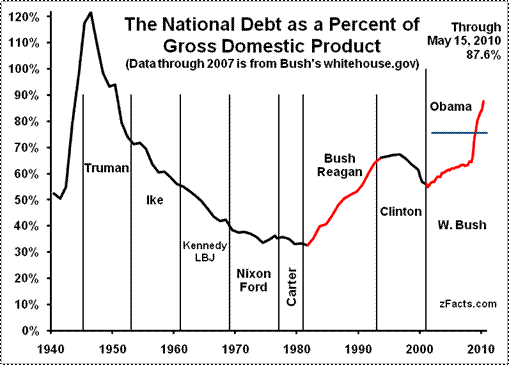
This chart tells it. Our debt has been higher, and lower. Will the U.S. economy come roaring back and cut the deficit? You have to believe it will (I do). And frankly, you don’t have a choice. It has to. It will.
What’s got me most excited is the U.S. innovation engine keeps chugging along. In fact, with technology and the Internet, it’s moved into warp overdraft.
Morgan Stanley has upgraded Apple. The target now is $310, though I recently saw a target of $400 a share from someone else. Morgan Stanley says 58% of iPhone customers expect to upgrade their iPhone in the next year, far higher than the 18% upgrade rate in 2008 — a difference of 18 million units globally in CY11. Morgan Stanley assumes a 30% global upgrade rate in its base case, 50% in its bull case.The new iPhone 4G is coming out in June or July. There are strong rumors that Verizon will sell the new phone. You can find more on the new iPhone here. I’ve still got my Apple shares and am praying that Morgan Stanley is right, though I don’t put much faith in my prayers.
Watch what you copy: A recent CBS report noted that many copiers contained hard drives filled with images of every document they’d ever copied. Often, owners don’t wipe these hard drives clean before selling the machines or returning them to the leasing company. It’s real easy to read sensitive information like Social Security numbers and medical records and hence to have it fall into the wrong hands.
CBS and the founder of a company that sells software to delete data on copier hard drives purchased four old copiers from a warehouse in New Jersey and found loads of sensitive data stored in the copiers.
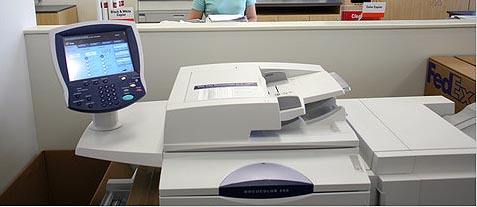
Copiers with hard drives tend (I believe) to be larger and newer. I’m not sure there’s any definitive way of knowing if it’s got a hard drive — short of opening the thing. Be wary what you copy. Or buy yourself a cheap all-in-one machine for your home.
The Internet continues to generate immense wealth. Go to Groupon. Sign up. You’ll see discounts (often 50%+) at some local stores. You buy a deal. The supplier gets some of the money; Groupon gets the rest. It’s a cash cow. Groupon is now worth something like $1. 5 billion, based on its latest money-raise valuation. Visit Groupon. It doesn’t cost anything if you don’t buy. Personally, I’m not attracted to what they’re selling. But I am attracted to the valuation.
Gold is rising.
May 24 (Bloomberg) — Speculators are buying gold faster than the world’s biggest producers can mine it as analysts forecast a 27 percent rally that may extend the longest run of annual gains since at least 1920.
For the full Bloomberg story, click here.
With newspapers ebbing, experiments abound. The latest is Honolulu Civil Beat. It’s a new venture by the eBay founder Pierre Omidyar and Rupert Murdoch’s Times of London. Click Civilbeat.
Warren Buffett’s latest stock holdings. The holdings are as of December 31. No dramatic change. Click here for Buffett’s portfolio.
Wall Street’s business is creating products to sell to you and me. Unlike micromini-dresses (see below) these products are neither pleasing nor profitable. I’ve written about auction rate preferreds, structured investment vehicles, etc. many times. Some people claim that none of Wall Street’s creations of the past ten years made anyone any money, except Wall Street. Anyway, here’s another one from Gretchen Morgenson writing in Sundays New York Times:
‘100% Protected’ Isn’t as Safe as It Sounds
By GRETCHEN MORGENSON of the New York Times.
BROKERS selling complex securities that they once contended were safe and sound have saddled individual investors with billions in losses since the credit bubble burst. Remember auction-rate securities? Those were peddled to investors as just as good as cash — until they no longer were after that market seized up in 2008.
Questions about how Wall Street marketed yet another complex product, sold as solid and secure, are now emerging in investor arbitration cases. The instrument is named, inaptly as it turns out, “100 percent principal protected absolute return barrier notes.”
These securities are essentially zero-coupon notes sweetened by tying the return, in part, to the performance of an equity index, like the Standard & Poor’s 500 or the Russell 2000. The securities promise to return an investor’s principal, typically at the end of 18 months, with the added gain from the index’s performance if that index trades within a certain range. Brokerage firms often issued these securities.
For an investor in one of these notes to earn the return of the index as well as get the principal back, the index cannot fall 25.5 percent or more from its level at the date of issuance. Neither can it rise more than 27.5 percent above that level. If the index exceeds those levels during the holding period, the investors receive only their principal back.
Convoluted enough for you?
Yet, these securities appear to have been sold to conservative individuals whose financial market forays were usually limited to certificates of deposit. Many of these investors, to their great misfortune, bought principal-protected notes issued by Lehman Brothers. They are now worth pennies on the dollar.
CORINNE and Gregory Minasian were two of these investors who, at the suggestion of their broker at UBS, sunk almost $100,000 — more than half of their savings — into Lehman notes in early 2008. They lost everything and have filed an arbitration case against the firm to recover their losses.
The Minasians are a retired couple who live on Long Island. They contend that their UBS broker pushed the investment when one of their C.D.’s matured. The broker failed to explain the risks in the security, the Minasians said, and did not provide them with a prospectus. They did not even know their investment had been issued by Lehman Brothers until the firm collapsed.
“I am not a sophisticated investor,” said Mr. Minasian, a former engineer who is 68. “Many years ago I dabbled in the stock market, but I learned my lessons. Over the past 10 to 15 years my wife and I invested in C.D.’s.”
But that approach changed in January 2008, when, according to the Minasians, their UBS broker began calling with an investment idea — principal-protected notes. “We questioned him over and over,” Mr. Minasian said. “We initially told him we weren’t sure and that we wanted to think it over. Maybe the next day he called us and told us he was putting his father into the same notes and his father is very conservative.”
The Minasians said they decided to buy the instrument because they were assured by UBS, a financial adviser they had dealt with for years, that it was safe. The thing was called a “principal protected” note, after all.
Eight months later, Lehman went bankrupt. The note was virtually worthless.
Mrs. Minasian, 67, said she and her husband did not receive notice of problems with the investment until mid-October, when they received a form letter from UBS saying the value of their investment was “unavailable.”
“I opened the letter and said, ‘Why are we getting this?’ ” Mrs. Minasian said. “As I read it and we were wondering if it in fact did pertain to us, my heart sank. I almost fell on the floor.”
UBS sold $1 billion of these notes to investors. Commissions were 1.75 percent, far higher than those generated on sales of C.D.’s. When Mr. Minasian asked about the commission, he says, his broker said there was none.
A spokeswoman for UBS, Karina Byrne, said, “UBS properly sold Lehman structured products to UBS clients, following all regulatory requirements, well-established sales practices and client disclosure guidelines.” Client losses, she added, were the result of the “unprecedented failure” of Lehman Brothers.
Jacob H. Zamansky, the securities lawyer representing the Minasians, filed an arbitration claim against UBS on their behalf in late March. He says he has two dozen investors across the country telling similar stories of brokers recommending these securities without any explanation of their risks. Some UBS brokers are also telling him that they, too, feel they were misled about the risks in these securities.
“These are very opaque products that should not be sold to individual investors,” Mr. Zamansky said. “Nobody understands what the product is.”
In the Minasians’ complaint, they also contend that UBS was in a position to have known that Lehman was in trouble and therefore should not have sold the securities to investors. According to the report of the Lehman bankruptcy examiner, UBS was one of the firms that helped Lehman conduct its now-infamous Repo 105 transactions, helping it mask the leverage it had on its books.
Ms. Byrne said that the examiner’s report did not suggest that the banks that conducted those trades acted inappropriately.
As Lehman’s cash crisis grew in the spring of 2008, it ramped up the issuance of these notes. But some brokers at UBS stopped selling Lehman Brothers notes at this time, Mr. Zamansky said.
He said some inside UBS seemed to recognize that Lehman was vulnerable. In March 2008, for example, after Bear Stearns collapsed, a UBS analyst wrote of the “harsh reality that some investors will think of Lehman as next on the list for the confidence/liquidity crisis.”
The Minasians were not advised about any of these matters, Mr. Zamansky said. Now the retirees are unsecured creditors awaiting a minuscule payout in the Lehman bankruptcy.
“If the inner workings and true risks of these notes were ever honestly disclosed, no retail investor would buy one,” Mr. Zamansky said. He has asked for a full recovery of the Minasians’ losses from UBS.
THE Securities Litigation and Consulting Group, a financial economics consulting firm, analyzed 14 issues of these principal-protected notes and found that more than half of them carried a yield of less than 2 percent. More than half the time, the analysis concluded, “Investors would be better off investing in Treasury securities.”
Add these securities to the growing pile of Wall Street inventions that benefit … wait for it, wait for it … Wall Street.
Fed up with your day job? Try matador. A day after dashing Spanish bullfighter Julio Aparicio showed his dominance by cutting the ears off two vanquished bulls, one of their bovine brothers got revenge:
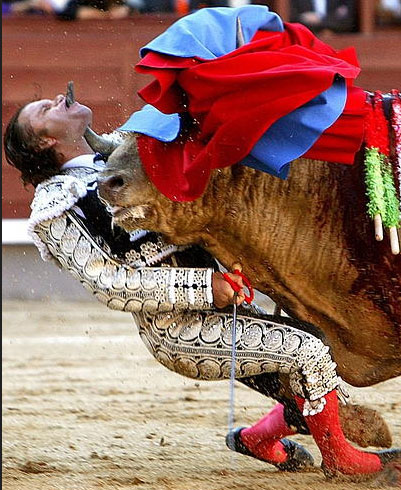
The bull impaled Aparicio through his throat and out of his mouth. Aparicio is alive, following two operations by Dr. Maximo Garcia. The goring took place during the Festival of Saint Isidro at the Plaza de Toros Las Ventas in Madrid. You can watch a YouTube video of it. Watch till the end. If you have the stomach, click here.

Harry Newton, who had a great weekend. On Friday night he went to an engagement party in New York’s meat packing district. I was flabbergasted by the number of young people partying and spending money like there was no tomorrow. Next time you’re in New York, take a trip down there one evening. You’ve never seen so many micromini-dresses and four-inch black high heels. I wonder if that is a good sign for the stockmarket? Usually when skirts rise, so does the market.

I asked one bouncer how he choose whom to let into his swish, exclusive, pricey club. His answer: The girls with the shortest dresses and the highest heels. Nice job if you can get it.

Wow — After reading Hugh's excellent analysis, clicked on Hugh's name and followed to his Website. Excellent site! Very well done (if a bit wordy, Sir). Hugh, I am now a follower and will link.
Hugh, I believe that Harry still finds that liberal thinking “feels good” and is fighting down his buyer's remorse over all the debt, taxes, and bloat that Liberalism brought us. NOT that the so-called Conservative Republicans offered much of an alternative. (Yes, McCain was a Cap-n-trade Big Tent farce.) Perhaps, if Conservatives can muster some good candidates, we will attract attract Harry with logic and glaring examples.
Keep in mind that as liberals create a world where everyone is equal in their misery, Harry will be one of the last to suffer. Cooking the frog slowly.
Excellent comments and nice site. Happy to meet you.
Harry, seeing that matador photo I first thought it was a new an ad for Goldman Sachs. The caption might be “When our customers stick their necks out, count on us to be there”.
As for the Minasians, how do we know this is just more “fluctuation”? 🙂
Principal-protected notes? Don't you just love it? Sometimes I wish the brokers I know would forget me–just drop my face and name from their memory banks. They come around thumping their chests over the heists they've pulled on naive investors. Their products, like those principal-protected notes, are proliferating like Mutant Ninja Roaches From Outer Space. A few weeks ago, for example, one broker was hawking a five-year principal-protected C.D. designed to perform a juggling act between the U.S. dollar and the Brazilian real (BRL). As he explained it, investors would receive as profit the difference between the exchange rate of the currencies five years down the road. (In the first quarter of 2010, the USD maintained an exchange rate between R$1.70-R$1.80. In April, the Brazilian Central Bank raised its benchmark interest rate 0.75% to 9.5%.) And just how is this C.D. protected? A swap backed by a foreign insurance company. The broker thought this monstrosity to be a clever work of financial art. He grinned when he mentioned he had sold his entire float within a week. Then there was the banker who explained the workings of a five-year annuity, insured by New York Life, designed with what he called “a C.D.-like guarantee” with a fixed YTM of about 4%. “Oh, it's safe,” he insisted. It was insured by New York Life. “It's the company you keep!” Investors had no cause to worry. Both gentlemen weren't trying to sell this junk to me; instead, they were crowing over the success they'd had dumping this crap on unsuspecting mom and pop investors. Conclusion: Take time to study the history of the auction rate security scandal and its resemblance to the “products” described by Ms. Morgenson and those I've mentioned here. You'd be safer swimming in the BP spill than buying into these sucker traps.
went to an engagement part — PARTY
how he choose — CHOOSES
Doable? hard but doable. The economy has to come roaring back? Technology will save us? Harry, come to your senses. You are wishin and hopin, hopin and prayin…The US did it before, why can't it do it again? Well for one, we were the only show in town after WW2. We had vast cheap energy, a hard working and motivated workforce and no competition. Now we have expensive energy, lots of competition, a tax system which almost demands companies to offshore jobs and production, a corrupt financial system, a dysfunctional political system owned by that system, a failing educational system, massive state, local and national debt with unfunded pension and health liabilities and zillions of dollars promised to public sector employees who service the economy but create absolutely nothing of value. I do not know why you cannot see that this highly complex, interrelated system which has hit the point of diminishing returns now has nowhere to go but over the cliff, probably with lots of company. The only way to pay off debt is to grow out of it. and Harry, you have not given us any reason to show how this could happen other than wishin and hopin… I still follow you daily and enjoy your blog so forgive me if I had to give you a dope slap to attempt to restore you to consciousness.