I was right about shorting IBM. Not growing. Overpriced. Disappointing latest earnings:
SAN FRANCISCO (MarketWatch) — IBM Corp. IBM -3.41% on Tuesday reported a fourth-quarter profit of $6.2 billion, or $5.73 a share, on $27.7 billion in revenue. During the same period in 2012, IBM earned $5.83 billion, or $5.13 a share, on revenue of $29.3 billion. IBM also reported an operating profit of $6.13 a share. Analysts surveyed by FactSet had forecast IBM to earn $5.99 a share on $28.27 billion in sales. IBM also said that for its 2014 fiscal year, it expects to earn at least $17 a share, or at least $18 a share in operating profit, while analysts had forecast earnings of $18.02 a share for the year.
Lessons here:
1. Techie companies should excite you with what they’re doing. I am singularly unexcited by what IBM is doing.
2. Analysts are like sheep. They follow each other. And, when they’re wrong, they’re all wrong.
I was right about Wendy’s:
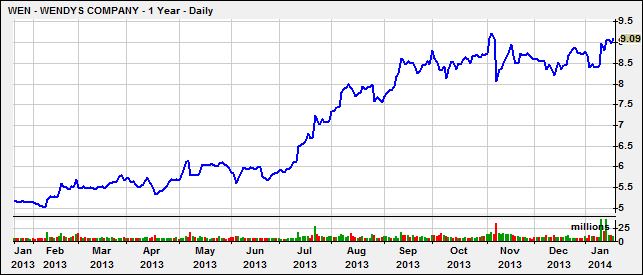
I continue to like what I see and hear about it. From Motley Fool:
Wendy’s Found the Beef, and It’s Getting Beefier, by Nickey Friedman, January 21, 2014
Wendy’s is the third largest quick service restaurant chain in the world, but it still has a long ways to go to catch up to McDonald’s (NYSE: MCD ) as measured by market cap. While McDonald’s has a market cap of around $95 billion, Wendy’s has a market cap of just $3.5 billion. This means there’s a lot of opportunity for growth and taking of market share, which Wendy’s seems to be doing steadily as once again evidenced by its preliminary 2013 report.
On Jan. 13, Wendy’s issued a preliminary report into its fourth quarter and full year 2013 results and an outlook for 2014. For the fourth quarter, the company expects to report that same-store sales climbed 3.1% as compared to a 0.2% decline last year. Adjusted earnings soared 25% – 37.5% to $0.10 – $0.11 per share. Analysts had only been expecting earnings per share of $0.06 so this is an enormous beat. For 2014, Wendy’s expects same-store sales to climb another 2.5% to 3.5%, with earnings per expanding 13% – 24% to end up between $0.34 and $0.36.
CEO Emil Brolick credited the past success with “tremendous strategic and financial progress” that it achieved through brand positioning, brand transformation, and system optimization. This caused Wendy’s to achieve certain financial targets “well ahead of expectations.” The company sold 415 company-owned restaurants to franchisees, has a pipeline of product and marketing plans, and expects to more aggressively transform its image at double the pace in terms of number of restaurants in 2014 as compared to 2013.
I have almost completely sold out of Berkshire Hathaway.
Tips on dealing with online banking. I started to write a piece:
Dear Jamie Dimon,
May I please become marketing VP at JPMorgan Chase? You really need me. Your people spent a lot of time telling me how they’re protecting, not pleasing me. In fact t, their “protecting” is downright unpleasing.
I spent much of yesterday trying to send a wire from my online Chase account. It was a nightmare. Downright unpleasing things I learned (which probably apply to other online banking services):
+ They don’t want dashes in their ABA numbers — despite their own ABA lookup system which gives dashes.
+ They don’t send wires immediately. They queue them. They can take all day. And maybe never arrive until the following day.
+ “Pending” doesn’t mean pending. It means it may or may not have gone through.
+ They have a limit on the size of the wire they will send each day, though their online system doesn’t tell you what the limit is. You guess. I guessed. It was $100,000 a day.
+ They don’t like the character “$” in their online message, e.g. “This $25,000 is for XYZ.” They won’t let your wire through with the dollar sign. But they don’t tell you why. You have to guess. Guessing is very time-wasting.
+ They log you out after 13 minutes. They don’t tell you about the 13 minutes. Nor can they or you extend it.
+ Calling them on the phone gets explanations and help. But they can’t change anything. Their peoples’ frustration is palpable. If I ran the place, I’d make a list of all the client frustrations and change them instantly. Why 13 minutes? Why not 23?
+ I still don’t know if yesterday’s wire was received. My friend said my monies didn’t show up by 4:30 PM. Chase says it was delivered by 3:10 PM — four hours after I sent the wire. Go figure.
Banks still have a way to go. Maybe one day, they’ll even issue credit cards with microchips in them (as they do in Europe) and they won’t be so vulnerable to theft. Think Target.
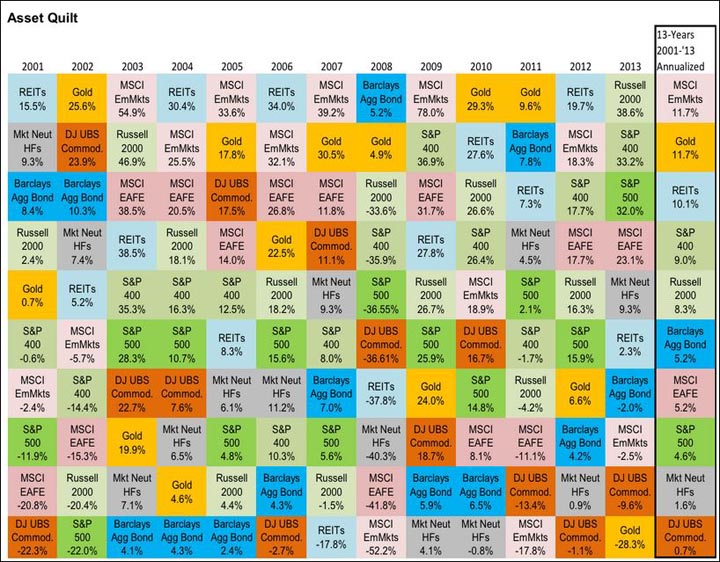
Diversification is a free lunch. If you lack control (or conviction), diversification is the way to go. This chart comes from Oppenheimer and is used as a sales tool by them. It argues no one can predict which asset will do well in any one year, so be in them all equally. At the end of each year re-balance. Sell the profits on the good ones; put the money into the poor performers.
To me this has appeal as a sales tool, but no appeal as an investment tool. Better idea: Choose stocks you like. Over time, keep the good ones. Sell the bad ones. Keep looking for good ones.
Personally, I find the chart misleading. Some big returns in one year — like emerging markets in 2009 — skewed the stats. Ditto for gold, which only now looks interesting again.-
In short, resist being sold “rebalancing.”
Sadly, I didn’t make Davos and the World Economic Forum. I’m not alone is not attending.
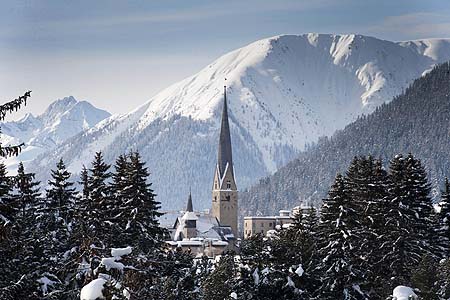
Davos, Switzerland, pretty place. Pretty expensive, too.
From Andrew Ross Sorkin in the New York Times:
The annual parade of boldface names at the World Economic Forum in Davos, Switzerland, is always striking. This year’s attendees at the meeting, which begins Wednesday, will include Japan’s prime minister, Shinzo Abe; the billionaire Bill Gates; JPMorgan Chase’s chief executive, Jamie Dimon; and the movie star-philanthropist Matt Damon.
But just as notable are the luminaries who consistently avoid Davos, despite repeated invitations.
The billionaire Warren E. Buffett has never attended. Neither has Timothy D. Cook, chief executive of Apple, the world’s largest company by market value. (His predecessor, Steve Jobs, never went, either.) The founders of Google, Larry Page and Sergey Brin, stopped going a couple of years ago, as did Mark Zuckerberg, Facebook’s chairman. Both companies do send other executives, though.
The leaders of General Electric and IBM, Jeffrey R. Immelt and Virginia M. Rometty, are not attendees either. “I don’t go to Davos and places like that,” Mr. Immelt once said dismissively.
The World Economic Forum, for which the cost of membership and a ticket to the annual meeting is more than $70,000, is both admired and derided as a velvet-rope club for the 1 percent of the 1 percent. The mayor of London, Boris Johnson, once attended Davos only to dismiss it as “a constellation of egos involved in massive mutual orgies of adulation.” (My emphasis.)
Whatever their reasons for staying away, the leaders of some of the largest and most transformative companies are demonstrating, with their absence, the difficulty of convening a global conversation with all the main stakeholders. Given that one of the themes this year is how to address economic inequality, it would be helpful to have the world’s largest employers participate in that discussion, not to mention a sampling of rank-and-file workers, who never receive an invitation.
You can read the rest of his fun piece here.
Real estate crowdfunding has high fees. There’s the cost of getting in. There’s the annual maintenance cost. And there’s the “rewards” cost. Realty Mogul, on one deal is splitting the rewards above an 8% preferred rate for the investors — 50-50. That’s 50% for them and 50% for you. That’s pricier than a typical pricey hedge fund.
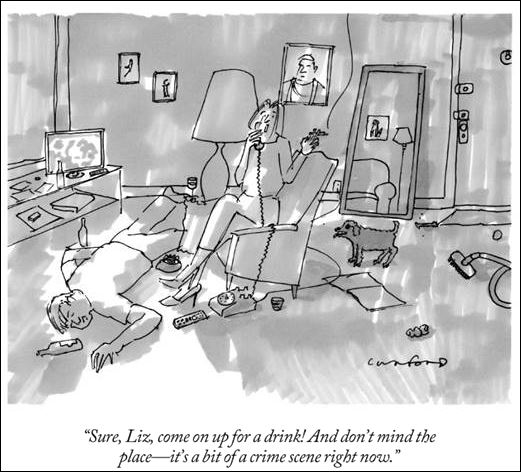
Latest wonderful New Yorker cartoons:
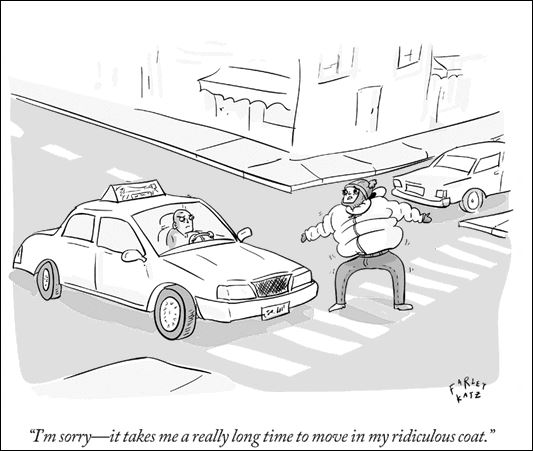
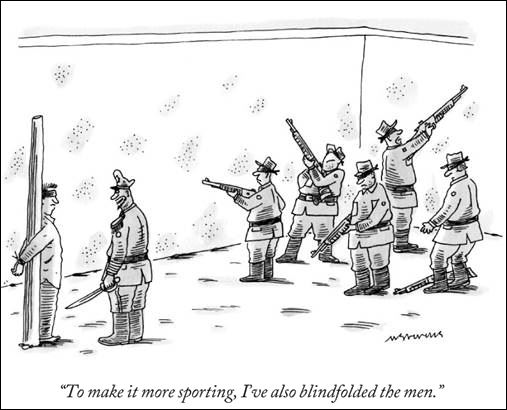

Harry Newton, who notes it’s minus 10 fahrenheit (minus 23 degreees celsius) where he is — midstate New York. It’s not outdoor tennis weather. In fact, it’s not outdoor anything.
This Russian mother sure knows how to take pictures of her children. Gorgeous stuff. Click here.
I shouldn’t stay up all night watching the Australian tennis open. But it’s been really good. Some of it gets re-run during the day on The Tennis Channel. This weekend is the semis and finals. I think they’re run on one of the networks.

The leaders of General Electric and IBM, Jeffrey R. Immelt and Virginia
M. Rometty, are not attendees either. “I don’t go to Davos and places
like that,” Mr. Immelt once said dismissively.
Comment is very excellent and informative.
I cam empathize with you on dealing with banks…they drive me right up the wall. Example…BMO Harris (formerly a nice bank called M&I) have just terminated my relatively small, low rate home improvement loan. They want it re-written with a nearly double interest rate, minimum 5 years with a $50. per year fee tacked on, even if you pay it off the fee must be paid for 3 years.
No problem, I’ll just do a balance transfer from Chase at 2% and no interest for one year (current offer)…oh, oh…Chase now has a limit of $5,000. once every 90 days,on transfers to another bank, no matter how much your line of credit is. Okay, I once bought a condo on an interest free transfer from BankAmericard, no interest for one year. Now, BofA charges 11% interest on balance transfers plus their 4% fee. Didn’t bother to find out if they have a limit…I’ll just pay it off with cash which is probably what I should have done in the first place.