Amazon continues to amaze. I buy a Kindle book. I can read it on any number of devices I own — from a Kindle Paperwhite to an iPad mini to a Lenovo ThinkPad laptop. Better yet, when I highlight a passage on one device, it is highlighted on all devices. Even better: my highlights all appear on an Amazon site: https://kindle.amazon.com. I log in, hit “Your highlights” and there they are. I can copy them into a report, an email or this column. It’s magic. Amazon just keeps on getting better.
Let’s go to Sochi. You get a double bang for your dollar: You get to see Winter Olympics and marvel at the security. According to Stratfor:
Russia’s Federal Security Service will control close to 100,000 security personnel during the games, which is four times the amount that were present at the 2012 London Olympics. On top of this, a multilayered security system will be in place in Sochi with extensive surveillance to include drones, reconnaissance robots for explosive detection, high-speed boats and submarines utilizing sonar for potential maritime threats.
Crowfunding is exploding. Today, places like Kickstarter and Indegogo let you donate money to good causes and invest in new products. But your rewards will be you’ll feel good and/or you’ll get a product, like a watch, a book or CD, but a share of the business. There are now places where accredited investors can invest in and actually own part of something. RealtyMogul does that for real estate. As their web site says,
Insider access to pre-vetted real estate investments.
Pool money with like-minded investors to make investments that are otherwise difficult to access. This is real estate crowdfunding.
You can invest as a little as $5,000.
Passive income.
Each real estate investment is tied to a real estate company that deals with the hassles of toilets, tenants and trash.
The whole crowdfunding phenom started on April 5, 2012. when the JOBS Act was signed into law on by President Obama; Title II of the JOBS Act which allowed in accredited (i.e. rich) investors became effective on Sept. 23, 2013, and Title III, which is for non-accredited (i.e. poor) investors, is currently under an SEC rulemaking period and will be out when that fast-moving organization decides.
I’m not endorsing RealtyMogul. I need to do more DD (due diligence). But it is the beginning of individual real estate property syndications for the masses. Their site is worth moseying around.
There’s also a crowdfunding site called AngelList, which, according to BusinessWeek:
AngelList, a four-year-old startup based in San Francisco, is starting to open things up with a social network for the kind of people who create and invest in social networks. It’s a Kickstarter-like online forum where startup founders post their ideas and meet investors who fund risky, early-stage companies. In 2013, 500 startups raised $125 million through the site, including transactions ultimately closed offline, says Naval Ravikant, AngelList’s co-founder and chief executive officer. Ravikant, suddenly one of the Valley’s highest-profile power brokers, says his company’s mission is “to make startup investing transparent, efficient, and more open.”
On AngelList, startups fill out profiles that list information such as their previous backers and the amount of capital they’ve already raised. With those profiles, they can simultaneously pitch hundreds of certified investors-financial firms and wealthy individuals and companies. AngelList handles the regulatory paperwork (so startups have to fill out the relevant forms only once) and offers resources for those that are navigating the funding labyrinth for the first time. A feature on the site called syndicates, introduced in September, lets users pool their money alongside a single well-connected angel. When that investor backs a company, so do they. Syndicates have formed behind some widely known Valley figures: Kevin Rose, a general partner at Google Ventures, and Tim Ferriss, the self-help and marketing guru.
You can read more about AngelList — “The Social Network for Startups” — at BusinessWeek’s site. Click here.
Harry’s thoughts about crowdfunding: For small amounts of “charity” money, if the project interests you, go for it. For the bigger stuff (like syndicated real estate), you need to know a lot about the management, the income split (between you and them) and their record. Have the projected IRR returns ever actually panned out? It may be too early for a definitive answer.
I hope no reader is still smoking cigarettes. The Wall Street Journal reports:
Cigarettes are deadlier and linked to more diseases than previously thought, according to a new report from the U.S. surgeon general being released 50 years after the government first warned that smoking kills.
In the report to be released Friday, the nation’s top doctor warned that smoking is linked to the deaths of about 480,000 Americans annually. That’s a substantial increase over the government’s previous estimate of 443,000 deaths, despite the fact that fewer Americans are lighting up and those who do smoke are lighting up less often.
Cigarettes are deadlier and linked to more diseases than previously thought, according to a new report from the U.S. surgeon general being released 50 years after the government first warned that smoking kills. Mike Esterl reports.
Cigarettes are a causal factor in 10 diseases and conditions they hadn’t previously been definitively linked to, including diabetes, colorectal cancer, arthritis and erectile dysfunction, the report said-bringing the total number to more than 30.
In 1964, a landmark surgeon general report pinpointed smoking as a cause of lung and laryngeal cancers as well as bronchitis. That report precipitated health warnings on cigarette packs, advertising bans and other regulations. Since then, such restrictions have contributed to a decline in U.S. smoking rates, though the pace has slowed in recent years. An estimated 18.1% of U.S. adults, or 42 million people, smoked in 2012, down from 42% in 1965.
Friday’s report suggests the design and composition of today’s cigarette is more dangerous than the 1950s equivalent because of the introduction of ventilated filters and rising levels of cancer-causing chemicals in recent decades. Cigarettes with ventilated filters were initially marketed as safer, though smokers tend to cover up the filters and inhale more deeply, pushing toxins farther into the lungs.
“I think they are more harmful today. We’re certainly worried,” Surgeon General Boris Lushniak said in an interview.
For the full WSJ article, click here.
Your children and their future jobs: A friend reports $100,000 of student loans, which she probably will never pay back. But it will haunt her for years. That college will led kids to a wonderful, magical career is increasingly being called into doubt. A better idea might be to start your own business, especially a tech one. There are two great trends: It’s easier, and there’s oodles of money around searching to fund bright, young kids with their “shiny new thing” — viz crowdfunding.
I keep highlighting the Special Report on Tech Startups in this weekend’s Economist:
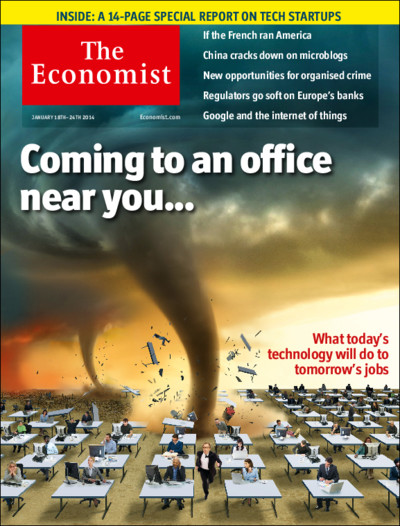
And I keep suggesting that learning programming would be a lot more rewarding than history, or even English. A easy-to-learn programming framework like Ruby on Rails is a good place to start:

Their web site is here. By the way, there’s a terrible shortage of programmers in the U.S. If you don’t start your own company, you can always get a high-paying job with a biggie, like Google, Amazon, etc.
Favorite cartoon from yesterday: In case you missed it:

The Australian Open Tennis continues on ESPN2 and The Tennis Channel. Some seriously great matches. Please watch.

Harry Newton who woke up yesterday with a gigantic cold. Not fair. And exceedingly boring. But nothing serious.

Well, I’m a little bit late tonight, but some comments. Cigarettes are bad for you, even worse than originally thought. Turns out recent studies show marijuana is even more carcinogenic, yet becoming more popular and legal every day with even our president “pitching” it. And it is 5 to 10 times stronger than the stuff of 40 years ago.
As for crowdsourcing, a good development, but one disadvantage is the need for a fund raising company to post a lot of information about itself on these sites to have any chance of raising money. So there is a significant risk there for many companies.