Stocking stuffers for the kids (revised). Here’s a list of companies which make things kids can relate to. Buy them one or several shares of
Activision (ATVI)
Amazon (AMZN)
Apple (AAPL),
Disney (DIS)
Electronic Arts (ERTS),
Glu Mobile (GLUU)
Google (GOOG)
Intel (INTC),
Microsoft (MSFT) — for the Xbox,
New York Times (NYT)
Nike (NKE)
Nintendo (NTDOY)
Zynga (when it comes public later this week)
Some companies will die. Some will boom. Discussing what happened and why each Christmas will be a great, continuing lesson in investing. I wish my father had done that for me.
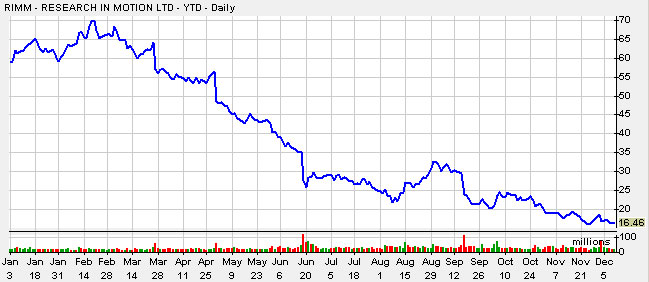
Shorting Dell and Blackberry (RIMM). I’ve pushed shorting Resarch in Motion several times. It keeps falling. and falling. Management is way out touch with the reality of competition from Apple and the android (Google) devices.
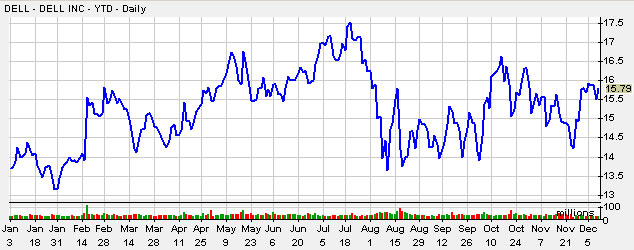
Dell hasn’t introduced an exciting product in eons — if ever. Its business model — in time manufacturing — cheaper and “custom” doesn’t work any longer.
This is what you get when you visit Dell’s home page. Gives excitement a whole new meaning? Nobody’s buying laptops today. Everyone is buying an iPad. You see anything here you want for Christmas? Me neither.

This is Dell from the beginning of this year. It’s going lower.
Your money at risk. s old dangerous ways. As you know, my number one obsession is capital preservation. And my number two obsession is beware of Wall Street. It hasn’t changed. And with the Justice Department ignoring Wall street fraud from the sub-prime mortgage mess and the Republicans stymieing appointment of a head of the Consumer Finance Protection Agency, it’s likely Wall Street will continue their old dangerous ways. Weekend reading only added to my fears:
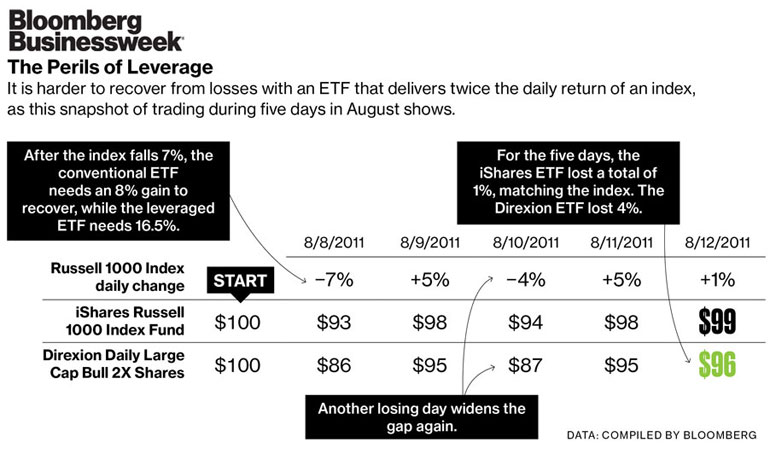
+ BusinessWeek has a piece on Beware of EFTs on Steroids. Laurence D. Fink, chairman of BlackRock, the world’s largest asset manager, has called leveraged ETFs “toxic.”
He’s right. Everyone has warned against these things — including me (on several occasions) and Jim Cramer (also on several occasions). This is the chart accompanying the BusinessWeek article:
You should read the entire BusinessWeek piece here.
+ This comes from a kind reader:
Just wanted to comment on Corzine. He’s lying. He knows exactly what happened to that $1.2 billion. It’s called re-hypothecation.
“Both U.S. and U.K. securities laws allow customer assets pledged as collateral (as in margin accounts) to be re-pledged by brokerage houses for their own accounts. U.S. law places a limit on the percentage of customer assets that can be re-hypothecated. However, U.K. law has no such limits. Therefore, most international brokerage houses transfer these pledged securities to their U.K. subsidiaries where they are used as collateral for loans to the brokerage house. By hypothecating, re-hypothecating, and re-re-hypothecating, etc., these securities get leveraged to about four times their value.
“MF Global pledged these securities to get loans to make their big Euro-bond bet. When that bet went sour, the securities were taken by the banks that made the loans to MF Global. All perfectly legal. But now, MF Global customers are just unsecured creditors to a bankrupt MF Global. The banksters win again.”
+ James Stewart is a financial reporter for the New York Times. He got stuck in the auction rate preferreds mess. I believe he eventualy got out unscathed, but certainly chastened (like all of us). Here’s the beginning of his piece:
A Risk Once Unthinkable
Are customer accounts at brokerage firms safe?
Until the collapse of MF Global, that’s a question I thought I’d never have to ask.
Brokerage firms are required by law to maintain segregated accounts holding all client assets, including stocks, bonds, mutual funds, money market funds and cash. The law was passed after the 1929 crash, in the depths of the Depression, to make sure that customer assets were there at all times, ready to be disbursed even if everyone asked for their money at once.
This obligation to protect customer assets “is considered sacrosanct,” Robert Cook, director of the division of trading and markets at the Securities and Exchange Commission, told me this week. “It’s considered a sacred obligation.”
Lehman Brothers may have engaged in many foolhardy practices, but even in the firm’s last days, when officials were desperate for cash, no one dared touch customer assets, which remained safely segregated despite the firm’s collapse.
And then came the revelation that an estimated $1.2 billion in customer assets had vanished at MF Global, the large brokerage and futures trading firm headed by Jon S. Corzine, the former Goldman Sachs executive and Democratic politician, that collapsed in late October after a catastrophic bet on European sovereign debt.
How could such a thing happen? I had always assumed it was impossible and that strict internal controls existed at all brokerage firms so that firm officials couldn’t tap segregated customer funds even if they were willing to break the law. Thanks to MF Global, it’s now apparent that isn’t necessarily true. “If people are determined to misuse customer funds, they will misuse them,” said Ananda Radhakrishnan, the director of the division of clearing and risk at the Commodities Futures Trading Commission.
That’s because the commodities and securities industry is mostly self-regulating, and self-regulation ultimately depends on the integrity of the regulated. Broker-dealers — securities firms that execute trades of stocks, bonds and other assets for customers — are overseen by the S.E.C., while futures commission merchants, which trade commodities, derivatives and futures, are regulated by the C.F.T.C. Like most large brokerage firms, MF Global was both a broker-dealer and a futures commission merchant, though its primary business was commodities futures trading.
You can (and should) read the entire piece here.
Sage legal advice.
A man about to be electrocuted phoned his lawyer from the death chamber. “They are about to put me in the electric chair. You are my lawyer. What should I do now?”
The lawyer answered helpfully. “So, don’t sit down.”

Harry Newton who marvels at the creativity of the American entrepreneur. Rosie now has an elegant down jacket that looks like it came from Neiman Marcus. And probably did, for all I know.

She moved her head just as I was taking the picture. Dogs are harder to photograph than children and have, sadly, fewer expressions.
Beware of cloud computing. It’s unreliable.
Beware of the Kindle Fire. It’s getting bad reviews. Stick with the iPad 2.

Harry, your comment on “Beware of cloud computing. It’s unreliable” is a little broad. Would you mind elaborating on this?
Hey, Harry, I've written a product review or two (more like 5,000) in my time and I'm loving the Kindle Fire that I am “preparing” for my 3 year old grand daughter. It's great fun, highly functional, and quite flexible. PLUS, at $199 it's way more “affordable” than an iPad.
My grand daughters are fighting over their one iPad. The Kindle Fire is a perfect alternative. The reviews say it “sometimes freezes”. It might pause for a second, but it doesn't “freeze”. There is just a lot of swapping going on.
The reviewers say they can't find a way to turn it on. Stupid.
The ONLY valid complaint is that I'd like a way to make “Home” the Apps page instead of the rather over-cooked sliding presentation that is locked in as “Home”. WHY do I think that will be “fixed” in some future release of the OS?
There are plenty of Apps. The screen is great for everything from books to YouTube. The WiFi setup is fast and practically invisible.
My iPad sits on the desk while I carry around and use the Fire. In fact, I'm on the way to Miami for an appointment this morning and I'm carrying the Fire, not the iPad.
For $199 with no tax and no shipping cost? Hey, this thing Burns! No, my grand daughter isn't getting it until I hand it over to Santa!
Harry where are you??? In the same sentence you bemoan the do nothing , leaderless JusticeDept, while begging for another czar agency responsible only to the Democrat party. Hello ???