My friend and analyst, Don Luskin writes
Stocks are in a “slow-motion melt-up” as earnings season disappoints. The generationally wide equity risk premium that made stocks crazy cheap last year has been more than enough to make up for it. Our trader’s gut senses that it’s time for a little rest, but that global systemic risk is being favorably reappraised, the equity risk premium is narrowing and stocks are rising. We still face appreciable recession risk, despite continued not bad macro data. But without a Lehman-type global systemic hard-stop, any recession will be mild and need not trigger a bear market in stocks.
I buy Luskin’s guarded optimism and have picked up a little BHP, Nike and ALV recently. I’m staying away from RIMM, despite the new CEO and his insane statement that he will follow the failed strategies Mr. Balsillie and Mr. Lazaridis put in place.
Meantime Reuters reported on Friday:
European banks prepare for worst, hoard cash
Jan 20 (IFR) – European banks are preparing for a potential worsening of the region’s sovereign and banking crisis, with many firms stockpiling cash and cutting back on loans to new clients as they seek to protect themselves against a possible seizing-up of financial markets.
Faced with 650 billion euros of debt coming due this year – almost 40 percent of which matures before the end of March – lenders are choosing to build up a cash cushion to ensure they can cover redemptions, creating a squeeze on the wider economy in the process.
Such hoarding illustrates the nervousness of lenders even after the European Central Bank injected 489 billion euros of cash into the banking system in December. Cash deposits at the ECB have ballooned since then, reaching a record 528 billion euros this week – higher than after the Lehman Brothers collapse.
“The big concern is that things might get worse,” said Bernd Hartwig, treasury manager at Nord/LB. “Political decisions are taking too long and most banks are building up liquidity just in case something happens. They are very worried that a new crisis could be a bigger than 2008.”
System-wide hoarding is the reverse of what happened the last time central banks injected hundreds of billions of long-term money into the system. Then, banks moved quickly to put the money to work and generate returns, sparking bond and equity market rallies – and economic growth.
The US Federal Reserve almost trebled the size of its balance sheet to more than $2 trillion in the months after the collapse of Lehman Brothers, pumping cash into the banking system through programs such as the Term Auction Facility. The ECB grew its balance sheet by about a quarter in that time.
But this time round, many banks have taken the decision to wait. While some have paid off interbank loans – so boosting the cash reserves of creditor banks – and a handful have bought some domestic government paper, most are choosing not to commit new cash to assets or to lending.
“For many banks it’s all about survival and they have just bought more time for themselves with the ECB money,” said the treasurer of one of Europe’s largest banks. “None of the fundamentals have been addressed. People are in standby mode – you might need lots of liquidity at short notice.”
There are other factors at work, too. Banks face strict new capital and liquidity rules, and many are planning to shrink their balance sheets in order to meet those targets – not buy more. They also do not want to commit to new assets because selling out could prove difficult should conditions worsen.
“The problem is completely different from 2009,” said Elie el Hayek, global head of interest rates at HSBC. “Back then, a big proportion of the money went into assets. This time, banks cannot do that simply because they need to protect their capital and liquidity. They know any mark-to-mark(et) losses will eat into those buffers so they don’t want to take the risk.”
The full article is here.
Hot IPO coming this week. Guidewire (GWRE). You and I won’t get any — unless you’re a J.P. Morgan client.
Why the Clean Tech Boom Went Bust. Absolutely fascinating long piece in the latest issue of Wired Magazine.
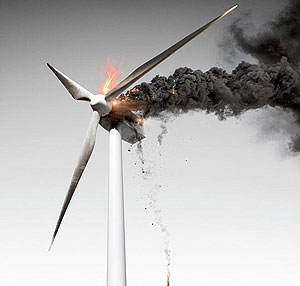
Wind Power: Plummeting natural gas prices now make this option comparatively expensive.
… Perhaps the biggest force working against not just Solyndra but clean energy in general is this: Because natural gas has gotten so cheap, there is no longer a financial incentive to go with renewables. Technical advances in natural gas extraction from shale-including the controversial practice of hydraulic fracturing, or fracking-have opened up reserves so massive that the US has surpassed Russia as the world’s largest natural gas supplier.
The price of natural gas peaked at nearly $13 per thousand cubic feet in 2008. It now stands at around $3. A decade ago, shale gas accounted for less than 2 percent of America’s natural gas supply; it is now approaching one-third, and industry officials predict that the total reserves will last a century. Because 24 percent of electricity comes from power plants that run on natural gas, that has helped keep costs down to just 10 cents per kilowatt-hour-and from a source that creates only half the CO2 pollution of coal. Put all that together and you’ve undone some of the financial models that say it makes sense to shift to wind and solar. And in a time of economic uncertainty, the relatively modest carbon footprint of natural gas gets close enough on the environmental front for a lot of people to feel just fine turning up the air-conditioning.
Another blow to the domestic clean-tech industry was a glut of processed silicon that sent prices back down below $30 a kilogram. That price, combined with the technological simplicity of manufacturing conventional solar panels, opened the door to relatively unsophisticated operators. For example, in 2007, a Chinese textile manufacturer approached Arno Harris, CEO of utility developer Recurrent Energy, to see if he’d be interested in buying solar panels that they hoped to begin making. When the bar to entry is so low that textile makers can churn out solar modules, Solyndra’s expensive CIGS-coated cylinders and other next-gen renewable technologies simply can’t compete.
There was another factor driving down the cost of conventional photovoltaics. In recent years, China has worked aggressively to develop its domestic solar production capacity. National banks have given credit lines that dwarf the federal loans US firms enjoyed; local and provincial governments have provided tax incentives as well as land at below-market rates; and the national government recently established a so-called feed-in tariff, which compels utilities to buy electricity from solar developers at above-market rates to offset their production costs.
Understandably, American firms have struggled to remain competitive. In 1995, more than 40 percent of all silicon-based solar modules worldwide were made in the US; now it’s 6 percent. In less than two years, at least eight solar plants have closed or downsized, eliminating nearly 3,000 American manufacturing jobs, including the 1,100 employees who saw their jobs disappear with Solyndra’s spectacular September 2011 bankruptcy. China now accounts for more than half of global photovoltaic output, and Chinese-made modules are up to 20 percent cheaper than American ones.
Wind has also taken a hit. Not only can the turbines not match the current costs of gas-fired plants, the flood of cheap Chinese solar panels can make them less attractive as a green option, too. The pace of new wind-turbine installations in the US has declined by more than half since 2008. This past October, Cliff Stearns, the Republican chair of the House Energy and Commerce Oversight and Investigations Subcommittee, admitted to NPR what had by then become obvious: “We can’t compete with China to make solar panels and wind turbines.”
The boom has gone bust.
And yet, clean tech is far from dead. Certain companies and technologies will emerge from the ruins not only to survive but to thrive, just like they did after the bursting of the Internet bubble.
Electric cars seem like a relatively safe bet, spurred by both rising oil prices and federal rules requiring greater fuel efficiency. Additionally, as it has with solar, China has aggressively pushed into the competitive battery industry. As a result, prices for the lithium-ion battery modules in electric cars-which can cost more than some gas-powered cars-are coming down. Tesla started out making 600 sports cars a year, priced at $109,000 each; in 2012 it will begin selling the Model S, a full-size sedan that goes from zero to 60 in six seconds and costs just under $50,000 (once you kick in a $7,500 federal tax credit). Within five years, the company says, it will be producing 100,000 cars annually and charging just $30,000 apiece. The company’s stock took a hit in early December, after Morgan Stanley cut its price target-citing concerns about the broader EV market-but it was still up for the year, even after the drop.
Meanwhile, the low silicon prices and cheap Chinese photovoltaics that undermined next-gen clean tech have proven a boon to distributed-generation businesses-the firms that install solar systems to power individual homes and offices. These companies are thriving because they came up with a new financing model that makes installing standard flat-panel solar generators truly affordable.
A decade ago, a rooftop solar array for a 3,000-square-foot home would have cost the owner about $45,000. The price can now be less than $20,000. That’s not cheap, but instead of having to pay it up front, homeowners can now work with companies like San Mateo, California-based SolarCity and Oakland-based Sungevity and lease the systems for $119 a month-less than a lot of conventional electricity bills. John Stanton, head of federal affairs for SolarCity-which recently closed a $350 million deal with Bank of America to install panels that will provide power for up to 120,000 military families-likens it to leasing Xerox machines to offices. “It’s taking a 60-year-old business-equipment model and bringing it into the solar industry,” he explains.
That leasing model, combined with a number of software advancements, has transformed the rooftop solar business. It used to take months to close a residential sale; now these companies can use a combination of remote mapping and mathematical calculations to help determine exactly how many solar panels an individual home would need and how they should be positioned. The whole process can be completed in a matter of weeks.
In at least one respect, these companies rely on a very old-fashioned boost: federal and state subsidies and tax breaks. When they install a solar system on someone’s roof, they take all the government sweeteners that accompany the installation, which helps these firms offer their systems at lower prices. “Between 40 and 50 percent of the system is covered up front,” says Danny Kennedy, founder of Sungevity. “The customer is getting an incredible value proposition: `I’m going to save money from day one.’ That’s a hell of a thing. For no investment, I’m going to save money.”
But there is an investor: the taxpayer. Government coffers have been compensating for a number of market challenges solar faces, including the incumbency advantage of the fossil fuel industry and private investors’ distaste for capital-intensive enterprises that will take years to deliver a return. And in 2012, the solar industry may face a sudden reduction in these subsidies, as the post-Solyndra political climate grows less and less receptive to investments in clean energy. Despite the fact that renewable energy received only a quarter of the subsidies that fossil-fuel-based electricity received between 2002 and 2007, it’s wind and solar that are on the chopping block.
Even solar’s biggest allies on Capitol Hill-people like Edward J. Markey, a top Democrat on the House Energy and Commerce Committee-fear the industry’s oil and gas foes may have gotten the upper hand now that the clean-tech bubble has burst. “We are not Panglossian about what lies ahead,” Markey says. “The fossil fuel industry and its allies in Congress clearly see the solar and wind industries as a threat and will try to kill these industries as they have for the preceding two generations. They want this to be a five-year aberrational period.”
For the full long, detailed article, click here.
25 Best Small Business Apps for 2012 from PC Magazine. Click here.
Why manufacturing jobs will never return to the U.S. How the U.S. lost out on iPhone work. “Apple’s experience shows why jobs are flowing to China.” From the New York Times piece:
Not long ago, Apple boasted that its products were made in America. Today, few are. Almost all of the 70 million iPhones, 30 million iPads and 59 million other products Apple sold last year were manufactured overseas.
Why can’t that work come home? Mr. Obama asked.
Mr. Jobs’s reply was unambiguous. “Those jobs aren’t coming back,” he said, according to another dinner guest.
The president’s question touched upon a central conviction at Apple. It isn’t just that workers are cheaper abroad. Rather, Apple’s executives believe the vast scale of overseas factories as well as the flexibility, diligence and industrial skills of foreign workers have so outpaced their American counterparts that “Made in the U.S.A.” is no longer a viable option for most Apple products.
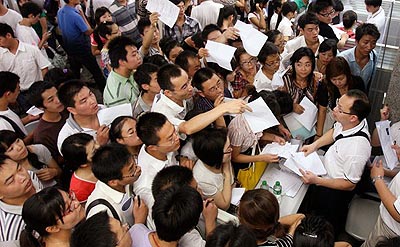
People flooded Foxconn Technology (a huge Apple supplier) with résumés at a 2010 job fair in Henan Province, China.
Apple has become one of the best-known, most admired and most imitated companies on earth, in part through an unrelenting mastery of global operations. Last year, it earned over $400,000 in profit per employee, more than Goldman Sachs, Exxon Mobil or Google.
However, what has vexed Mr. Obama as well as economists and policy makers is that Apple — and many of its high-technology peers — are not nearly as avid in creating American jobs as other famous companies were in their heydays.
Apple employs 43,000 people in the United States and 20,000 overseas, a small fraction of the over 400,000 American workers at General Motors in the 1950s, or the hundreds of thousands at General Electric in the 1980s. Many more people work for Apple’s contractors: an additional 700,000 people engineer, build and assemble iPads, iPhones and Apple’s other products. But almost none of them work in the United States. Instead, they work for foreign companies in Asia, Europe and elsewhere, at factories that almost all electronics designers rely upon to build their wares.
For the full article, click here.
The Australian Tennis Open continues on ESPN2 and The Tennis Channel. Djokovic and Federer are playing superbly. Watching them in slow motion is engrossing.


Roger Federer, left and Novak Djokovic.
Winston Churchill on Italian cruises. After his retirement he was cruising the Mediterranean on an Italian cruise liner and some Italian journalists asked why an ex British Prime Minister should choose an Italian ship.
There are three things I like about being on an Italian cruise ship.
First their cuisine is unsurpassed. Second their service is superb. And then, in time of emergency, there is none of this nonsense about women and children first”
Latest Borowitz Report:
In Confident Sign, Gingrich Changes Facebook Status to `In an Open Relationship’
CHARLESTON, SC (The Borowitz Report) – In a sign of renewed confidence, just minutes after former House Speaker Newt Gingrich romped to victory in the South Carolina primary he changed his Facebook status to “In an Open Relationship.”
Mr. Gingrich made no reference to his new Facebook status during his victory speech, in which he made an emotional appeal to the American people: “I say to each and every one of you: Join me. Join me in my marriage.”
The former House Speaker used the speech to highlight the differences between himself and the current resident of the White House: “The American people have a choice: do they want a President who issues food stamps, or one who runs up a $500,000 tab at Tiffany?”
Mr. Gingrich drew cheers and a standing ovation as he concluded his remarks, saying, “In closing, I am staying at the Marriott, Rm. 205. Ladies?”
In yet another boost, Mr. Gingrich received this nod from former rival Herman Cain: “I am not endorsing Newt Gingrich, but I am endorsing Newt Gingrich’s lifestyle.”
At the White House, President Obama made only a glancing reference to the results in South Carolina, telling reporters, “I haven’t been this happy since we smoked bin Laden.”
For his part, former Massachusetts Governor Mitt Romney minimized Mr. Gingrich’s 12% margin of victory: “That’s even less than I pay in taxes.”

Harry Newton who normally doesn’t like these pithy “profound” quotes. But I like this one. I have no idea if he really said this.
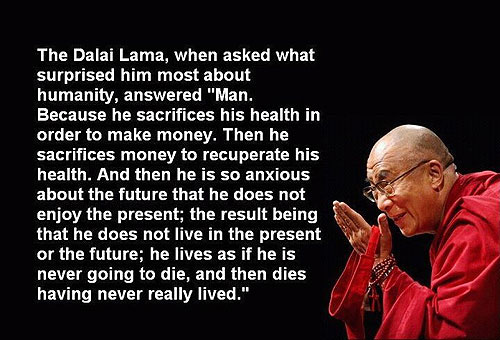

Does it really matter if Dalai Lama said it or not?
But I know for sure that these wise words will not come from us, you, or me, or RonaldReagan …
Why the clean tech boom went bust…..THE TRUTH FOR ALL TO READ…..Boo Hoo Hoo! Global Warming is, atbest, junk science and, as we learned in recent years, at worst,fraudulent science. To the left, Global Warming became a religionwhere the evil Capitalist would pay indulgences to Big Government andits favored cronies to expunge his sins. Environmentalism, with theaid of corrupted researchers, provides cover to Marxists who need abroad excuse to take control over the economy. With claims ofdisaster always conveniently just over the horizon, Global Warmingoffers the perfect propaganda tool for leftist public education andDominant Media to brainwash the masses into accepting the necessityof central planning to forestall disaster. Among many other failings,most Global Warming models fail to take into account an obviousfactor in atmospheric temperature: solar cycles. Why? The conclusionhas already been determined- that greedy, capitalist Man is guiltyand must be tamed and punished by wiser Elites who may grantthemselves a waiver- i.e. Al Gore proselytizing while indulging hisego with a private jet and mansions sporting big carbon footprints.Instead of putting a further drag on this economy of several hundredbillion dollars per year, I say drill, baby, drill in America to cutour dependence on dictatorships for fuel and to create well payingjobs by millions here at home for the working class who have bornethe brunt of the recession. But Obama and his enviro-Marxist allies,by design, must prevent the market from functioning.
I don't know Jack…..maybe the cost labor unions, environmental regulations, insurance (work-mans comp) and ridiculous state and federal tax rates might be making it rather difficult for American business to compete. But hey …..what the fuck do I know. And by the way I love my new I-mac mini.
you want the jobs bcck, easy tell those 99% that i walked bye everyday in NY that were using ipads, i phones and i whatever to say i will not buy until they are made in america. they talked a big story but do not any idea how to get it to work. in my hometown of reading pa last year hersey candy shut down a 50 year old plant laying off 300 and moved it to mexxico. i emailed and wrote them many times, i have a hersey product everyday but if they move never again. they do care because i'm one person but what if everyone said that. and i have not had one product in a year.