Oh my God. OMG for you texters.
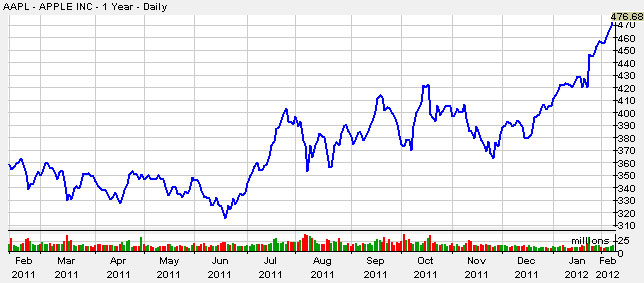
Why now? What next?
I don’t know. It’s way above its 50 and 200-day moving averages. But it doesn’t look like a an exponential bubble. My Fidelity shows Apple’s P/E ratio at a relatively low 13.57. Maybe Apple’s going to pay a dividend, introduce the iPad 3, iPhone 5? The buzz is still positive. My fingers and toes are crossed.
Investing in Annaly is faith, sort of like religion. You either believe or you don’t. They had their analyst conference call yesterday. The opening remarks ranted at the government. The analysts asked question. Sample Annaly management answer:
Generally we don’t comment on specifics that where we’re concentrating, there is no question that the Fed has done a good job of engineering a flatter curve and spreads. I don’t care who you are, spreads have come in for everybody, and you don’t get protection without a price. So we continue to balance between all the options that the market has to offer.
Considering that the financial media reported a major earnings miss for the fourth quarter of 2011, the stock didn’t move much. It is now below its 200 day moving average (red line) and just on its 50 day moving average (green line).
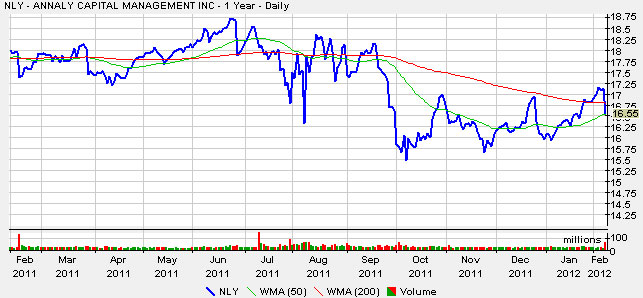
I think they’ll drop the dividend a little in March but it will still yield 13+%. Here’s an surprisingly positive analyst report on Annaly. Click here.
Here are yesterday’s opening remarks. And here are “answers” to the analysts questions.
I hope it drops a bit more.
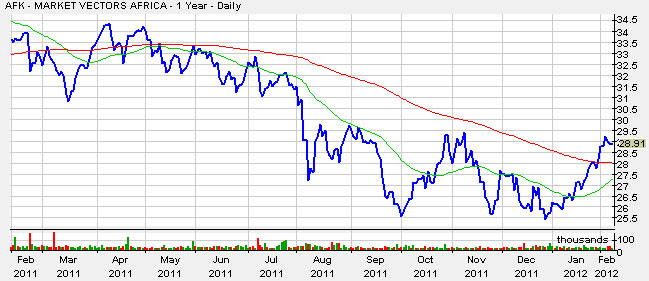
What about Africa? My savvy friend loves Africa. Hence Africa’s best ETF. And his words: “It’s biggest holding is Tullow Oil which is UK based and has interests around the globe. Global powerhouses with African exposure might not be gambling. Africa is the next area of the world to pop.”
Can GM, RIMM, Radio Shack, Best Buy, Barnes & Noble and other disasters come back? Probably not is the simple answer.
Megan McArdle writes a great piece in this March’s The Atlantic Magazine. Here are some excerpts:
Why Companies Fail
GM’s stock price has sunk by a third since its IPO. Why is corporate turnaround so difficult and rare? The answer is often culture-the hardest thing of all to change.
… Over the past few decades, GM’s ability to resist change has proved almost uncanny. Why did the company wait so long and do so little—not once, but time and again—before finally falling into bankruptcy? And what, if anything, does that portend for its future? The questions go beyond GM, a company that’s hardly unique. Why did Blockbuster idly watch Netflix destroy its business? Why did Kodak let digital cameras drive a once-mighty industrial giant into penny-stock territory?
Ask Jeff Stibel, and he’ll tell you: because that’s what troubled companies do. Stibel, once an aspiring cognitive scientist in Brown’s graduate program, is now a serial entrepreneur who has led turnarounds at Web.com and Dun & Bradstreet Credibility Corp. “Once the human mind has set out to do something, or has gotten in the habit of doing something,” he told me, changing it is “very hard.” When you add group dynamics, it’s even harder. You don’t need to be a brain scientist, of course, to know that people resist change … and yet, even knowing that, you’d be surprised at how many firms keep driving toward inevitable disaster at top speed. GM’s record is very much the norm, not the exception.
Years ago, I listened to an earnings call with the head of a biotech firm that had sold off the income streams from all its patents, had nothing in its pipeline, and was rapidly burning through its cash. Nonetheless, the CEO kept talking about “our future” as if the company had one, other than liquidation. The equity analysts on the call didn’t seem fazed; apparently, that’s how companies in these situations usually behave. Management and workers seem oblivious to their failures. They wait too long before they act, and even when they do take action, it’s often inadequate.
This dynamic has given rise to a booming industry of turnaround specialists. They range from serial CEOs, like Stibel, who may walk in with an entire senior management team, to more-traditional management consultants. The industry is big enough to support considerable specialization—by company size, by industry, even by technique (cost cutter, brand builder). All seem to agree on one thing: most companies wait far too long to even recognize that they have a problem.
“Typically, a company doesn’t pull someone in until they’re on the brink of disaster,” says Thomas Kim, a Denver-based turnaround specialist and an officer of the Turnaround Management Association. “They can’t make payroll, can’t make a loan payment, or can’t pay off their loan that’s coming due.” Obviously, if everyone waits until the checks get rubbery, the chances of avoiding the onrushing debacle are slim. But the flip side of the problem, says Michael Buenzow, a senior managing director in the corporate finance and restructuring practice at FTI Consulting, is that unless the crisis is acute, it’s hard to make anything happen. “If you’re brought in too early,” he says, “the employees in the organization won’t have that same sense of urgency.”
And yet, the argument that people continue down dead ends merely because they hate change seems inadequate. After all, people also hate losing their jobs and their money. As economists like to say, most people are risk-averse—it’s why unions accept wage cuts to keep pensions and health-care benefits, and why extended warranties are big business for Best Buy. Firms are full of these mostly risk-averse people. So why do they so commonly refuse to swerve?
One possibility is that firms don’t change because inertia is in their DNA—indeed, it’s a gene that once made many of them successful. In their 1989 book, Organizational Ecology, Michael Hannan and John Freeman argue that organizations are actually selected for inertia by their environment, and “rarely change their fundamental structural features.” Change is risky, after all, since it definitionally involves doing something that isn’t already working—and even product lines that have grown lackluster still have some customers. Firms that are prone to frequent large changes will probably have more opportunities to kill themselves off with bad choices than firms that resist big changes.
Moreover, the need for accountability and reliability in the modern economy selects against constant radical experimentation—people like knowing that their bank has cumbersome and invariable procedures for keeping track of deposits, for instance. Think of McDonald’s, where a core premise is that no matter where you go, the food and decor will be reliably, exactly the same. Or consider what happened to Coke after it tried to change the recipe of its iconic product, even though taste tests showed that most people actually liked the new version better. The larger and older the firm is, the heavier the selection for stability.
This is a powerfully attractive model for explaining why innovation so often seems to be driven by newcomers, rather than by profitable incumbents with huge R&D budgets. It also helps explain why so many companies in turnaround situations are gripped by inertia.
Blockbuster, for instance, promised—and for a long time delivered—reliability and ubiquity. Most customers were never more than a few minutes from a bright, clean, spacious store with an ample selection of the latest videos. But eventually that commitment to ubiquity and sameness killed the company. Blockbuster did see the possibilities of streaming, and explored some partnerships to exploit them, but was slow to roll out changes to its core business (as late as August 1999, only 1,000 Blockbuster stores even carried DVDs). Meanwhile, the commitment to ubiquity had caused the firm to take on a mountain of debt to lease all that pricey real estate. At some point, the company needed to leap into the unknown. But by the time its managers all held hands and took the plunge, the clock had run out. Blockbuster’s streaming service, launched in 2004, was far too little, and far, far too late.
Thomas Kim sums up the problem of corporate inflexibility pungently. “There are companies that perform reasonably well, and are completely dysfunctional.” But then the market changes. “In the companies that we see that hit the wall, that dysfunctional corporate culture really becomes a problem.”
Detroit labor relations have been a disaster ever since the early unionization drives, which were acrimonious and at times violent (at the infamous “Battle of the Overpass,” in 1937, a claque of Ford security guards attacked union agitators in front of an assembled press delegation). The result was a poisonous relationship; in many ways, GM workers were more a part of the United Auto Workers than of GM. Eventually, the union became a sort of shadow management that had to sign off on every production decision the company made, if it had any effect at all on workers.
This system actually worked during the boom years. Because GM’s competitors were unionized too, the UAW’s power kept wages more or less equal across the Big Three, and helped contain cost competition that might have led to price wars, undercutting margins. The UAW, meanwhile, never had to worry that an excessively rich compensation package would put the Big Three in jeopardy.
Conditions changed, but the thinking didn’t. The union frequently behaved like a parasite that didn’t care whether it killed its host—calling strikes just as the company was trying to launch a pathbreaking small car; demanding that GM keep paying surplus workers nearly full salary indefinitely, even as market share declined. Rather than trying to change this dynamic, management caved, again and again—possibly, Ingrassia suggests, because any increase in wages would “trickle up,” as GM strove to maintain a pay differential between management and the hourly workers.
GM’s strategy, which focused first and foremost on sheer scale, also became ineffective over time, yet the company never moved substantially beyond it. Competitors built well-understood brands based on super-reliability, or style and performance, picking off customers year after year. But GM never settled on what it wanted to be, beyond gigantic.
Even a dysfunctional culture, once well established, is astonishingly efficient at reproducing itself. The UCLA sociologist Gabriel Rossman told me, “If new entrants assimilate to whatever is the majority at the time they enter, and if new entrants trickle in slowly, then the founding culture can persist over time, even if over the long run they make up a tiny minority.” This is why Americans speak English even though more of us are ethnically German or Yoruba. In linguistics and sociology, it’s known as the “founder effect.” In corporations, it’s known as “how we’ve always done things.”
Corporate culture, like any other culture, can change, of course. Edward Niedermeyer, of TheTruthAboutCars.com, who has been a pretty tough critic of GM, thinks that this time may really be different. Finally, he says, “folks over there seem well aware of the ‘old bad habits’ and are trying extremely hard to avoid them.” (Although he is quick to point out that new bad habits could easily emerge.)
David Cole, of the Center for Automotive Research, agrees. For one thing, it’s clear that the UAW has come to understand that it needs to actively work to keep the auto industry healthy. With membership a quarter of what it used to be, the union is now in worse shape than the Big Three. So it is focused on providing a more flexible, better-skilled workforce. It has also allowed workers’ pay to be tied to the fate of GM.
“One of the things that the UAW never wanted,” says Cole, “was to have an equity position in the company, because they didn’t want the membership to think like investors. Now with the bonus scheme, they’ve essentially got an equity position.”
But then, some questions linger … the scattered complaints that the company is “channel stuffing” (upping its reported sales by getting dealers to take cars they don’t want), the continued reliance on incentives like zero percent financing, and of course, those exploding batteries. Unfortunately, corporate culture is a sort of black box; from the outside, you can’t see what’s going on. You have to wait to see what emerges.
What we can say is that this time, we’re actually going to find out. GM has fixed basically every other problem that anyone could name: Instead of a $2,000-a-car cost disadvantage due in large part to legacy costs such as wages and retiree benefits, it now has a cost advantage. The eight marques that multiplied the overhead and muddied the value propositions of its brands have been streamlined to four. The excess dealerships have been closed.
What’s left is culture. After everything, if GM begins losing market share again, we’ll know that it’s beyond saving. To paraphrase the old joke: “How many experts does it take to turn around a big company? Only one—but the company has to really want to change.”
Read the entire piece here.
The big buzz on Wall Street . It’s a cover story on the current issue of New York Magazine. It’s called “The End of Wall Street as We Know it.”
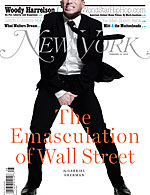
It’s worth reading.
Stupid but funny.
Be careful about buying anything from EBay.
Spent $50 on E-bay for a penis enlarger.
Bastards sent me a magnifying glass.
Instructions said don’t use it in the sun.

Harry Newton who has focused on his health lately because several of his friends have been sick, very sick. Prevention is key.
+ I’ve cut back on salt, sugar and calories.
+ I’ve maintained my daily 1 1/2 to 2 hour biking and tennis. I’m stretching a little more.
+ I’ve cut sitting at my desk by using a cordless to answer phone calls. Sitting makes my feel stiff.
+ I’ve just had flu shot and visited my dermatologist for work on my face. He put me on another regimen of Zyclara for my nose and the backs of hands. He says he can’t make my nose smaller. But he can make it less pre-cancery.
+ I’ve adopted most of the recommendations from The End of Illness, the book I reviewed in yesterday’s column. My doc says let’s do Lipitor (to keep inflammation low) twice a week and a baby aspirin every day? I’m mulling.
The key is to take charge of your own medical life, document it thoroughly (only you know what works for you) and question everything the doctors do and say. My friend is still in hospital with an undiagnosed form of pneumonia or fungus or TB or something else awful she got from travels in Asia. Yuch.

Hey Bruuno, you say…”Both liberals and conservatives contributed historically in vital ways that made this country the envy of the world.”……can you please give me an example of “ANYTHING” the liberals have ever done to advance America?…….please be specific.
Why? To be shot down, have a label stuck on me and be ridiculed.
No thanks.
I will happily engage in conversation with those who are open minded only.
There is a record. Avail yourself of a library.
But most of all, check your biases and prejudices at the door, otherwise all the “facts” in the Galaxy won't make a dent.
I have not problem acknowledging the achievements of Republicans and Conservatives, but I've already been soundly shamed and ridiculed for taking a positive tack. I am not about to stop, but I will not walk into a brick wall for the fun of it.
Thank you again Harry.
I like watching Public Television's “Nightly Business Report” because it's concise and easy to follow. Last night I thought I stepped onto the platform of the Wayback Machine. NASDAQ is soaring… CISCO is the stock to own… Computer Sciences Corp went up 4% in one day.
I looked for Digital Equipment Corporation to see if it was going to release a PC.
Hey, Technology Investor… what happened to “Own Cisco”?
Harry.Your work is astounding and it makes my day to read your blog.
NLY – missed earnings and has already cut the dividend twice. Another dividend cut is on the way. For those of us that bought the stock a few months ago on your recommendation (I paid just under $18) and are underwater what do you suggest? High yields mean high risk. Earnings misses and dividend cuts are more than just casual warning signs yet you still endorse and support owning the stock. I dont get it Harry?????
Sell NLY – I did. I paid 17.65 in Sept 11. Stock has gone down, earnings have been missed and the dividend has been cut twice. Another dividend cut will be announced soon and the stock will continue lower. Cut your lossess- get out. Harry is wrong on this and it cost me $$$.
Harry-GM will definitely fail again because of its culture and its union….as a life long GM Truck owner I currently own my last ever GM vehicle….I refuse to buy another GM Truck or car ever!!! and that is a shame for someone who loves the brand and styling but my refusal to buy that GM product is all based on principle. Our Lovely President threw out contract law and ran around GM bondholders and gave the company to the Union members! Now I was not a bondholder of GM but just a customer…but as an investor this irks me. The talk that GM and American Car companies are back is laughable…sure wipe out their debt and give them a “loan” that will never be repaid they are back…but its just an illusion….kick the can down the road GM will fail again……Oh btw I dont want my $$$ to go to a car company that is owned by a union that 95% backs the democratic/liberal machine which goes against my political/principal beleifs. I suspect that there are several other Americans like me!…..guess we will all be driving Toyotas or German cars..or Fords! Ugh!
Harry, I'd like to live in a world where we can disagree but ultimately come together as Americans to build a better, stronger, fairer country- one where people can live happy and productive lives; perhaps we all want that, but partisan “bickering” has gotten beyond the bickering stage -we now have proponents of various viewpoints who wont rest until they destroy “them”, the other side. To some “liberal” is a dirty word and to others “conservative” is anathema. Both liberals and conservatives contributed historically in vital ways that made this country the envy of the world. Let's disagree but ultimately let's work together to achieve a better life.
We can do it.
Bruuno-Bravo!!…spoken like a true liberal utopian! Words like “Fairer” are the liberals and democrats code word for socialism and class warfare!…That sounds great and all but its unrealistic..there will always be the haves and the have nots! We live in a world where there is always going to be someone who is smarter, richer, prettier and thinner than you! Once you come to grips with that and not worry about anyone but yourself life will be so much easier..”WE CAN DO IT!”…what are you a paid intern for the democratic party…LOL
What is great is that we live in a country that you can speak your mind and if you dont want to participate in something (for the most part you don't have to join) you don't have to. You too Bruno are allowed to speak your mind
I am a conservative, anti-union/anti-liberal , God and country loving individual and I am proud of it! I will pay my taxes and make sure my government spends my hard earned money correctly!…Yeah and I wont buy a GM truck again and thats my right!!…..I wish the democrats and liberals would own who they are and stop chattering about what is fair and playing the class warfare card.
here is one for you
Life isnt fair!!
Amen. Well said. Life's fair when “they” take your money to do what “they” want with it, like buying votes and building Smart Trains in Calif. between farm villages? That's fair? How do you define “unfair”? Maybe, “liberal”.
53%, You broke the code: get government money, short change the real investors, and support and re-elect the politicians who funded you. Makes sense….if you like crooks and socialism. Or today's liberals.