Snippets of brightness for Apple:
From Seeking Alpha
+ I am publishing an updated price target for Apple (AAPL) of $790 per share. This target forecasts a 60% gain in the share price from the closing price of $493.42 on Friday, February 10, 2012. I consider this price target to be moderate based on the expectations of strong revenue and earnings growth over the next 12 months and the low valuation range in which the shares currently trade, despite the recent run-up in price.
From Bloomberg
+ The U.S. Air Force plans to buy 18K iPad 2s in what could be an important milestone for Apple’s (AAPL +0.1%) foray into becoming a supplier to the federal government. The goal of the USAF’s tech buy is to replace the bag of manuals and navigation charts carried by pilots and navigators that can weigh as much as 40 pounds.
Warren Buffett’s latest writes in Fortune. His title, “Why stocks beat gold and bonds.” Excerpts:
Investments that are denominated in a given currency include money-market funds, bonds, mortgages, bank deposits, and other instruments. Most of these currency-based investments are thought of as “safe.” In truth they are among the most dangerous of assets. Their beta may be zero, but their risk is huge.
Over the past century these instruments have destroyed the purchasing power of investors in many countries, even as these holders continued to receive timely payments of interest and principal. This ugly result, moreover, will forever recur. Governments determine the ultimate value of money, and systemic forces will sometimes cause them to gravitate to policies that produce inflation. From time to time such policies spin out of control.
Even in the U.S., where the wish for a stable currency is strong, the dollar has fallen a staggering 86% in value since 1965, when I took over management of Berkshire. It takes no less than $7 today to buy what $1 did at that time. Consequently, a tax-free institution would have needed 4.3% interest annually from bond investments over that period to simply maintain its purchasing power. Its managers would have been kidding themselves if they thought of any portion of that interest as “income.”
For taxpaying investors like you and me, the picture has been far worse. During the same 47-year period, continuous rolling of U.S. Treasury bills produced 5.7% annually. That sounds satisfactory. But if an individual investor paid personal income taxes at a rate averaging 25%, this 5.7% return would have yielded nothing in the way of real income. This investor’s visible income tax would have stripped him of 1.4 points of the stated yield, and the invisible inflation tax would have devoured the remaining 4.3 points. It’s noteworthy that the implicit inflation “tax” was more than triple the explicit income tax that our investor probably thought of as his main burden. “In God We Trust” may be imprinted on our currency, but the hand that activates our government’s printing press has been all too human.
… Under today’s conditions, therefore, I do not like currency-based investments. Even so, Berkshire holds significant amounts of them, primarily of the short-term variety. At Berkshire the need for ample liquidity occupies center stage and will never be slighted, however inadequate rates may be. Accommodating this need, we primarily hold U.S. Treasury bills, the only investment that can be counted on for liquidity under the most chaotic of economic conditions. Our working level for liquidity is $20 billion; $10 billion is our absolute minimum.
The second major category of investments involves assets that will never produce anything, but that are purchased in the buyer’s hope that someone else — who also knows that the assets will be forever unproductive — will pay more for them in the future. Tulips, of all things, briefly became a favorite of such buyers in the 17th century.
This type of investment requires an expanding pool of buyers, who, in turn, are enticed because they believe the buying pool will expand still further. Owners are not inspired by what the asset itself can produce — it will remain lifeless forever — but rather by the belief that others will desire it even more avidly in the future.
The major asset in this category is gold, currently a huge favorite of investors who fear almost all other assets, especially paper money (of whose value, as noted, they are right to be fearful). Gold, however, has two significant shortcomings, being neither of much use nor procreative. True, gold has some industrial and decorative utility, but the demand for these purposes is both limited and incapable of soaking up new production. Meanwhile, if you own one ounce of gold for an eternity, you will still own one ounce at its end.
What motivates most gold purchasers is their belief that the ranks of the fearful will grow. During the past decade that belief has proved correct. Beyond that, the rising price has on its own generated additional buying enthusiasm, attracting purchasers who see the rise as validating an investment thesis. As “bandwagon” investors join any party, they create their own truth — for a while.
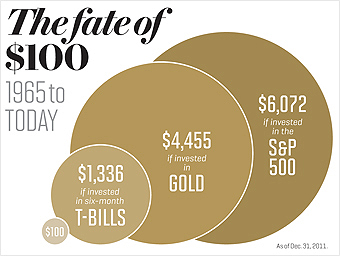
Over the past 15 years, both Internet stocks and houses have demonstrated the extraordinary excesses that can be created by combining an initially sensible thesis with well-publicized rising prices. In these bubbles, an army of originally skeptical investors succumbed to the “proof ” delivered by the market, and the pool of buyers — for a time — expanded sufficiently to keep the bandwagon rolling. But bubbles blown large enough inevitably pop. And then the old proverb is confirmed once again: “What the wise man does in the beginning, the fool does in the end.”
Today the world’s gold stock is about 170,000 metric tons. If all of this gold were melded together, it would form a cube of about 68 feet per side. (Picture it fitting comfortably within a baseball infield.) At $1,750 per ounce — gold’s price as I write this — its value would be about $9.6 trillion. Call this cube pile A.
Let’s now create a pile B costing an equal amount. For that, we could buy all U.S. cropland (400 million acres with output of about $200 billion annually), plus 16 Exxon Mobils (the world’s most profitable company, one earning more than $40 billion annually). After these purchases, we would have about $1 trillion left over for walking-around money (no sense feeling strapped after this buying binge). Can you imagine an investor with $9.6 trillion selecting pile A over pile B?
Beyond the staggering valuation given the existing stock of gold, current prices make today’s annual production of gold command about $160 billion. Buyers — whether jewelry and industrial users, frightened individuals, or speculators — must continually absorb this additional supply to merely maintain an equilibrium at present prices.
A century from now the 400 million acres of farmland will have produced staggering amounts of corn, wheat, cotton, and other crops — and will continue to produce that valuable bounty, whatever the currency may be. Exxon Mobil (XOM) will probably have delivered trillions of dollars in dividends to its owners and will also hold assets worth many more trillions (and, remember, you get 16 Exxons). The 170,000 tons of gold will be unchanged in size and still incapable of producing anything. You can fondle the cube, but it will not respond.
Admittedly, when people a century from now are fearful, it’s likely many will still rush to gold. I’m confident, however, that the $9.6 trillion current valuation of pile A will compound over the century at a rate far inferior to that achieved by pile B.
Our first two categories enjoy maximum popularity at peaks of fear: Terror over economic collapse drives individuals to currency-based assets, most particularly U.S. obligations, and fear of currency collapse fosters movement to sterile assets such as gold. We heard “cash is king” in late 2008, just when cash should have been deployed rather than held. Similarly, we heard “cash is trash” in the early 1980s just when fixed-dollar investments were at their most attractive level in memory. On those occasions, investors who required a supportive crowd paid dearly for that comfort.
My own preference — and you knew this was coming — is our third category: investment in productive assets, whether businesses, farms, or real estate. Ideally, these assets should have the ability in inflationary times to deliver output that will retain its purchasing-power value while requiring a minimum of new capital investment. Farms, real estate, and many businesses such as Coca-Cola (KO), IBM (IBM), and our own See’s Candy meet that double-barreled test. Certain other companies — think of our regulated utilities, for example — fail it because inflation places heavy capital requirements on them. To earn more, their owners must invest more. Even so, these investments will remain superior to nonproductive or currency-based assets.
Whether the currency a century from now is based on gold, seashells, shark teeth, or a piece of paper (as today), people will be willing to exchange a couple of minutes of their daily labor for a Coca-Cola or some See’s peanut brittle. In the future the U.S. population will move more goods, consume more food, and require more living space than it does now. People will forever exchange what they produce for what others produce.
Our country’s businesses will continue to efficiently deliver goods and services wanted by our citizens. Metaphorically, these commercial “cows” will live for centuries and give ever greater quantities of “milk” to boot. Their value will be determined not by the medium of exchange but rather by their capacity to deliver milk. Proceeds from the sale of the milk will compound for the owners of the cows, just as they did during the 20th century when the Dow increased from 66 to 11,497 (and paid loads of dividends as well).
For Buffett’s entire Fortune piece, click here. For comments on the piece, click here.
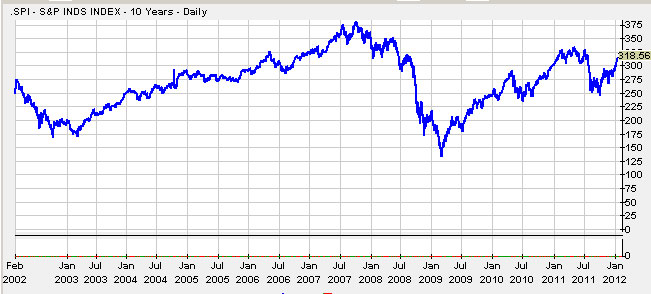
For contrast, here’s the S&P 500 over the past ten years:
Delicious factoid:
In 2007, Morgan Stanley held $1.05 trillion in assets supported by just $30 billion in equity. If my math is correct, that’s a 35 to one leverage..
Revenge of the Frog. Classic short video. Watch here.
From the British press:
+ Commenting on a complaint from a Mr Arthur Purdey about a large gas bill, a spokesman for North West Gas said, ‘We agree it was rather high for the time of year. It’s possible Mr. Purdey has been charged for the gas used up during the explosion that destroyed his house.’ (The Daily Telegraph)
+ Police reveal that a woman arrested for shoplifting had a whole salami in her underwear. When asked why, she said it was because she was missing her Italian boyfriend. (The Manchester Evening News)
+ Irish police are being handicapped in a search for a stolen van, because they cannot issue a description. It’s a Special Branch vehicle and they don’t want the public to know what it looks like. (The Guardian)

Harry Newton who had a wonderfully peaceful weekend, reading, playing tennis and doing a little writing. Very cold. 8 degrees early Sunday morning.

Harry I'm glad that you are built to withstand common boorishness and complete lack of civility. Troubled males use the gang structure as an outlet for their pathological hate… but now we have the the internet and anonymity so anyone can take potshots and release their inner moron, sometimes couching it in self-righteous partisan/political demagoguery.
We have seen this dynamic in most parts of the world but whoopee! now it's available to everyone 24/7.
Just how it is; thanks for being you, Harry.
Harry, that Buffett guy is an idiot! You always say stuff like “cash is king” and tell your readers to stay out at the bottom of markets just before big turnarounds, & we all know that your returns have consistently outpaced Buffett's over the past 40 years…oh, wait, I had that backwards. Harry is the idiot. Sorry.
I never quite understand why a handful of my readers consider me an idiot, yet they apparently still keep reading my blog. And then, to make sure, they know I'm an idiot, they drop me a comment telling me I'm an idiot. My ego (and net worth) are large enough to withstand being called an idiot. But why do they waste their time?
I read once a week or so for the New Yorker cartoons. Huge fan of the borrowed drollery. While scanning down the page, I can't help but digest a tiny bit of your “cash is king” garbage, and touting bonds, which, in my humble opinion, is akin to touting Internet stocks in 2002, which I believe you also did? If I interpret “Snowball” correctly. Perhaps my interpretation is incorrect. I'd love some proof of your net worth. All I've seen are posts by you stating such.
Hey DumbA$$ Chet. You sure look like you have a lot of time to waste. For starters, you sound quite well off when you question Harry's net worth, who you refer to as an idiot yet keep coming back to “read once a week or so for the New Yorker cartoons.” Why come to this site when you can go straight to the New Yorker? Oh, wait! Perhaps you are afraid that your entire net worth will be wiped out if you pay for a subscription to the New Yorker…so you “preserve” your wealth by mooching off a site put together by an “idiot”. Yet again, you question the sound advice of cash being king which may totally sound meaningless if YOU have no cash! Sounds like you pi$$ and $hit through your mouth and think with your a$$! Go get yourself some clue, if you can afford it.
The key statistic and fact in Buffett's comments is the cost to most of us of government caused inflation. Without the government printing presses, that number historically would be zero. So retire at your own risk!
A good article by Buffett that works most of the time…except when money supply is expanded too much and too fast.
This article is from the February 27, 2012 issue of Fortune…gives speed reading a whole new meaning, dated February 13, 2012.
Harry,
You might want to update your SSD drive information. New technology is faster. Check OCZ
Every month or so a new maker comes along with a faster SSD. I have tested a whole bunch of SSDs from Corsair to Samsung, from Kingston to someone else… Frankly, I can't tell much of a difference in speed. Putting one in your laptop makes such a huge difference that I really don't care. They're all fast and all reliable. Of course, some run even faster under Windows 7, but I'm not on that operating system yet, since I haven't figured out how to run some older and newer software on it — .e.g. Wind 7 professional 64-bit doesn't work with Fidelity's Active Trade Pro. But they're looking into it for me.
Harry,
I have Windows 7 and use Fidelity's Active Trader Pro without problems
Are you running the 64-bit version of Windows 7?
Yes I am.
Harry I also have been running Fidelity ATP under Win7 Pro 64bit daily since 2010 with no problems, with 15 to 20 real time screens open on my three monitor setup. I also run the Options Trader Pro on the same.
Mr. Buffett writes: “Beyond the staggering valuation given the existing stock of gold, current prices make today’s annual production of gold command about $160 billion. Buyers — whether jewelry and industrial users, frightened individuals, or speculators — must continually absorb this additional supply to merely maintain an equilibrium at present prices.”………hmmm somehow he forgot to mention Central Banks. Gazing back through the looking-glass if it were the year 1999 again, clearly “PILE A” was the buy of a life time. The Keynesian system is crumbling before our very eyes. It will be interesting to see how Berkshire will immerge from the dust and thrive in the Austrian system…….
“+ The U.S. Air Force plans to buy 18K iPad 2s in what could be an important milestone for Apple’s (AAPL +0.1%) foray into becoming a supplier to the federal government. The goal of the USAF’s tech buy is to replace the bag of manuals and navigation charts carried by pilots and navigators that can weigh as much as 40 pounds.” Harry, that doesn't mean squat for Apple. So it's a 10 million dollar sale. Big woop. What it DOES mean is that you should short Garmin. (Nasdaq: GRMN), The REAL loss will be to Jeppesen, but they're a tiny subsidiary of Boeing. In my humble opinion, the use of the iPad as a navigation tool will result in huge losses to Garmin. Garmin makes excellent, but very high priced products. Each dollar that Apple takes is $10 to Garmin.
Not so sure that shorting Garmin is a good idea. I recently purchased two new Garmin products after I retired my old Garmin Nuvi 765 GPS. Last year I got the excellent Garmin Forerunner 610 GPS watch that has a touchscreen. This year the app Garmin USA which I use on my iPhone 4S to replace the Nuvi 765. Since the stock is up I might not be the only one purchasing new Garmin products. Garmin seems to be coming out with new products to replace the outdated ones.
Your 8° makes me sooo glad I live in Phoenix where the temps have been running in the mid to high 70s with night time temps in the 40s-50s. Sure the temps get much higher in the summer…but remember…it is a “DRY” heat!!!<grin> Glad I sold all my gold!</grin>
I'm working in Northern Labrador, Canada. It was -40 on Friday, without any consideration for wind-chill…8 degrees? Luxurious warmth.
What, pray tell, are doing in Northern Labrador? Which town? How do you get there?