Check out these big tennis matches. don’t look at the scores. Look at the points. You’ll find the whole match was won by a couple of points — 110 points won to 108 points lost. The discipline of battling through so many losing points is what makes championships. There’s one big difference between tennis and investing. You don’t have to play all the points in investing. In tennis you do. In investing, you can invoke my favorite mantra, “When in doubt, stay out.“
ING asked investors where they got their ideas from:
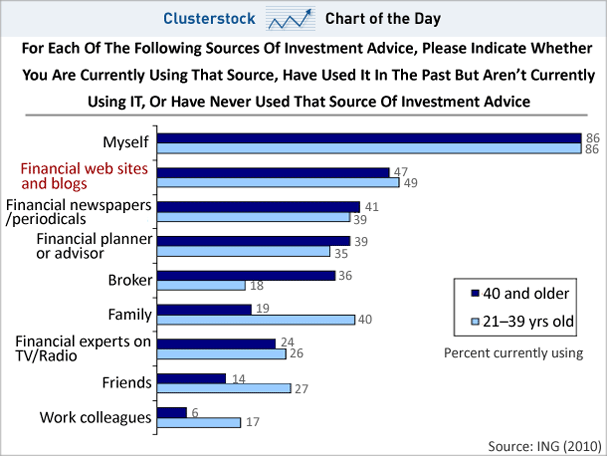
The good news so many generated their own ideas. The bad news is they listened so heavily to financial web sites (like this one).
I was reading Paul Kedrosky’s Infectious Greed. He writes:
Dan Primack at PE Hub has some savvy & provocative analysis of Yale’s (supposedly contrarian) increase in its allocation to private equity:
The allocation increase was reported in Yale’s Annual Endowment Report., But Yale also publishes something called the Annual Financial Report, which notes the following:
Under the terms of certain limited partnership and limited liability company agreements for private equity and real estate investments, the University is obligated to remit additional funding periodically as capital calls are exercised. At June 30, 2009, the University had uncalled commitments of approximately $7.6 billion.
For context, Yale’s entire endowment was valued at just $16.3 billion as of June 30. And then it gets worse:
The University has various sources of internal liquidity at its disposal, including cash, cash equivalents and marketable debt and equity securities. If called upon at June 30, 2009, management estimates that it could have liquidated approximately $3.6 billion (unaudited) to meet short-term needs.
In other words: If all of the uncalled commitments came due on July 1, Yale would not even have been able to meet half of them.
One commentator on the above post replied, “VCs don’t like to hear this, but a capital call is optional. You can try to collect on a limited who would rather delay, but only once. And after that, you will never do biz with that limited again, because he will tell you to go pound sand.”
This is simply not true. Capital calls are not optional. If you don’t make a capital call, the fund is likely to sell your interest to fund your call. Whatever’s left — which won’t be much — they may keep to fund future calls, or return the balance to you — if there is one. In short, you better make your capital call.
Returning to the chart, I do like the fact that most older investors have learned not to trust their friends and their work colleagues.
Beating a dead horse. BankDirect is the Internet banking division of Texas Capital Bank, which is FDIC-insured. Hence BankDirect’s deposits are probably FDIC-insured. But frankly, I would not give BankDirect any of my money. Reasons:
1. “Probably” is not good enough in a Post-Madoff world. A fellow called Jim White at Texas Capital Bank instanced an FDIC document. It showed BankDirect, SSB merged into Texas Capital Bank, National Association. It shows that BankDirect has a Cert # of 35447, which the FDIC (after 20 minutes on the phone with them) cannot find. It says on BankDirect’s web site that BankDirect is a division of Texas National Bank. I asked the FDIC for verification on this. They said they had none. Please contact the Office of the Comtroller of the Currency.
I then spoke with the OCC. The OCC said they could find no record in their system that BankDirect was a part of Texas Capital Bank.
2. There’s something seriously wrong with a bank who won’t talk to a financial blogger (i.e. me). Ever since I asked their chairman emeritus, Jody Grant, for more information on BankDirect’s alleged FDIC insurance last Thursday, the bank simply doesn’t return phone calls or identify their executives who send me occasional stuff by email. For example, there’s a fellow called “Jim White,” who has responded to my emails. But he won’t give me either his phone number or his position within the Bank. He actually emailed me, “please understand that I am not available for comment.” Such strange behavior by a publicly-listed company — the first like this I’ve seen in 40+ years of financial reporting — must raise a red flag. Why Jody Grant simply doesn’t pick up the phone and talk to me — like a normal human being — beats me.
There’s a lesson here? From the English newspaper, The Independent, comes this delicious story:
The coded command was: “Willy, go and get the green file out of the car.” It was the cue for the vanguard of an all-pensioner kidnapping team – led by its 74-year-old ringleader – to limp into action. Their target: the investment adviser they accused of losing their money during the financial crisis.
It also marked the start of a horrific four-day kidnap ordeal for James Amburn, a respectable American-born consultant at the hands of a gang of five pensioners aged between 61 and 80. Mr Amburn was snatched from his home, driven 300 miles in the boot of a car, hidden in a cellar, interrogated and beaten. “I feared for my life – I did not know whether I would survive,” he recalled.
The final chapter of the story was played out in a Bavarian courtroom yesterday, when four of the pensioners were sentenced for the kidnapping and torturing of Mr Amburn after they lost investments worth €2.4m (£2.2m) entrusted to him during the credit crunch. Roland K, the ringleader, was jailed for six years.
Karl Niedermeyer, the presiding judge, described their crimes as a “spectacular case of individuals taking justice into their own hands”.

Two of the defendants, Roland K and his wife Sieglinde, arrive at court in Traunstein, near Munich.

James Amburn, kidnapped financial adviser: ‘I thought they were going to take me out into the woods and shoot me’
The events that led up to what is believed to be Germany’s first kidnapping by pensioners began in the late 1990s. Roland K and his wife Sieglinde started investing their capital in Florida’s then booming property market via an investment company run by Mr Amburn. In the early years, the Ks reaped handsome returns and entrusted their adviser with even more cash. But their investments crashed as a result of the sub-prime mortgage crisis and by early 2009, the Ks and three other pensioners who had invested were clamouring for their cash to be returned. Mr Amburn did not provide it.
Desperate for their money, Roland K and his accomplice Willy D, 61, went to Mr Amburn’s home in the German cathedral city of Speyer in June last year with a plan to kidnap him.
After their victim returned from the pub, they sat on him and bound him with yards of brown sticky tape they had bought the day before at their local DIY shop. The two pensioners then bundled the 57-year-old Mr Amburn, his mouth gagged with tape, into a specially made removal company carton they had brought with them.
Sweating profusely, the two men lifted the box on to a trolley and staggered past unsuspecting customers sitting outside cafes as they pushed it towards their silver Audi 8 saloon parked some 500 yards across town.
“If anybody has asked what was inside, we had an answer ready,” admitted Roland K. “We were going to tell them it contained a marble statue.”
They drove Mr Amburn to Roland K’s holiday home on the shores of lake Chiemsee in Bavaria. On the way, Mr Amburn freed himself sufficiently to grab a crowbar lying in the boot and start smashing the boot. Roland K stopped, opened the boot, beat Amburn for “wantonly damaging his car” and broke two of his ribs.
Mr Amburn was held semi-naked in a cellar in the house and taken out for interrogation sessions in the garage. These were also attended by Gerhard and Iris F, aged 63 and 66, a doctor couple who live nearby and who had also lost money through Mr Amburn. “I thought they were going to take me out into the woods and shoot me,” Mr Amburn told the court.
During the trial in the Bavarian city of Traunstein, Roland K tried repeatedly to play down the kidnapping and told disbelieving judges that Mr Amburn had been taken to Chiemsee so that the “mountain air might help him to think better”.
He claimed that the pensioner gang had held their captive in an “extra guest room” in the cellar and that they held “meetings” about their missing investments in the “office/garage” of the house. “We treated him well. He was always given an excellent three-course dinner by my wife,” insisted Roland K.
However, the kidnappers did allow their chain-smoking captive to take cigarette breaks in the garden. Thinking he had been left unnoticed, Mr Amburn leapt over the garden wall in his underpants one rainy afternoon and ran down the street in the wealthy Bavarian resort town shouting: “Help – I’ve been kidnapped.”
His abductors followed in hot pursuit in their silver Audi shouting: “Stop that man, he’s a burglar.” The well-to-do burghers of Chiemsee preferred to believe their own neighbours and promptly grabbed Mr Amburn and pinned him to the pavement before handing him back to his pensioner abductors.
Back in his cellar prison, Mr Amburn managed to convince his kidnappers that he could return some of their money if they allowed him to send a fax to a Swiss bank to organise a cash transfer. He was able to send a message with the fax which appealed to its recipients in a lightly coded form to “please call the police”.
Within a matter of hours the Chiemsee house was surrounded by 40 heavily armed police from Bavaria’s anti-terrorist unit. The five members of the “pensioner gang” were instantly arrested.
Four were convicted yesterday and given sentences ranging from an 18-month suspended sentence and the six-year jail term for Roland K for kidnapping and torturing Mr Amburn. The fifth pensioner, who is aged 67, will be tried later because of illness.
A good year to die. A friend died last week, depriving the IRS of millions of dollars of estate taxes. Yes, there is good tax news: There’s no Federal estate tax if you die in 2010. Which brings me to an old “joke.”
An elderly woman decided to prepare her will and told her preacher she had two final requests.
First, she wanted to be cremated, and second, she wanted her ashes scattered over Walmart.
“Walmart?” the preacher exclaimed.
“Why Walmart?”
“Then I’ll be sure my daughters visit me twice a week”
How times change. The joke used to feature Bloomingdales.

Harry Newton, who is teaching himself the discipline of “moving on” — in both tennis and investing. Take your lumps. Concentrate harder. With luck you’ll stay in the game and ultimately win the match.

Got a response to my with Texas Capital as to why they hadn't filed an assumed name registration for BankDirect with Dallas County. Response said they didn't need to, … BankDirect is a trademark. I don't think their position on that is correct, … i'm not a lawyer but the statute is quite clear:
http://www.statutes.legis.state.tx.us/Docs/BC/h…
Their web site shows their offices in Dallas.
Texas Capital Bancshares holds the trademark for BankDirect:
http://tess2.uspto.gov/bin/showfield?f=doc&stat…
USPTO Registration number: 2637518
Doesn't shed any more light on proving that accounts are FDIC insured, but just wanted to share the info here.
I'm not trying to be a pain in the FDIC's side, but this still has not been solved, in my opinon.
The FDIC's response to BankDirect was that since Texas Capital Bancorp lists BankDirect in their 10-K file with the SEC, then BankDirect is the same FDIC institution. It took me about 30 seconds to find another online-only brand that, guess what … is a division of a parent company but isn't mentioned in the parent's 10-K. So, I filed another inquiry with the FDIC, as follows:
*****************
I am having trouble verifying that the online bank MyBankingDirect ( http://MyBankingDirect.com ) is truly FDIC insured.
Your 'Safe Internet Banking' web page http://www.fdic.gov/bank/individual/online/safe…) shows:
'you should check the FDIC's online database of FDIC-insured institutions'
So I did a search on FDIC's 'Bank Find' for: MyBankingDirect, MyBankingDirect.com and 'My Banking Direct' All three yield the message dialog:
'Based solely on the information you have provided, we can find no FDIC insured institution in our database* that meets these criteria.'
Your 'Safe Internet Banking' web page then says:
If your bank does not appear on this list, contact the FDIC.
So this is my inquiry about this.
I got MyBankingDirect's address from:
http://www.mybankingdirect.com/index.asp?pID=cu
Their site claims to be a service of New York Community Bank, however I could find nothing on that organizations website ( http://mynycb.com ) that acknowledges MyBankingDirect nor could I find anything in New York Community Bancorp's 10-K:
http://investing.businessweek.com/research/stoc…
In fact, they specifically identify their online brands, and MyBankingDirect is not included:
“We also serve our customers through three connected websites: http://www.myNYCB.com, http://www.NewYorkCommercialBank.com, and http://www.NYCBfamily.com.”
The full response from the FDIC follows:
————————————
From: “FDIC STARSMail” <StarsMail@FDIC.gov>
Subject: FDIC Reply [SCC2010W-003047-0]
Date: Thu, 25 Mar 2010 14:36:31 -0400
March 25, 2010
Ref. No: SCC2010W-003047-0
Dear Mr. [me]:
Thank you for contacting the FDIC. Specifically, you asked the
following:
“I am having trouble verifying that the online bank BankDirect (
http://BankDirect.com ) is truly FDIC insured. Your 'Safe Internet
Banking' web page (http://www.fdic.gov/bank/individual/online/safe…)
shows: 'you should check the FDIC's online database of FDIC-insured
institutions' So I did a search on FDIC's 'Bank Find' for: BankDirect
BankDirect.com and 'Bank Direct' All three yield the message dialog:
'Based solely on the information you have provided, we can find no FDIC
insured institution in our database* that meets these criteria.' Your
'Safe Internet Banking' web page then says: If your bank does not
appear on this list, contact the FDIC. So this 'complaint' is me
contacting you to inquire about this. I got BankDirect's address from:
<http://www.bankdirect.com/clientsupport/contact…> I checked
with the Dallas County website ( http://67.152.106.40/ailis/search.do )
to determine which institution operates under the Assumed Name
BankDirect: I found no results when searching for BankDirect. A search
for 'Bank Direct' yields 'Bank Direct Capital Finance' which likely has
the same parent company, but is not the BankDirect that accepts
deposits.”
In order to verify that your bank is FDIC insured, you can go online to
the FDIC website and access the FDIC Bank Find Directory at
http://www4.fdic.gov/idasp/main_bankfind.asp. However, not all internet
banks are listed on the FDIC website as they are often not independent
banks; Internet banks are often divisions of FDIC insured banks.=20
Texas Capital Bancshares, Inc. is the holding company for Texas Capital
Bank, National Association (FDIC Cert: 34383) which is FDIC-insured.=20
According to Texas Capital Bancshare, Inc.'s latest annual report on the
Securities and Exchange Commission's (SEC) Form 10-K (filed on February
19, 2010), “We compete for deposits by offering a broad range of
products and services to our customers. While this includes offering
competitive interest rates and fees, the primary means of competing for
deposits is convenience and service to our customers. However, our
strategy to provide service and convenience to customers does not
include a large branch network. Our bank offers nine banking centers,
courier services and online banking. BankDirect, the Internet division
of our bank, serves its customers on a 24 hours-a-day/7 days-a-week
basis solely through Internet banking.”
Accordingly, BankDirect is a division of Texas Capital Bank, National
Association which is a subsidiary of Texas Capital Bancshares, Inc.
Therefore, deposits placed through BankDirect and deposits at Texas
Capital Bank, National Association are in the same FDIC insured
institution. Assuming you own deposits in the same ownership category
through BankDirect and at Texas Capital Bank, National Association, your
funds will be added together to determine your maximum allowable FDIC
insurance coverage.
If you have additional questions about FDIC coverage limits and
requirements, please visit EDIE the Estimator at
<http://www.fdic.gov/edie>, call the FDIC toll-free at 1-877-ASK-FDIC or
ask your bank representative. EDIE allows you to calculate the
insurance coverage of your accounts and generate a printable report that
clearly states if your deposits are fully insured or not.
Additional information regarding deposit insurance coverage, including
printable brochures, can be found at:
<http://www.fdic.gov/deposit/deposits>. In particular, we suggest you
review “Your Insured Deposits” (Comprehensive Guide), which explains in
detail all of the deposit insurance ownership categories.=20
We hope you found this information helpful.
As part of our ongoing efforts to improve our service to the public, we
would appreciate it if you would complete a short consumer satisfaction
survey on the level of service you received from this office. The
survey can be accessed at: http://www2.fdic.gov/starsmail/customer.html.
Sincerely,
Federal Deposit Insurance Corporation
Division of Supervision and Consumer Protection
550 17th Street, N.W.
Washington, DC 20429
The opinions expressed herein should only be considered advisory in
nature. Such opinions are not binding upon the FDIC or its Board of
Directors. In addition, the information provided is not meant to be all
inclusive and the opinions expressed herein are based upon the facts
presented in the request. Any changes in the facts or circumstances may
result in different conclusions.
So the FDIC sent me a reply.
> not all internet banks are listed on the FDIC website as they
> are often not independent banks; Internet banks are often
> divisions of FDIC insured banks.
The response then included a quoted from Texas Capital Bancshares's 10-K (filed with the SEC on Feb 19, 2010):
“BankDirect, the Internet division of our bank, […]”
And the response then reads:
“[…] deposits placed through BankDirect and deposits at Texas Capital Bank, National Association are in the same FDIC insured institution.”
So, my interpretation of FDIC policy is that if an online bank brand claims that customer accounts are FDIC insured and that brand is acknowledged as a division by an FDIC institution in its 10-K filing with the SEC, then the FDIC does indeed insure that brand's accounts.
I see holes yet (i.e., what if the institution is private, non-SEC ?).. but I guess this is close enough for government work.
But I still don't get a warm fuzzy. The end of the FDIC email gives the boilerplate disclaimer (emphasized by them in BOLD):
“The opinions expressed herein should only be considered advisory in nature. Such opinions are not binding upon the FDIC or its Board of Directors.”
A supervisor at the Texas Dept. of Savings and Mortgage Lending responded:
“The charter never became operational, no. They are not a Texas SSB.”
The FDIC's “Safe Internet Banking” page ( http://www.fdic.gov/bank/individual/online/safe… ) shows:
If your bank does not appear on [FDIC's Bank Find web tool], contact the FDIC.
So I filed an inquiry. I'll share here any correspondence that results.
So probably can scratch that about the BankDirect SSB, … that was in 2000. I don't see any references from either BankDirect.com or TexasCapitalBank.com that show BankDirect, SSB so it appears that the FDIC order from a decade ago appears to not ever have been finalized.
But since BankDirect does business in Dallas (e.g., that's the name used when you mail your deposit http://www.bankdirect.com/clientsupport/deposit… ) then the assumed name “BankDirect” should be registered with the County. Texas Capital Bank is likely not following Texas state law in that one regard.
Of course this gets you no further in verifying that deposits made by a check to BankDirect are FDIC insured.
The Federal Reserve knows nothing of BankDirect, per: http://www.ffiec.gov/nicpubweb/nicweb/OrgHierar…
It really shouldn't be this tough though to verify. Even if everything is legit in this instance, this ability to operate “divisions” without them being formally and separately registered appears to be a hole large enough to drive a ponzi scam truck through.
Fascinating saga on BankDirect, Harry.
I could not find an “Assumed Name” registered for either BankDirect nor BankDirect.com registered in Dallas County.
http://bit.ly/dallascounty
But “Bank Direct” did yield: Bank Direct Capital FInance:
http://www.bankdirectcapital.com/ (notice, same logo)
When the OCC looked to make sure Texas Capital Bank was issuing enough subprime loans, er loans that met Community Reinvestment Act guidelines, … they at least cognizant that an entity BankDirect, probably repeating whatever the bank told them, who knows:
“The bank has an Internet-based operation, BankDirect, and an offshore branch in the Grand Cayman Island.”
http://www.occ.treas.gov/ftp/craeval/Jan05/2324…
http://www.occ.treas.gov/ftp/craeval/Mar08/2324…
But here's the zinger Harry:
http://www.fdic.gov/regulations/laws/bankdecisi…
This is BankDirect SSB (a PROPOSED bank)
“Federal deposit insurance shall not become effective unless and until the applicant [BankDirect, SSB] has been established as a state savings bank,”
The SSB regulator in Texas is the Texas Dept. of Savings and Mortgage Lending:
http://www.sml.state.tx.us/tdsml_contact_us.html
I've sent an e-mail to them asking if BankDirect has been established as an SSB.
There's a document on the FDIC's web site called “BankDirect, SSB (Proposed New State Savings Bank)”. It says the FDIC will look favorably on DirectBank when it becomes a state savings bank. The document is at http://www.fdic.gov/regulations/laws/bankdecisi…. One of my readers has emailed licensing@sml.state.tx.us to obtain verification that that BankDirect or BankDirect, SSB is registered as an SSB in Texas.He's awaiting a reply. This whole process would be a lot easier if Mr. Joseph (Jody) Grant would return his phone calls. I keep wondering what he's hiding – if anything.