People are holding their cars longer. This has hugely benefited companies like ALV (Autoliv) and AZO (Autozone). I prefer ALV, which also pays a dividend.

People are shopping more and more online. You can figure the implications for companies like Amazon (good) and for companies like Best Buy and RadioShack (bad). This piece is from the latest Economist:
Clicks and bricks
Many retailers are being too slow in reinventing themselves for the age of online shopping
“WE TEND to overestimate the effect of a technology in the short run and underestimate the effect in the long run,” observed Roy Amara, an American futurologist. This is certainly proving true of retailers and their attitude to the internet. After a panic at the turn of the millennium about the impact on their industry of online shopping, bricks-and-mortar stores settled into making only modest alterations to their business model or, ostrich-like, trying to ignore it. Few have so far made the radical changes needed to meet the threats from, and tap the enormous potential of, e-commerce (see article).
Such inaction threatens retailers’ survival. Online sales are now approaching $200 billion a year in America. Their share of total retail sales is creeping up relentlessly, from 5% five years ago to 9% now. People in their 20s and 30s do about a quarter of their shopping online. True, few ladies who lunch will buy their Christian Dior dresses online; and bargain-hunters will still enjoy rummaging in discount stores like Dollar General. But to attract everyone in between, retailers will have to build a strong online offering while making their shops nicer, more conveniently located and, in the case of many big-box retailers, smaller. Otherwise they are likely to go under, as United Retail Group, an American clothing chain, did this month.
To build a profitable online business retailers must integrate it seamlessly with their bricks-and-mortar operations. Many keep them separate, increasing the risk that they fail to communicate or work together properly. Walmart’s online operations are in Silicon Valley, far from its Arkansas headquarters. Target, another supermarket giant, until recently outsourced its e-commerce to Amazon, the biggest online retailer, and is only now building its own e-business. Both Walmart and Target still have a puny online presence relative to their size.
Are you being served?
Retailers also need to be ruthless in chucking out products that do not gain from being sold in a physical store: not just things like CDs and DVDs, which can be replaced by digital goods, but bulky stuff like nappies (Amazon has become a big seller of Pampers). Their shops must focus on those things, such as expensive clothes and gadgets, that customers will want to try before they buy, and for which they will pay extra, such as advice from competent sales assistants.
Stores have to become more fun to visit, so shoppers feel it is worth the trip to the mall or high street. Apple’s shops thrive not only because they contain cool products; they are beautifully designed, with helpful staff. Disney stores may be an ordeal for parents but they often succeed in giving their pint-sized clients “the best 30 minutes of a child’s day”. But too many retailers think only of getting a quick sale, neglecting to build relationships with customers. They are the most at risk from “showrooming”: shoppers trying products in physical stores before sneaking off to buy them more cheaply online.
To survive in the new world of retail shopkeepers will need large amounts of imagination-and money. Macy’s is investing $400m in the renovation of its flagship store in New York. The losers will include those (like Borders, an extinct chain of bookshops) that keep selling things people are happy to buy online. The biggest winners will be consumers. They can look forward not only to ever-greater convenience thanks to the internet. They will also find a growing number of physical stores that compete to make shopping a pleasure.
Financial Innovation in the Economist. An excellent 16-page survey. Click here.
Son and daughter-in-law buy a new car, a Honda Fit.
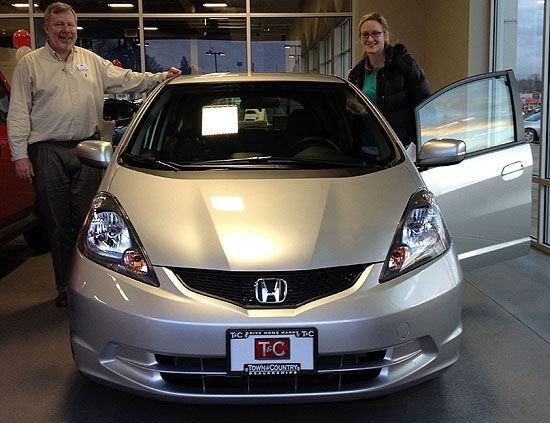
Salesman, Gary Monahan from Town & Country Honda in Gladstone on left and Anne Newton, proud owner on right.
Michael writes, After a bunch of research, we bought Anne a 2012 Honda Fit in silver. We choose the car for a handful of reasons:
– Safety
– 3rd party review ratings- Friends who have them love them
– Great gas mileage — 28/37 miles per gallon city / highway
– Very creative design. Seats disappear to produce huge space, etc.
– Big front window gives the driver a great view
– Remarkably powerful brakes
– Fun little car to drive
– Good cost — all in, including taxes and plates — $17,005
I’ve driven in the car. It’s very comfortable. Michael says “If you need a Honda in Oregon, call Gary.”

What makes all this possible is software from a remarkable company called DisplayLink. Its software powers a remarkable number of display things –For a list, click here.
Nurses Don’t Laugh
“Of course I won’t laugh,” said the nurse. “I’m a professional. In over twenty years I’ve never laughed at a patient.”
“Okay then,” and he proceeded to drop his trousers, revealing the smallest male part the nurse had ever seen. In length and width was a AAA battery.
Unable to control herself, the nurse tried to stop a giggle, but it just came out. Then she started laughing at the fact that she was laughing.
Feeling very badly that she had laughed at the man’s part, she composed herself as well as she could.
“I am so sorry,” she said. “I don’t know what came over me. On my honor as a nurse and a lady, I promise that won’t happen again. Now, tell me, what seems to be the problem?””It’s swollen.”
She ran out of the room.

Harry Newton who is captivated by the Capital One commercial that has a waitress pulling the table cloth out, while the plates and glasses stay. If you want to try this trick at home, here’s how. Click here. Hint, don’t try this with your best dishes and wineglasses.
