The big money in tech is not buying Facebook after it goes public. It will be overpriced and, most likely will fall in coming weeks. The big money is forming a company and selling it to Facebook, Groupon, Zynga, Google, Apple or Microsoft. Tell your kids to get on it.
This is from yesterday’s Wall Street Journal:
Silicon Valley start-ups are being energized by some new big spenders in town: Facebook Inc., Groupon Inc. GRPN and Zynga.
This year, Facebook and newly public Groupon and Zynga have been snapping up companies at a record pace. In the first three months of the year, the three companies bought at least 21 firms, more than double their combined acquisitions in the same period a year ago, according to Dealogic and people familiar with the deals.
While Facebook, Zynga and Groupon haven’t been shy about buying companies in the past, they recently have ramped up their acquisitions pace and delivered some of their highest-ever prices for deals. Many of the deals, such as Facebook’s purchase of app developer Glancee, are strategic moves into mobile technologies or new markets, instead of like past acquisitions to grab engineering or other talent.
The activity is an outgrowth of the huge sums that the Web companies have raised, or expected to soon raise, through IPOs. Groupon and Zynga went public late last year, snagging $805 million and $1 billion, respectively. When Facebook goes public this week, it is expected to raise up to $13.6 billion.
The rapid-fire acquisition pace and the swelling deal prices are rippling across Silicon Valley, boosting the expectations of many entrepreneurs and investors that lucrative-some would say overly expensive-payouts will continue.
“The effect [of Facebook, Zynga and Groupon buying companies] has been throwing a match into an already very heated venture environment,” said Patricia Nakache, a partner at venture-capital firm Trinity Ventures, which invested in travel start-up Uptake that Groupon acquired in February for an undisclosed sum. “It is leading in the short term to an even more frothy investment environment.”
Jason Willig, chief executive of San Francisco-based mobile game company Booyah, agrees: “I think there is tremendous opportunity for big exits.”
Of all the companies, Facebook has been the fiercest acquirer, buying 12 firms in the first three months of 2012, compared with 12 for all of last year, according to Dealogic.
That puts Facebook in line with one of Silicon Valley’s most voracious buyers, Google Inc., GOOG -0.20% which grabbed 13 companies in the first three months of 2012, according to Dealogic.
Since the first quarter, Facebook’s deal making has included its biggest-ever purchase: the $1 billion agreement last month for photo-sharing app firm Instagram Inc. At the time, Facebook CEO Mark Zuckerberg said the acquisition differed from past deals in that Instagram’s technology would be incorporated into Facebook’s mobile strategy to help the social network beef up its presence in the mobile market.
The Menlo Park, Calif., social network is spending its funds in other ways too, buying $550 million worth of AOL Inc. AOL +0.08% patents from Microsoft Corp. MSFT -1.56%
Meanwhile, Zynga this year also made its biggest-ever purchase: a $180 million acquisition of games maker Omgpop in March. The sum exceeds the $147.2 million that Zynga said it spent in all of 2010 and 2011 to buy 22 companies.
Zynga declined to disclose how many acquisitions it has made this year apart from Omgpop.
Rob Coneybeer, a venture capitalist at Shasta Ventures, has seen firsthand how hungry Zynga has been in acquiring start-ups. He invested in 20-person mobile game company Wild Needle Inc., which he said Zynga scooped up several weeks ago for an undisclosed sum.
Mr. Coneybeer said Zynga executives were “rapid in their decision making and they made an offer that was easy to say yes to.” Zynga wooed Wild Needle by selling the start-up on its reach and cross-promotion abilities, he said. Wild Needle employees were “really fired up,” he added.
“Zynga can’t afford to miss the next big hit,” said Mr. Coneybeer. “Games have a shelf life so Zynga by definition will have to be a voracious acquirer.”
Groupon, the Chicago-based daily deals site, bought seven companies in the first three months of 2012, compared with seven in all of 2011, according to Dealogic. But unlike Facebook and Zynga, Groupon isn’t spending big sums, instead shelling out just $28.4 million on start-ups so far this year, according to a regulatory filing.
Recent deals include San Francisco mobile-payment company Kima Labs, which Groupon bought in February. Terms weren’t disclosed.
Groupon said the purpose of the deals has been to snag talent to build up product and technology offerings. That is a shift from last year, when Groupon focused on buying daily-deal sites in international markets to expand its footprint.
Executives at Zynga and Facebook have sought to blunt expectations that their buying streaks will continue. Zynga CEO Mark Pincus said in an earnings call last month that big acquisitions such as Omgpop will be rare.
Facebook’s Mr. Zuckerberg, in a blog post announcing the Instagram deal, said, “We don’t plan on doing many more of these, if any at all.”
But entrepreneurs aren’t discouraged. Mike Ouye, CEO of games company Red Robot Labs Inc. in Mountain View, Calif., said Zynga’s $180 million for Omgpop is a sign that entrepreneurs building one-hit wonders in the mobile space have the chance to sell that hit for potentially hundreds of millions of dollars. Mr. Ouye adds that he has already had some calls from bigger companies looking to buy, but wouldn’t disclose the details of the conversations
Venture capitalist Ms. Nakache said hope springs eternal. “Silicon Valley is a glass half-full optimistic place,” she said.
JPMorgan’s ugly trade. Further reading:
1. Senior management was warned about the riskiness of the trades. They ignored the warnings, because they wanted to believe their employees, and because …
2. Few understood what the trades actually were. Wall Street is a product creator, selling its creations to whoever will buy them, and then moving along to something even more complex. Once, when I was naive, I bought some of these concoctions. They always blew up (i.e. lost me money) because I didn’t fully understand them — I believed what they told me. All of them contained “gotchas.” And once sold, Wall Street had no interest in whether I as a client made money or didn’t. They’d made their fees. End of their interest.
The JPMorgan $2 billion “trade” (also called gamble) is apparently still not unwound, and could end up costing $3 billion.
Lessons for us:
1. Don’t gamble with things you don’t understand.
2. Stay away from the big banks. If one made these awful trades, the others did also.
3. All the big banks are now cockroach stocks. In coming months we’ll hear more about their similar disasters.
JPMorgan’s annual meeting is today. I doubt we’ll learn anything new. But there will be a lot of pissed shareholders and this afternoon’s news stories should be fun.
It’s 1929 all over again, but not in the U.S. Business Insider writes:
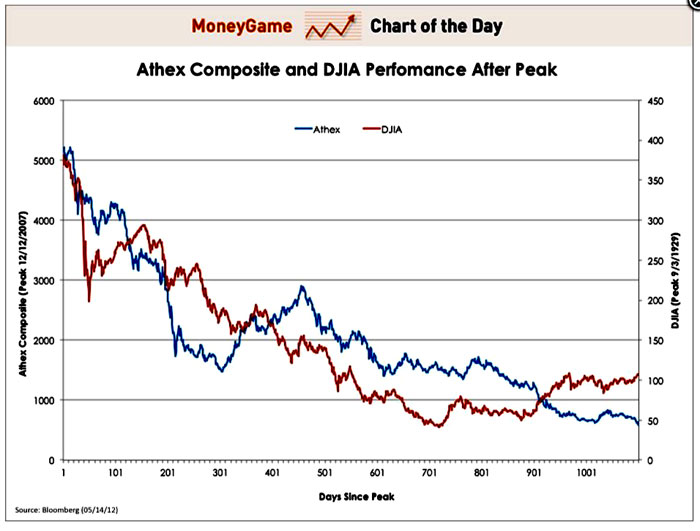
As Greek markets hit levels not seen since the 90s, we thought it appropriate to look at how the Dow performed during the Great Depression.
The results, both suffered huge declines. But the big difference: where as the U.S. began to pick back up five years after its fall, Greece continues to tumble lower.
Below, Athex performance from the 2007 peak compared to the Dow Jones Industrial Average and its 1929 peak.
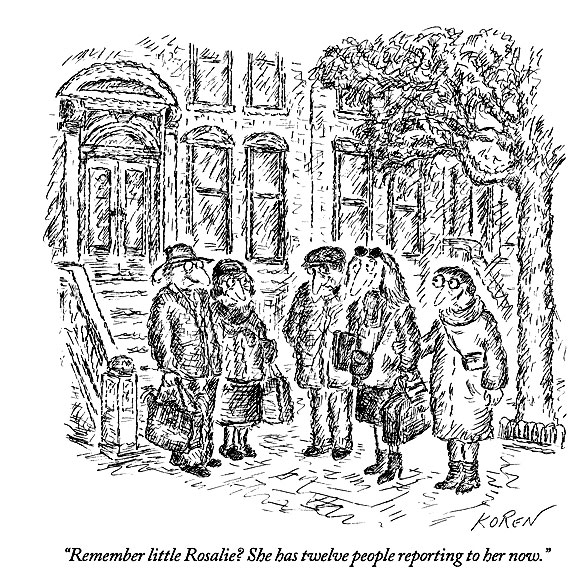
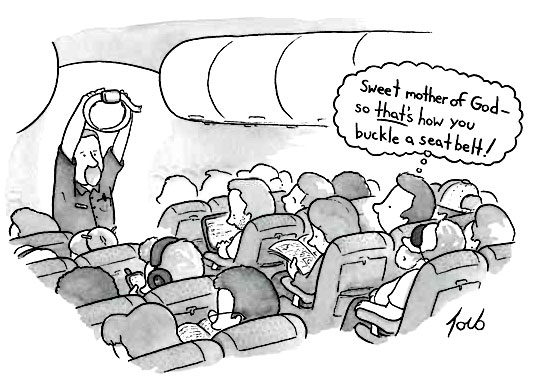
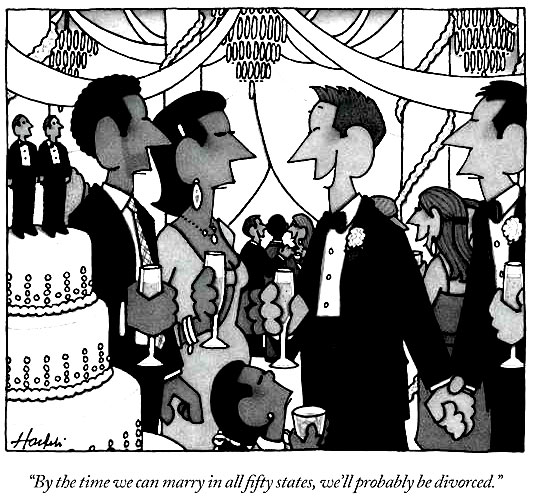
Favorite recent New Yorker cartoons.

Harry Newton who says grab shares in Facebook pre-IPO, if you can. But don’t hold onto them after the IPO. Many of the hot tech IPOs have fallen after their IPOs — Pandora, Groupon, Zynga, etc.
I don’t like the overall market. Prices are turning down. Good time to be short obvious coroach stocks like RDH and BBBY. Stocks with European and overseas exposure are good shorting candidates also.
