Thursday, July 5.
July 4th was great. Tasty food, spectacular fireworks, good company. And renewed faith in the ability of this great country to deliver on our wildest dreams.
Many old friends yesterday. Healthy, happy, some not so healthy, not so happy. The broad spectrum.
The lesson I took away from yesterday was the urgency of writing your very own Bucket List — all the things you want to do before you kick the bucket. Don’t make your list trivial. Write the book you always wanted. Learn the skill you always wanted. Start the business you always wanted. Take the kids on a dream vacation. Go to Bhutan, Patagonia, or Botswana. Marvel at the mountains. Marvel at the animals. Go see Africa’s Big Five.
Write your list today. Tomorrow I’ll share mine.
For now, I’ve left up yesterday’s column. — Harry Newton
++++++++++++++++
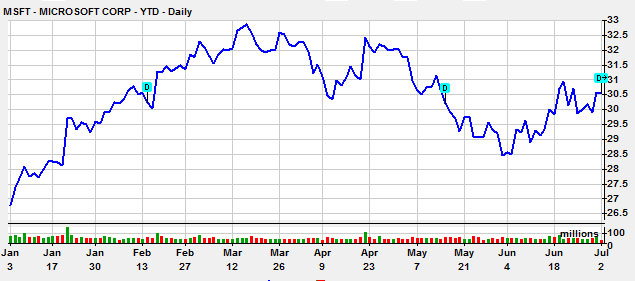
Ouch. Microsoft is taking a $6.2 billion non-cash write down for its acquisition of digital marketing company aQuantitative. The acquisition did not provide the growth it was expected to.
Harry’s take: Most corporation acquisitions don’t work out. Especially when the company buys a entrepeneurial startup. The new managers are bureaucrats. That dooms it from the start.
Software Maker, M*Modal, is to to be bought for $1.1 billion
M*Modal, which makes voice-recognition software for the medical industry, said it agreed to be bought for $1.1 billion in cash by One Equity Partners, an arm of JPMorgan Chase, (Another cockroach? See below.)
The cloud has its problems. I’m not a big fan of cloud computing for you and me — using the cloud as a backup for our precious work.Or using it to write this column. Something always goes wrong. Usually at the wrong time.
Storm Makes the Cloud Look Riskier | Problems with Amazon’s cloud computing service over the weekend underscored how businesses and consumers are increasingly exposed to unforeseen risks as they embrace life in the cloud, Quentin Hardy reports in Monday’s New York Times.
On Friday night, lightning in Virginia took out machines that were part of Amazon Web Services, which hundreds of companies use for data storage and computation. Well-known sites like Netflix, Pinterest and Instagram were not accessible for hours. Besides Internet-connected computers, tablets and smartphones, which people rely on daily, consumers and businesses are connected to the Web through everything from cars and appliances to utility monitors and surveillance cameras. How well the systems behind these are built, and how they handle unforeseen disruptions, will increasingly affect the larger economy. Amazon has built a thriving business in cloud computing, with a range of customers including Intercontinental Hotels, Fox Entertainment, Unilever, Spotify, as well as 187 government agencies and hundreds of small start-ups looking for the cheapest possible computing. “The way companies view it is in terms of reliability generally,” said Michael Chui, a senior fellow at McKinsey & Company. Big customer! s of Amazon, he said, “have the opportunity to shape the marketplace and make demands that make products better. They will push for improvements.” They will also have another option. On Thursday, Google said it would offer computing over the Internet at half the price of Amazon.
Yet more cockroaches at JPMorgan Chase: A regular flow of cockroaches typically drive down the stock price of a cockroach-infested company. Cockroaches comes from three places: First, the company itself. JPMorgan Chase’s $2 billion trading loss is now up to $9 billion. Second, from the press. Journalists love beating dead horses. It sells newspapers. Third, employees within the company become unhappy with their lot living in a cockroach company and they blab to the press.
By the end of all this Jamie Dimon reputation will be big-time sullied. My banker friend who used to work with Jamie tells me Jamie does a great job substituting charm for talent. That may be totally unfair. But it’s a cute turn of phrase — ones writers (like me) love cute turns of phrases. I’m very tempted to short JPM again. Nice higher price.
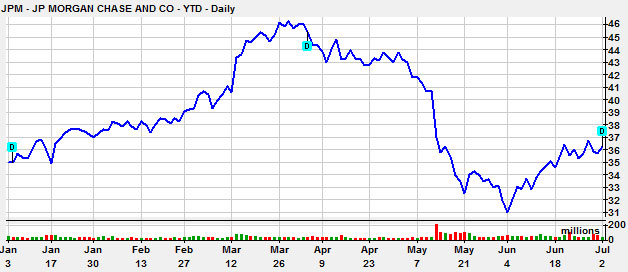
For now, read the latest bad press for Mr. Dimon. It’s from the New York Times:
Former Brokers Say JPMorgan Favored Selling Bank’s Own Funds Over Others
Facing a slump after the financial crisis, JPMorgan Chase turned to ordinary investors to make up for the lost profit.
But as the bank became one of the nation’s largest mutual fund managers, some current and former brokers say it emphasized its sales over clients’ needs.
These financial advisers say they were encouraged, at times, to favor JPMorgan’s own products even when competitors had better-performing or cheaper options. With one crucial offering, the bank exaggerated the returns of what it was selling in marketing materials, according to JPMorgan documents reviewed by The New York Times.
The benefit to JPMorgan is clear. The more money investors plow into the bank’s funds, the more fees it collects for managing them. The aggressive sales push has allowed JPMorgan to buck an industry trend. Amid the market volatility, ordinary investors are leaving stock funds in droves.
In contrast, JPMorgan is gathering assets in its stock funds at a rapid rate, despite having only a small group of top-performing mutual funds that are run by portfolio managers. Over the last three years, roughly 42 percent of its funds failed to beat the average performance of funds that make similar investments, according to Morningstar, a fund researcher.
“I was selling JPMorgan funds that often had weak performance records, and I was doing it for no other reason than to enrich the firm,” said Geoffrey Tomes, who left JPMorgan last year and is now an adviser at Urso Investment Management. “I couldn’t call myself objective.”
JPMorgan, with its army of financial advisers and nearly $160 billion in fund assets, is not the only bank to build an advisory business that caters to mom and pop investors. Morgan Stanley and UBS have redoubled their efforts, drawn by steadier returns than those on trading desks.
But JPMorgan has taken a different tack by focusing on selling funds that it creates. It is a controversial practice, and many companies have backed away from offering their own funds because of the perceived conflicts.
Morgan Stanley and Citigroup have largely exited the business. Last year, JPMorgan was the only bank among the 10 largest fund companies, according to the research firm Strategic Insights.
“It said financial adviser on my business card, but that’s not what JPMorgan actually let me be,” said Mathew Goldberg, a former broker who now works at the Manhattan Wealth Management Group. “I had to be a salesman even if what I was selling wasn’t that great.”
JPMorgan has previously run into trouble for pushing its own funds. In a 2011 arbitration case, it was ordered to pay $373 million for favoring its products, despite an agreement to sell alternatives from American Century.
JPMorgan defends its strategy, saying it has “in-house expertise,” and customers want access to proprietary funds. “We always place our clients first in every decision,” said Melissa Shuffield, a bank spokeswoman. She said advisers from other companies accounted for a large percentage of the sales of JPMorgan funds.
At first, JPMorgan’s chief, Jamie Dimon, balked at the idea of pushing the bank’s investments, according to two company executives who spoke on the condition of anonymity because the discussions were not public. Several years ago, Mr. Dimon wanted to allow brokers to sell a range of products and move away from its own funds. Jes Staley, then the head of asset management, argued that the company should emphasize proprietary funds. They compromised, building out the fund group while allowing brokers to sell outside products.
Now, JPMorgan is devoting more resources to the business, even as other parts of the bank are shrinking. Since 2008, JPMorgan has added hundreds of brokers in its branches, bringing its total to roughly 3,100. At the core of JPMorgan’s push are products like the Chase Strategic Portfolio. The investment combines roughly 15 mutual funds, some developed by JPMorgan and some not. It is intended to offer ordinary investors holdings in stocks and bonds, with six main models that vary the level of risk.
The product has been a boon for JPMorgan. Begun four years ago, the Chase Strategic Portfolio has roughly $20 billion in assets, according to internal documents reviewed by The Times.
Off the top, the bank levies an annual fee as high as 1.6 percent of assets in the Chase Strategic Portfolio. An independent financial planner who caters to ordinary investors generally charges 1 percent to manage assets.
The bank also earns a fee on the underlying JPMorgan funds. When Neuberger Berman bundles funds, it typically waives expenses on its own funds.
Given the level of fees, one worry is that JPMorgan may recommend internal funds for profit reasons rather than client needs. “There is a real concern about conflicts of interest,” said Andrew Metrick, a professor at the Yale School of Management.
There is also concern that investors may not have a clear sense of what they are buying. While traditional mutual funds update their returns daily, marketing documents for the Chase Strategic Portfolio highlight theoretical returns. The real performance, provided to The Times by JPMorgan, is much weaker.
Marketing materials for the balanced portfolio show a hypothetical annual return of 15.39 percent after fees for three years through March 31. Those returns beat a JPMorgan-created benchmark, or standard of comparison, by 0.73 percentage point a year.
The actual return was 13.87 percent a year, trailing the hypothetical performance and the benchmark. All four models with three-year records were lower than the hypothetical performance and the benchmarks.
JPMorgan says the models in the Chase Strategic Portfolio, after fees, gained 11 to 19 percent a year on average since 2009. “Objectively this is a competitive return,” said Ms. Shuffield.
The bank said it did not provide actual results for the investment models in the Chase Strategic Portfolio because it was standard practice in the industry to wait until all the parts of the portfolio had a three-year return before citing performance in marketing materials. She said the bank was preparing to put actual returns in the materials.
Regulators tend to discourage the use of hypothetical returns. “Regulators frown on using hypothetical returns because they are typically very sunny,” said Michael S. Caccese, a lawyer for K&L Gates.
While brokers do not receive extra bonuses or commissions on the Chase Strategic Portfolio, some advisers said they had felt pressure to recommend such internal products as part of the intense sales culture. A supervisor in a New Jersey branch recently sent a congratulatory note with the header “KABOOM” to an adviser who had persuaded a client to put $75,000 into the Chase Strategic Portfolio. “Nice to know someone is taking advantage of the best selling day of the week!” he wrote.
JPMorgan also circulates a list of brokers whose clients collectively have with the largest amounts in the Chase Strategic Portfolio. Top advisers have nearly $200 million of assets in the program.
“It was all about the money, not the client,” said Warren Rockmacher, a broker who recently left the company. He said that if he did not persuade a customer to invest in the Chase Strategic Portfolio, a manager would ask him why he had selected something else.
Cheryl Gold said she got the hard sell when she stopped by her local Chase branch in New York last year and an adviser approached her about the Chase Strategic Portfolio.
“They pitched this product to me, and I just laughed,” said Ms. Gold. “I saw it as a way for them to make money at my expense.”
They got a deal on columns? Susan says it’s fun to look at the real estate ads. Yesterday’s New York Times had an insert called the “Gold Coast Special Edition.” It was from Prudential Douglas Elliman Real Estate. It featured this wonderful house 6 Birch Hill Court, Old Westbury, Long Island. Eat your heart out that you didn’t think of building such a beauty. Make sure you read the words below. I didn’t write them. I simply scanned them.

It can be yours for only $2 million. I bet they’d take less for cash. Don’t you just love the front door?
P.S. I don’t make this stuff up.
Wimbledon tennis is moving along. The tennis is amazing. Trust me. I play this sport every day and I can’t do one-tenth of what these guys and girls can do. …Welll maybe one-fifth…
Congratulate reader Pam Long. She just emailed me:
Good morning Harry,
Closed on the sale of our last rent property.
We are now debt-free.
A great feeling.
Favorite New Yorker cartoons from this week’s issue.



Harry Newton who had a wonderful last night with a friend who happens to be a headhunter. At one point in the dinner, he turned to me and said, “No one would ever give you a job.”
I thought that was the sweetest thing anybody had ever said to me.
Here’s a gorgeous ad from United promoting the upcoming Olympics. I wish their service was as good as their advertising.

Tomorrow is July 4. I like July 4. It celebrates the birthday of my favorite place.
Happy Birthday America.

My un-bucket list of things I won't miss:
http://bloggingaboutdeath.blog…
Gee, my chief bucket list item is simply to unload my white elephant of a condo at 40% of the price I paid for it.
Harry – In my opinion, your view on Cloud computing is the wrong one. Cloud computing is like agile software development. It will be incrementally better day by day with many small steps learnt through episodes like what happened to Amazon on Sunday. It is safer to store your data on a platform like amazon (who take care of security / viruses / backups) than it is to store it on your own network – they will always out-spend you in protecting and backing up data . Every major breakdown, rather than being an “outage” is more of a lesson to guys, I am confident that were this to happen in future, they will have a contingency in place. Finally, it is competition here that will keep these companies honest, and it is very transparent what you will get for your money.
The service is also getting cheaper by the second because of the competition, as noted in your article with google entering this space. I think you are right not to rely on one source to keep all your data, doing your own back-ups is advisable, even just for your own piece of mind, but overall, cloud is here to stay – embrace the change, even if you are hesitant, as it is the way of the future.
Since you challenged me less than a week ago to make my own recommendations on here, they're up about four percent, an hour or so before Tuesday's close. I even forgot to mention Wal-mart, which I bought big time three months ago at $51 per share. It's up 2% today, and will close at around $71.
So I know of what I speak when I say you don't know what you're taking about, Harry. I could buy that $2 million Long Island house with what I've earned in the market the past couple of years. Trust me, dude. Trust me. And stop playing all those shorts, dummy! Warren Buffett is our greatest investor, historically, and he's never shorted anything. Shorting, like quoting Cramer, which you also do, is not smart at all.
I think you're a liar, Fred. Make your predictions right now and we can see how well you've done in three months. Until then, give it a rest.
You're a moron, Tired of Fred.I gave my stock calls a week ago, looking back. The reason nobody else commented is that they know I'm right.
If you read Harry Newton for financial advice then you're a true dummy. I'm hardly the first to call our Cramer and Newton.
“Looking back”. I don't care what you would have bought if you had a time machine and your mother's Ameritrade password. Give us, the benighted readers of this blog something we can buy tomorrow that will make us a ~40% return in 3 months, 6 months, or whatever timeframe you the anonymous internet expert stock picker feel is appropriate. Then, at that time we can find out once and for all if you're full of crap.
I did that, idiot, read consistently, or don't comment. I recommended BRK-B, Microsoft, JP Morgan, and several others you'll have to check the archives on. I also recommended Wal-Mart, but since it's up about 5-6 percent since I recommended it, I'd hold off and wait for a pullback that may or may not come. I also strongly recommend any junk bond fund you can get your hands on,f or the long haul. I've done quite well with them
By the way, if you're looking for a 40% return in 3 to 6 months, you're a lousy excuse for an investor. I've gotten very wealthy utilizing the buy and hold tactics espoused by Benjamin Graham & Warren Buffett. Names you may want to Google, Mr. Probably-Buys-On-Margin.
The 40% return is from your imaginary Walmart investment above, einstein. Jeez.
Spell it out next time, loser, I don't have time to follow a thread back two days to know what you're jabbering about.
“I’m not a big fan of cloud computing for you and I” — should be “for you and me.” Object of preposition. Would you say “for I”? Why do so many educated people make this mistake?
You're 100% right. I fixed my mistake. Thanks for saying I was educated. Sometimes I wonder.
I was educated by nuns and learned “proper English”; not many people
speak “proper English” any more, partly because they are not properly educated but
formal English I believe has become somewhat archaic. I don't like to be a “Grammar Nazi”-
it's pointless, and it's probably better that English be allowed to morph and evolve into a simpler language for every day use. This is a personal opinion that some people would find abhorrent and repugnant, and to them I say: CHILL.
I don't come here to see this kind of garbage about the Catholic church. Totally inappropriate.