Are you positive or negative on the economy?
Does it really matter what we think? The perfect investment remains your own business and now is the right time to start one (or buy one you can improve). Items:
+ It’s much cheaper now. Lots of good people are looking to join you. Computer power is cheap. The cloud is cheap. Rents are cheap.
+ Money is freely available. You can get it from angels, from VCs, and, now from a new source — crowdfunding — see Kickstarter and RocketHub. Read more on Wikipedia.
+ Promotion and marketing is easier and cheaper. Ads on Google are a lot cheaper than ads in magazines, newspapers or in the phone companies’ yellow pages. Facebook, Twitter and email are super ways to get buzz for your product.
If you have an idea, call me and we’ll talk.I know several firms and people looking to invest in startups.
Goldman Sachs says Apple will be $850 in 12 months. If that’s true, that means you’re looking at a 40% gain over last night’s closing price of $606.26. Goldman sees lower iPhone units, higher iPhone ASPs, higher iPad units and lower Macs. It also expects the iPhone 5 to be introduced in time for the all-important December quarter. Goldman says “we would be aggressive buyers of Apple’s stock at current levels.” Goldman bases its 12-month target price on an unchanged 14X on its new CY 13E EPS.
Goldman has to be right. I’ve never so many iPads on the subway as recently.
Of course, there’s no reason to believe any of this since:
1. Goldman Sachs can’t predict the future any more than I can.
2. Goldman could easily be angling for investment banking business from Apple. Nothing taints Wall Street research more than the prospect of investment banking business. Goldman could also be long Apple and be popping the stock a few points in order to get out of it. Or they could be front-running their own recommendation. Or they could be generating “news” that they can leak to their preferred customers.
Don’t believe my skepticism? Read this editorial from Tuesday’s New York Times:
Not All Investors Are Equal
In the Facebook fiasco in May, brokerage firms that sold Facebook’s initial shares apparently warned large investors about doubts from analysts regarding the company’s prospects. Many ordinary investors who were not warned sustained considerable losses. The Securities and Exchange Commission is investigating the disclosures.
But what if it turns out that the selective release of views of analysts is more the rule on Wall Street than the exception?
Gretchen Morgenson reported in The Times this week that a handful of top hedge funds appear to be taking an early peek at views from research analysts, allowing them to trade on the information while other investors are still in the dark. The tips come from surveys that the hedge funds send to research analysts, either monthly or quarterly, asking about possible earnings surprises or the competitive position, management or innovations of companies.
Among hedge funds using the surveys are those run by BlackRock, the money manager; Marshall Wace, a large British hedge fund operator; and Two Sigma Investments, an American hedge fund company. Among analysts that have participated in the surveys are those from Citigroup, Goldman Sachs, JPMorgan Chase, Merrill Lynch and several large European banks.
The funds say they ask only for information that analysts have already expressed publicly, and some participating banks say their analysts follow strict policies to keep their comments in line with their public views. If the information is public, why do a survey? A BlackRock spokesman said the surveys allow troves of data from analysts to be crunched with other data for use in computerized investment models. But documents obtained by The Times from Barclays Global Investors, now a unit of BlackRock, tell a different story. Regarding information about analysts’ expectations for earnings, a confidential memo from 2008 stated the firm expected “to be able to capture the information not released to the market.” A 2009 document about the surveys said, “We are trying to front-run recs,” meaning to trade ahead of recommendations from analysts. BlackRock says the wording in the memos is sloppy, inaccurate and inconsistent with the purpose of the surveys and the firm’s ethical standards.
Still, what if big investors systematically receive early word of important company developments?
The answer, in brief, is that there are already more than enough reasons that individuals shun the stock market. Serial booms and busts of the last 15 years have cast justifiable doubt on the conventional wisdom of buy-and-hold investing. Serial scandals – insider trading, Ponzi schemes, the flash crash of 2010 – have also eroded trust. At the same time, the S.E.C. and other investor protection agencies must fight for every penny from Congressional Republicans who are hostile to the very notion of regulation. Politicians of both parties, in thrall to financial-industry campaign contributors, have supported legislation to erode investor safeguards.
Trading by big investors ahead of recommendations from analysts would be another example of the uneven playing field that markets have become – and another reason for ordinary investors to shun equities.
The result will be a less robust market, a less robust economy and a less wealthy society, as individuals are unable to mass the sums needed for retirement. But until the stock markets are restored to health – with rules and protections that are clearly understood and enforced – individual investors have reason to be wary.
I am in love with my new $99 Kindle Touch. Everything the old one did by button, this one does by touch. It’s more logical and easier. Going page forward, going page back. Setting bigger font sizes (good for old people). Picking what to read. Downloading. All done by touch. And it fits snugly in my jeans’ back pocket.
Of course, the best thing is that no one can tell what you’re reading. Susan knows I’m totally engrossed in my new book. And she’s impressed with my new literary skills. She’d be less impressed if she knew I was reading the second book in the Fifty Shades of Grey trilogy. This one is called Fifty Shades Darker.
Buy yourself a $99 Kindle Touch and the three-set Kindle edition, $29.99, which ironically is $1.28 more than the paperback edition. This may be the first time an electronic book got priced higher to protect its identify.
Thank you. My friend and reader, Pam Long sent me a present: this wonderful mug:

Is she’s telling me she’s sick of reading about tennis on this column? Not too easy. Some days (like today) I’m bereft of investment ideas — good or bad. You should have seen my forehand yesterday…
I’m a sick mother. But I found this very funny.
More sick humor.
A little old lady sold pretzels on a street corner for a dollar each. Every day a young man would leave his office building at lunch time and as he passed the pretzel stand he would leave a dollar, but never take a pretzel. T
This ritual went on for more than three years. The two never spoke.
One day as the young man passed the old lady’s stand and left his dollar as usual, the pretzel lady spoke to him.
She said: “They’re a dollar and a quarter now.”
.
Harry Newton who has a llifelong obsession: To invent some cheap concoction he can package in a small container, sell at an exorbitant and laugh all the way to the bank.
Others must have the same idea. Here are two containers I found on my recent visit to a hardware store:
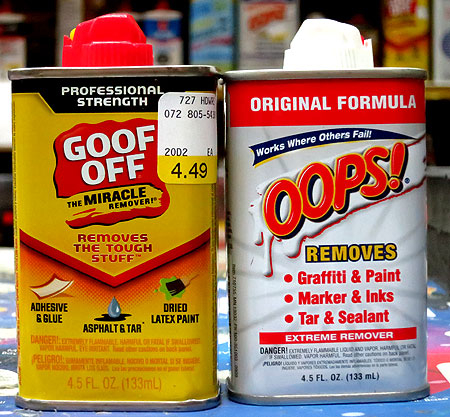
They compete against the leader in the field (good luck) and my favorite:

This field is getting a little crowded. There are several others out there that promise the same miracle — removing goo.

I think if you want to start your trading business then you should start with the small investment. So that you can also easily handle the loses also.
It is too bad you cannot yet give as an example of crowdfunding one of the crowdfunding platforms that support equity crowdfunding. The two you mention are for donation-based crowdfunding.
Equity crowdfunding is where you own real shares and have a stake in the future profits or if the venture shuts down, a proportionate share of the proceeds after liquidation.
This probably doesn't seem as much of a big deal to you Harry as you've been pitched with startup ideas for years. The rest of us, however, were prohibited from being pitched. If there was a private business venture opportunity, it came from a friend or relative — nearly none of which were doing anything I'ld want to sink my money into.
Thanks to the JOBS act and its crowdfunding ammendment, the day will soon arrive where the next chemist to have a better idea than Goo Gone, or a laid-off salesperson from Radio Shack can pitch their idea, using the internet-based crowdfunding platforms and other methods permitted, and potentially find a better use for money, raised $50 and $500 at a time, than what a Microsoft could think of doing with it.
And as some of these crowdfunded companies succeed and take off, it won't just be the venture capitalists and angels that benefit. Finally, the wisdom of the true crowd is finally coming to the small business and startup arena.[The SEC is still formulating the rules governing how these companies and the crowdfunding platforms will operate, so early next year, hopefully, the first companies will be out of the gate.]
Crowdfunding has raised money for hundreds of startups, i.e. entrepreneurs. that's who I was referring to as using crowdfunding successfully. Some of these crowdfundings have not sold equity but given away product (when it's finally made). so far, great for entrepreneurs, lousy for investors. But that should change.
My best potential stock picks right now are bonds and a few selective technology stocks. WPRT one of those and is a player in the auto industry. I think the bond ride might be about to be over. Starting to look for an entry into the gold miners for the fall rise. AUY is my favorite there.
WPRT's sales go up, but so do their losses. What am I missing?
Gold is down in price. Expenses, I'm guessing, are rising….
It's not easy…
Your Kindle was a bad investment. You should have gotten the Kindle Fire — not the archaic monochrome model. The Fire has a color screen and does almost as much as my iPad, but is more schleppable. We live in a colorful world. More and more ebooks are being produced in color. The web, apps, movies and magazines are in color, too. Send it back and upgrade.
Bought my 3 year old grand daughter a Kindle Fire for Christmas. As you said, it does darn near everything an iPad will do for $199. It's nifty. However, my 13 year old grand daughter got a Mac Air laptop for school, so she passed HER iPad down to the 3 year old. I now have the Fire back and am perfectly happy. There is a lesson in there, I'm sure. But, I do not know what it is!
Dear Frank and Mike,
The 99 Kindle Touch is totally wonderful for reading a black and white book, like a novel like 50 Shades of Grey. It fits in my jean's back pocket. I can carry it to the theater. I can read it on the subway, while holding my bicycle. It's easy to use on a plane. I can increase the type face when my eyes tire. It's the perfect technology for one use. We don't all need a piece of technology that does everything. .
What about e-books that are 50,0000 shades of red, orange, green, blue, indigo and violet?
Arch Coal, your favorite new short, is up another 2.3 percent as of late morning. Go Arch! Go coal!
Excellent. I'm glad for you. I'm guessing you've sold and banked your profits.