Damn it. Facebook was so obvious a short. I knew they weren’t generating the big-time advertising revenue they wanted (and needed). Think about Google. It responds to key word searches. I want to buy a Canon S100. It gives me places where I can buy one. Facebook has no search engine and seems to arbitrarily throw ads in — for subjects I’m totally not interested in — e.g. Find High School Alumni, Join AT&T, or One Day Before My Next Heart Attack (I’m still waiting for my first one). Here is today’s piece on Facebook from the Economist.
EVER since Facebook made its stockmarket debut on May 18th, its new shareholders have had ample reason to grumble. The company’s shares have been trading for much less than the $38 at which they were first offered. The social-networking giant’s first quarterly results as a public company, unveiled on July 26th, did little to cheer shareholders up.
The numbers Facebook reported were in fact far from shabby. In the three months to June revenues were 32% higher than a year earlier, at $1.18 billion, much as expected. Facebook also boasted an increase of 29% in its number of monthly active users, to an astonishing 955 million. Against that, the company made a loss of $157m, largely because of a huge rise in share-based compensation costs. And Facebook gave no guidance to its future prospects. The market had not cut Apple any slack two days earlier, despite increases in revenue and profit of more than 20%; it cut Facebook none now. The share price fell by more than 10% in after-hours trading, to below $24, a record low, having already lost 8.5% during the day.
The main way in which Facebook turns membership into money is through advertising: 84% of its revenue comes from ads. For advertising budgets, pointed out Brian Wieser of Pivotal Research Group in a note earlier this week, country-by-country numbers matter more than the global total. In some countries, notably America, which produces half its revenue, Facebook may have reached saturation: comScore, a research firm, reckons that it had 159.8 million American members in June, 1.1 million fewer than a year earlier. But “there is still no other satisfactory [social media] provider for most marketers”, Mr Wieser wrote. Twitter, which has the next widest reach, attracted 41.1m visitors last month. People also spent far longer on Facebook than on any rival medium.
However, there is room for doubt about the effectiveness of Facebook ads-and especially about Facebook’s ability to put moneyspinning ads on mobile devices. People are checking Facebook more and more often on phones and tablets, rather than on desktop computers, yet making suitable ads is harder for smaller screens. The company is yet to show that it can nail this, although Sheryl Sandberg, Facebook’s chief operating officer, told analysts that “sponsored stories” (posts saying that a friend has “liked” an advertiser or its product) are bringing in $1 million a day, half of it via mobile devices.
Investors had already had a jolt the day before Facebook’s results came out, when Zynga, a games company that uses Facebook as a platform and provides most of its non-ad revenue, reported “bookings” of $302 million in the quarter ending in June, much worse than expected. (Zynga’s definition of “revenue” reflects its practice of deferring receipts from its sales of virtual goods to players of its games; “bookings” are what actually comes in.) Zynga’s share price promptly dropped by 40%, to around $3, miles below the $10 for which they were sold in an initial public offering last December. Facebook’s slid in consequence, beginning that 8.5% drop on July 25th. Its own results provided no relief.
From late yesterday’s Richard Russell newsletter:
The market shot up today on the “exciting” words of Italian Euro central bank chief Mario Draghi. But what did Mario say? He crowed that the Euro crowd would do whatever it takes to ensure that the eurozone stands. On that brave statement (with no details to back it), the US market surged with the Dow up over 200 points. Go figure.
Now you know why I’ve kept me (and you) away from gambling on Europe. From this week’s Economist:
Hedge funds
Où est Monsieur Paulson?
Why no hedge fund has made a killing out of the euro crisis
MARKET turmoil usually spells good news for someone. When America’s housing market collapsed, the beneficiaries were hedge-fund managers such as John Paulson of Paulson & Co, who made $15 billion shorting subprime mortgages in 2007. Why, then, has the euro-zone crisis not produced a Monsieur Paulson of its own? Despite more than two years of disarray, funds with double-digit returns are rare; those with triple-digit returns are unheard of.
Dejected hedge-fund managers blame political meddling for their flagging performance. Last year several battered European countries, including Italy and Spain, banned short-selling of financial stocks, which cut off one route to winnings. On July 23rd Spain and Italy put in place new short-selling bans, frustrating bearish hedgies everywhere. Uncertainty has made many funds nervous about placing big bets. Confusion over whether a Greek sovereign default would trigger payouts on credit-default swaps (CDSs) scared off many funds, for example.
Market trends have also struggled to gather steam because of political interventions. Usually funds add to a small position as a trend gains momentum, but this strategy has not worked in Europe. Markets have whipsawed in response to announcements in Brussels: managers who have a good month often suffer the next. Shorting the euro, an obvious trade for euro bears, has not worked because the currency has not yet tanked, partly because of a rush for Bunds.
Appearances have mattered, too. Few want to incite a political backlash by being seen to profit from Europe’s woes, which is partly why funds are “in risk-aversion mode”, says Dominic Freemantle of Morgan Stanley. Investors are also gun-shy. Few would want a fund to take on the tremendous leverage (and volatility) required for a triple-digit pay-off like Mr Paulson’s, says Marc Lasry of Avenue Capital, a $12.5 billion hedge fund.
The crisis is not over, of course: there may yet be a big winner. Luke Ellis of Man Group, a large hedge fund, is sceptical. “The only environment where in theory you could make a subprime-equivalent return”, he says, “is such a doomsday scenario that you won’t be able to get your payout because there won’t be any banks left.”
Perhaps too many people are looking for the next “big short” and instead should be looking for the next “big long”. Mr Paulson (whose fund has done badly of late) was able to buy CDSs cheaply because everyone else was bullish on American housing. Should the euro crisis somehow see a swift resolution, the optimists who defied consensus could be the ones counting their billions.
What a brilliant idea! Yesterday we talked about “layoffs” as an indication of stocks to short. so yesterday I set up a Google Alert on the word “layoffs.”
Which online service for you? I’ve wanted to recommend an online trading system for some time. But I’ve always felt guilty because I haven’t thoroughly tested each one. I doubt I ever will, since there are so many. And they’re all evolging. Then I had a better idea: I’d tell you all the ones I hate, and semi-hate and why. They are:
+ TDAmeritrade. Their web trading “platform” doesn’t update to show latest prices of your stocks. In TDAmeritrade’s words, “it’s not streaming.” For streaming you need to use one of their two “platforms” – ThinkorSwim or TradeArchitect. I haven’t been able to get either to work, though I’m sure they do, after you’ve updated Adobe Flash, cleared your cache and Internet history and rebooted several times. Getting to TDAmeritrade’s technical support is long, long wait on hold. And when you finally get on, they tell you it’s all your fault that their software doesn’t work. (And that’s all all those recommendations above.)
+ Interactive Brokers has the most complex software on planet Earth. It’s probably really good, but the learning curve is too steep for my tired brain. Also, their security is absurdly complex, cumbersome and time-consuming.
+ Vanguard is great for two features — their proprietary, cheap funds, especially the bond funds (like VWALX) which I’ve mentioned in recent days, and lots of free trades when you sign up. Vanguard is not a “trading platform.” Its tools are basically non-existent. For example, it has no tools for simple things like automatic stop losses. Vanguard probably has the cheapest fees for buying and for holding. Their Admiral funds offer very cheap deals, though you typically need to put $100,000 in to qualify.
+ Fidelity. They have software called Active Trade Pro, though you don’t have to an active trader to use it. It has simple tools, like nice charts (the ones on this web site are done with them). Best of all, you load Active Trader Pro on your machine. Your screens get updated with a data flow that you can stream (it seems) over the slowest data connection. I like that. Their telephone support is pretty good. I’ve only had one argument with them — when they charged me for fees they didn’t disclose. I lost that argument. They told me to pound sand. I use Fidelity the most.
The BIG tip when thinking about an account with these things is to ask for zillions of free trades and/or free money. Also, before you hit the button to buy something like a mutual fund or sell calls and puts, call them and ask them for the associated fees. Don’t assume that their low prices apply to everything they peddle. Fidelity stiffed me big-time on a mutual fund. Disclosure about their exhorbitant fees were buried in the tiniest of type on the most obscure web page. I was not pleased with them.
Never ever accept the published retail price. Everything in today’s weak economy is bargainable. Keys:
+ Speak to a real person.
+ Ask for a cents-off coupon. There’s always one in the drawer under the cash register.
+ Check the Internet for comparative prices. Being armed with information is good.
Insanity personified.I met a man who signed up for this insanity, the first one New York City.

Look carefully at what you’re expected to do in one day — swim down the Hudson River for 2.4 miles, bike 112 miles up and down the unbelievably hilly Pailsades in New Jersey and then run a complete marathon.

The winner will take 8 1/2 hours. The others longer. When tickets went on sale for the 2,500 places at $895 an entry, the thing was sold out in nine minutes, yielding the owners of the for-profit corporation running the thing a cool $2.24 million. Not to mention fees paid by sponsors, including Timex.
I asked my friend after dong this extraordinary amount of physical exertion? He replied, “Great, Really great.”
I don’t make this stuff up. The web site is here.
Favorite recent New Yorker cartoons.

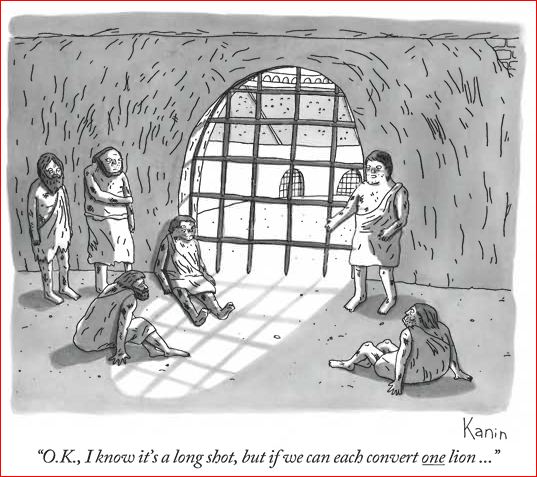
And my absolute favorite:
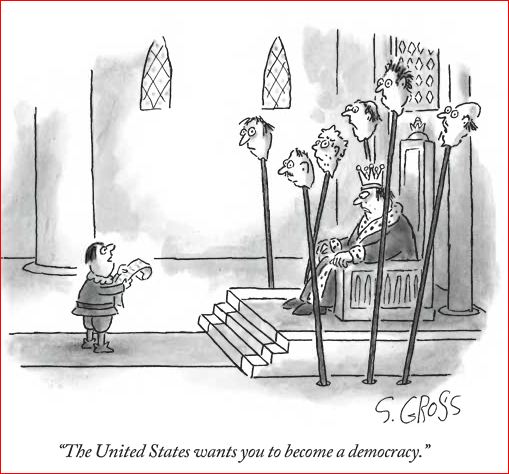

Harry Newton who sometimes wonders about Mr. Romney:
Said Mr. Romney in an interview on NBC discussing the London Olympics: “There are a few things that were disconcerting, the stories about the private security firm not having enough people, the supposed strike of the immigration and customs officials, that obviously is not something which is encouraging.”
Romney’s remarks prompted the British prime minister, David Cameron to answer: “We are holding an Olympic Games in one of the busiest, most active, bustling cities anywhere in the world. Of course it’s easier if you hold an Olympic Games in the middle of nowhere.”
The allusion was to Salt Lake City, which hosted the Games that Mr. Romney oversaw in 2002.
Touche.

Vanguard changed the minimums for Admiral shares from $100,000 to $10,000 on most of their offerings. Some have annual fees as low as $6.00 per $10,000 invested. The only thing I have full control over in my portfolio is costs. With Vanguard, my costs are negligible.
Arch Coal blasted through earnings expectations and revenue forecasts today and finished up 29.4 percent for the day. I realize that Harry is just chronicling his adventures in investing, but when he calls for a short on a great stock like this (and I've posted three or four times on here in the past month that it is great) and his readers follow through and short the stock, it could spell financial ruin.
I don't mean to dog Harry. By all accounts he's a gentleman and has a fine backhand. I'm trying to look out for those who take his advice to heart. I've made my point and I'll stop now.
I'm trying to remember the name of that obscure website Harry quoted here the other day that also called for shorting Arch? I'd love to warn people about that site too. I posted on here that many top hedge and mutual fund managers like coal, but you guys just buy what Harry's sellin'. You coulda listened to me and got WEALTHY.
Harry Newton short Arch Coal is up 30.5 percent today and still climbing at 2:55 eastern time. After getting into a war of words with Harry and other posters on here, this stock is now making me even wealthier.
Now here's a future Fred pick that will just drive you people nuts – Facebook, if it drops a little bit more from here.
You asked for an idea.
Real/true tax reform to regain our lost financial freedoms
by eliminating the IRS; reverse the outward flow of jobs, businesses and
capital; create more jobs with tax code change; remove some $.22 per dollar of
hidden taxes from higher prices we now pay; eliminate regressive payroll taxes;
fight poverty; tax the underground economy and greatly reduce the taxing power
of lobbyists, politician and the 1%.
Let’s talk about moving the tax base from income, dividends, capital gains,
investments, inheritance and savings to a tax base on consumption with one progressive sales/consumption tax
system.
Lets talk about the 5 Principles of Tax Reform: fair, simple, transparent,
supports economic growth and raises same tax amount.
Want a solution to all these issues? Then support the FairTax bill, HR25
/ S13. Learn more at http://www.fairtax.org
Uh, Mr. Newton..you know your favorite short, Arch Coal? As of 11:30 a.m. eastern time Friday it's up 14.5 percent. In one day.
It's not my favorite short. It is one of many. And a relatively small one at that.
Strange comment, considering you emphasized your preference for shorting it in bold face several times. It is now up 20.3 percent in one day. If someone saw that in your list of shorts yesterday and shorted it they would have lost their shirt.
You comment about Fidelity not disclosing fees – I had the same experience. This is common @ Fidelity. TD Ameritrade is the worst, though.
Harry-really! Those comments from Romney are not bad at all…your Biasis are showing through! Mr Romney is stating facts!
But Harry “you didn't build your publishing empire!…your not that smart” ….. from Mr. O's mouth…now that should make one Wonder!!
Please tell us Harry, do you sometimes wonder about the things Mr. Obama says too?
Yes. He said one silly thing about governments creating new companies, etc.
I thought the Romney / Cameron interchange was great verbal tarrying. I like that stuff.
Don't worry Harry – I ALWAYS wonder about President Obama……..
And you should—–Harry does not get it!—–He will in four years when Obama destroys this country !
Obama will destroy this country? I don't believe he could — even if he wanted to.
I wish you guys would focus on developing a positive, workable economic plan that has a shot at getting us out of this present mess.You have some ideas?
Yea, elect conservatives!!!
The same ones who put us in this mess? You know? The ones who will sell every corner of our great country to the highest bidder. Isn't it funny, whenever we see money buying influence in other nations, we cry foul and call it “corruption”….however, we see the same thing right here in the US and our lawmakers protect their own interests to line their pockets by simply calling it “lobbying” and taxing it? What gives? Anybody know of a politician who served in the House or Senate and left broke or poor? On the other hand, can we even count those who went into office poor/broke and came out relatively wealthy beyond their paycheck?
When will the people see that our elected representatives have outsourced lawmaking to the highest bidders who hire the most effective lobbyists to influence, and ultimately write, our laws?
Our “system” is broken.
Because much of it is built on myths, myths that can be found right here in the readers' words.
The people in office trying to “fix” it probably will make it worse.
I say let it be funky and imperfect, give up the absurd memes of the godly “hand of the free market”, kill the Republican thrust for destroying education, the kind that promotes common sense and being informed (they benefit from ignorance), institute not for profit universal medical, and teach people that the country belongs to ALL of US, not one group that is trained to parrot that the country was “stolen” from THEM.
Then it might be a little easier to breathe.