There’s nothing more wonderful than finding a hot stock, riding it up and having the perspicacity (nice word?) to get out at the right time.
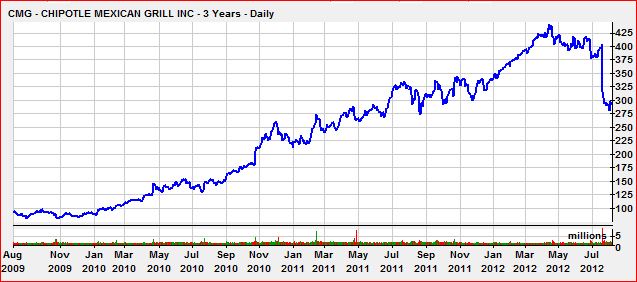
Remember, Chipotle?
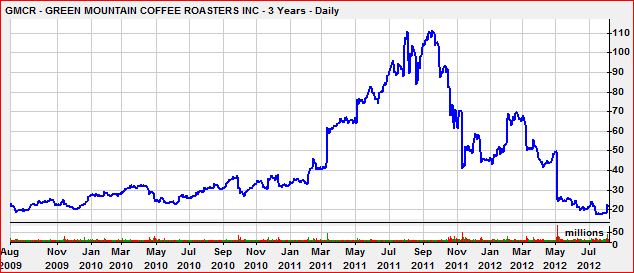
Remember Green Mountain Coffee?
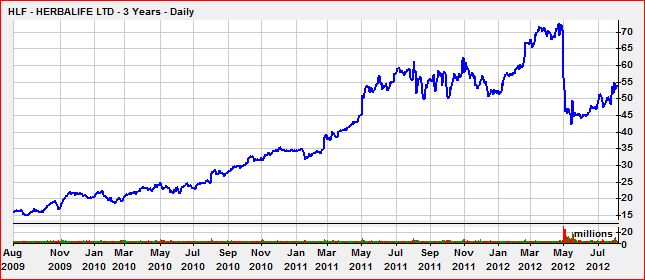
Remember Herbalife?
Remember Tempur Pedic?
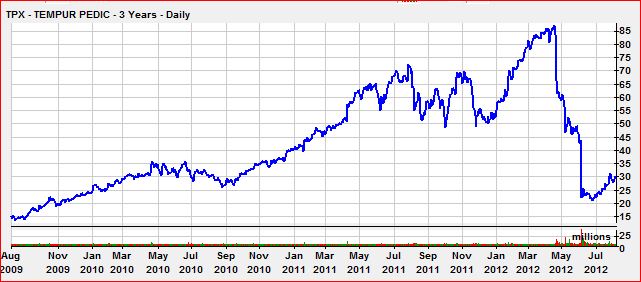
Pretty scary? Maybe not always.
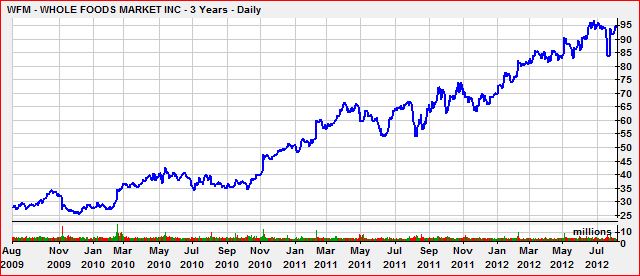
And the latest hot food retailer?
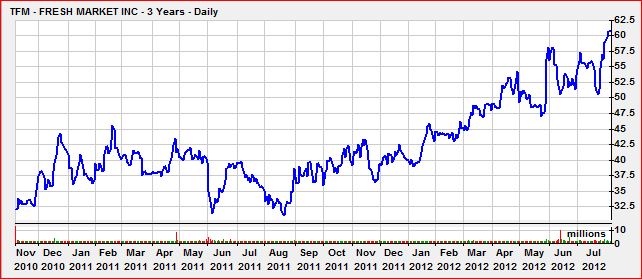
These Fresh Market guys are expanding fast — and I mean fast. Check out the list of upcoming stores here. To me, they look overpriced, with a P/E of 51, compared with Whole Foods’ 40.
Why are investors staying out of the market? Last night VectorVest said issued a BUY signal, meaning they thought the market would go up from here. They’re actually pretty good on their market calls.
Yet…
Investors have left the market in droves recently. Here’s Andrew Ross Sorkin’s take on that phenom from the New York Times:
Why Are Investors Fleeing Equities? Hint: It’s Not the Computers
Let’s stop with the excuses.
You’ve no doubt been reading a lot about a “crisis of confidence” on Wall Street in recent days after software problems at a big trading firm sent the stock market, briefly, into a tizzy.
Everyone is hyperventilating at the errant trades at the Knight Capital Group – suggesting, in the words of Arthur Levitt, that these malfunctions “have scared the hell out of investors.” The problems at the firm were immediately lumped together with Facebook’s glitch-filled initial public offering, the flash crash of 2010 and the rescinded public offering of BATS Global Markets, among others.
Apparently – if the experts are to be believed – these computer errors are the reason “investors are fleeing the markets like never before,” Dennis Kelleher, president of Better Markets, told The Los Angeles Times. Dozens of articles about the trading blunder included some form of that contention, using statistics showing that $130 billion or more had been withdrawn from mutual funds over the last year or so.
Let me offer a more straightforward explanation of why investors have left the stock market: it has been a losing proposition. An entire generation of investors hasn’t made a buck.
“The cult of equity is dying,” Bill Gross, the founder of Pimco, wrote in his monthly letter last week.
“Like a once bright green aspen turning to subtle shades of yellow then red in the Colorado fall, investors’ impressions of ‘stocks for the long run’ or any run have mellowed as well,” Mr. Gross wrote. His letter came after he had sent a Twitter post that read: “Boomers can’t take risk. Gen X and Y believe in Facebook but not its stock. Gen Z has no money.”
(Mr. Gross, who manages the largest bond fund in the world, started a stock fund several years ago, too, so he has a vested interest in seeing stocks succeed for his clients.) This is not to say that Knight Capital’s software debacle is helping instill confidence in investors. But it’s doubtful it would make a Top 10 list of reasons for investors to flee.
So why are so many investors sitting on their hands? The unemployment crisis, the European debt crisis and the looming fiscal-cliff crisis, to name just a few reasons. Economic growth is slowing, not just in the United States but in China, too.
Those are the same reasons that chief executives and boards of American companies are sitting on $2 trillion in cash and not investing in their own businesses. They are scared, rightly or wrongly, about the future. (It should be noted that some of the most skilled investors recommend staying in the game during such times. Warren Buffett famously advised that investors “should try to be fearful when others are greedy and greedy only when others are fearful.” But it doesn’t seem like that advice is being followed.)
Even the hedge fund titan Louis M. Bacon has been so humbled by the stock market that he returned $2 billion to his investors last week rather than risk losing it.
None of these fundamental issues have anything to do with a computer that ran amok or a trade order mistakenly entered by a fat finger.
Blaming computers is not a new phenomenon. In 1988, months after the 1987 crash, The New York Times explained that small investors shared a “fear of being whip-sawed by program trading.”
“I think everybody is concerned about the flight of the small investor – the S.E.C., the exchanges, everyone,” Howard L. Kramer, assistant director of the Securities and Exchange Commission’s division of market regulation, said in another article, also in 1988.
Here are the numbers today: About $171 billion has flowed out of mutual funds over the last year, according to the Investment Company Institute, which tracks mutual fund data. Where has all that money gone?
Bonds. About $208 billion has flowed into the bond market over the same period, according to numbers from the I.C.I.
The fact that so few long-term investors are in the stock market has only worsened the volatility, since it often seems as if the only people who are trading stocks are the professionals.
Which brings us back to the “crisis of confidence.” This does exist among investors, but they are not focused on how computers are making the markets go haywire. Rather, they are concerned about the future of the economy and, yes, trust.
Individuals are worried that it’s hard to make the right bet and worried that the market is rigged against them. Much of this is an outgrowth of woes of Wall Street’s own making, like insider trading cases or market manipulation scandals. Those situations are partly why individual investors don’t believe they stand a chance against the professionals.
Consider this: Of 878 students at 18 high schools across 11 different states surveyed by the Financial Literacy Group, three-quarters of them said they agreed with this statement: “The stock market is rigged mostly to benefit greedy Wall Street bankers.”
So for now, it seems, trading firms don’t just need to throw out their electronic trading systems or bring in more regulators to oversee their stock executions. They need the country to get a shot in the arm to address its economic problems, and they need the public to have faith in the long term.
Instead of pointing the blame at one incident or another, look at the fundamentals.
The trashiness of Wall Street has no bounds. Several days ago I receive a letter from StepStone Capital Partners II telling me of a “Notice of Net Cash Distribution” of $185,413.02 which will be wired on or about June 29, 2012. I am a sad shareholder of that leveraged buyout fund. But I hadn’t received the money. I guessed it (and the letter) were late. Yesterday, I called StepStone.
“So what happened to my money?”
Sorry about that, they said. The letter was “an error. The fund administrator made a mistake.”
So, why didn’t you call and apologize? Or send an email or something? Anything?
“We didn’t have your email or phone number.”
You’re kidding.
I don’t make this stuff up.
The fund originally was from Citigroup and was run by a very smart successful guy. Later Citigroup decided it shouldn’t be in the fund business and sold it to StepStone, a company I’d never heard of and would never have invested with.
Good that I didn’t spend the $185,413.02.
If I had run my business the way StepStone does, I would have lost all my customers in about three seconds flat.
Modern Technology
I was visiting my son and daughter-in-law last night when I asked if I could borrow a newspaper?
‘This is the 21st century, old man,’ he said. ‘We don’t waste money on newspapers. Here, you can borrow my iPad.’
I can tell you, that fly never knew what hit it…

Harry Newton who eyes the downgrades which his favorite mortgage REITs are getting — especially AGNC and NLY, Ultimately, when interest rates start to rise (not for at least two years), these mREITs won’t be worth holding. But for now, they yield nicely. If they come back a little, I won’t like it, but it’s fine with me since I never expected their recent capital gains. I’d always bought them for their dividend yield, not their appreciation — which recently has surprised me.

“Andrew Ross Sorkin’s take on that phenom from the New York Times”……….PPPPPlease, the guy is a gigantic liberal — I wouldn't waste my time.
Harry, the fresh market by me in new jersey is pretty darn empty. I like fairway better personally. I think fresh market is a little over priced and quality not as good in my experience..
Harry, you write about finding a hot stock. Perhaps the hottest stock anywhere is Arch Coal, up another 6.5 percent today. It's up an astounding 45 percent in the past two weeks or so. Yet, you have repeatedly called for shorting this stock.
Another hot stock: JP Morgan Chase, up 3.5 percent today. Again, a stock that you keep calling for your readers to short.
Long article about how apple and google accounts were hacked and within an hour. All the hacker needs is associated e-mail address (on file), the billing address (on file), and the last four digits of a credit card on file. It goes on to say how easy it is to use one to get to the other…
http://www.wired.com/gadgetlab…