Dividends float my boat. Tight stops (i.e. falling prices) have killed my love for ED and FSLR. It’s no easy in this market to figure stocks. Love them. But dump them when they fall 8%+.
Peter Lynch was right. Our friend’s mum invested in Amazon because she liked her Kindle. Good move. Good lesson. If you like the products, buy the company. Peter Lynch was right. I do like the new iPhone 5 and will switch my iPhone AT&T service to Verizon, which says its iPhone 5 is unlocked. That means you can take it overseas, switch SIM cards and happily talk at local prices.
More Harry travel tips:
1. On checking in, ask for more pillows, the Wi-Fi access codes and a device to put your suitcase on. Save you asking for them later on.
2. Most European hotels often include breakfast and Wi-Fi. But always ask when making your reservation. Could save big bucks. Begging works. You can get a better room with sweetness and flattery.
3. Europe loves pensioners and old people. Carry your passport to museums and train stations. Saves big time. Never have I been so happy to be a “pensioner.” Never have I been so flattered to be carded.
4. Hotel breakfasts are always the best meal of the day.
5. European trains are fast, reliable and comfortable. Get your ticket at the station. Train web sites are “too complicated,” We spent $100 per person for 331 miles on this train.
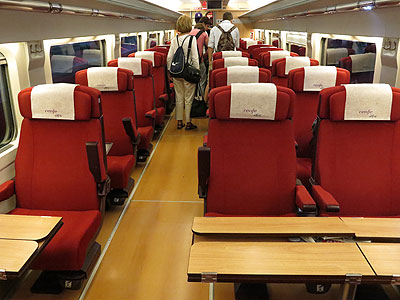
I think it was the “preferred class,” one up from peasant, which was fully booked. We got the pensioners price.This was our train. 2 1/2 hours = 132 miles an hour average. And it stopped once. It had to be peaking at nearly 200 miles per hour. The ride was as smooth as silk.
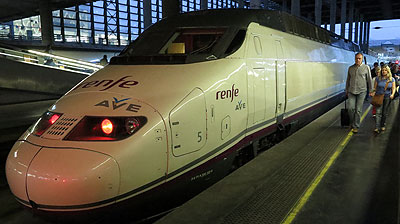
Are you listening, Amtrak?
This is the Madrid train station. It has a jungle, replete with tortoise pond and hundreds of tortoises. Susan thought the whole effect was rather “random.” I loved watching the tortoises tootle around their pond.
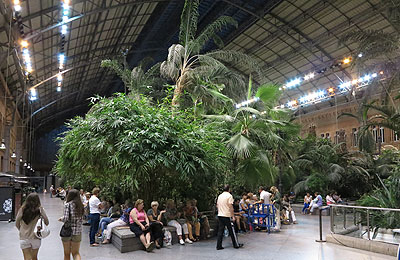
Here’s two of the critters. In case no one believes me. Fascinating to watch.

6. Google Translate is great. Especially if you’re trying to understand web sites that aren’t in English.
7. Hotel WiFi is always slow and often reliable. Take your own MIFi unit. Verizon or XcomGlobal work spectacularly well. I had Internet access all the way from Sevilla to Madrid at over 100 miles an hour. Can’t get that in the U.S.
8. Europe now has many budget airlines, including Rynannair, EasyJet, Helitt, But you won’t find them on Expedia, Kayak or Orbitz. You need to check their own web sites. Google works. You’ll save at least half with a budget airline. I found one case where I could actually save 90%.
9. Garmin, Tom Tom and other GPS systems are horribly out of date for fast-growing areas — like Spain’s Andalucia province (where we were). Best was Google maps on iPhone or BlackBerry.
10. Don’t check luggage. Retrieving it is slow. Big airlines’ overheads will take an Eagle Creek 25 inch roll-on, though their rules say they’ll only take a 22 inch bag. Got to get on planes fast, though, before the bins fill up.
11. European GSM cell phone service is much better than ours. It looks like the Verizon iPhone 5 comes unlocked, which is fantastic. Thank you Brenda. You can buy an unlocked GSM phone on eBay. Load Verizon or your eBay phone with a GSM card from a local seven-eleven. Use it to make calls in the country. AT&T’s American phone will receive and make calls happily (but expensively) in Europe. Of coursed, the cheapest way to call is to use Skype on your U.S. smartphone (iPhone, BlackBerry or Android) with the local hotel Wi-Fi. Works like a charm — and is basically free.
12 Exercise every day. Stretch. Run up the stairs. Walking is not exercise. Do something. Otherwise you’ll feel creaky and gain weight.
13. Everyone uses TripAdvisor. You shouldn’t trust it. But it is ubiquitous. Good for hotel reviews and tips on visiting sites.
Yahoo has been hacked. Ignore all emails from friends with Yahoo addresses — especially those that send you to web sites you’ve never heard of.
What is happening to our great country. This piece appeared in the City Journal. The author, Victor Davis Hanson, is well-known.
Life with the Vandals
If the coast of California is “postmodern,” as its residents like to say, we in the state’s interior are now premodern. Out here in the San Joaquin Valley, civilization has zoomed into reverse, a process that I witness regularly on my farm in Selma, near Fresno. Last summer, for example, intruders ripped the copper conduits out of two of my agriculture pumps. Later, thieves looted the shed. I know no farmer in a five-mile radius who has escaped such thefts; for many residents of central California, confronting gang members casing their farms for scrap metal is a weekly occurrence. I chased out two last August. One neighbor painted his pump with the Oakland Raiders’ gray and black, hoping to win exemption from thieving gangs. No luck. My mailbox looks armored because it is: after starting to lose my mail once or twice each month, I picked a model advertised to resist an AK-47 barrage.
I bicycle twice a week on a 20-mile route through the countryside, where I see trash-everything from refrigerators to dead kittens-dumped along the sides of less traveled roads. The culprits are careless; their names, on utility-bill stubs and junk mail, are easy to spot. This summer, I also saw a portable canteen unplug its drainage outlet and speed off down the road, with a stream of cooking waste leaking out onto the pavement. After all, it is far cheaper to park a canteen along a country road, put up an awning over a few plastic chairs and tables, and set up an unregulated, tax-free roadside eatery than to battle the array of state regulations required to establish an in-town restaurant. Six such movable canteens line the road a mile from my farm. For that matter, I can buy a new, tax-free lawnmower, mattress, or shovel at the ad hoc emporia at dozens of rural crossroads. Who knows where their inventory comes from?
Few residence-zoning laws are enforced in the rural interior of highly regulated California. My neighbors often plop down broken Winnebagos-three or four per acre-and add a few Porta-Potties and propane grills, thereby creating a hacienda of renters. You can earn the ire of a building inspector in Menlo Park if your new fence is an inch too high, but out here in the outback, no one cares if you crowd 40 adults onto your premises.
To be in a car accident in rural central California, as I have been three times, is often to have the assailant driver flee the scene, or to learn later that he lacked license, registration, and insurance. About once every three years, I find a car-again, lacking registration and insurance-that has veered off the road into my vineyard, destroying thousands of dollars’ worth of vines, and been abandoned.
Law enforcement seems not so much overburdened as brilliantly entrepreneurial. Patrol cars flood the highways as never before, looking for the tiniest revenue-raising infraction; the police realize that going after the man who throws a freezer into the local pond is costly and futile, while citing the cell-phone-using but otherwise responsible driver is profitable. In 2009, the most recent year for which traffic statistics have been released, the highway patrol issued 200,000 more violations than in 2006.
As I write, my local community is confronting a peculiar epidemic. Bronze dedicatory plaques are being stolen from our ancestral institutions-churches, halls, clubs, parks-many of which my grandparents and great-grandparents helped establish. No records exist for most of the ancient dedicatory names, so all prior benefaction has been erased from our collective memory-and all for the recycled meltdown that supplies only a day or two’s drugs for the thieves. For central California’s parasitic criminal class, melting down what the departed bequeathed us is a growth industry. It reminds me of the fifteenth-century Turkish occupation of Greece, when scavengers pried the lead seals off the building clamps of classical temples, destroying in decades what nature had not damaged in centuries.
The world outside my window reminds me a lot of what my grandfather told me about the wilderness that his pioneer grandmother discovered on arriving here in the 1870s. We’ve come full circle, tearing up what was handed down.
Victor Davis Hanson is a contributing editor of City Journal. He is the author of the recent novel The End of Sparta and of the forthcoming The Savior Generals.
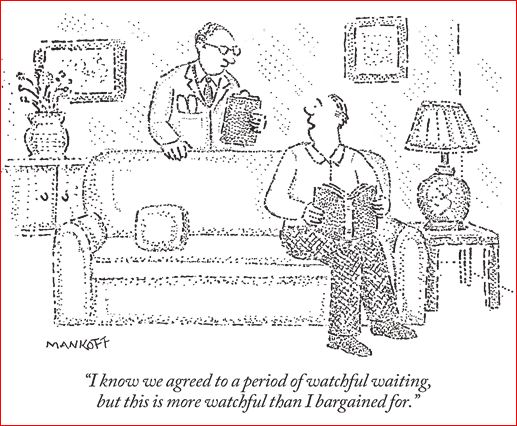
Favorite recent New Yorker cartoons.
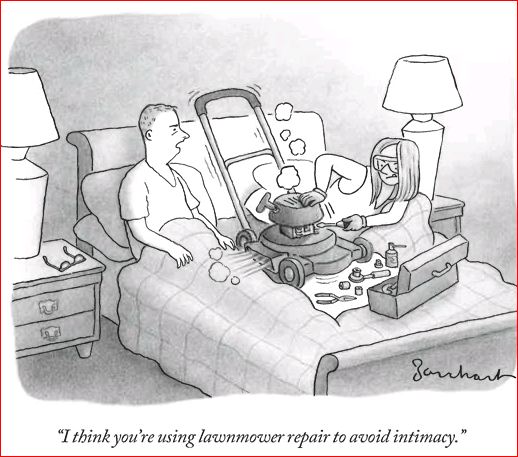
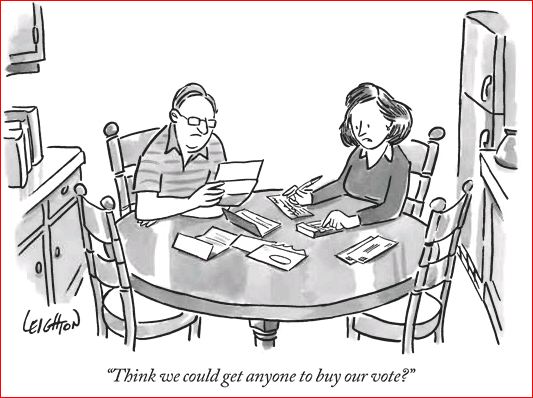

Harry Newton who notes (once again) that newness in software is not necessarily better. To wit: This web site kept crashing on the weekend. Tech support at the web hoster said it wasn’t their fault. It never is. They said “upgrade” to the newest version. Reluctantly, I did. The new version sucks. So this morning I’m struggling with idiotic enhancements. There’s a rule in the computer world. “If it’s working, don’t mess with it.” Good rule. I’m still using Microsoft Office 2003. Works like a charm and doesn’t have all the “enhancements” I don’t need and mostly don’t work. God, I sound like a grouchy old man. I do wish they’d leave well enough alone.

iphone 5 is a flop. IOS6 is buggy and the mapping feature is a disgrace. You watch Apple shares fall. The best for Apple is behind us. Short
Victor Davis Hanson is a brilliant author and observer of life in the USA, including interior Calif. What he writes about is a shame. Welcome to foolish California, once the land of dreams, now nightmares, be it the politically correct Bay Area or the wilderness farm country, still somehow feeding America. Picture the future, USA, and it could look like Calif.
I agree not to trust TripAdvisor but it can useful for insights other than service, room size and cleanliness. For instance, I recently stayed in Paris and a user commented that every morning at 6am the trashed is picked up in the alley so we decided to get a different room and we are glad we did. That person was right because we could still hear the noise a little but not as bad if we didn’t switch our rooms and this hotel was in a great location, priced well and a good choice.
Harry,
I have a friend who lives near Fresno as well who is leaving and moving back to Missouri due to the conditions you mention in the area.. Politics and not enforcing our immigration laws have taken their toll he says.
Cheap European air can get costly…on an international trip that included a short hop from Glasgow to London, we were charged $100.00 for one piece of checked luggage. No charge on international flights, however, Glasgow to London on Ryan Air turns out to be a domestic flight…all within the UK. Enjoying your trip right along with you. You should do more of this and do your travel while you are still young (yes you are) it gets tougher as you get older.