I went to an afternoon seminar yesterday on “Six mistakes retirees make with their finances.” Certified financial planners (people with CFP after their name) hold seminars in restaurants to snare new clients. The key risks are longevity risk (I’ll outlast my money); inflation (I’ll get killed), asset allocation (where should I put my money?), finding decent yielding investments (look at today’s interest rates), underestimating mutual fund expenses (turnover will eat you alive) and excessive withdrawal risk (which I guess is the same as longevity risk.) I’d be more specific except the seminar started 35 minutes late, despite being harangued by the seminar giver to be on time because “we will start precisely on time.”
Lesson one: Bring a spare slide projector. Second lesson: Know how to hook it up.
No one seemed to care. The CFP had organized every table with a plate of cheese, grapes and dried apricots. Several attendees told me they attended retirement seminars “for the food.”
The big fear among retirees is the last few years of their life. They’ll have dementia and be confined to a nursing home, wheelchair bound, immobile, incontinent and mute. Human vegetables. For retirees who visited a parent in a nursing home the experience is frightening. One attendee told me her husband recently died in a nursing home. It cost $17,600 a month for the home, plus $5,000 for a 24/7 attendant — who changed his diaper when kaka happened, not when the nursing house got around to changing it. It’s not possible to buy insurance to cover all the expenses.
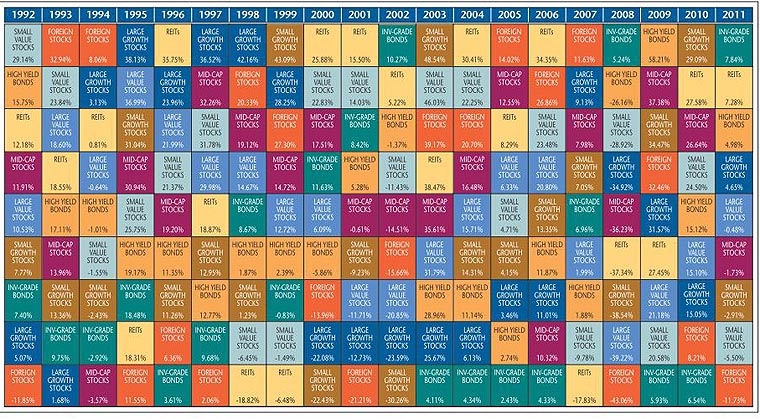
I’m 70. Our CFP told me I’m living to 87. That’s 17 more years of mismanaging my investments. How mismanaged? Every retirement seminar giver dutifully trots out this chart. He did too.
Key to the colors:
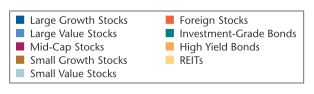
The headline on the chart is “Still trying to time the market? Take a closer look.” The chart tells us that different market segments do differently each year. Trying to predict which ones will do best is a fool’s game.” In 2011, investment grade bonds did best with a 7.84% return. Worst was foreign stocks, with a loss of 11.7%. In 2005, guess what happened? foreign stocks did best with a 14.02% return and investment grade bonds did worst with a 2.43% return.
I don’t find this chart frightening or educational, since I don’t buy ETFs or mutual funds that match these nice little colored boxes. They’re a great tool for a CFP pushing his services or a broker pushing a balanced portfolio that he will rebalance every year. His mantra: Always keep 10% of your portfolio in each of ten segments. At the end of the year, sell the ones that did well and are now more than 10%. Top up the ones that are under 10%. That will keep you afloat, or balanced or something. Focusing on the system of rebalancing is easier than figuring which segment, if any, is gong to do well.
There’s a bigger version of the chart here.
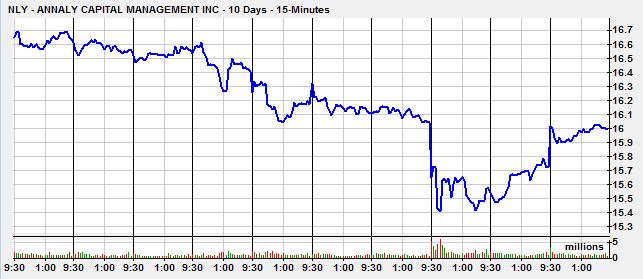
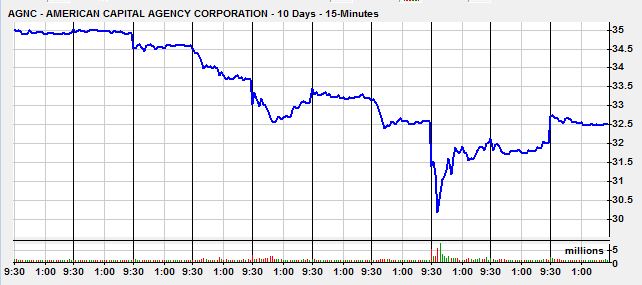
The Mortgage REITs bounced back. Panic is bad. It kills your performance. I panicked and sold some of my mortgage REITs — mostly at the bottom of this hiccup. I had convinced myself this was the end for the mortgage REITs. Maybe that’s exactly what I was expected to believe? Maybe this big recent fast drop was orchestrated by person (or persons) intent on a quick profit by shorting the stocks? I don’t know. I’ll never know. The charts are interesting to look at. Here are three from the last ten days of trading:
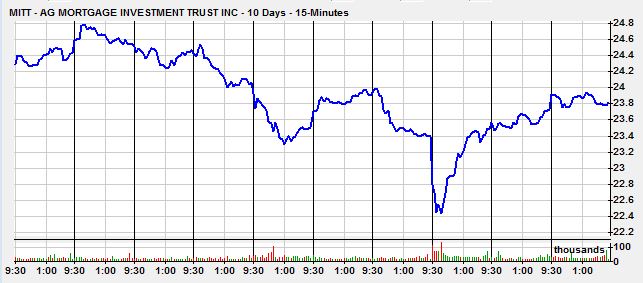
As to whether these things are worth buying at this level, the jury’s still out. I’m still mulling and researching. Analyst reports are bullish — but then most of the analysts come from investment banks that underwrote recent offerings and have an obligation (to their bosses) to push what they just sold.
What a great looking watch.

Until you see it up close and smaller. And hear its price. About $3,300.
Being mechanical, it’s less reliable than my $15 Timex quartz.
Ah, such is marketing.

Harry Newton who feels comfortable (?) with his old age now he’s read Wikipedia on Medicaid:
According to CMS the federal Centers for Medicare and Medicaid), the Medicaid program provided health care services to more than 46.0 million people in 2001.[12][13] In 2002, Medicaid enrollees numbered 39.9 million Americans, the largest group being children [14] (18.4 million or 46 percent). Some 43 million Americans were enrolled in 2004 (19.7 million of them children) at a total cost of $295 billion. In 2008, Medicaid provided health coverage and services to approximately 49 million low-income children, pregnant women, elderly people, and disabled people. In California, about 23% of the population was enrolled in Medi-Cal for at least 1 month in 2009-10.[15]
Medicaid payments currently assist nearly 60 percent of all nursing home residents and about 37 percent of all childbirths in the United States. The federal government pays on average 57 percent of Medicaid expenses.
Loss of income and medical insurance coverage during the 2008-2009 recession resulted in a substantial increase in Medicaid enrollment in 2009. Nine U.S. states showed an increase in enrollment of 15% or more, resulting in heavy pressure on state budgets.
CMS monitors the state-run programs (Medicaid is state-run) and establishes requirements for service delivery, quality, funding, and eligibility standards.
The seminar did highlight four ways to increase your income:
+ Preferred shares
+ Federally back mortgage notes
+ Energy partnerships (MLPs)
+ Annuities (those offered by insurance companies).
Retirement is not a good idea for most people.
Getting old is really depressing.
I prefer Woody Allen’s approach — focus on distractions. Click here.

Harry, I began selling my AGNC several months ago. I can’t complain about the dividends or appreciation this stock has returned over the past year and a half.
I have no plans to by any m-reits back again. With the Fed now competing with m-reits, I think the show is over. We’re probably seeing a dead cat bounce on the stock price right now, but I expect the stock and it’s dividend will fall over the long haul.
Harry – ValueForum.com has some great discussions on the m-reits from people who really know what they are talking about – not just brokers pushing what their research departments publish.
Once it was high tech high growth companies; now it’s solid long term dividend paying stocks. Oh, and for awhile it was cheap fee ETF’s. There is no one secret to investing from the experts. Except from me: one secret is always saving money when you’re earning it and another is living frugally when you’re not. Dah!
Perspective Harry! There is only one alternative to getting old. Question is; is it worth undertaking? 😉