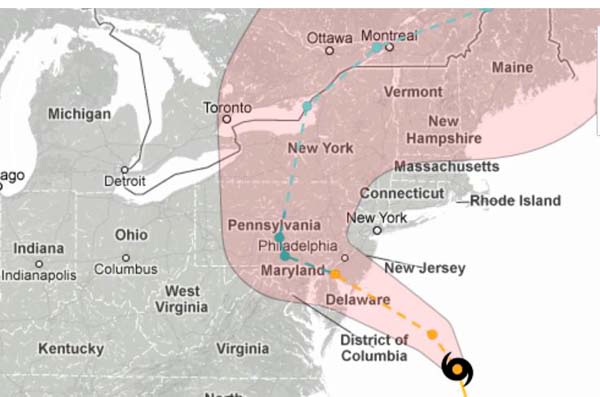
Everything is closed in New York today — including the exchanges and the subways — because of Hurricane Sandy, which is forecast to be the biggest storm in 100 years and meant to hit big-time later today. At present it’s raining a little and is very gray. The big fear is flooding. There’s a guesstimate that as many as ten million homes will lose electricity. Already 375,000 people have been evacuated from the lower areas of New York City. More probably will be. The black twirly shows where the eye was at 8:00 AM this morning. The pink shows the likely path. Winds are gusting to 85 MPH.
It’s a good idea to shutter the windows, stay in bed and do some reading and watching.
+This music video by a Korean pop start has attracted over 580 million views on YouTube. That’s phenomenal. It’s especially amazing since you and I can’t understand a single word. The tune is catchy, though. Click here.
+ The world is mercifully awash in new startups. The headline on this story is “In London, Nimble Start-Ups Offer Alternatives to Stodgy Banks.” Click here.
+ How do you live forever? A fellow has been studying the Greek island of Ikaria where everyone lives well and long. They don’t eat the crap we do. They eat locally grown vegetables and very little meat. They have a heady social life. They have no stress. They don’t wear watches. The author concludes:
The big aha for me, having studied populations of the long-lived for nearly a decade, is how the factors that encourage longevity reinforce one another over the long term. For people to adopt a healthful lifestyle, I have become convinced, they need to live in an ecosystem, so to speak, that makes it possible. As soon as you take culture, belonging, purpose or religion out of the picture, the foundation for long healthy lives collapses. The power of such an environment lies in the mutually reinforcing relationships among lots of small nudges and default choices. There’s no silver bullet to keep death and the diseases of old age at bay. If there’s anything close to a secret, it’s silver buckshot.
The headline on the story is “The Island Where People Forget to Die.” For the full story, click here.
+ Pro-Life? In recent weeks, a bunch of Republican Senate hopefuls have come out with amazing statements on why they’re opposed to abortion. I’ve never understood why men think they have any right to tell women what they can and can’t do with their bodies. Strikes me that it’s a matter between them and their doctors. Thomas Friedman wrote an excellent piece “Why I am Pro-Life.” He concludes:
The term “pro-life” should be a shorthand for respect for the sanctity of life. But I will not let that label apply to people for whom sanctity for life begins at conception and ends at birth. What about the rest of life? Respect for the sanctity of life, if you believe that it begins at conception, cannot end at birth. That radical narrowing of our concern for the sanctity of life is leading to terrible distortions in our society.
Respect for life has to include respect for how that life is lived, enhanced and protected — not only at the moment of conception but afterward, in the course of that life. That’s why, for me, the most “pro-life” politician in America is New York City Mayor Michael Bloomberg. While he supports a woman’s right to choose, he has also used his position to promote a whole set of policies that enhance everyone’s quality of life — from his ban on smoking in bars and city parks to reduce cancer, to his ban on the sale in New York City of giant sugary drinks to combat obesity and diabetes, to his requirement for posting calorie counts on menus in chain restaurants, to his push to reinstate the expired federal ban on assault weapons and other forms of common-sense gun control, to his support for early childhood education, to his support for mitigating disruptive climate change.
Now that is what I call “pro-life.”
You can read Friedman’s entire piece here.
+ Mike Bloomberg is among our best politicians. Here’s a lengthy interview with our Mayor in the latest The Atlantic Magazine. Excerpts:
On why he’s tackling obesity:
This is the first disease that has gone from a rich person’s disease to a poor person’s disease. Generally, it would go in the other direction. For the first time in the history of the world, this year, more people will die from the effects of too much food than from starvation.
And there’s one other answer to the question as to why. And that is—whether it is in my foundation [Bloomberg Philanthropies] or here [as mayor]—I like to take on those things that other people either are unwilling to take on for political reasons, or unwilling to take on because it’s just too complex, or they just don’t care. That would include guns, for example. If you think about it, it is poor minorities that are the victims, and so most elected officials would not get involved—or foundations—and I think we should.
On why he’s limiting the size of sodas:
The correlation between the rise in obesity and the consumption of sugar is just up 100 percent … no matter what the beverage companies think or say. Look, the beverage companies aren’t stupid. Coca-Cola is run by a very smart guy; PepsiCo by a very smart woman. They see this train coming down the tracks at them. And that’s why they’re trying to get people to move over to Coke Zero or Diet Coke or … Diet Pepsi, because down the road, the public is going to say “No más. The cost of treating obesity is just out of control.”
On why high approval ratings mean you’re failing:
If I finish my term in office … and have high approval ratings, then I wasted my last years in office. That high approval rating means you don’t upset anybody. High approval rating means you’re skiing down the slope and you never fall. Well, you’re skiing the baby slope, for goodness’ sakes. Go to a steeper slope. You always want to press, and you want to tackle the issues that are unpopular, that nobody else will go after.
On the low tax rate charged on “carried interest,” a benefit to hedge funds and private-equity investors:
The next tax bill should get rid of carried interest, which is a joke … My friends in the private-equity business think this is such a joke, even they can’t keep a straight face.
On how President Obama alienated Wall Street:
He had enormous support three years, or three and a half years, ago. An awful lot of Wall Street—for sure, more so than the business community, I think, across the country—is much more liberal than you’d think. They may be wealthy, but you know, the entertainment industry and Wall Street are traditional hotbeds of Democrats as much as Republicans, maybe even more so.
I think a lot of them were frustrated that he didn’t give the change that they had expected. I think a lot of them thought he’d be more of a centralist and less of a populist once he got elected.
On his own regrets:
We haven’t improved the schools as much as we want. We’ve raised graduation rates from 40 percent to 60 percent, or whatever those numbers are, for minority kids as well as whites and Asians, but we’re still, I think, falling behind the needs of industry and the improvement in education elsewhere in the world. And we’ve done a better job than any other big city, far and away.
But you eat your heart out and say, “If I’d been smarter, could I have done more?” You can’t live your life that way. I mean, I’ve looked forward to coming into work every single day. I looked forward to going to work at Salomon Brothers, even the day I knew I was going to get fired. I’ve always been an optimist, I always think tomorrow is going to be better, I always think today is going to be fun, challenging.
For the full article, click here.

Harry Newton, who’s plans to spend the day catching up.Today’s big disaster: They’re closing the Roosevelt Island tennis courts. They’re afraid the bubble will come down on hapless tennis players, like me.

We are watching the big storm from our desert home in Arizona, hoping that our many East Coast friends are safe and dry…we hope and pray for the very best for all of you…remember, Harry…no swimming on Park Avenue!