Unemployment is up from 7.8% to 7.9%. I don’t ascribe much to single months. But this is the second month that it’s been under 8%. Things are getting a little better. Coming months will show huge gains in construction employment as the Northeast builds back.
The mortgage REITs slide, then bounced back a little. AGNC released lower earnings but then announced a buyback. I remain worried about this sector, because of the latest QE easing. I need to find something to replace their handsome dividend yields. This week has been busy with Sandy.
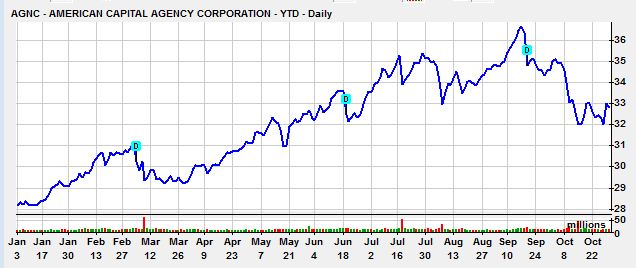
I rue upcoming fourth quarter earnings. They’ll be awful. Meantime, many tech stocks — like AMZN, AAPL, MSFT — and previous high-fliers (think restaurant stocks) are not doing well.
How to Keep Your Electronics Going With No Power. The New York Times technology editor has no power at this Sandy-stricken home. Here’s how David Pogue opes. Creatively is the answer. Click here.
My friend lives downtown and runs a large real estate business there. He emailed this morning:
“No email,no cell, no Internet, no water, no elevators.”!
New York’s cell phone sucks. Many of the switching hubs are still flooded and/or damaged. Why Verizon didn’t protect its switching sites better in recent years — they’ve been flooded before — beats me. For more, today’s Wall Street Journal. click here.
I do like Apple iCloud email service. It’s easier to use than Google’s gmail. And it’s free. Get yourself an iCloud email address. You might actually find your real name is available. Mine was. Go here.
The problem with entrepreneurs is they’re pigheaded and don’t listen. This can be a good thing, since they are often right — like Steve Jobs, Bill Gates or Warren Buffett. But most often they’re not. There are few geniuses. By not listening to their advisers, board members or investors, they risk alienating their supporters and, worse. Some entrepreneurs would prefer to muddle on, raising tiny bits of money — enough to keep the door open, but not enough to crank up marketing in a meaningful way. Some actually prefer to let their company die than accept the outside advice.
Yes, I’ve run into this several times. Figuring your entrepreneur’s willingness to listen is key to your Due Diligence — before you dump in your hard-earned money.
Which brings me to one of my favorite Oscar Wilde quotes:
Yet each man kills the thing he loves
By each let this be heard,
Some do it with a bitter look,
Some with a flattering word,
The coward does it with a kiss,
The brave man with a sword!
Obama and the Road Ahead: The Rolling Stone Interview. I keep looking for an interview with Romney that deals with specifics and decent logic, not just “feel good” stuff and financial plans that don’t seem to nut out financially. I actually have a degree in accounting. I do like the interview with Obama that he gave to Rolling Stone. Here’s an excerpt:
Forget for a moment about obstruction by Wall Street lobbyists and Republicans in Congress. If you could single-handedly enact one piece of regulation on the financial industry, what would it be?
The story of Dodd-Frank is not yet complete, because the rules are still being developed. Dodd-Frank provided a platform to make sure that we end some of the most egregious practices and prevent another taxpayer-funded bailout. We’ve significantly increased capital requirements and essentially created a wind-down mechanism for institutions that make bad bets, so the whole system isn’t held hostage to them going under. We have to make sure that the rules issued around the Volcker Rule are actually enforced. So there’s a lot of good work that will be done around Dodd-Frank.
I’ve looked at some of Rolling Stone‘s articles that say, “This didn’t go far enough, we didn’t institute Glass-Steagall” and so forth, and I pushed my economic team very hard on some of those questions. But there is not evidence that having Glass-Steagall in place would somehow change the dynamic. Lehman Brothers wasn’t a commercial bank, it was an investment bank. AIG wasn’t an FDIC-insured bank, it was an insurance institution. So the problem in today’s financial sector can’t be solved simply by reimposing models that were created in the 1930s.
I will tell you, the single biggest thing that I would like to see is changing incentives on Wall Street and how people get compensated. That ultimately requires not just congressional legislation but a change in corporate governance. You still have a situation where people making bets can get a huge upside, and their downsides are limited. So it tilts the whole system in favor of very risky behavior. I think a legitimate concern, even after Dodd-Frank, is, “Have we completely changed those incentives?”
When investment banks, for example, were partnerships, as opposed to corporations, all those partners understood that if there was some tail risk out there – some unanticipated event that might result in the whole firm blowing up – that they were going to lose all their money, they were going to lose all their assets. They weren’t protected. These days, you’ve got guys who are making five years of risky bets, but it’s making them $100 million every year. By the time the chicken comes home to roost, they’re still way ahead of the game. So I think it’s something that needs to be discussed. But that’s not something that can entirely be legislated – that’s something that also has to involve shareholders and boards of directors being better stewards of their institutions.
You can (and should) read the entire interview here.
Dumb fishing story
Saturday morning I got up early, put on my long johns, dressed quietly, made my lunch, grabbed the dog, slipped quietly into the garage to hook the boat up to the truck, and proceeded to back out into a torrential downpour.
There was snow mixed with the rain and the wind was blowing 50 mph. I pulled back into the garage, turned on the radio, and discovered that the weather would be bad throughout the day.
I went back into the house, quietly undressed, and slipped back into bed. There I cuddled up to my wife’s back, now with a different anticipation, and whispered, “The weather out there is terrible.”
She sleepily replied, “Can you believe my stupid husband is out fishing in that miserable weather?”

Harry Newton who wonders how he can be soooo stupid. A friend sent his 15-year old kid to New York. He got off the plane with a raging cough, then spent the next days camping out in my home office. Now I have a raging cough. I should have quarantined the kid. Idiot me.
The New York Marathon will be on this Sunday. That’s the City’s vain attempt to demonstrate everything is normal. Which it’s not. There’s still almost no electricity below 34th Street. About 570,000 Con Ed customers remain without power. Con Ed said they’d have power back by this evening. And pigs may fly also. Many New Yorkers need power to flush their toilets. Pumps push the water up to tanks on New York high-rise roofs where gravity then brings it down to the flush the toilets. With no water on the roof, no flushing. New Yorkers could always join Rosie on Wee-Wee Pads.

Harry, I plan to prepare for the next power outage event with a power inverter instead of a generator.
http://www.consumerreports.org/cro/2012/02/can-a-pint-sized-power-inverter-replace-a-generator/index.htm
As we’ve seen, generators need gas regularly and you can’t get gas at gas stations when there is no power. I can store a lot more gas in my car than in my garage and gas does not have a long shelf life anyway.
http://www.straightdope.com/columns/read/2668/why-does-gasoline-go-stale-so-quickly
An inverter is not an option for high rise city dwellers, but might be a good option for your country house and your suburban readers.
Thank you for your fine work as always.
Roy
The inverter is still going to require gasoline to power the car engine however. Unless the larger car engine is more efficient than the generator, this would be less efficient overall and put out less AC.
Another alternative would be to keep the generator and buy a siphon pump to take gasoline from the car’s tank as needed.
Or, invest in a few solar panels for the roof of your house and become less dependent on the grid. Of course, none of these options would be practical in a NYC high rise.
Harry, when I sold my AGNC a while back, I too had to find something to replace the income with. Being a little younger and more growth oriented, I split the money among 2 LP’s- UAN and RNO. UAN (aka CVR Partners) is an excellent fertilizer manufacturer with some very strong competitive advantages. Although it has climbed a bit recently, UAN is still yielding above 7%.
Rhino Resource Partners is a coal LP yielding north of 11% right now. Although coal companies have been getting hammered by low natural gas prices lately, RNO is one of the better positioned coal companies around, having less debt than many competitors. I see coal as an eventual turnaround sector. In the mean time, I’ll collect the dividend.
AGNC was a fun ride while it lasted, but I’m not comfortable with MRIETs anymore.
Your power outage makes me think again about getting the small solar rechargers for electronic devices. Would certainly be handy in these rare but real long term power outages.
You can’t seriously like this Harry,
“I will tell you, the single biggest thing that I would like to see is changing incentives on Wall Street and how people get compensated. That ultimately requires not just congressional legislation but a change in corporate governance. You still have a situation where people making bets can get a huge upside, and their downsides are limited. So it tilts the whole system in favor of very risky behavior. I think a legitimate concern, even after Dodd-Frank, is, “Have we completely changed those incentives?”