The “fiscal cliff” looms ever larger in people’s panicked brains.
My savvy friend remarks, “We have the real possibility of a real big selloff. A lot of people are going to cash. They eye the fiscal cliff. And they fear sharply increased taxes next year. Take all the profits now. Other than special situations, it’s too ‘iffy’ to be in the general market.”
Sample selloffs:
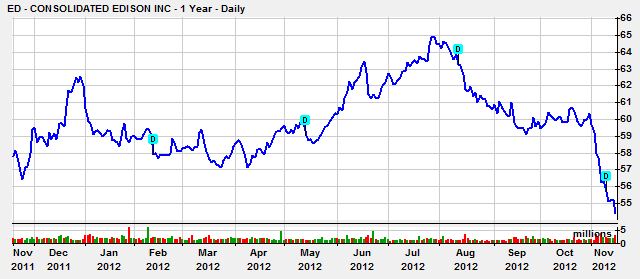
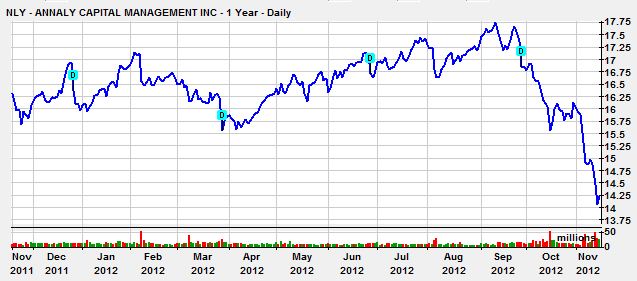
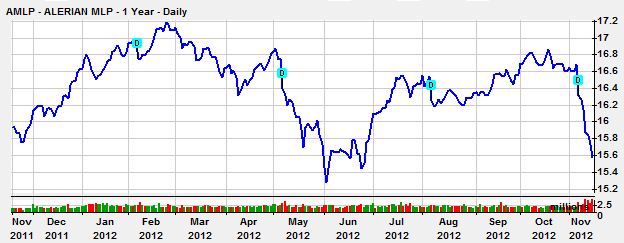
Why we didn’t see this coming and sell stocks like these short?
I don’t know.
Is it too late to go short? Or are we close to the bottom and many of these stocks are now screaming bargains?
Do I want to play this gambling game? Do I feel comfortable?
Or do I feel more comfortable being completely out of the market?
I’m mulling. My temptation is “When in doubt, stay out.”
An invitation to Uber. Two days ago I raved (positively) about my new limo company, called Uber. For an invite from Harry and a $10 saving the first time you use them, click here
The joys of being a landlord. I own an apartment which I rent. Yesterday my tenant complained about a “squeaky front door.” A first in the annals of landlordism.
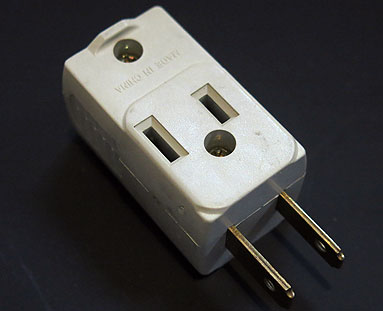
When traveling, this is the most important gadget to take. There is no shortage of chargers to fire mobile devices, but thee is a real shortage of outlets to plug them into — especially at airports. Hence, this $3 thing:
A little weekend reading. The New York Times Magazine ran a cover story on the economy between New York and Washington — where Amtrak’s Acela runs. Excerpt:
This is an economy changing too fast for the residents to keep up. For many who live along the corridor, the central theme is the decline that’s all too visible. The old brick factory buildings with huge windows that gave workers light and air in a pre-air-conditioned world are boarded up, crumbling or, in a few of the luckier spots, being converted into condos. There’s also another, somewhat more hopeful story on display, though you have to look a little harder to see it. These are the decidedly unromantic houses of modern production: short, vast complexes, built without any nod to aesthetics. There are few windows in these buildings, because precision machinery operates best without the fluctuations in heat and humidity caused by exposure to the sun. They are one story high, because it’s too costly to build a second or third floor capable of withstanding the weight and pounding of massive machinery. There are some workers inside – there to make sure the machines keep running – but not many. These jobs, which go to people with advanced, post-high-school training, typically offer a good-enough wage to afford a house in the suburbs, far from the industrial zones that hug the rail line. The people who do make their lives right next to these factories – in Elizabeth, N.J., or Chester, Pa., say – generally can’t afford the technical schooling that would qualify them for jobs inside.
The atrophying of the country’s ability to “make real things” has been much lamented, but the truth is that U.S. manufacturing has never been stronger. While there are no universally accepted numbers, the United Nations Statistics Division calculates that the dollar value of goods made in America is at an all-time high of $1.9 trillion, just about even with China. The catch is that the number of American workers needed to create all thatvalue has dropped steadily. In the mid-1940s, more than half of the New Jersey work force was in factories; today around 7 percent do. Thereare the same number of manufacturing jobs nationwide as there were in 1941, when the country was just more than one-third its current population. For much of the 20th century – and especially in the boom decades of the ’50s and ’60s, when U.S. factories had little global competition – manufacturing provided something that simply doesn’t exist anymore: a job for anyone willing to put in a hard day’s work. The Boeing plant making Chinook helicopters outside Philly, the Johnson & Johnson campus in New Brunswick, N.J., the Merck plants in Rahway, N.J., and Fort Washington, Pa., and the acres of chemical and natural gas refineries throughout New Jersey, Pennsylvania and Delaware – they all tell the same story: a handful of highly trained workers guiding machines that return huge value to shareholders while all the time finding ways to produce more goods with fewer workers.
That doesn’t stop both presidential candidates from constantly invoking the magnificent working-class economy we once had and can have again, if only we give them our vote. Manufacturing nostalgia is as powerful as ever. But one more look out the Amtrak window reveals something else: the shiny new buildings that are actually filled with workers have nothing to do with manufacturing. They’re in the broad service sector, in the anonymous office centers that bloomed out of nowhere – near Metropark Station in New Jersey and in Claymont, Del., and Aberdeen, Md. – to hold law firms and engineering companies and I.T. firms. For people with advanced training, the service sector means an above-average wage, a below-average risk of unemployment and days sitting at a desk. For those with only a high-school degree or no degree at all, far fewer jobs are available, and the ones that are pay poorly and disappear quickly. Calling for a return to the days when everybody who was willing to put in a hard day’s work could make a good living at the factory is a fantasy, maybe a lie and certainly an implicit acknowledgment that nobody has any idea what to do with the underemployed in the slums of Trenton, Philadelphia, Baltimore and Southeast D.C. It’s safer to talk about Pakistan.
The contradictions along the line converge near the center, in the city that is arguably the most representative of our new and confusing economy. Wilmington, Del., has become wildly successful as the place where Wall Street and D.C. meet. In 1981, Gov. Pierre S. du Pont, who got to office, in part, because of his family’s old-economy wealth, pushed through the Financial Center Development Act, which led to the state’s new economic engine: regulatory arbitrage. For large financial firms, the state offers uniquely compliant rules (European politicians and economists talk, with horror, of the Delaware effect, which will inevitably lead toward ever-looser regulation). The state’s Web site claims that 63 percent of Fortune 500 companies and half of all publicly traded companies are legally incorporated in Delaware – “because we provide a complete package of incorporation services including modern and flexible corporate laws . . . [and] a business-friendly state government” – and yet only two have their headquarters there: DuPont and, notably, Sallie Mae, technically a private firm but one that owes its existence and profit to government guarantees. The rest of the buildings house tens of thousands of highly paid lawyers, accountants and other specialists engaged in the arcane work of taking advantage of flexible, business-friendly corporate laws.
After all those workers return to the wealthy suburbs at the end of the day, what’s left behind is one of the most dangerous cities in America, its unemployment stuck stubbornly two points above the national average. For those who live there, the future is grim. As the C.E.O. of the global outplacement company Challenger, Gray & Christmas, John Challenger, who might as well have been speaking at any point in the past 30 years, said the week before last that the recent announcement of 1,500 layoffs “may be a harbinger of things to come.”
To read the full engrossing piece, click here.
The Rabbi in the confessional.
A priest was called away for an emergency. Not wanting to leave the confessional unattended, he called his rabbi friend from across the street and asked him to cover for him. The rabbi told him he wouldn’t know what to say, but the priest told him to come on over and he’d stay with him for a little bit and show him what to do.
The rabbi comes over, and he and the priest are in the confessional. In a few minutes a woman comes in and says, “Father, forgive me for I have sinned.” The priest asks, “What did you do?”. The woman says, “I committed adultery.” Priest: “How many times?” Woman: “Three times.” Priest: “Say two Hail Mary’s, put $5 in the box and go and sin no more.”
A few minutes later a man enters the confessional. He says, “Father, forgive me for I have sinned.” Priest: “What did you do?” Man: “I committed adultery.” Priest:”How many times?” Man: “Three times.” Priest: “Say two Hail Mary’s put $5 in the box and go and sin no more.”
The rabbi tells the priest that he thinks he’s got it so the priest leaves.
A few minutes later another woman enters and says, “Father, forgive me for I have sinned.” Rabbi: “What did you do?” Woman: “I committed adultery.”
Rabbi: “How many times?”
Woman: “Once.”
Rabbi: “Go do it two more times. We have a special this week, three for $5.”

Harry Newton who suffered coughing and spluttering for nearly three weeks. Finally, yesterday he visits a doctor. What a novel idea. The doc diagnoses my disease as “fuzzy brain,” also called sinusitis. He prescribes a Z-pack — five days of Azithromycin. Harry takes two last night. Bingo, this morning, No more coughing. The headache has disappeared. God bless antibiotics. They actually work — for certain ailments. Remember to finish the entire pack.

My tenant called at 2:30 AM to complain about a mosquito in his bedroom.
I honestly feel for the first time in my life that there is a resl chance that the market goes to zero or close to it. 25 years of investing, first time I’ve felt this way. If the Dow does drop to, say, 30 pts what will happen? Will trading be suspended?
Many of my wealthy friends out here in the Silicon Valley area, VC’s and such, support Obama and much of the insane Calif. rules and regulations including the new ones just passed. So my new attitude is: tax the bastards to the roof! They deserve it, brought it on and have the money. Then I saw a shocking chart in today’s Wall Street Journal of the minor costs to various income groups if the country runs off the Fiscal Cliff ahead. For incomes of $500,000 to $1,000,000, the average increase is only $38,602, and $200,000 to $500,000 incomes will pay on average $11,887 more. That’s PEANUTS, particularly for the larger incomes. The problem is not, can they afford it? Of course the top 1% easily can. The problem is the overall impact on our economy and what that does to the rest of us. Even the capital gains tax is livable for the wealthy. They’ll keep their mansions. The question is its extremely negative impact on their job creating support of entrepreneurship and further company growth. That will hurt the 99% while REDUCING the tax income to Wash. DC and the states. My disappointment is falling off the Fiscal Cliff it doesn’t hurt the folks who put us into this situation – they’re above it or on the dole.
My disappointment in falling off the Fiscal Cliff is it doesn’t hurt the folks who put us into this situation – they’re above it or on the dole. (Corrected English to meet Harry’s high standards :-).
Harry, glad to see you didn’t blame the republicans for the sell off this time. Hey look, I like the republican views on private capital not public capital building the economy, especially since gov’t doesn’t have money and we capitalists do. But the republicans have failed to protect the middle class. From 1968 to 2008, the republicans held the white house for 29 years and the democrats 12 years. During this time, wages have not kept up with inflation much less risen above it. Our wives and mothers have gone to work to simply stay middle class and pay the bills. White collar crime is widespread. Republicans have failed the middle class, and people are fed up. And when a Republican talks about fair trade and prosecution of white collar, he is termed a protectionist, and isolationist, and a fascist.
When republicans (like me) talk about the boom years under Reagan and Bush, the middle class guys and gals in Ohio, Pennsylvania, and Florida say, “wasn’t much of a boom to us.. though we love the cheap stuff from China that fills our houses”.
We get the politicians we deserve. Also the world of business and finance has gotten a lot more complicated. It’s no longer easy. And not getting any easier. I wish the best minds of both parties would sit down with successful entrepreneurs and come up with some intelligent, workable solutions. Sample: Why doesn’t the Fed government announce a program to switch all its vehicles to natural gas? We have plenty of it. And their switching would encourage private truckers and others to switch. Right now, it’s hard to get the stuff. A Fed govt program would encourage entrepreneurs to build distribution networks.