I’m in Los Angeles for the LD Micro conference. They invite hot new companies looking for money. Each company gets 25 minutes to present, and five minutes of Q&A with the audience. My job is to find the hottest one, fall in love and recommend it to my sponsors. My expenses are being picked by a boutique investment bank called Wellfleet Partners, to which I’m a “senior advisor” (heh, titles are cheap) and occasional investor. I put a little money in about six of their companies. And so far, I’m happy. Fingers crossed. One paid out already with a handsome gain — more than I’ve been making in bonds or equities recently. The risks are high.
I get to travel “extra leg room” JetBlue (actually on time) and stay at the Hotel Angelino for $125 a night. I thought it would be fun to escape New York’s cold wet weather for a few days of LA warmth. In fact, the weather in both cities is the same at 68 — perfect for biking, tennis, running. Still, I do have a 3 square foot balcony, a view of a charming parking lot and the lullaby of the traffic on the 405, though no gunshots or screams. It’s not New York. Just kidding.
It’ll be neat to see if any of the 140 companies presenting have discovered marketing and have actually budgeted for it. The good news is none of these companies seem to be slowing their growth or limiting their ambitions because of The Fiscal Cliff. I’m a long way from Washington and that’s good. The West Coast has its own insanity with its own endearing qualities. You can eye the LD Micro companies here. They’re presenting in four tracks. If you find one that grabs your imagination, email me. I’ll check it out and send you some info on it — probably yet another overcrowded Powerpoint. What do they always cram so much into each slide? Use the “Contact” button up top.
One quick check on a high-tech startup is “How’s your patents?” Are they issued? What do they cover? Are the claims broad? The high-tech investing world is obsessed with patents. The logic is that if you’re successful, someone will sue you for infringing on their patents. And if you’re not successful, you can always sue someone and make their life miserable. It’s also called an exit strategy. I don’t make this stuff up.
I’m not good at listed equities. I panic too quickly. And I don’t do enough research. I’ve decided to get better and buy into the Best of Breed theory. Which is why I now own Costco and Visa. I’ll buy Whole Foods today also. Why I didn’t hold it from the last time … I don’t know.
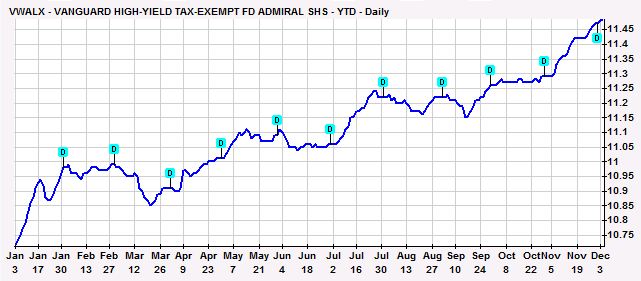
Meantime, nothing has performed as well as bonds in the last few years. And my favorite fund VWALX continues to look wonderful and pays a continuing handsome dividend:
For Buffett, the Long Run Still Trumps the Quick Return. That’s the headline of an article by Andrew Ross Sorkin reporting on Warren Buffett’s book tour. Warren needs the royalties like he needs a hole in the head. Maybe he’s trying to get away from Iowa weather? Still, it’s clearly fun having lunch with Warren:
“If somebody bought Berkshire Hathaway in 1965 and they held it, they made a great investment – and their broker would have starved to death.”
Warren E. Buffett was sitting across from me over lunch at a private club in Midtown Manhattan last week, lamenting the current state of Wall Street, which promotes a trading culture over an investing culture and offers incentives for brokers and traders to generate fees and fast profits.
“The emphasis on trading has increased. Just look at the turnover in all of the stocks,” he said, adding with a smile: “Sales people have forever gotten paid by selling people something. Generally, you pay a doctor for how often he gets you to change prescriptions.”
Mr. Buffett, 82, is famous for investing in companies that he sees as solid operations and essential to the economy, like railroads, utilities and financial companies, and holds his stakes for the long run. The argument that the markets are better off today because of the enormous amount of liquidity in the stock market, a function of quick flipping and electronic trading, is a fallacy, he said.
“You can’t buy 10 percent of the farmland in Nebraska in three years if you set out to do it,” he said. Yet, he pointed out, he was able to buy the equivalent of 10 percent of I.B.M. in six to eight months as a result of the market’s liquidity. “The idea that people look at their holdings in such a way that that kind of volume exists means that to a great extent, it’s a casino game,” he said. Of course, unlike many investors, he plans to hold his stake in I.B.M. for years.
Mr. Buffett was in a reminiscing mood about a bygone era, in part because he was in New York to make the rounds on television to discuss a new book chronicling his 61-year career, which began in 1951 at Buffett-Falk & Company in Omaha. (After lunch, he was going to visit “The Daily Show With Jon Stewart.”)
The book, “Tap Dancing to Work,” by a longtime journalist and good friend of his, Carol Loomis of Fortune magazine, is a compendium of articles that she and others wrote in Fortune that creates a series of narratives spanning the arc of his career.
Ms. Loomis, who first met Mr. Buffett in 1967 — and whose long career is a story unto itself — also came to our lunch. Ms. Loomis may know more about Mr. Buffett than he knows about himself. (“There’s nothing here you’re going to like,” she said, after surveying the various pies when the dessert cart came around. She was right: he took a quick look and asked if they served ice cream. They did.)
As we talked about the “good old days” – he spoke of some of his early friends who were successful hedge fund investors, like Julian Robertson, who founded Tiger Management – it became clear that he was less enamored of the investor class of the next generation.
When I asked, for example, if there were any private equity investors that he admired, he flatly replied: “No.”
When I asked if he followed any hedge fund managers, he struggled to name any, before saying that he liked Seth Klarman, a low-key value investor who runs the Baupost Group, based in Boston.
“They’re not as good as the old ones generally. The field has gotten swamped, so there’s so much money playing and people have been able to raise money by just saying ‘hedge fund,'” he said. “That was not the case earlier on; you really had to have some performance for some time before people would put money with you. It’s a marketing thing.”
For a moment, he paused, and then posited that if he started a hedge fund today, “I’d probably grow faster, because a record now would attract money a lot faster,” speculating that his record of returns would attract billions of dollars from pension funds and others. But he then acknowledged a truism of investing that he knows all too well, as the manager of an enterprise that is now worth some $220 billion: “Then money starts getting self-defeating at a point, too.”
Until 1969, Mr. Buffett operated a private partnership that was akin in some ways to a modern hedge fund, except the fee structure was decidedly different. Instead of charging “2 and 20” – a 2 percent management fee and 20 percent of profits – Mr. Buffett’s investors “keep all of the annual gains up to 6 percent; above that level Buffett takes a one-quarter cut,” Ms. Loomis wrote. However, in 1969, he announced he would shutter his partnership. “This is a market I don’t understand,” he said, according to Ms. Loomis.
He believed that the stock market of 1968 had become wildly overpriced — and he was right. By the end of 1974, the market took a tumble. Instead, he remained the chief executive of Berkshire Hathaway, one of his early investments.
“If you want to make a lot of money and you own a hedge fund or a private equity fund, there’s nothing like 2 and 20 and a lot of leverage,” he said over a lunch of Cobb salad. “If I kept my partnership and owned Berkshire through that, I would have made even more money.”
Mr. Buffett says he now considered himself as much a business manager as an investor. “The main thing I’m doing is trying to build a business, and now we built one. Investing is part of it but it is not the main thing.”
Today, Mr. Buffett is particularly circumspect about the investment strategies that hedge funds employ, like shorting, or betting against, a company’s stock. He used to short companies as part of a hedging strategy when he ran his partnership, but now he says that he and Charlie Munger, his longtime friend and vice chairman of Berkshire, see it as too hard.
“Charlie and I both have talked about it, we probably had a hundred ideas of things that would be good short sales. Probably 95 percent of them at least turned out to be, and I don’t think we would have made a dime out of it if we had been engaged in the activity. It’s too difficult,” he explained, suggesting that the timing of short investments is crucial. “The whole thing about ‘longs’ is, if you know you’re right, you can just keep buying, and the lower it goes, the better you like it, and you can’t do that with shorts.”
One of his big worries these days is about what’s going to happen to all the pension money that is being invested in the markets, often with little success, in part because investors are constantly buying and selling securities on the advice of brokers and advisers, rather than holding them for the long term. “Most institutional investors, whoever is in charge – – whether it’s the college treasurer or the trustees of the pension fund of some state — they’re buying what they’re sold.”
Most pension funds probably didn’t buy Berkshire in 1965 and hold it, but if they had, they would have far fewer problems today. At the end of her book, Ms. Loomis notes that when she mentioned Mr. Buffett’s name for the first time in Fortune magazine in 1966 — accidentally spelling Buffett with only one “t” — Berkshire was trading at $22 a share. Today it is almost $133,000 a share.

Harry Newton, who is still agonizing over the layout of the emailed column his software is sending out to nice readers who signed up (top left). It still doesn’t work properly. Yesterday some of us received the full column with oodles of empty space. Others received only the first few lines ended by a [..], whatever that means. I’m sure we’ll get this solved eventually. Meantime, visit the main web page. It still works.

You probably sold WFMI because of you inviolate 8% stop loss rule.
Everybody writes up Warren Buffett like he’s a nice boy who did well from Nebraska. In fact, he is an aggressive Wall Street Tycoon (who happens to live in Omaha), who is all for greatly increasing the taxing of the hard working middle class, even pushing for increased real estate taxes here in Calif. for new home buyers while his California ex-wife in her large mansion is protected since it was purchased by Warren years ago. If he truly believed any of the crap he dishes out while holding hands with Obama, he’d give his fortune to the government, not charity where he gets yet further adoring public articles by an idolized media. They are all afraid to point out his gross hypocrisy and dishonesty.