How important is the “fiscal cliff” for you and I as investors? Answer not very? Here’s Barry Ritholtz writing recently in the Washington Post:
The “fiscal cliff” paranoia continues unabated. Apparently, it is the only thing that matters to the markets. Every twist and turn in the negotiations is crucial to the future of the republic!
Whenever the media obsess over a potential crisis, history teaches us that it is most likely to be overwrought hype. Recall the Y2k frenzy as Exhibit 1 in The People v. Really Bad Media prosecution.
Want to learn just how absurdly obsessive the media have become over this? Just type “fiscal cliff” into Google Trends and you will see how, post-election, the term’s appearance in the media simply went ballistic.
Where did this sudden spike in mentions begin? The Columbia Journalism Review points to coverage such as that of the financial network CNBC. Ryan Chittum, who reports on the business media for CJR, notes that CNBC began a campaign called Rise Above that blanketed its airwaves since the day after the election with pleas for a solution to the fiscal cliff. As Google’s trend chart shows, it was part of a media dogpile – at least until the David Petraeus affair sent the drones scurrying after a more salacious story.
What does the fiscal cliff mean to investors?
Let’s start with a definition: The term refers to the deal that Congress made in late 2011 to temporarily resolve the debt ceiling debate. The “sequestration,” as it is known, calls for three elements: tax increases, spending cuts and an increase to the payroll tax (FICA). The Washington Post’s Wonkblog has run the numbers and finds “$180 billion from income tax hikes, $120 billion in revenue from the payroll tax, $110 billion from the sequester’s automatic spending cuts and $160 billion from expiring tax breaks and other programs.”
That is a not-insignificant amount of money, but it is hardly the end of the world. To put this into context, it is a little less than the TARP bailout for Wall Street in 2009 and somewhat less than the American Recovery and Reinvestment Act, President Obama’s stimulus package. An educated guess puts this at about $600 billion to $700 billion out of a $15 trillion U.S. economy. I’d ballpark that at about 4 percent of the GDP, or 0.50 percent of the forecasted GDP growth of 2 percent for calendar year 2013.
The term “fiscal cliff,” popularized by Fed Chairman Ben Bernanke, is really a misnomer. As several analysts have correctly observed, the effects of sequestration are not a Jan. 1, 2013, event. The impact of the spending cuts and tax hikes would be phased in over time. A fiscal slope is more accurate. Additionally, as students of history have learned, single-variable analysis for complex financial issues is invariably wrong. Because of the inherent complexity of economies and markets, we cannot adequately explain or predict their behavior by merely looking at just one variable.
Given all this, what else might be driving equity markets? Consider the following factors as the causes of recent volatility:
Weak corporate profits: If you want to understand market jitters, look no further than falling earnings growth. Profits and revenue have disappointed in the third quarter, coming in below estimates. As the Wall Street Journal noted, this has been the “worst quarter for corporate profits in three years.” Even worse, future estimates for earnings growth keep sliding. In July, estimates for fourth-quarter profit were annualized gains of 14 percent. By October, that fell to 9.6 percent. It has now slipped to 5.5 percent, according to S&P Capital IQ.
Markets got ahead of themselves: For the first three quarters of the year, the markets put up impressive numbers, with the S&P 500-stock index gaining 17 percent, and the tech-heavy Nasdaq running up over 23 percent. Those are great numbers versus historic average gains of 10 to 11 percent. Given the mediocre post-credit crisis recovery and the softening earnings growth, perhaps markets simply got too far ahead of themselves.
Wall Street bet wrong on the elections: Lots of people seem to be saying that recent market turmoil is based on the financial community’s evaluation of a possible deal between the White House and Congress.
Do not pay much attention to Wall Street’s assessment of politics. Let me remind you that the Street made very heavy bets on Mitt Romney winning the election. This was both in the campaign donations made by Wall Street firms as well as how fund managers and traders positioned their portfolios. They all misread what turned out to be an Obama electoral college blowout of 332 to 206.
The sell-off since the election is as much about how a mispositioned Street was reversing itself as anything else.
Those are probably the three largest factors. Of course, the euro-zone sovereign debt crisis is unresolved, and most of Europe is in a recession. In Asia, growth has been slowing, especially in China and India. And then there is the decreasing impact of Federal Reserve interventions in the markets. We seem to be getting less bang for the buck with each subsequent QE.
I submit that all of these other factors are weighing much more on equity markets than the fiscal cliff.
I am much more concerned about declining earnings and what they mean for the possibility of a recession in 2014. You should be, too.
Apple Year to date:
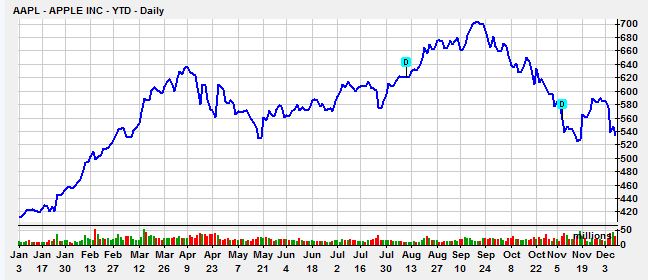
Predicting Apple has become a sizeable growth industry. Every pundit and their uncle are weighing in with theories: Apple declined because of margin pressures. Click here. Apple is going to $750 says a new report (which I can’t understand) from Goldman Sachs. Click here. Or read Tim Cook’s cover story interview with BusinessWeek.
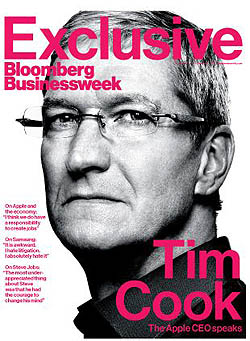
Click here. Or don’t bother. The 13-page interview is pure pablum, and boring. You won’t learn anything except cliches about innovation and a what wonderful, special place Apple is.
Tim Cook shouldn’t give press interviews when he has no new product to announce. Steve did a great job pumping Apple excellence B.S. But he did with annnouncements of new products. Tim’s announcement was he s spending a tiny $100 million to make some Macs in America. Big deal. Dumb interview.
Contemporary art has done much better than stocks. The key to making money with art is to become intimately familiar and in love with one small segment. It should be stuff you enjoy. You can buy name pieces. Or you can assemble a unique collection. Collections are easier to sell by auction houses. We own some paintings by, so far, no-name artists. But they’re paintings we love. If they never become valuable, we’ve have had the pleasure of their company. Which is a lot more pleasurable than framing the certificates of dead companies.
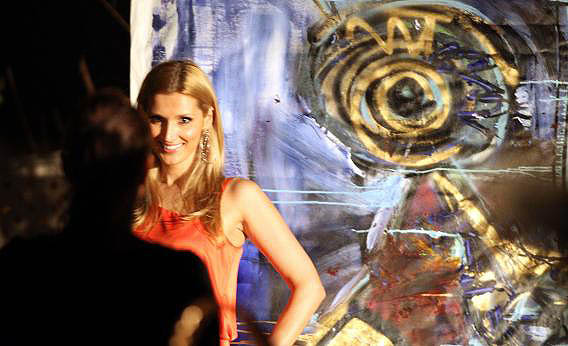
Photo by Marc Serota/Getty Images for Domingo Zapata
There are many ways of buying art — the auction houses, local galleries and Miami Art Basel, a gigantic show/event which attracted 40,000 plus people to see 20th- and 21st-century artworks by more than 2,000 artists from more than 250 galleries in North America, Latin America, Europe, Asia, and Africa. I didn’t go. The show just ended. But my friends tell me it was a “hoot.” How much of a hoot? You must read the piece below my photo entitled, “Why the Art World Is So Loathsome. Eight theories.” It’s hysterical. The photo above is from last year’s show.
Whoever introduced demand pricing to airlines should be shot. To wit. I’m going to Consumer Electronics Show in Vegas. I leave Monday January 7, come back Thursday Jan 10. Cost on JetBlue: $1,369.60. A week later, same flghts Monday and Thursday, cost on JetBlue: $471.60. Mammoth $898 difference. Both trips include paying about $10 an inch for extra leg room. Pillows, blankets, meal and headphones not included.
Why don’t I fly the next week and save the $898?
The story of DDD. ON Friday I wrote,
DDD is an English company that 3D-enables TVs, smartphones and computer monitors. They’re exploding. They sell to everybody and their uncle from Samsung to Intel, from LG to Texas Instruments. They’re English and about to get American ADR listing. Presently they’re listed on the OTCQX whatever that is.
I emailed their CFO for an explanation and received:
Our company is presently traded on the Alternative Investment Market of the London Stock Exchange (AIM) under the ticker DDD. If you are in the US, you have to request DDD.L on Yahoo or DDD LN on Bloomberg to get the right quote. As we discussed at the conference, we have just partnered with Deutsche Bank for a Level 1 sponsored ADR program where 1 ADR share will be equivalent to 10 ordinary shares of the company’s UK stock. This is intended to make the investment process easier for US investors.
This ADR program will trade in the US on the Over-the-Counter market under the ticker DDDGY as soon as FINRA approval is complete (which should be within 10 days). We will be trading on a level of the OTC market called the Quality Exchange – known as OTCQX which is considered to be an upper tier of the OTC market. The OTCQX international is exclusively for companies meeting basic requirements including being listed on a foreign stock exchange that has regulatory compliance levels that are considered to be acceptable for US investors (London Stock Exchange is one of these).
Complex stuff. But I do like the company.
The perfect noise-cancelling headphones. All my rich friends have Bose. All my poor friends suffer.

I don’t like Bose. They’re too big and heavy to carry. And your ears get hot. I have sensitive ears. I also have a drawer full of headphones and earbuds that I’ve bought in years past full of great hope that the latest pair would be perfect. None were — until these.
Get on a plane. Pop them into your ears and plug them into your iPhone or other music player. Suddenly you’re in a different world, no longer bothered by asshole sitting next to you who hasn’t washed in several days and is still eating garlic sandwiches and farting. The earbuds cost $52.50 at Amazon (where else?). I just used them back and forth to LA. And I lived another day. You can also plug hem into your ears, turn them and plug them into no music or movies and actually enjoy peace, free of the drone of the jet engines. Click here.
You can’t buy this yet. But what a wonderful invention — a little $150 gadget called Scanadu which you hold to your forehead and it gives you your body vital signs.

As the tagline says, it allows you to check your body as often as you check their email. You need to read the incredible story of this invention. It’s on Gizmodo. Click here.
I love these. I am sick.

WASHINGTON (The Borowitz Report)-A consortium of billionaires today warned that if their taxes are raised they will no longer have enough money to buy politicians. The group, led by casino billionaire Sheldon Adelson, commissioned a new study showing that the cost of an average politician has soared exponentially over the past decade.
While the American family has seen increases in the cost of food, health care and education, Mr. Adelson says, “those costs don’t compare with the cost of buying a politician, which has gone through the roof.” The casino billionaire points to his group’s study, which puts the cost of purchasing an average House member at two million dollars and an average senator at several times that.
“And let’s say you buy a Senator like [South Carolina Senator] Jim DeMint and he decides to quit,” Mr. Adelson says. “Good luck trying to get your money back.”
The Vegas magnate complains that the media has ignored billionaires’ essential role in giving jobs to politicians who would otherwise have difficulty finding “honest work of any kind.” “Billionaires are providing employment for a group of seriously incompetent and marginal people,” Mr. Adelson says. “You raise taxes on us, and who’s going to create those jobs? I really don’t think people have thought this through.”
Adding insult to injury for America’s billionaires, he says, “the simple dream of someday owning a President is slipping out of reach.”
“People think a billion dollars buys you a President, but they’re wrong,” he says. “It barely gets you a lemon like Mitt Romney.”

Harry Newton, who
Why the Art World Is So Loathsome. Eight theories. By Simon Doonan
Freud said the goals of the artist are fame, money, and beautiful lovers. Based on my artist acquaintances, I would say this holds true today. What have changed, however, are the goals of the art itself. Do any exist?
How did the art world become such a vapid hell-hole of investment-crazed pretentiousness? How did it become, as Camille Paglia has recently described it, a place where “too many artists have lost touch with the general audience and have retreated to an airless echo chamber”? (More from her in a moment.)
There are sundry problems bedeviling the contemporary art scene. Here are eight that spring readily to mind:
1. Art Basel Miami.
It’s baaa-ack, and I, for one, will not be attending. The overblown art fair in Miami-an offshoot of the original, held in Basel, Switzerland-has become a promo-party cheese-fest. All that craven socializing and trendy posing epitomize the worst aspects of today’s scene, provoking in me a strong desire to start a Thomas Kinkade collection. Whenever some hapless individual innocently asks me if I will be attending Art Basel-even though the shenanigans don’t start for another two weeks, I am already getting e-vites for pre-Basel parties-I invariably respond in Tourette’s mode:
“No. In fact, I would rather jump in a river of boiling snot, which is ironic since that could very well be the title of a faux-conceptual installation one might expect to see at Art Basel. Have you seen Svetlana’s new piece? It’s a river of boiling snot. No, I’m not kidding. And, guess what, Charles Saatchi wants to buy it and is duking it out with some Russian One Percent-er.”
2. Blood, poo, sacrilege, and porn.
Old-school ’70s punk shock tactics are so widespread in today’s art world that they have lost any resonance. As a result, twee paintings like Gainsborough’s Blue Boy and Constable’s Hay Wain now appear mesmerizing, mysterious, and wildly transgressive. And, as Camille Paglia brilliantly argues in her must-read new book, Glittering Images, this torrent of penises, elephant dung, and smut has not served the broader interests of art. By providing fuel for the Rush Limbaugh-ish prejudice that the art world is full of people who are shoving yams up their bums and doing horrid things to the Virgin Mary, art has, quoting Camille again, “allowed itself to be defined in the public eye as an arrogant, insular fraternity with frivolous tastes and debased standards.” As a result, the funding of school and civic arts programs has screeched to a halt and “American schoolchildren are paying the price for the art world’s delusional sense of entitlement.” Thanks a bunch, Karen Finley, Chris Ofili, Andres Serrano, Damien Hirst, and the rest of you naughty pranksters!
Any taxpayers not yet fully aware of the level of frivolity and debasement to which art has plummeted need look no further than the Museum of Modern Art, which recently hosted a jumbo garage-sale-cum-performance piece created by one Martha Rosler titled “Meta-Monumental Garage Sale.” Maybe this has some reverse-chic novelty for chi-chi arty insiders, but for the rest of us out here in the real world, a garage sale is just a garage sale.
3. Art a la mode.
The growing mania for melanging fashion with art is great for the former, but it has been a gravitas-eroding catastrophe for the latter. The world of style is ephemeral and superficial by nature. Art, real art, fabulous art, high art, must soar and endure and remain unencumbered by the need to sell handbags and blouses. Example: Selfridges recently strapped a massive effigy of dot-queen Yayoi Kusama to the front of the store in celebration of her new collaboration with Louis Vuitton. Similar installations took place at Vuitton stores worldwide. There was no downside for the historic department store or for Maison Vuitton. From a fashion point of view the entire project was memorable and rather marvelous. But what about Art? Did the excitable hordes of tourists who were sticker-shocking their way through the spotty merchandise have any notion that they were scrutinizing the oeuvre of a so-called great artist? Did they, as a result, schlep to the Whitney to see the Kusama exhibit? And what of Ms. Kusama herself? How is the poor luv fairing after being dragged up Rodeo Drive and down 57th Street? Just as well she is already in a nut house. (She voluntarily committed herself to a psychiatric hospital in 1977 and has lived and made art there ever since.)
4. The post-skill movement.
“No major figure of profound influence has emerged in painting or sculpture since the waning of Pop Art and the birth of Minimalism in the early 1970s,” writes Camille P. But what about those annoying YBAs, the young British artists, the folks that noted U.K.-based art critic Brian Sewell has wickedly and accurately dubbed “The Post-Skill Movement”? Are they profound or influential?
As a window dresser (recently retired) who pursued his craft for more than 40 years, I have always taken a keen interest in art. I have occasionally collaborated with artists-Warhol, Rauschenberg, Mapplethorpe, Candyass-all the while enjoying the freedom of not being an artist myself. I always saw my work as a combo of street theater and Coney Island sideshow. This allowed me to switch styles and try anything without ever feeling the need to create profundity or permanence. Example: I am probably the only person on Earth to have incorporated-back in the ’70s-colostomy bags into a designer clothing display. Did it mean anything? Was it ART? No, emphatically, no! A nurse friend gave me large stash of dead-stock unused bags, and I felt compelled to rescue them, which is another way of saying that I had not prepared anything for my window installation on that particular week and was glad to take receipt of a ready-made prop.
For years I happily free-associated with my papier-mâché, my props, and my found objects . and then something weird happened. Artists put down their brushes and stole my objets trouves, my staple guns and glue guns. I first noticed the trend at the 1997 Sensation show at the Royal Academy in London. Enter the Post-Skill Movement.
With its Damien Hirst vitrines, Tracey Emin camping vignettes, and Sarah Lucas found-object tableaux, this landmark show was like one giant Barneys window. This realization brought me no satisfaction: “If art is morphing into display, then what the hell are we window dressers supposed to plonk into our constantly changing vignettes?” I asked myself as I gazed at Jake and Dinos Chapman’s defiled window mannequins. I felt like a professional hooker who is no longer sure what to wear because all the regular respectable ladies are now dressing like sluts. (Which, by the way, they are.)
In a desperate search of some gravitas and some skill, I fled the Sensation tableaux and ran next door to the adjacent, and infinitely more artful, Victorian Fairy Painting exhibit. FYI, the catalog for this strange and significant show is still available and makes a lovely holiday gift.
5. The flight of craft.
As stated above, a lack of skill and craft among artists is sucking the life and the gravitas out of the art world. There are, thank God, still some artists and designers who are bucking this trend and making gorgeous stuff. You won’t find it at trendy galleries or at Art Basel. You are more likely to find it among the potters and craftsmen on Etsy. My favorite artists at the moment work in the field of illustration and applied art: Examples include Ruben Toledo, John-Paul Philippe, and Malcolm Hill.
6. Adderall a go-go.
Short attention spans have made art into one quickie sight gag after another. Is that an oversized Tiffany bag? No, it’s a metal sculpture by Jonathan Seliger. Gotcha! Clearly, in our frenetic, technology-obsessed age we have lost the ability to contemplate and are interested only in visual puns. Camille to the rescue: Glittering Images-I keep banging on about her book, but only because it’s so fantastic-is an invitation to think, to scrutinize, to gaze, to stare, to shut the fuck up, to learn, and to self-cultivate. La Paglia dares to take us beyond the high jinks of contemporary art and refocuses our Internet-scrambled brains on the pure uncynical contemplation of high art. Surrender to her!
7. Dollars and shekels and rubles.
My father-in-law, Harry Adler, was a committed, ferocious, lifelong passionate artist who produced a massive body of work in all mediums. However, I never once remember him holding up a painting or a drawing and asking, “How much d’ya think I could get for this?” Unfettered by the impulse to grease his creative journey with financial validation, he pursued his art with freedom and authenticity.
Today’s successful artists, on the other hand, seem obsessed with money. How, you may ask, does this jive with the artist’s bohemian esprit? In the age of Occupy, when the 1 percent are so reviled, how do groovy, liberal, and, one assumes, democratic dealers and artists rationalize their politician-like reliance upon, and coziness with, the super-wealthy?
“Aha!” I hear you artists say. “But what about fashion? Aren’t fancy designers and retailers reliant on exactly the same group?” To which I reply, “Exactly my point. Fashion has no lofty goals. It’s about buying a dollop of transformative glamour and a jolt of prestige. Should art not aspire to more than that?”
8. Cool is corrosive.
The dorky uncool ’80s was a great time for art. The Harings, Cutrones, Scharfs, and Basquiats-life-enhancing, graffiti-inspired painters-communicated a simple, relevant, populist message of hope and flava during the darkest years of the AIDS crisis. Then, in the early `90s, grunge arrived, and displaced the unpretentious communicative culture of the `80s with the dour obscurantism of COOL. Simple fun and emotional sincerity were now seen as embarrassing and deeply uncool. Enter artists like Rachel barrel-of-laughs Whiteread, who makes casts of the insides of cardboard boxes. (Nice work if you can get it!)
A couple of decades on, art has become completely pickled in the vinegar of COOL, and that is why it is so irrelevant to the general population.
Enough kvetching. Let’s end on a positive note. Not every blue-chip artist today is shoving his poo into tins and calling it art. I love me a little Nick Cave and an occasional Jeff Koons. And here’s the great news: While we wait for the art world to change direction and seek out a more meaningful place in our lives, there are no shortage of chuckles to be had. The landscape of art has never been more vast or intriguingly bonkers. The pretentions and foibles, to mention nothing of the gobbledygook theoretical justifications that accompany all the neo-Duchamp-ian bollocks, provide many occasions for amusement, mockery, and parody. If Jacques Tati were alive today he would have unwittingly blundered round that “Meta-Monumental Garage Sale” looking for a new raincoat. On his way home, he would have popped into a travel agent and booked his flight to Miami.

The media is a megaphone finding little-but-exciting news and blasting it into the crisis end-of-the-world news, usually ignoring any counter arguments, Being desperate for readers/viewers they are worse today, I believe, than ever, and less educated. Bloomberg Magazine being typical – worthless and not informative or even entertaining.
The serious topic the stock market seems to be ignoring, then responding to, then ignoring, then responding to, etc., etc., is the huge disparity between our governments at all levels income, even with taxing the “rich” to the maximum, and its spending. Someday, someone has to pay, no? Options: screw later generations, severe inflation, implode like Greece without a German savior or all of the afore mentioned corrections. Remember Rome!
I think Americans would be smart to study Europe with its intrusive big government heavy-handed regulatory environment and get back to an entrepreneurship friendly climate. Governments can’t create long term growing economies; businesses men and women can and do, every day. But only if you let them.
Art Basel is a must – fabulous art and something for everybody but be prepared to spend if you enjoy art. And definitely beats going to Chelsea these days…
Golly, Harry. Do you avoid Southwest for some reason? I just checked their prices from LaGuardia to Las Vegas on those dates and they ranged from $151 to $599 going west, and $151 to $603 coming home. So at the least, you could fly there and back for $302.
The point of my story was JetBlue raised the prices for Consumer Electronics Show. Other times, it’s cheap. Real cheap
The hotels do it too. When I was there for a big construction equipment show I stayed on a few days and my hotel went from $150 a night to $40 if I recall..
Ah, Harry. You’ll never change. So misinformed about the markets, so consistently overly pessimistic, so over-invested in cash, so afraid to take small, educated risks, so intent on leading your readers to bad investments like Annaly and shorting JP Morgan Chase. Happy holidays, and keep the laughs coming in the new year!
It’s not so much the sound of his farts that bother me but the smell his B.O. or farts. When will they come up with a reverse smell-a-vision! LOL!!
I agree about demand pricing. It sucks, especially if you are not attending the event that triggered the price hike.
Do yourself a favor, stay the weekend and watch the price drop again. Even without an event, the airlines know that the only people who travel out and back during the week are business people.
I flew Houston to Milwaukee a couple of years ago. Up Wednesday back Friday. $2,800 in coach!! It’s a huge burden for a small business.