But first, there’s the “news.” From my iPhone:
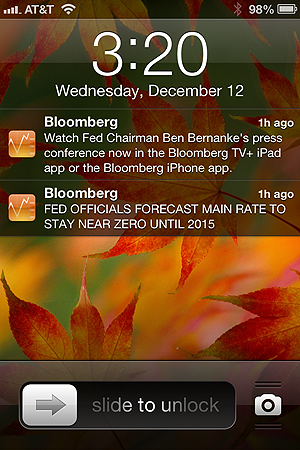
Here’s your “explanation.” From today’s New York Times:
The Federal Reserve, clarifying its intentions for an economy hobbled by uncertainties, for the first time spelled out the unemployment level it would like to see before it raises short-term interest rates.
The Fed said Wednesday, at the conclusion of its last policy meeting of the year, that it would enter 2013 with a plan to purchase $85 billion a month of mortgage-backed securities and Treasury securities, part of a continuing attempt to drive down long-term interest rates to encourage borrowing, spending and investing.
The Fed said it didn’t expect to touch short-term rates until it saw the unemployment rate fall to 6.5% or lower, as long as inflation forecasts remain near its 2% target. That would mean, according to the Fed’s economic projections, that it would keep short-term rates near zero into 2015.
Now think of how stooopid this is. Our government is printing money to buy its own bonds. It isn’t printing the money to build bridges, highways, tunnels or employ teachers. . It’s buying the bonds it issued itself. It’s doing this so it can keep interest rates so low — almost zero — so that you and I and our businesses will feel the urge to borrow money, build factories and employ people. This is insane thinking.
I successfully ran businesses for 30 years. I invested in new businesses and I expanded old ones when I felt the opportunity was there. Not because my banker was at my front door offering free money. Heck. no matter how cheap the money, I still got to pay it back it. And if the opportunity isn’t there and the new business opportunity sucks, his cheap loan has zero interest.
The last time the Feds pulled this cheap money policy they encouraged the housing boom, which led to the sub-prime mortgage fiasco and the horrible bust, which we’re still edging out of.
I don’t run Washington. And they don’t listen to me. But if you want the unemployment rate to drop, i.e. more people should be employed, then you damn well ought to do something about it — like fix our crappy infrastructure. For example, no one’s built a new bridge or tunnel in New York City for over 50 years. Land at Kennedy Airport. Get on the Van Wyck “Highway” to come into the city. You’d think you were in some third world country. Welcome to America’s crappy infrastructure.
Why does all this piss me off?
I’m semi-retired. I live off my interest and dividends. And that money is dropping. My muni bonds — the heart of my portfolio — are being called because it’s cheaper for the issuers to pay me off and issue bonds paying nothing. Great for them. Shit for me.
I’m not crying. I’m doing OK even with my equity “strategy” that no one likes — except those who do the opposite of what I suggest. But, owning equities is gambling. And I don’t want to spend the rest of my life gambling because Mr. Bernanke and his merry band of government bureaucrats (they get a guaranteed annual salary) are taking my money and giving it to the big banks — where they expect to be employed when they leave Washington.
Enough for now.
Save your life life. Read this.
This is a long article about why you and I should be taking a baby Aspirin every day. The numbers are staggering.
The 2,000-Year-Old Wonder Drug
By DAVID B. AGUS
THE inexorable rise in health care spending, as all of us know, is a problem. But what’s truly infuriating, as we watch America’s medical bill soar, is that our conversation has focused almost exclusively on how to pay for that care, not on reducing our need for it. In the endless debate about “health care reform,” few have zeroed in on the practical actions we should be taking now to make Americans healthier.
An exception is Mayor Michael R. Bloomberg of New York, who is setting new standards that we would do well to adopt as a nation. In the last several years, he’s changed the city’s health code to mandate restrictions on sodas and trans fats – products that, when consumed over the long term, harm people. These new rules will undoubtedly improve New Yorkers’ health in years to come.
Such bold moves prompt a provocative question: when does regulating a person’s habits in the name of good health become our moral and social duty? The answer, I suggest, is a two-parter: first, when the scientific data clearly and overwhelmingly demonstrate that one behavior or another can substantially reduce – or, conversely, raise – a person’s risk of disease; and second, when all of us are stuck paying for one another’s medical bills (which is what we do now, by way of Medicare, Medicaid and other taxpayer-financed health care programs).
In such cases, encouraging a healthy behavior, or discouraging an unhealthy one, ought to be a matter of public policy – which is why, for instance, we insist on vaccinating children for the measles, mumps, rubella and polio; we know these preventive strategies save lives.
Under that rationale, then, why not make it public policy to encourage middle-aged people to use aspirin?
Developed in 1897 by the German chemist Felix Hoffmann, aspirin, or acetylsalicylic acid, has long proved its value as an analgesic. Two millenniums before that, Hippocrates, the father of modern medicine, used its active ingredient – which he extracted from the bark and leaves of the willow tree – to help alleviate pain and fevers.
Since then, we’ve gained insight into both the biological mechanism and the effects of this chemical compound. Many high-quality research studies have confirmed that the use of aspirin substantially reduces the risk of cardiovascular disease. Indeed, the evidence for this is so abundant and clear that, in 2009, the United States Preventive Services Task Force strongly recommended that men ages 45 to 79, and women ages 55 to 79, take a low-dose aspirin pill daily, with the exception for those who are already at higher risk for gastrointestinal bleeding or who have certain other health issues. (As an anticoagulant, aspirin can increase the risk of bleeding – a serious and potentially deadly issue for some people.)
New reports about aspirin’s benefits in cancer prevention are just as convincing. In 2011, British researchers, analyzing data from some 25,000 patients in eight long-term studies, found that a small, 75-milligram dose of aspirin taken daily for at least five years reduced the risk of dying from common cancers by 21 percent.
In March, The Lancet published two more papers bolstering the case for this ancient drug. The first, reviewing five long-term studies involving more than 17,000 patients, found that a daily low-dose aspirin lowered the risk of getting adenocarcinomas – common malignant cancers that develop in the lungs, colon and prostate – by an average of 46 percent.
In the second, researchers at Oxford and other centers compared patients who took aspirin with those who didn’t in 51 different studies. Investigators found that the risk of dying from cancer was 37 percent lower among those taking aspirin for at least five years. In a subsection of the study group, three years of daily aspirin use reduced the risk of developing cancer by almost 25 percent when compared with the aspirin-free control group.
The data are screaming out to us. Aspirin, one of the oldest remedies on the planet, helps prevent heart disease through what is likely to be a variety of mechanisms, including keeping blood clots from forming. And experts believe it helps prevent cancer, in part, by dampening an immune response called inflammation.
So the question remains: given the evidence we have, why is it merely voluntary for physicians to inform their patients about a health care intervention that could not only help them, but also save untold billions in taxpayer dollars each year?
For some men over the age of 45 and women over 55, the risks of taking aspirin outweigh any benefits – and patients should talk with their doctors before taking any medication, including something as familiar as aspirin.
But with such caveats in place, it still ought to be possible to encourage aspirin’s use in those for whom the potential benefits would be obvious and the risks minimal. Just as we discourage smoking through advertising campaigns, for example, shouldn’t we suggest that middle-aged Americans speak to their doctors about aspirin? Perhaps pharmacists or even health insurance companies should be enlisted to help spread the word about this disease-prevention drug?
The right policy will have to be hammered out, of course. But if we’re going to address the country’s sky-high medical bill, we’re going to have to address the need for Americans to be active in protecting their own health.
Everyone may want the right to use tobacco products and engage in other behaviors that are unequivocally linked with disease – or have the right not to wear a seat belt and refrain from other actions that may protect their well-being. But, if so, should society have the obligation to cover the costs of the consequences?
As the former Supreme Court justice Potter Stewart once said, “There is a big difference between what we have the right to do and what is right to do.” Health care reform should, at long last, focus on the latter.
David B. Agus is a professor of medicine and engineering at the University of Southern California and the author of “The End of Illness.”

Harry Newton, who asks, “Does anyone have a decent, reasonably-priced hearing aid they can recommend? My hearing is weak, but largely OK. I’d like to use a pair in places like restaurants, lecture halls and theaters. I’m batting zero on finding anything.
Google Maps is now available — for free, no less — for your iPhone. I just downloaded it from Apple’s AppStore.

I suggest Costco for hearing aids. Great service and 100% money back if not 100% satisfied. Zero risk investment. You can try different models if needed. No need to pay $5000 or to take your own ear impression. Ridiculous. They guarantee them and you return to Costco for any needed adjustments. This is a no lose proposition.
Aspirin doesn’t come only in pills, but also in some foods:
http://nutritionfacts.org/video/aspirin-levels-in-plant-foods/
I’m delighted to see your rejection, Harry, of the insanity we’ve been living with for 4 years and hearing idiot Paul Krugman screaming for even more of. Enough!
Aspirin with the stomach protection coating has been shown to not provide the heart benefits promised. But I’ve been taking baby aspirin daily for 20 years plus.
Harry, thanks for your thoughts and information. And you don’t need me to say this: I encourage you to ignore the comments here chastising you for voting for the “wrong” party. There is no right party. And from my perspective one of the parties has done a good job of attracting genuine crazies. Getting our country and the world on a healthy footing economically and otherwise will take a lot of work- beware the snake oil salesmen with the instant solutions.
You are pissed…and who did you vote for?
Do you want politicians telling you what and what not you can do?
Do you like the way politicians use the tax code to punish and reward?
Decisions have consequences
We are all responsible for our decisions, so make the right ones
Harry hearing aids are not reasonability priced but you can get excellent brand name models for significantly less than your local audiologist charges. I was considering Costco but then found http://www.TheHearingCompany.com and this May I purchased a pair of Siemen Nitro 701 Power CIC for $3,340 with an extended 3-year warranty. Excellent customer service from Andy at 877-531-4327, located in Florida. You send him your hearing test results; Costco does them at no charge. Andy mails you the ear mold impression kit, easy to do and all mailing fees are included. Highly recommended.
HARRY, I FEEL YOUR PAIN. The government from the top down is behaving like we want to be Sweden. We want a form of comfortable socialism. High taxes, most especially if you made enough money to be wealthy, socialized medicine that they cannot pay for and now municipal bonds that will not be tax free to people of a certain income bracket! This president may really take us back to Jimmy Carter’s days if given the freedom he has demanded with his (51%) “mandate.”
I wonder why some of my wealthy friends have the mind-set to chintz on hearing aids. It is normal to lose part of the high-range of hearing as one ages. These same folks feel compelled to pay up for every latest and greatest electronic gadget, but somehow think going to one’s audiologist and buying the recommended, specifically-perscribed $5,000 sophisticated, electronic hearing ‘solution’ is a rip-off. This is no more of a do-it-your-self, over-the-counter purchase event than would be buying cheaper fillings on-line and repairing one’s own dental work. Consider the end result of changing one’s mind set: An end to the annoyance (to you and others) of not hearing and understanding all that you want, plus the ability to shut out a lot of background noise while on airplanes, in public places and while bicycling. I also wonder why those folks then complain about their ever so treatable condition. Harry, you are a daily ‘must-read’ for me, thank you for years of enjoyable daily content. But on this subject I urge you to join us who have been blessed with a second ‘opportunity’ to hear well once again. Respectfully,