I should retire instantly, if not sooner, from investing after my brilliant JCPenney call. Or I can relish my wonderfully expensive pants — perhaps the world’s most expensive.
Last time I made a big boo-boob , I bought and quickly closed a magazine called Trucks. I had really good “logic” why the magazine would boom with new, high-tech advertisers, etc. I was wrong. Dead wrong. The only thing of value I recovered from that disaster was several pairs of gorgeous white socks we had used for promotion. “Subscribe to Trucks Magazine and get a free pair of socks.” The socks promotion actually worked. Truckers liked our socks. We got lots of subscribers. But the magazine didn’t make money.
I don’t like losing money. Not good for my delicate psyche. So I simply divided the loss by the number of socks I got left with and figured that each pair had cost me $3,000. A pricey pair of socks.
This time I figure my unbelievably gorgeous JCPenney pants will cost me about $4,000, depending on what price I can dump my JCP shares this morning. None of my friends have ever spent $4,000 on a pair of cotton trousers. So I figure I’m right up among the haute fashionista (or whatever they’re called).

The good news is that diversification remains the best antidote to stupidity. I don’t bet the house on single gambles (also called “stock picks). In my old age, I tend to buy lots of things I like. And the ones that seem to be least risky — like VWALX, BRKA and Vanguard index funds — I tend to buy most of. Fortunately, some of my other picks — like VWALX, BRKA, GOOG, HON, WEN, TIP, STWD and V (see list on the right) have actually made money. More than sufficient to absorb the idiocy of JCP.
The even better news is that several people (including a few brokers) had called me yesterday and said “If you really love JCP, why don’t you buy their bonds? They’re yielding big-time.” In fact, some of JCP’s bonds were selling at $90 to yield 6.40%. (They’ll probably be even lower today). I actually mulled on the idea of the JCPenney bonds. My conclusion was “the yield is too low for the risk.” Junk bonds should, in my humble opinion pay 12% or more. Anyway, I was still cogitating when JCPenney’s yuchy report came out last night. Maybe they will fall today and will yield 12%? When bonds drop in price, their yields go up. And vice versa.
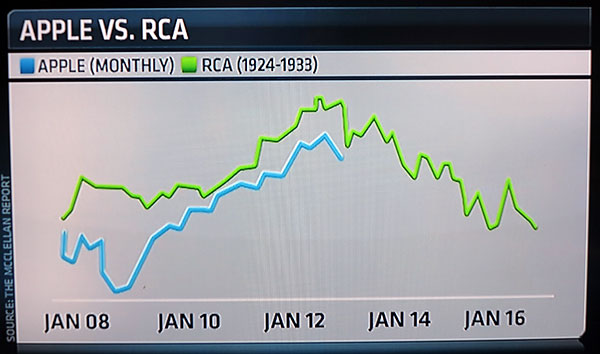
Apple’s Tim Cook said nothing at yesterday’s annual meeting. No new products. No new finances — like a dividend or a stock split. No nothing. Except I run a wonderful company that thinks good thoughts, including that David Einhorn’s suit was “silly.” Which neither the suit nor David is. Absent anything of substance and any new product, the investing world is left with lots rumors and lots of stuff to make up, like this chart that Tom McClellan showed on CNBC yesterday. Tom was the guy who called Apple’s $700+ its peak.
Qualcomm moves ahead. They have made the lives of the cell phone makers — their customers — easier with new developer software. This is big, good news. I like QCOM. For more click here.
The solution to Sequestration? From reader Erica Payne:
Hi Harry – Consider this:
– A recent Bloomberg View study found that the 10 largest U.S. banks receive an annual taxpayer subsidy of around $83 billion, or about 3 cents of every tax dollar.
– The first year of sequestration cuts will cost around $85 billion or . . . wait for it . . . about 3 cents of every tax dollar.
I think we should avoid sequestration by ending our annual subsidy to Too Big to Fail (and now Too Big to Prosecute) banks.
But that’s just my three cents.
Make sense?
New tech industry — cellular signal boosters. The FCC has started a new tech industry. I’ve seen these boosters in operation. Put one on your house or office and your cell phone service (voice and data) is suddenly clean and fast. Here’s the FCC’s February 20 press release:
Washington, D.C. – Today, the Federal Communications Commission (FCC) adopted a Report and Order that furthers the goal of improving our nation’s wireless infrastructure by expanding the reach of wireless coverage for consumers. These new rules governing signal boosters – which amplify signals between wireless devices and wireless networks – will substantially improve signal booster design by requiring manufacturers to include safeguards that protect wireless networks. As a result, all four nationwide carriers, as well as many rural and regional carriers, have consented to the use of boosters on their networks, as long as those boosters meet the technical specifications outlined in the Order. Removing consumer and industry uncertainty regarding signal booster use and operation will promote further investment in and use of this promising technology. Signal boosters not only help consumers improve coverage where signal strength is weak, but they also aid public safety first responders by extending wireless access in hard-to serve areas such as tunnels, subways, and garages. This Report and Order reflects a common sense, consensus-based technical solution that will help millions of consumers across the country.
Read the FCC’s release here. This is my definition for them from my Newton’s Telecom Dictionary:
Also called signal boosters. Cell phone boosters are radio frequency amplifiers that increase incoming (receive) signal and outgoing (transmit) cell and mobile phone signal to provide an improved voice connection, reduce dropped calls and increase data speeds. They are also known as cellular phone amps, amplifiers and repeaters. Boosters can be used to increase the range of a cell phone, smartphone, datacard, aircard and other cellular and PCS frequency band devices such as a remote alarm, vehicle tracking device and video device. For these marvelous gadgets to work, you must receive a cell phone signal of some sort — though it may not be at street level, it may be 20 foot up. Not necessarily powerful, but at least a signal. These things will not work without a signal. A cell booster consists generally of three four of equipment — an outside antenna, wire to bring the captured signals into the house or the office, a small box inside (which acts as a mini cell phone tower) and an internal antenna to distribute the signal insde the home or office. Even if there is no signal on the ground there could be one 20ft up. Cellular boosters are also available for cars and trucks. On February 20, 2013, the FCC announced it had adopted a Report and Order that furthers the goal of improving our nation’s wireless infrastructure by expanding the reach of wireless coverage for consumers. These new rules governing signal boosters — which amplify signals between wireless devices and wireless networks – will substantially improve signal booster design by requiring manufacturers to include safeguards that protect wireless networks. As a result, all four nationwide carriers, as well as many rural and regional carriers, have consented to the use of boosters on their networks, as long as those boosters meet the technical specifications outlined in the Order. Removing consumer and industry uncertainty regarding signal booster use and operation will promote further investment in and use of this promising technology. Signal boosters not only help consumers improve coverage where signal strength is weak, but they also aid public safety first responders by extending wireless access in hard-to serve areas such as tunnels, subways, and garages.
Tech reviewers love writing fun reviews o new products. This one just out is one of my favorite. It’s by Brian Barrett of Gizmodo. The headline photo is this:

Hardware comes last.
Google’s Chromebook Pixel is aspirational in nearly every way. It’s designed within an inch of its life, a physical specimen worthy of Rodin. Its lines are sharp, its display is crisp. And nearly every review has had the same takeaway: It’s amazing. Don’t buy it.
It’s enough to give you whiplash, or at least a decent migraine. But however absurd and contradictory a sentiment it seems, it’s actually spot on. The Chromebook Pixel is gorgeous, expensive, and worthless as anything other than the physical embodiment of an ineluctable truth: hardware isn’t just secondary now, it’s an afterthought. At best.
The Pixel’s problem, of course, is that it runs Chrome OS, a cloud-based platform that supports, outside of Google’s offerings, none of the applications you need. That, and it’s effectively useless unless you’re connected to the internet. In that sense, spending $1300 on a Pixel is like hiring a mannequin from an escort service: it might look nice, but it’s not functional in any of the ways you’d expect.
Software has always driven adoption; that’s nothing new. But hardware used to at least ride shotgun. There’s a reason Jony Ive is ascendent and Scott Forstall is looking for a job. Not too long ago, how something looked mattered nearly as much as-and sometimes more than-what that thing did.
Now, though? Sony spends two hours announcing its latest console without ever actually showing the console. That’s partly because it’s not done yet, and partly-in Sony’s own words-because a console is “just a box.” Which is true! But boxes used to matter.
What the PS4 and Z10 and Lumia 920 and (especially, resoundingly) a $1300 Chromebook all shout are that we don’t buy gadgets anymore. We buy ecosystems, keys that unlock gardens whose walls are high and fiercely guarded. A display’s pixel count is worthless if it doesn’t show us what we want. Touchscreens have made buttons obsolete; apps take precedence over build. A three-year-old iPhone beats next year’s BlackBerry.
That’s not new, but it’s truer than ever before. And it leaves innovation in the hands of a few entrenched platforms, most of whom are already set in their ways. Hardware breakthroughs are neutered if they come from the wrong company, back the wrong horse. Our laptops and phones and tablets become more and more commoditized until we’re all staring at the same screen, pushing the same keys.
The ChromeBook Pixel is amazing. Don’t buy it. But by all means, wish that you could.

Harry Newton, who suggests you label your camera, your computer, your cell phone, and other valuable goodies with your name and phone number (landline). There are actually good people in the world who will return your items, if you tell them where to send it. And while you’re at it, please scan your passport, all your credit cards and all the other stuff you have in your wallet.
P.S. Don’t believe anything you read on the Internet, especially predictions about JCPenney, or any other company.
