The idea is great. Put your money in a fund that buys companies. Have the companies borrow money, improve them and ultimately sell them. It’s called private equity or leveraged buyout. It’s the business that made Romney rich. It worked for a while until it got very competitive and the world fell apart in 2008.
I have money in several funds. They’ve been great for the managers, not so good for me. The field is starting to blossom again. New funds are being raised and old ones are — finally — being liquidated. Their companies are being sold now the economy is more mre buoyant and the stockmarket is up.
How to benefit? Not by going into another fund as a limited partner. I’ve been there, done that. Too slow. Too unrewarding. And I can’t get out when things go awry and I want to put my money elsewhere. Not good for me, a limited partner. Maybe there’s a better way — invest in the general partner, the company that runs the whole show and gets the bigger, faster and longer rewards.
Normally I don’t like investing in “management” companies because the managers take their salaries and bonuses out long before any money shows up on the bottom line for the public shareholders. Not so in these companies. The bosses take small salaries, but get their big rewards from the dividends they pay themselves and you and me, common shareholders. The four companies I like — APO, BX, CG and KKR all seem to have the bulk of their founders still running the place and taking their not-insubstantial rewards from dividends.
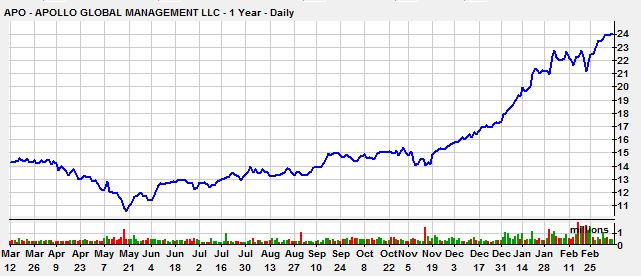
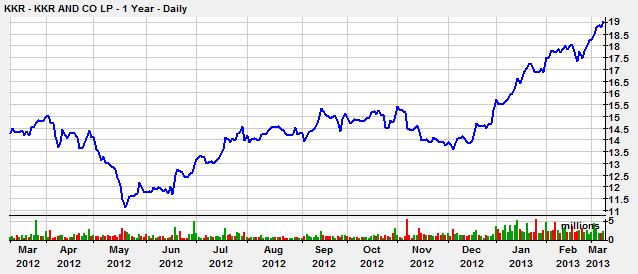
These four look like a good deal. I can see getting a 20% return on your money in these this year.

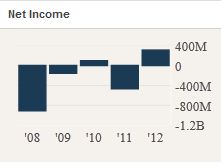
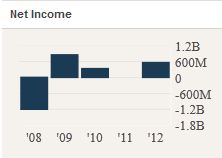
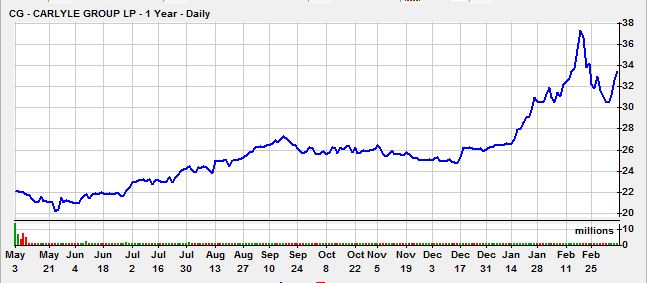
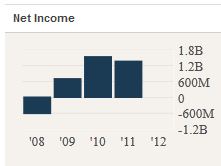
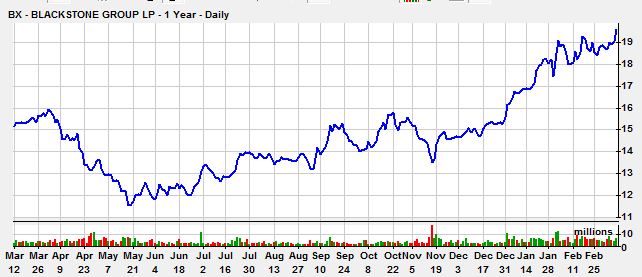
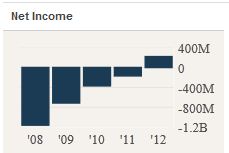
First is the recent one-year chart, followed by earnings chart from the Wall Street Journal. I like what I’m seeing. I small that 2013 will be the year they cash out many of the companies in their older funds. This should lead to much imrpoved dividends and much higher stock prices.
More reading on these firms:
+ KKR Duo: $1.65 Billion Stock Stake. Buyout firm discloses co-founders’ compensation, stake ahead of planned New York listing. Click here.
+ From March 1, 2013 Reuters:
Blackstone’s Schwarzman’s earnings flat in 2012; Apollo’s Black gains
(Reuters) – The earnings of Blackstone Group LP <BX.N> head Stephen Schwarzman were flat in 2012 at more than $200 million, while Leon Black, the CEO at private equity rival Apollo Global Management LLC <APO.N>, closed in on him with a 73 percent rise in his earnings.
Black’s 2012 earnings rose to $180.2 million, while Schwarzman’s earnings were $213.3 million, according to separate regulatory filings by the two firms on Friday.
The two buyout kings saw a big rise in dividends from their stakes in the firms they founded. Schwarzman, however, received just $800,000 in 2012 from funds predating Blackstone’s initial public offering in 2007, compared with the $74 million he received from these funds in 2011.
Private equity firms took advantage of buoyant equity and debt markets in 2012 to sell many of their investments, leading to bumper profits for their fund managers who receive performance fees in the form of so-called carried interest.
Schwarzman and Black, who are both billionaires, receive other income through their own investments in their funds, which is not disclosed. Schwarzman had a net worth of $5.2 billion as of September 2012, while Black had a net worth of $3.5 billion, according to Forbes.
KKR & Co LP’s <KKR.N> co-founders and chief executives, Henry Kravis and George Roberts, received about $137 million and $141 million, respectively, in executive compensation and cash dividends in 2012, up by more than 45 percent over what they received in 2011.
Most of Schwarzman’s and Black’s profits came from their ownership stakes in their firms. Schwarzman, who has a 21 percent stake in Blackstone, received $204.1 million, up from $134.5 million in 2011. Black, who holds a 24 percent in Apollo, received $179.9 million, up from $103.9 million.
Schwarzman, 66, received $8.4 million in compensation, which includes a $350,000 salary. Black, 61, received just $287,368, of which just $100,000 is salary. The rest includes carried interest the two men are entitled to as chief fund managers.
Blackstone had $210.2 billion of assets under management as of the end of last year, making it the world’s largest alternative asset manager, while Apollo had $113.4 billion. KKR & Co LP <KKR.N> had $75.5 billion, and Carlyle Group LP <CG.O> had $170 billion.
Schwarzman co-founded Blackstone in 1985 with Peter Peterson and in 2002 brought in veteran investment banker Tony James as his right-hand man. Black founded Apollo in 1990 together with Joshua Harris and Marc Rowan.
James, 62, is Blackstone’s president and chief operating officer. He got about $66 million from salary, bonus and holdings in the private equity firm in 2012. That compares with $52.6 million in 2011 and follows his $64.2 million sale of a small portion of his shares last month.
Black’s partners Harris, 48, and Rowan, 50, who each own 15 percent of Apollo, took $114.5 million apiece for 2012 in dividends. They got $66.1 million each for 2011.
Apollo also said senior employees had committed about $1 billion of their own money into the private equity firm’s funds from its inception through the end of last year.
The amount of distributions, including profits and return of capital, in 2011 from these investments was $88.5 million for Black, $26.2 million for Rowan and $33 million for Harris. However, Apollo does not disclose how much the actual profits from these investments were.
Black, Rowan and Harris, respectively, invested $15.6 million, $18.2 million and $4.2 million in Apollo’s funds in 2011. But in 2012 they invested, respectively, only $46,868, $1.7 million and $97,631, Apollo said.
Blackstone does not disclose Schwarzman’s and James’s income from investments in Blackstone’s funds.
Carlyle’s founders, William Conway, Daniel D’Aniello and David Rubenstein, in 20122 received $134 million each in cash distributions and $3.8 million in executive compensation. Their 2012 earnings will be disclosed in a regulatory filing later this month.
(Reporting by Greg Roumeliotis; Editing by Leslie Adler)
General weekend reading:
+ Preparing for (the) Day When Rates Rise. From the Wall Street Journal, Excerpt:
Rather than trying to guess exactly when that moment will happen, they are pre-emptively making investments that will pay off when it does. The moves include buying debt with floating interest rates that rise as overall rates climb, as well as interest-rate swaps and inflation-protected bonds that will also increase in value.
Other investors are hedging against potential bond losses by making bearish bets on U.S. Treasury bonds through derivatives that gain when rates rise. As rates rise, prices of bonds fall. Because rates are so low now, many investors are worried that even a small rise could be particularly painful for anyone holding Treasurys.
“We don’t subscribe to the view that once the fire starts, we’ll be able to outrun everybody through the door,” said Stephen Kane, managing director for U.S. fixed income at TCW in Los Angeles. “Rates could be up 50 basis points before your traders can get all the sell orders through.”
For the full Wall Street Journal article, click here
+ Venezuela after Chavez. From the Economist. Click here.
Neat entrepreneurial idea for your local community: Executive Errands. A variation on the TaskRabbit theme with more assured revenues. Click here.

Harry Newton, who visited the gym with his son yesterday.

Does pushing the shutter button qualify as exercise?

Hey Harry, besides your family, children and personal education, and besides the business you sold – what is the single greatest returning kind of investment you have ever made? Was it real estate, a stock, a private equity?
The best investment was a technology company that I became chairman of as a result of my investment. I ran the thing remotely for 18 months and ended up with a 20-fold increase in my investment when I sold it. The best investments are ones you have some control over, or at least significant input into.
Harry, just back from a week in Las Vegas. I have one question for you, “How many Starbucks are there in the town ?” Most hotels had multiple stores and on the street you passed several every block. One thing was common , all had the same equipment behind the counter. Who makes this equipment? There is a bubble that is going to burst someday when the craze is over.
I’m addicted to their Mocha Frappucino that comes in a bottle. But I’ve never owned stock in Starbucks, since I ‘ve never understood their business.