Germany won’t pony up the money for Greece. But even if it does, the total IMF/Euro “rescue” package won’t be enough to save Greece. It will default on its bonds. Greece will be paralyzed by a continuing nationwide general strike to protest the IMF-imposed austerity programs. The contagion will spread to Spain, Portugal and ultimately to England.
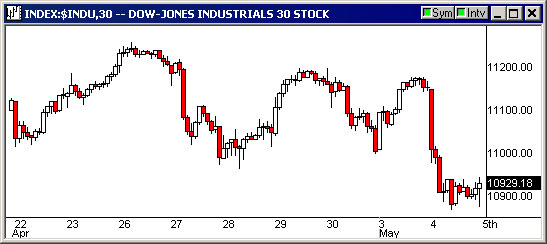
Yesterday panicked investors dreamed the worst case and dropped Greek stocks yesterday by 6.7%, Spanish stocks by 5.4% and U.S. stocks by 3%. More panic and woes are coming, as the market remains volatile — as in recent days:
Meanwhile the U.S. is facing $3.4 trillion of commercial real estate debt, most of which is under water. Some high percentage of this debt not worth what it’s being carried on the books of banks and other institutions for. We’ll see large writedowns at some point. Very depressing for bank stocks.
The oil spill will bankrupt BP and stop all further drilling for oil everywhere.
Martin Schulman says Greece matters to everyone, and concludes:
Bottom line: Greek sunlight is shaking up sovereign debt markets and this will have a tremendous ripple effect on fiscal matters, growth, and consumer spending, in turn hitting growth, profits, stocks and markets in the fourth quarter of this year and into 2011. It is hard to see how the current prices of US equities can be sustained in the face of this economic slowdown combined with the possibility of slightly rising interest rates. …
The simplest plays may be currencies though currency markets can be treacherous for individual investors. There are options available on fairly liquid currency ETFs — the FXE for the euro, the FXB for the British pound, the UUP for the dollar.
I don’t buy the contagion thesis. The world economy is clearly recovering, with signs of higher spending, buoyant corporate sales and, finally, some employment gains.
But….
Last year, when things looked bleaker, stockmarkets rose. This year, who knows? Cash remains king. Keep enough for three years of living expenses.
Meantime, stocks are on sale. Apple is cheaper. Annaly is cheaper. CSX is cheaper. European travel will be cheaper this summer.
You get the idea.
Don’t listen too much to the gloom and doomers.
The iPad makes phone calls. Dan Good called me from his iPad speakperhone via Skype VoIP. I was on a Verizon landline in New York. Dan was on WiFi in California. He said the call cost him a penny a minute and hence, he couldn’t talk too long. (He’s cheap.) However, for the three minutes (and three cents) he afforded me of his company, the call was crystal clear. … Yet another happy iPad story.
Not bad for a day’s work.
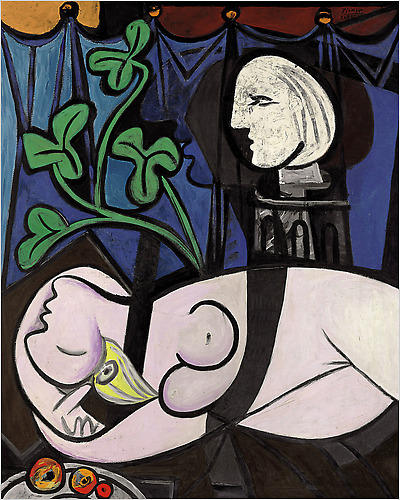
Nude, Green Leaves and Bust was painted in a single day by Picasso in March 1932. Yesterday it sold for $106.5 million, a world record auction price for a work of art.
One reason the painting brought such a staggering sum, art experts say, is that it drips with “wall power,” meaning it screams expensive. It is large — more than 5 feet by 4 feet — and has all the hallmarks of a great Picasso, including its subject, Marie-Thérèse (with Picasso’s profile faintly visible in the background), and its palette of rich blues, pinks and greens.
Drips with wall power… I don’t make this stuff up. Somebody is doing super-well to afford this wall adornment.
I hate everybody in Congress. And other common emotions today. From the New York Times, a fascinating look at history:
Founding Amateurs?
By GORDON S. WOOD
THE American public is not pleased with Congress — one recent poll shows that less than a third of all voters are eager to support their representative in November. “I am not really happy right now with anybody,” a woman from Decatur, Ill., recently told a Washington Post reporter. As she considered the prospect of a government composed of fledgling lawmakers, she noted: “When the country was founded, those guys were all pretty new at it. How bad could it be?”
Actually, our founders were not all that new at it: the men who led the revolution against the British crown and created our political institutions were very used to governing themselves. George Washington, Thomas Jefferson, Samuel Adams and John Adams were all members of their respective Colonial legislatures several years before the Declaration of Independence. In fact, these Revolutionaries drew upon a tradition of self-government that went back a century or more. Virginians ran their county courts and elected representatives to their House of Burgesses. The people of Massachusetts gathered in town meetings and selected members of the General Court, their Colonial legislature.
Of course, women, slaves and men without property could not vote; nevertheless, by the mid-18th century roughly two out of three adult white male colonists could vote, the highest proportion of voters in the world. By contrast, only about one in six adult males in England could vote for members of Parliament.
If one wanted to explain why the French Revolution spiraled out of control into violence and dictatorship and the American Revolution did not, there is no better answer than the fact that the Americans were used to governing themselves and the French were not. In 18th-century France no one voted; their Estates-General had not even met since 1614. The American Revolution occurred when it did because the British government in the 1760s and 1770s suddenly tried to interfere with this long tradition of American self-government.
Of course, a deep distrust of political power, especially executive power, had always been a part of this tradition of self-government. Consequently, when the newly independent Americans drew up their Revolutionary state constitutions in 1776, most states generally limited the number of years their annually elected governors could successively hold office.
“A long continuance in the first executive departments of power or trust is dangerous to liberty,” declared the Maryland Constitution. “A rotation, therefore, in those departments is one of the best securities of permanent freedom.” In addition to specifying term limits for its plural executive, the radical Pennsylvania Constitution of 1776 required that after four annual terms even the assemblymen would have to give way to a new set of legislators so they would “return to mix with the mass of the people and feel at their leisure the effects of the laws which they have made.”
At the same time, the Articles of Confederation also provided that no state delegate to the Congress could serve more than three years out of six.
In the decade after the Declaration of Independence, however, many American leaders had second thoughts about what they had done amid the popular enthusiasm of 1776. Since many of the state legislatures were turning over roughly 50 percent of their membership annually and passing a flood of ill-drafted and unjust legislation, stability and experience seemed to be what was most needed.
As a consequence, many leaders in the 1780s proposed major changes to their constitutional structures, including the abolition of term limits. In Pennsylvania, reformers eliminated rotation in office on the grounds that “the privilege of the people in elections is so far infringed as they are thereby deprived of the right of choosing those persons whom they would prefer.”
The new federal Constitution, itself a reaction to the excessive populism of 1776, also did away with any semblance of term limits, much to the chagrin of Thomas Jefferson and many others uneasy over the extraordinary power of the presidency. Jefferson thought that without rotation in office the president would always be re-elected and thus would serve for life. When he became president he stepped down after two terms and thus affirmed the precedent that Washington had established — a precedent finally made part of the Constitution by the 22nd Amendment in 1951.
Although federal term limits have been confined to the presidency, the fear of entrenched and far-removed political power, as the present anti-incumbency mood suggests, remains very much part of American popular culture. Yet precisely because we are such a rambunctious and democratic people, as the framers of 1787 appreciated, we have learned that a government made up of rotating amateurs cannot maintain the steadiness and continuity that our expansive Republic requires.
Gordon S. Wood, a professor emeritus of history at Brown, is the author, most recently, of “Empire of Liberty: A History of the Early Republic, 1789-1815.”
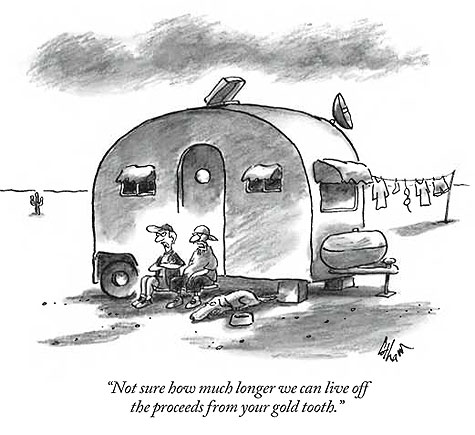
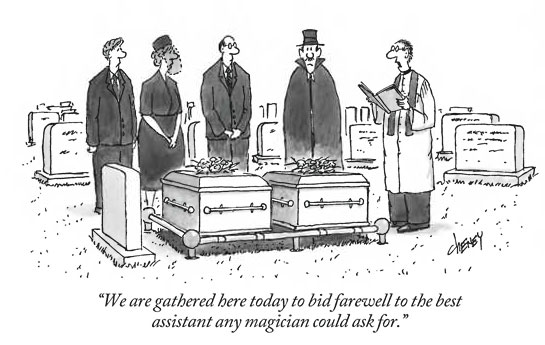
Favorite New Yorker cartoon:

Harry Newton, who feels a little more into equities today might be a good idea and meantime is praying the Greek riots don’t get too much out of hand. It’s fascinating (but sad) watching them live on TV. I’ve watched similar riots in person in India and Indonesia in the sixties. They get ugly very fast. The police start using serious force. Then people die.

Have to disagree about 'recovery':this is a stimulus induced drunken binge. Almost all the GDP increase is govt spending which is not sustainable. People dont pay their mortgage for a year so they can spend conspicuously.
When this stimulus runs out, and it will, 100% sure, we'll be back where we were, with the added burden of this ridiculous health care bill…