Sam Zell says the stockmarket feels like housing did in 2006, i.e. a bubble. Zell doesn’t like printing all the money which the Fed is doing. He has a point. He was on CNBC yesterday.
Today Ted Leonsis (his bio is here) was guest host. He’s really impressive. One of his points resonated with me — the rise of alternative education, viz. Echo 360 which he has invested in. Click here. His other companies are here.
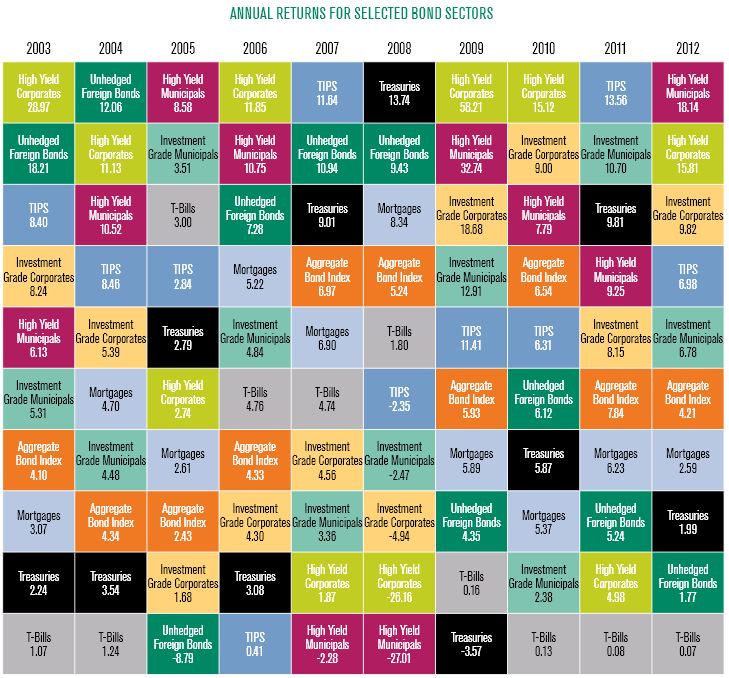
Yesterday stocks. Today bonds.This chart again from American Century Investments Click here:
PC sales are plummeting. From MarketWatch:
Worldwide personal computer shipments fell 14% in the first quarter of 2013, the industry’s worst quarterly decline ever, according to an IDC report released Wednesday. PC shipments totaled 76.3 million units, falling lower than a projected 8% decline. “The extent of the year-on-year contraction marked the worst quarter since IDC began tracking the PC market quarterly in 1994,” the tech research group said. Hewlett-Packard HPQ -5.51% remained the No. 1 PC maker, followed by Lenovo and Dell Inc. DELL -0.28% But each company shipped fewer PCs, with H-P suffering 24% drop, while Dell took an 11% hit. Lenovo sold five fewer PCs, according to IDC. The report also included bad news for Microsoft Corp. MSFT -3.70% IDC analyst Bob O’Donnell said that the company’s Windows 8 launch “not only failed to provide a positive boost to the PC market,” it “appears to have slowed the market.”
In other words, Microsoft’s miserable Windows 8 ain’t the BIG incentive to buy a new PC it should have been.
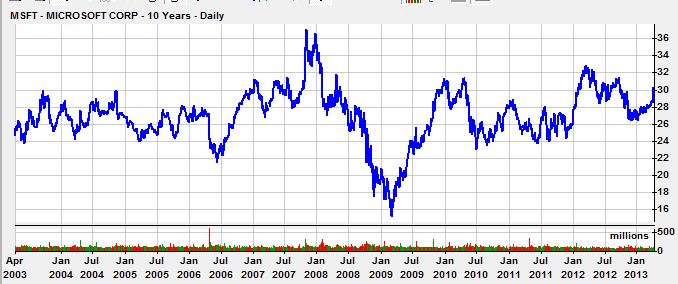
The BIG inviolate rule is “when the founder leaves, sell the stock.” Look at Microsoft over the past ten years. Unless you bought it in early 2009, you would be a moron to own this stock.
I’m still using Outlook 2003, because subsequent editions of Microsoft Office, beginning with Office 2007, dropped the weekly Calendar view I use several times each day. When I googled it last night, I found the web loaded with comments from stunned Microsoft customers who couldn’t understand why Microsoft was so stupid to drop this popular feature!
Whatever happened to gold? Of late it’s been a totally awful investment. My recommended SGOL ETF is down 13% from its high. Which makes me look like a total idiot, since I violated by inviolate 8% stop loss rule. My worst — the absolute worst — part of this was that I substituted “hope” for my inviolate rule. And then — my latest justification — it was a hedge against the stockmarket going south. But the market didn’t go south. Fortunately, the rise there covered up the small fall on SGOL.
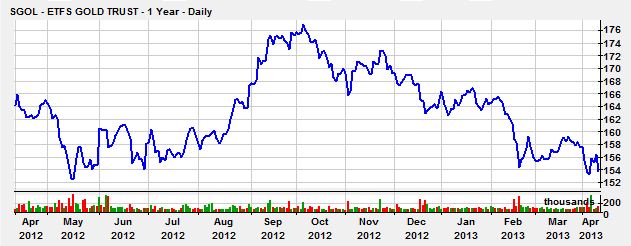
But where now? Hope or The Inviolate Rule? Hope has never worked. Today I’ll take The Rule and sell my remaining SGOL. Meantime, the New York Times has a neat piece on gold:
Gold, Long a Secure Investment, Loses Its Luster
Below the streets of Lower Manhattan, in the vault of the Federal Reserve Bank of New York, the world’s largest trove of gold – half a million bars – has lost about $75 billion of its value. In Fort Knox, Ky., at the United States Bullion Depository, the damage totals $50 billion.
And in Pocatello, Idaho, the tiny golden treasure of Jon Norstog has dwindled, too. A $29,000 investment that Mr. Norstog made in 2011 is now worth about $17,000, a loss of 42 percent.
“I thought if worst came to worst and the government brought down the world economy, I would still have something that was worth something,” Mr. Norstog, 67, says of his foray into gold.
Gold, pride of Croesus and store of wealth since time immemorial, has turned out to be a very bad investment of late. A mere two years after its price raced to a nominal high, gold is sinking – fast. Its price has fallen 17 percent since late 2011. Wednesday was another bad day for gold: the price of bullion dropped $28 to $1,558 an ounce.
It is a remarkable turnabout for an investment that many have long regarded as one of the safest of all. The decline has been so swift that some Wall Street analysts are declaring the end of a golden age of gold. The stakes are high: the last time the metal went through a patch like this, in the 1980s, its price took 30 years to recover.
What went wrong? The answer, in part, lies in what went right. Analysts say gold is losing its allure after an astonishing 650 percent rally from August 1999 to August 2011. Fast-money hedge fund managers and ordinary savers alike flocked to gold, that haven of havens, when the world economy teetered on the brink in 2009. Now, the worst of the Great Recession has passed. Things are looking up for the economy and, as a result, down for gold. On top of that, concern that the loose monetary policy at Federal Reserve might set off inflation – a prospect that drove investors to gold – have so far proved to be unfounded.
And so Wall Street is growing increasingly bearish on gold, an investment banks and others had deftly marketed to the masses only a few years ago. On Wednesday, Goldman Sachs became the latest big bank to predict further declines, forecasting that the price of gold would sink to $1,390 within a year, down 11 percent from where it traded on Wednesday. Société Générale of France last week issued a report titled, “The End of the Gold Era,” which said the price should fall to $1,375 by the end of the year and could keep falling for years.
Granted, gold has gone through booms and busts before, including at least two from its peak in 1980, when it traded at $835, to its high in 2011. And anyone who bought gold in 1999 and held on has done far better than the average stock market investor. Even after the recent decline, gold is still up 515 percent.
But for a generation of investors, the golden decade created the illusion that the metal would keep rising forever. The financial industry seized on such hopes to market a growing range of gold investments, making the current downturn in gold felt more widely than previous ones. That triumph of marketing gold was apparent in an April 2011 poll by Gallup, which found that 34 percent of Americans thought that gold was the best long-term investment, more than another other investment category, including real estate and mutual funds.
It is hard to know just how much money ordinary Americans plowed into gold, given the array of investment vehicles, including government-minted coins, publicly traded commodity funds, mining company stocks and physical bullion. But $5 billion that flowed into gold-focused mutual funds in 2009 and 2010, according to Morningstar, helped the funds reach a peak value of $26.3 billion. Since hitting a peak in April 2011, those funds have lost half of their value.
“Gold is very much a psychological market,” said William O’Neill, a co-founder of the research firm Logic Advisors, which told its investors to get out of all gold positions in December after recommending the investment for years. “Unless there is some unforeseen development, I think the market is going lower.”
Gold’s abrupt reversal has also been painful for companies that were cashing in on the gold craze. In the last year, two gold-focused mutual funds were liquidated after years of new fund openings, Morningstar data shows. Perhaps the most famous company to come out of the 2011 gold rush, the retail trading company Goldline, has drastically cut back its advertising on cable television, lowering spending to $3.7 million from $17.8 million in 2010, according to Kantar Media.
Goldline agreed to pay $4.5 million last year to settle charges brought by the city attorney of Santa Monica, Calif., accusing the company of running a bait-and-switch operation. Goldline did not respond to requests for comment for this article.
But the worst news for gold is probably good news for the broader economy, which, though still struggling to grow, has recovered from its lows.
“As the economy improves, the demand for gold as a financial hedge declines more than the fundamental demand for gold jewelry increases,” said Daniel J. Arbess, a partner at Perella Weinberg Partners, who sold off his fund’s large stake in gold in the fourth quarter of 2012.
Investment professionals, who have focused many of their bets on gold exchange-traded funds, or E.T.F.’s, have been faster than retail investors to catch wind of gold’s changing fortune. The outflow at the most popular E.T.F., the SPDR Gold Shares, was the biggest of any E.T.F. in the first quarter of this year as hedge funds and traders pulled out $6.6 billion, according to the data firm IndexUniverse. Two prominent hedge fund managers who had taken big positions in gold E.T.F.’s, George Soros and Louis M. Bacon, sold in the last quarter of 2012, according to recent regulatory filings.
“Gold was destroyed as a safe haven, proved to be unsafe,” Mr. Soros said in an interview last week with The South China Morning Post of Hong Kong. “Because of the disappointment, most people are reducing their holdings of gold.”
Gold’s most vocal bulls say gold doubters are losing faith too easily. Peter Schiff, the chief executive of the investment firm Euro Pacific Capital, said that he still expected gold to hit $5,000 an ounce within a few years because, he said, the world is headed for a period of dangerous hyperinflation.
“People believe the U.S. economy is recovering. It’s not,” said Mr. Schiff.
The most famous investor who is standing by gold is John Paulson, the hedge fund manager who made a fortune betting against the American housing market. His $900 million gold fund reportedly dropped 26 percent in the first two months of this year.
Mr. Paulson’s losses were particularly severe because he bet heavily on gold mining companies, which have fallen more sharply than gold itself.
Mr. Norstog, in Pocatello, made a similar mistake. He put his money in a gold fund that was focused on mining company stocks.
“If I had to do it all over again, I would have just bought the gold,” Mr. Norstog said. “At least that way I could have run my fingers through the glittering coins.”
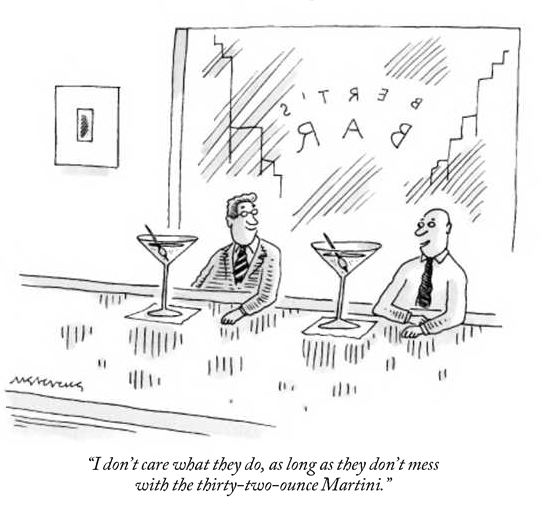
Favorite New Yorker cartoon.

Harry Newton is being iunundated with new venture startups. It’s as thought everyone has a great idea for a new buisness and is starting a new buisness. I have two criteria:
+ Is it scalable? Can it grow to encompass the world?
+ Is there enough money, resources and attention on marketing? People don’t buy your service or product because you have a better mousetrap. I don’t want companies whose success is dependent on selling to other companies, especially large, bureaucratic companies.

If your investment falls in value, do you never dollar-cost-average down? This has been a proven strategy for making money in undervalued investments, provided the fundamentals of the investment are sound.
Sometimes yes. Mostly no. But that’s probably a mistake
Not sure what you mean by dropped weekly calendar view in Outlook. I’ve checked version 2007 and weekly view is default when looking at the calendar. Left panel bottom, select Calendar. Right pane displays a week’s worth of entries. There are options at the top to select Day/Week/Month, as well as work week v. full week. Week and full week options are defaults. This is Office 2007 Pro, SP3.
Yes, they have a work week. but they changed the view. and it’s no longer useful. Send me your email address and I’ll send you a picture of the old one — so you can see. There’s also been a big discussion on the web about how Microsoft simply dropped the old 2003 week view without saying anything.And they annoyed a whole bunch of people, including me.