Hold onto your seats for a wild ride today. Stock prices will be up strongly at the open. And then, the computerized trading systems will glitch and who knows. Over 70% of trading in stocks is now in the hands of anonymous computers that suffer blue screens of death — just like yours and mine do.
You can read all the zillions of words on the mess in Europe and today’s bailout. You will learn:
1. The world is run by politicians, who get to stay in power if they spend money to benefit their voters.
2. The more they spend, the more likely they will keep their jobs — except maybe in Germany.
3. Spending more than you can afford means running up your debts.
4. At one stage, you longer afford earn enough to pay the interest on your debts. In the U.S. they’ll foreclose on your house. When you’re a government you would normally default, revalue your currency and agree to pay your bondholders ten cents on the euro. You can’t do that if it’s not your own currency, i.e. it’s the Euro.
5. You now go for a bailout from your rich friends. They reluctantly do it. That’s what this trillion dollar bailout is — financed by Germany, France and the U.S. (through the IMF).
This bailout is a bandaid. The long-term cure is economic growth, which generates taxes to pay off the bonds and keeps the banks who own the bonds from going broke, and spewing carnage all over the town. Don’t forget, much of Greek government bonds is owned by German banks. So the bailout financed by Germany for Greece will go to bail out German banks. Sound familiar?
Maybe this will work. Maybe it won’t. This morning my friends in the investing business talk of being stuck on a permanent roller coaster, or being tied down, coated with honey and having hungry ants crawling all over you.
Each of us needs to assess our stomach for roller coasters or ants. I repeat and modify some of my recommendations from Friday’s column.
1. This stuff is too hard to predict. Who needs the agita? It’s ultra-bad for your health. This is gambling not investing.
2. You don’t want to be in this unpredictable market with any money you’ll need in the next five years. (I agree with Cramer on this.)
3. Take today’s predicted upswing to take money out. I thought that upswing would occur on Friday. It will happen this morning.
4. Gold makes huge sense. Gold is what the world flees to when everything else looks awful — as it does now. Interestingly, gold rose 275% over the ten years from December 31, 1999 to December 31, 2009. During those ten years, the S&P 500 fell 9%.
5. Diversification in your remaining equity portfolio should focus on big, multi-national solid, market leaders. Here’s some neat statistics: About 70 percent of companies on the MSCI World Index that reported quarterly earnings since April 12 have beaten analysts’ forecasts, according to Bloomberg data. Employment in the U.S. increased in April by the most in four years, the Labor Department said May 7, indicating the recovery is becoming self- sustaining.
6. Bonds make some sense. But you have to be ultra-careful since many municipalities are broke, are likely to default and are not likely to be bailed out by the Federal Government.
In short, cash and gold are king. This mantra sounds like the coward’s way out.
“Harry, I should read this column to hear you tell me to do nothing, except buy a little gold?”
Yes. I was about to say also stay with some of your favorite stocks — like Apple and Google. But look at their recent cratering.
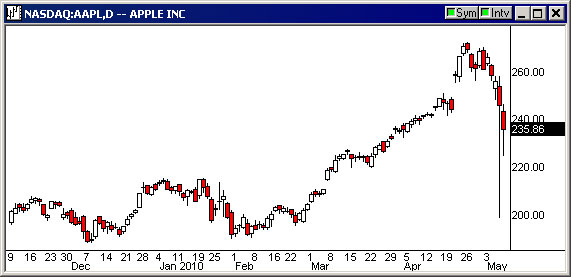
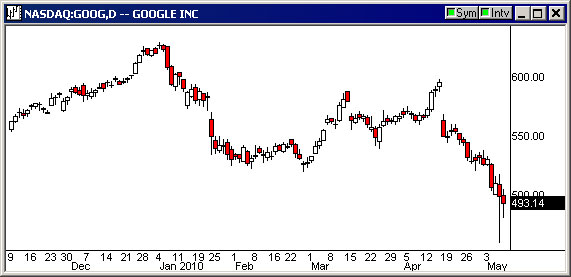
Google Alerts are useful. Want news on something you’re following? Sign for the free Google Alerts.
The sagging market for breast implants.
The recession has triggered a sharp decline in plastic surgery, especially breast implants.
So sad.
Woman sues salon after fallling through window
A Chicago woman who drunkenly fell through the window of a hair salon is suing its owners for having the wrong sort of glass. Melanie Shaker admits she lost her balance during a drunken fight with her husband, but says the salon owners should have installed special safety glass, since the sidewalk out front is “frequently traveled by intoxicated pedestrians.”
The one that got away. From the May 14 issue of The Week Magazine,
Living on a retirement pension in a remote California desert town is the little-known “third founder” of consumer electronics giant Apple. Back in the early 1970s, Ronald Wayne, now 75, worked with Steve Jobs at Atari. Jobs was about to launch a computer firm with his friend Steve Wozniak, and asked Wayne to draw up the partnership agreement. It gave them each 45 percent, and Wayne 10 percent. The idea was that he would act as a “tie-breaker” between the two bosses. But after two weeks, Wayne got the jitters. A previous venture had left him saddled with big debts, and he didn’t have the nerve to get involved in another start-up. “I was getting too old, and those two were whirlwinds,” he tells the London Daily Telegraph. “It was like having a tiger by the tail.” So he gave up his share, and in return received a check for $1,500. Today, that stake would be worth about $23 billion. But he’s not bitter. “Would I like to be rich? Everybody would like to be rich,” he says. “But I couldn’t keep up the pace. I’d have been the richest man in the cemetery.” Instead, he says, “I will be a footnote in history because I happened to have known someone.”
The richest man in the cemetery is total B.S. If Mr. Wayne had $23 billion, he could do a a great deal of good in the living world, before he made it to the cemetery.
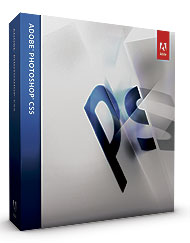
Adobe has a new version of Photoshop. It’s called Photoshop CS5. Adobe’s Photoshop CS5 recently became available, and as usual, there’s plenty of magic for photographers under.
The star of the new Photoshop is without a doubt Content-Aware Fill. This technology takes Content-Aware Scaling, which first appeared in CS4, to the next logical level by enabling you to select an object — a stranger who wandered into your photo shoot, for instance — and then delete him from the photo. Content-Aware Fill will then examine the background surroundings and fill in the white space where your object formerly resided. It’s fun and often amazingly accurate. A video shows how it works. Click here.
Also in the realm of magic is the Puppet Warp feature. Puppet Warp lets you recompose part of an object to achieve specific design goals. For instance, you can select an elephant’s trunk and change the curve of the trunk. Puppet Warp isn’t as easy to use as Content-Aware Fill and you won’t use it as much, but it’s cool nonetheless, reports the New York Times.
Adobe also has made it easier to select and mask intricate images with improvements to its Refine Edge tool, an enhancement that is less fanciful that Puppet Warp but will certainly be much more widely used. The software enables you to more accurately isolate an object from its background, and it’s particularly helpful with complicated edges like human hair.
Fans of high-dynamic range (HDR) photography will appreciate the HDR enhancements. The HDR Pro tool enables you to merge identical images taken at different exposures and combine the exposures to create a single shot with a very wide dynamic range. The tool also includes a Remove Ghosts feature that automatically removes artifacts that often occur when merging overlapping shots.
If you’re working with a single shot, however, the HDR filter is a fun addition that enables you to easily adjust the toning of the image to mimic the effects of HDR photos.
The Camera Raw 6 plug-in, which ships with CS5, has been updated to support new camera models; in all, 275 models are supported. Camera Raw 6 also has improved sharpening and noise removal, and lets you apply film grain when editing a RAW image.
Adobe also added a lens-correction feature that corrects the three most common lens-based errors: geometric distortion, chromatic aberration, and vignetting. You can also create custom profiles of your lenses.
As usual, Photoshop doesn’t come cheap. CS5 is $699 for the full version, or $199 for an upgrade from previous versions. You can download a fully-functioning trial version for free from here. Beware the dowload is the biggest I’ve ever seen — 980 megs.

Harry Newton, who wonders whether he should short at the open, or go play tennis?
