Pat yourself on the back. You’ve been doing good. The market has been on a tear.
I don’t know why. Enjoy it while it lasts. Keep your finger on the trigger. And don’t buy any long term bonds.
News:
+ Japanese Q1 GDP increased 3.5% year-over-year, beating expectations for 2.8% growth. Buy DXJ.
+ Gold prices fell below the $1,400 mark yesterday and continue to fall. Nobody should own gold at present.
+ Cramer and others are pushing the mantra — Google has mega-new products; Apple is stuck in a rut. Personally I wish Apple would make a phone the size of the Samsung Galaxy S4. No one should own stock in Apple, until it shows signs of life. Apple is what happens when the founder is no longer.
+ Europe is coming back. Euro area exports increased 2.8% month-over-month in March. Imports fell 1%. Some are finding value in European stocks. I need to look.
I wish I had a bigger position in Google. But the good news is that it’s been on my “Stocks We Like” list on the right for a while. Android phones are exploding. The Samsung Galaxy S4 is a gamechanger. Google is clicking on all cylinders.
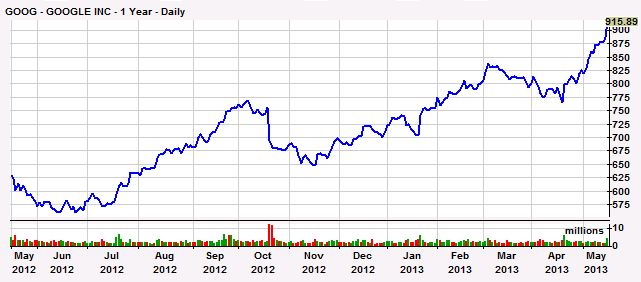
For an indication, here’s this morning’s story from Bloomberg:
Google Rises as Page Updates Music to Maps Services
Google Inc. (GOOG) shares rose to a record after the company unveiled a subscription music-streaming service and overhauled its online maps, part of several product updates aimed at attracting more users and advertisers.
The world’s most popular search provider also showed off enhancements to the search engine, the Android mobile operating system, Glass computing spectacles and other initiatives at the I/O conference in San Francisco yesterday. By getting developers to write software for such products, Google is seeking to broaden the appeal of its services.
Keeping a fresh lineup is critical as the Mountain View, California-based company vies with Amazon.com Inc. (AMZN), Apple Inc. (AAPL) and Microsoft Corp. (MSFT) for Web consumers of information and entertainment. Google shares rose past $900 for the first time, a sign of shareholders’ optimism that Chief Executive Officer Larry Page will outpace software and services competitors.
“To see such a large company attack so many fronts with such agility is rare and, evidently for the market, inspires confidence,” said James McQuivey, an analyst at Forrester Research in Cambridge, Massachusetts.
Google shares rose to a record, partly boosted by an increased price target to $996 from $932 by Morgan Stanley analysts. The stock climbed 3.2 percent to $915.89 at yesterday’s close in New York, the highest since the initial public offering in August 2004. Google has advanced 29 percent this year, compared with a 16 percent gain in the Standard & Poor’s 500 Index.
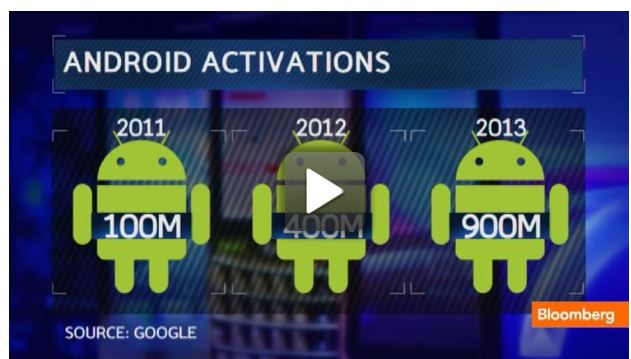
By offering music, Google is seeking to give consumers more reasons to use the Android operating system, already the most widely used software in smartphones with more than 900 million activations.
Google’s All Access music service will cost $9.99 a month, making millions of songs available on Web browsers as well as mobile devices. Universal Music Group Inc., Sony Music Entertainment and Warner Music Group Corp. have reached agreements to license songs, according to people with knowledge of the matter, who asked not to be identified because the details weren’t public.
The company is also challenging online-music providers like Spotify Ltd., which lists more than 6 million paying subscribers and more than 24 million active users in 28 countries.
“Not only is it a new music subscription service, but it’s built into everything else,” said Michael Facemire, an analyst at Forrester Research. “That was a big focus — having all of my stuff, all of my content, with me wherever I go.”
A central feature for smartphones, mapping applications have become a key tool for software and hardware makers to lure more users. Apple introduced its own maps app in September to replace one that relied on Google’s data. Following poor reviews of Apple’s product, Google rolled out its own version that’s become popular with iPhone users.
The upgrade to Google Maps provides more context and recommendations, whether for a particular restaurant or museum, according to Jonah Jones, lead designer at Google Maps.
While Google’s preview of Maps is tailored for the desktop and not yet for mobile devices, a new version will eventually be available across all platforms, Jones said. Google Maps also competes with a Microsoft desktop version, and the revamp will let users quickly zoom into a location without running into fuzzy images, thanks to technology that constantly renders the map, depending on the speed of the browser.
Google also unveiled improvements for Android, such as tools to make money from software purchases or ads. Revenue per user on the Google Play store, which features games and other software, rose 2 1/2 times in the past year, according to Hugo Barra, vice president of Android product management.
“Over the last four months this year, we’ve already paid out more money to Android developers in Google Play than in all of last year,” Barra said.
Google+, the social service, is getting more than 40 updates. That includes improvements to its photo service, including a new feature that can automatically make photos appear more professional by adjusting lighting or contrast. The software can also identify the best photos from a group of images, say from a vacation, and provide users with the top selections.
Google is also devoting part of the conference this week to YouTube. The online-video service could grow into a business with $20 billion in sales by 2020 from $4 billion this year, according to Scott Devitt, an analyst at Morgan Stanley. In video, YouTube reaches about 80 percent of viewers of online video, and Google’s measuring tools can help advertisers target precise audiences, Devitt wrote in a research note.
“We believe that Google has been aggressively courting video-advertising dollars,” wrote Devitt, who has an overweight rating, or the equivalent of a buy, on Google stock.
“We’re only at 1 percent of what’s possible and even only less than that,” Page told software engineers at the event. “Despite the faster pace of innovation in the industry, we’re still moving slow relative to the opportunities that we have.”
Page, whose appearance at the event was not announced in advance, had disclosed this week that he’s been diagnosed with left vocal cord paralysis, a condition that has impaired his ability to speak.
Google’s Web search also got an upgrade, with the introduction of voice-based queries for the desktop version, a feature already available on smartphones.
Google rose 2.7 percent during three days at the 2012 I/O conference and the impact this year “should be positive,” according to Brian Pitz, analyst at Jefferies & Co.
“As in prior years, we expect news coming out of Google I/O should move the stock, but this year’s impact may be more muted,” Pitz, who has a buy rating and a $1,000 target price for the stock, wrote in a research report.
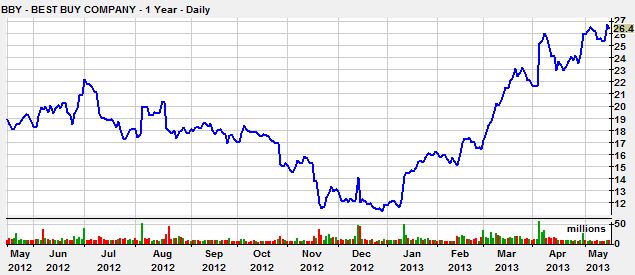
Shorting Best Buy. Part 2. I’m staying with my decision to short Best Buy — especially at its present ridiculous price.
A reader called Zinda wrote:
I am sure there is a technical reason (beyond my scope) why the stock is soaring. Until BBY changes the current business model – your palate is too refined and you’re too smart for BBY. Amazon may never completely replace the retail experience. Shopping will always be the top hobby/pastime in the US. (it should be exercise) BBY should think more “genius bar” type of employee (and training), instead of unknowledgeable kids who don’t really care. Shopping will be at the top in the US.
I have been in retail development for 16 years – rule #1 never say, “if you need anything – let me know.” (Wait – Now I have to come to find you if I want something? Am I working for you now…?) Its a fireable offense. Count how many times you hear this on your next shopping adventure…its like a virus! In reality, If you meet a sincere knowledgeable person – you can forgive a ton of the design/product placement/inventory sins, as you mentioned above. To me, its all about the relationship – period!
Example: Imagine if you asked for that Nikon, but the kid said “Oh, I wish we had that one in inventory, its an awesome camera – let me make a few calls and look online to see what other camera stores in the area that sell that model” First, after you pick yourself up off the floor… This person (lets call him Tim) now becomes your own personal camera concierge. While you sit back, Tim is calling and checking online for you – a dialogue ensues, questions asked, things learned, needs expressed, you tell him about kids/grandkids, he tells you about himself…etc. You just extended the time in the store and may just walk out with something. (regardless of price) If not, you will now know Tim, met a sincere person, know where to buy your camera and had a nice experience – you may be back.
Sincere retail salesmanship is an important life skill – it can be applied to EVERY business. I wish retailers would approach it as such… Kids today think its a meaningless transition job. It needs to change.
This may never change the stock price – but I hope they figure it out.
Yes, you’re right. And all this and more is what they do at B&H, the incredible photo/video store in Manhattan. But it’s not what they’re doing at Best Buy. I’m betting it’s too late for BBY to learn new retailing skills and to stock their stores with reasonably-priced stuff that excites their customers — even me. If you were Nikon or Canon, would you extend big-time credit to Best Buy — especially after the Circuit City bankruptcy, which left bad taste in suppliers’ mouths. I was in a real estate syndication that got stuck with a big Circuit City lease their bankruptcy broke. It was painful.
A broker called Janney Capital Markets disagrees. He believes that Best Buy is going through the roof. Here’s his report. Click here.
I schlepp my ThinkPad X220 laptop everywhere. To get onto the Internet I use Personal HotSpot on my Verizon iPhone 5. This piece from today’s New York Times discusses the options:
Keeping Wi-Fi Always Within Range
It’s enough to give tech devotees the shivers: imagine being stuck on a train with no Wi-Fi, or out of range of the free access provided by coffee shops and bookstores.
An important business report could go unfinished. Access to a customer list could be cut off. And any number of items you’re accustomed to using on a laptop computer could be rendered unreachable.
But there is a growing list of options, including turning your cellphone into a Wi-Fi hot spot or buying small independent devices, to ensure a constant link to the Web.
Start with the basics. Before buying a hot spot device or paying for a plan that adds this sort of capability to a cellphone, consider the coverage area for data. Review a map that shows how well the services provided by, say, the Clearwire network, which is owned by Sprint, work in certain areas.
This map is usually on the carrier’s Web site or at its store. Network speed is important, too: a 4G network is faster than 3G, for example, and while 4G is about the fastest available, some 4G networks are faster than others. This is important, as the Wi-Fi options can be dizzying.
One of the newer and more novel options is a mobile hot spot from Karma. As the name suggests, owners of a Karma device are encouraged to share their Wi-Fi hot spot with anyone within range, including strangers. There is a reward for this generosity: 100 megabytes of free data if someone else logs in and signs up.
“Any new customer that buys our hot spot is also immediately an evangelist of our service by emitting an open Wi-Fi signal,” said Robert Gaal, Karma’s chief executive.
The Karma service uses the Clearwire data network. It offers coverage in 80 cities and provides a 4G connection. The Karma device ($79) is compact, and the first gigabyte of data is free. After that, each gigabyte costs $14, on a pay-as-you-go plan, with no time limit for using the data. That gigabyte can accommodate the downloading of about 170 music files of typical size.
FreedomPop also takes an unusual approach. After buying the FreedomPop Photon mobile hot spot ($99), users get up to 500 megabytes of data a month. While that’s not enough for downloading lots of videos, it’s plenty for basic e-mail and simple Web browsing. After that, monthly plans cost $18 for two gigabytes of data and $29 for four gigabytes. There is no contract and users can switch among plans as needed. The device gets six to eight hours on a battery charge.
As with Karma, the FreedomPop device provides a 4G connection from the Clearwire network. For $4 a month extra, the network’s full speed is unlocked. Otherwise, downloads are capped at about half speed.
The company recently began offering a device called the FreedomPop Overdrive Pro ($40), which provides a larger area of coverage by using both 4G and 3G networks. The 3G network coverage is provided by Sprint, and a plan with two gigabytes of data is $20 a month.
Chances are, smartphone owners already have a hot spot in their pockets. Most newer models of the iPhone, Android phones, BlackBerrys and Windows phones have built-in hot spots. Enabling the feature, known as tethering, is straightforward; on an iPhone 5, for example, select Settings, then Persoonal Hotspot.
The major carriers offer the hot spot feature in their smartphone plans. T-Mobile includes it at no extra cost in its Simple Choice offering. Plans start at $50 a month and include 500 megabytes of high-speed data use on the phone or in tethering. That also includes the phone’s talk and texting services. The data can be increased for an extra $10 a month for each additional two gigabytes, to a maximum of 12.
Verizon includes the hot spot feature in its Share Everything plan at no extra cost. A plan with one gigabyte of data costs $50 a month, plus $40 for the phone’s other services, like talking and texting. It provides access to Verizon’s 4G LTE network for both the phone and tethering. Users can move up to two gigabytes for an extra $10, or four gigabytes for $20.
AT&T’s Mobile Share plans include the hot spot feature, starting at $40 for a gigabyte of data plus $45 for the phone’s talk and text services. A $70 option, with four gigabytes of data, and several others are also available.
Sprint charges an add-on fee to use the phone for tethering; $20 a month for two gigabytes of data, or $50 for six gigabytes. That’s in addition to the data plan and other services for the phone. The same plans are available for tablets, allowing users to turn an iPad or Android tablet into a hot spot. Other carriers also offer the hot spot feature for tablets.
Stand-alone devices are another option from the major carriers. Some have a contract while others are month-to-month or pay-as-you-go. Verizon offers the Jetpack 4G LTE Mobile Hotspot MiFi 5510L at no cost with a two-year contract (four gigabytes for $50; 10 gigabytes for $80).
Unlike the Karma and FreedomPop Photon devices, it has a screen that shows information like remaining battery life, connection speeds and number of devices attached. AT&T and Sprint also offer MiFi devices with different features and pricing.
T-Mobile offers the Sonic 2.0 Mobile HotSpot LTE, the company’s first mobile hot spot for its 4G LTE network. It has a screen, supports up to eight Wi-Fi-capable devices and costs $150 (or a $30 down payment with $5 monthly payments for 24 months). Data plans start at 500 megabytes for $20, or two gigabytes for $30, and other increments up to 12 gigabytes for $80.
The other option is to hunt down public access points. If no free option is within range, Boingo, with more than 600,000 hot spots worldwide, may have one nearby.
The company offers a variety of plans at boingo.com/wifi-plans. Customers of Comcast, Cablevision and other providers of home Internet access can use more than 100,000 public hot spots in many major cities. Subscribers of most Comcast Xfinity plans can use the hot spots at no additional cost (more information is at cablewifi.com).
AT&T offers free access at Starbucks and other locations. And apps like JiWire’s Wi-Fi Finder, which can find both free and fee-based hot spots, can also display the locations of hot spots while a phone or tablet is offline.

Harry Newton who spent half of yesterday fixing things — busted light fixtures, closet doors falling off their hinges, etc. The lesson here? When you buy the thing the first time, when your carpenter installs it — get spares. Get spare hinges. Get spare track fittings. Get spare everything. The only thing certain in life is that when you need a replacement, it will be “manufacturer discontinued.” Better to have a spare in your closet, than to spend 30 minutes searching for it on the Internet. Trust me. I wasted a lot of time yesterday looking for a replacement closet hinge — a Grass 1806, made in, of all places, Austria. I got in eBay. We’ll see when it arrives.

Love Google maps…their street level car has been in our neighborhood the past couple days driving around in a painted-up, tiny Toyota with a 4 lens camera mounted on a tri-pod on top of the car. He followed me for awhile in my golf cart…I’ll have to check it out later to see if we “made” Google Maps!