We should have been buying late yesterday afternoon — when it cratered.

Maybe it will crater some more today and present us some handsome buying opportunities.
I remain optimistic for stocks.
Yesterday is the sort of hiccup that markets go through when they get hit by events as unclear and as imprecise as yesterday’s comments by Bernanke in front of Congress.
He burbled that the Fed might cut back on its $85 billion per month money-printing / bond buying adventure sooner than later. Maybe by the middle of this summer.
Why is the Fed so important?
It’s normally important because it sets short-to-medium term interest rates. But it’s ultra-important now because it’s very active – unusually so. It’s the only arm of government trying to stimulate the economy. The rest of the government is on hold or on cutback (called sequestration) because of the deadlock in Congress.
The Fed, which can do whatever it feels like without Congressional approval, is printing money and using that money to buy government bonds, which it then puts on its balance sheet. It’s not GAAP accounting. It’s weird government stuff.
Let’s look at what happens. If it talks down interest rates and buys oodles of bonds, it drives up the price of bonds and drives down interest rates. Lower interest rates are meant to stimulate the companies to borrow money and to grow. Lower interest rates make housing more affordable since the buyer’s monthly nut is lower. That’s working. Stats show a nice uptick in housing. And companies are expanding, though very cautiously.
If the Feds keeps interest rates so low that it’s impossible to earn anything on bonds — which it has been doing — then the only place for investors to earn something on their savings is in the stock market. Hence the big recent rise in stock prices.
The fear is that if the Fed buys fewer bonds, interest rates rise. Investors will discover a “new” place to put their money (i.e. bonds) and stocks will fall.
There’s a conundrum here: If Fed tapers off, it means that it believes the economy is recovering nicely on its own. And if that’s the case, then the argument in favor of owning equities (i.e. stocks) is even stronger.
Yesterday we had our regular investors meeting. Just under a dozen of us crowded around a (borrowed) boardroom table in mid-town Manhattan. The air was upbeat. Most reported “more and more positive things are happening.” Like more business. More clients. One highlighted his Ardsley Train Station Parking Lot Index . Through 2008-2009, the lot, which serves businesspeople training to New York City, was more than half empty every day. Now it’s full — even as late as 9 PM. Business is booming for a whole bunch of people. Other attendees had positive stories also.
Does all this anecdotal “good times” stuff portend higher future stock prices? I personally believe so.
We have two hurdles to overcome: First, the Fed. Second, this chart. The last two times the market has hit where it’s at, it took a big tumble. This is the chart that has everyone freaked:
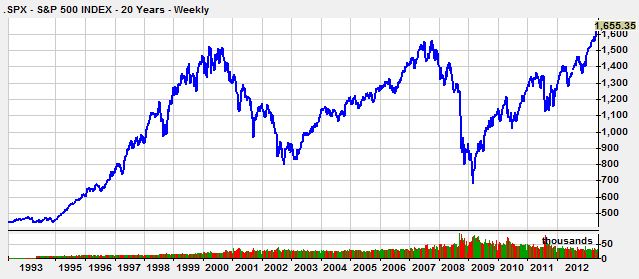
Me? I’m staying positive. I can see a little tumble while the Fed mulls. But not for long, or for hard.
I sold a little of my bond fund yesterday — VWALX. I’ll sell a little more.
What actually went on yesterday? Here’s the New York Times’ piece.
Fed Endorses Stimulus, but the Message Is Garbled
WASHINGTON – Despite signs of improvement in the job market, the chairman of the Federal Reserve, Ben S. Bernanke, and most other Fed officials signaled Wednesday that they remained cautious about easing back too quickly on their efforts to stimulate the economy.
While some Fed policy makers suggested that the central bank could begin reducing its monthly purchases of government bonds as early as next month, most still want to see continued evidence of an upswing in the job market and a decline in unemployment first, according to minutes of the most recent meeting of the Fed’s policy arm that were released Wednesday afternoon.
Confusion on Wall Street over the Fed’s intentions led to a topsy-turvy day in the stock market. The major indicators were up in the morning after Mr. Bernanke testified to a Congressional committee but then fell sharply after the meeting minutes were disclosed.
In his testimony, Mr. Bernanke said that ending the $85 billion monthly bond-buying effort too soon would do more harm than good.
“A premature tightening of monetary policy could lead interest rates to rise temporarily but also would carry a substantial risk of slowing or ending the economic recovery,” he said.
While Mr. Bernanke clearly enjoys the support of a majority of the Fed’s Open Market Committee, the minutes suggested that he was finding it challenging to forge a consensus.
Under questioning from a lawmaker, Mr. Bernanke suggested that the Fed might cut back on bond purchases some time in “the next few meetings.” That statement took on greater significance on Wall Street after the minutes hinted at the more unnerving prospect of action as early as June.
Still, many analysts said the odds were against a change of direction at the Fed’s meeting next month.
“It’s been on the minds of committee members, but I don’t think the minutes mean they’re going to collectively take their foot off the gas in June,” said Erik Johnson, an economist with IHS Global Insight.
More likely, he said, would be a pullback beginning in late summer or early fall if the economy sustains its momentum. Even if that happens, the Fed will remain extraordinarily accommodative by many other measures, with short-term interest rates staying very low.
In response to a question from Representative Kevin Brady, a Texas Republican who is chairman of the Joint Economic Committee, Mr. Bernanke said that whenever the stimulus began to taper off, it would not happen in an “automatic, mechanistic program. Any change would depend on the incoming data.”
Further evidence for a move in a few months, rather than weeks, came in an interview shown on Wednesday on Bloomberg TV with the president of the Federal Reserve Bank of New York, William C. Dudley, that seemed aimed at clearing up some of the confusion.
“I think three or four months from now you’ll have a much better sense of is the economy healthy enough to overcome the fiscal drag or not,” said Mr. Dudley, who is a close ally of Mr. Bernanke.
Outside the canyons of Wall Street and the world of Fed watchers, the difference between June and August or September might not appear significant. But with interest rates at historical lows, any move to cut back on bond purchases by the Fed would undoubtedly cause an uptick in bond yields. That would affect the huge market for government and corporate bonds and force stock market investors to recalibrate their positions.
When the trading day began on Wednesday, investors were in a buoyant mood, sending stock indexes higher as Mr. Bernanke began his testimony. Markets around the world have rallied this year on hopes that the Fed and other central banks will continue to support financial markets with monetary policies.
As the day went on, though, traders began to reconsider some of Mr. Bernanke’s comments. After the details of the Federal Open Market Committee meeting on April 30 and May 1 were released, many strategists said they were surprised by the number of voices inside the Fed calling for a slowdown in the stimulus effort in the near future.
The minutes said, “A number of participants expressed willingness to adjust the flow of purchases downward as early as the June meeting if the economic information received by that time showed evidence of sufficiently strong and sustained growth.”
In response, the Standard & Poor’s 500-stock index finished the day at 1,655.35, down 13.81, while the Dow Jones industrial average fell 80.41 to 15,307.17. The tech-heavy Nasdaq index, which has been on a tear lately, sank 38.82 to 3,463.30, or slightly over 1 percent.
Mr. Bernanke indicated that he was not particularly worried that the stock market was moving into bubble territory, despite the 16 percent surge in the S.& P. 500 since the beginning of the year.
“Our sense is that major asset prices like stock and bond prices are not inconsistent with fundamentals,” he said. Commonly used yardsticks for measuring the value of stocks, like price-to-earnings multiples, Mr. Bernanke concluded, are “fairly normal.”
The history of the world in one brutal photo. (Please don’t be offended. It’s a funny picture.)

Bad Musllim humor.
I went to see a Muslim tribute band last night. They were called “Bomb Jovi”. They were brilliant. Their last song “Living on a Prayer Mat” almost brought the house down. Then this Muslim bloke started bragging about how he had the entire Koran on DVD. I was interested so I asked him “Can you burn me a copy?” Well that was when the trouble started..

Harry Newton who erased all yesterday’s comments because his private address and phone number appeared in answer to a reader and he couldn’t trash just that one comment. In desperation he trashed all of them by simply re-posting yesterday’s column. I use software called WordPress, which is the world’s most popular and widely-used blogging software — it’s on something like 60 million plus web sites. That’s the good news. The bad news is that it’s got oodles of bugs. Like not being able to trash one comment. The good news is that you can work around most bugs — as I did last night.

THe perfect buying opportunity was in 2011 when you called for shorting the market. Or, in 2009. I wasn’t a reader then, but I’m guessing you were shouting “Head for the hills.”
The smart time to buy was then. It’s too late now.
Before the Fed existed some 75-80 years ago, the USA had no inflation. None. Now we have “officially” 2 to 4% inflation. Accident? No way: the government badly needs inflation to be able to reduce their future payments for their outrageous wild spending. Maybe time to eliminate the fed? Good luck.
Before the Fed existed some 75-80 years ago, there was a depression from 1873-79, a depression from 1882-85, and a depression from 1893-96.
the federal reserve was created after the panic of 1907 because no one was confident there would be another j. p. morgan to restore liquidity in the event of another panic.
after the federal reserve there was only one depression. 1929-39, because the federal reserve failed to restore liquidity in the wake of the crash of 1929, because there were no regulations to reign in the excesses of the 1920s, and because the hoover administration wasn’t able to recognize or cope with the depression.
http://en.wikipedia.org/wiki/Long_Depression
http://en.wikipedia.org/wiki/Depression_of_1882–85
http://en.wikipedia.org/wiki/Panic_of_1893
HEY HARRY – good morning – since you trashed your home address & phone number – if you can’t find you way back I think I can locate it here for you – tee hee – on your VWALX are you sellIng a percentage per week/day or what criteria are you using? I’m in similar situation with VOHIX – hate to sell but I can read the graffiti on the wall as well as the next guy – don’t want to simply hit the sell button and drive it all down.
capt.bill
Harry, see if this will help: http://help.disqus.com/customer/portal/articles/466229-removing-and-editing-your-comments
You should be able to do this as you’re both a registered user and a moderator.