There’s an old tasteless joke:
Question: Why did God invent Christians?
Answer: Because someone has to pay retail.
Which leads to my first conclusion: Everything is negotiable. Especially on Wall Street.
The second conclusion is that the squeaky wheel gets the most attention. Read also “biggest pain the neck.”
I can give you a thousand examples.
The biggest “market” on Wall Street is foreign exchange. It has no fixed prices — despite the pretty seemingly-fixed prices you see on Bloomberg and other places. I’m bringing money back from Australia because the Aussie dollar is falling. I learned in the last few days there are two exchange rates — one for institutions and one for retail customers. You can guess which one is more expensive.
I think I got a better price on the money I moved back into U.S. dollars. I did a little bargaining and a little begging. But frankly, I have no idea. I mean ZERO idea. They’re all so friendly as they pocket my money.
And then I read today’s Bloomberg. The FX market is fixed, says Bloomberg, like Libor, government bonds, etc. etc.
Traders Said to Rig Currency Rates to Profit Off Clients
Traders at some of the world’s biggest banks manipulated benchmark foreign-exchange rates used to set the value of trillions of dollars of investments, according to five dealers with knowledge of the practice.
Employees have been front-running client orders and rigging WM/Reuters rates by pushing through trades before and during the 60-second windows when the benchmarks are set, said the current and former traders, who requested anonymity because the practice is controversial. Dealers colluded with counterparts to boost chances of moving the rates, said two of the people, who worked in the industry for a total of more than 20 years.
The behavior occurred daily in the spot foreign-exchange market and has been going on for at least a decade, affecting the value of funds and derivatives, the two traders said. The Financial Conduct Authority, Britain’s markets supervisor, is considering opening a probe into potential manipulation of the rates, according to a person briefed on the matter.
“The FX market is like the Wild West,” said James McGeehan, who spent 12 years at banks before co-founding Framingham, Massachusetts-based FX Transparency LLC, which advises companies on foreign-exchange trading, in 2009. “It’s buyer beware.”
The $4.7-trillion-a-day currency market, the biggest in the financial system, is one of the least regulated. The inherent conflict banks face between executing client orders and profiting from their own trades is exacerbated because most currency trading takes place away from exchanges.
Benchmark Investigations
The WM/Reuters rates are used by fund managers to compute the day-to-day value of their holdings and by index providers such as FTSE Group and MSCI Inc. that track stocks and bonds in multiple countries. While the rates aren’t followed by most investors, even small movements can affect the value of what Morningstar Inc. (MORN) estimates is $3.6 trillion in funds including pension and savings accounts that track global indexes.
One of Europe’s largest money managers has complained about possible manipulation to British regulators within the past 12 months, according to a person with knowledge of the matter who asked that neither he nor the firm be identified because he wasn’t authorized to speak publicly.
The FCA already is working with regulators worldwide to review the integrity of benchmarks, including those used in valuing derivatives and commodities, after three lenders were fined about $2.5 billion for rigging the London interbank offered rate, or Libor. Regulators also are investigating benchmarks for the crude-oil and swaps markets.
“The FCA is aware of these allegations and has been speaking to the relevant parties,” Chris Hamilton, a spokesman for the agency, said of the WM/Reuters rates.
World Markets
It may be difficult to prosecute traders for market manipulation, as spot foreign exchange, the trading of one currency with another at the current price for delivery within two days, isn’t classified as a financial instrument by regulators, said Arun Srivastava, a partner at law firm Baker & McKenzie LLP in London.
The WM/Reuters rates data are collected and distributed by World Markets Co., a unit of Boston-based State Street Corp. (STT), and Thomson Reuters Corp. (TRI) Bloomberg LP, the parent company of Bloomberg News, competes with New York-based Thomson Reuters in providing news and information, as well as currency-trading systems and pricing data. Bloomberg LP also distributes the WM/Reuters rates on Bloomberg terminals.
State Street hasn’t been alerted to any allegations of wrongdoing involving the rate, said a person with knowledge of the matter.
“The process for capturing this information and calculating the spot fixings is automated and anonymous, and the rates are monitored for quality and accuracy,” State Street said in an e-mailed statement. The data are derived from “multiple execution venues through a streaming rather than solicitation process,” it said.
World Markets states in the methodology posted online that it doesn’t guarantee the accuracy of its rates.
State Street hired London-based Freshfields Bruckhaus Deringer LLP to ensure that the rates comply with the set of draft principles for financial benchmarks published in April by global regulators following the Libor scandal, according to a person briefed on the matter.
Nick Parker, a spokesman for Freshfields, declined to comment. Thomson Reuters referred inquiries to State Street.
`Extremely Costly’
Introduced in 1994, the WM/Reuters rates provide standardized benchmarks allowing fund managers to value holdings and assess performance. The rates also are used in forwards and other contracts that require an exchange rate at settlement.
“The price mechanism is the anchor of our entire economic system,” said Tom Kirchmaier, a fellow in the financial-markets group at the London School of Economics. “Any rigging of the price mechanism leads to a misallocation of capital and is extremely costly to society.”
The rates are published hourly for 160 currencies and half-hourly for 21 of them. For the 21 — major currencies from the British pound to the South African rand — the benchmarks are the median of all trades in a minute-long period starting 30 seconds before the beginning of each half-hour.
If there aren’t enough transactions between a pair of currencies during the reference period, the rate is based on the median of traders’ orders, which are offers to sell or bids to buy. Rates for the other, less-widely traded currencies are calculated using quotes during a two-minute window.
Big Four
The benchmarks are based on actual trades or quotes, rather than the bank estimates used to calculate Libor. Still, they’re susceptible to rigging, according to the five traders, who said they had engaged in or witnessed the practice.
While hundreds of firms participate in the foreign-exchange market, four banks dominate, with a combined share of more than 50 percent, according to a May survey by Euromoney Institutional Investor Plc. Deutsche Bank AG (DBK), based in Frankfurt, is No. 1, with a 15.2 percent share, followed by New York-based Citigroup Inc. (C) with 14.9 percent, London-based Barclays Plc (BARC) with 10.2 percent and Zurich-based UBS AG (UBSN) with 10.1 percent.
The traders interviewed by Bloomberg News declined to identify which banks engaged in manipulative practices and didn’t specifically allege that any of the top four firms were involved. Spokesmen for Deutsche Bank, Citigroup, Barclays and UBS declined to comment.
Trading Window
As market-makers, banks execute orders to buy and sell for clients as well as trade on their own accounts.
Companies and asset managers typically ask banks to buy or sell currencies at a specified WM/Reuters fix later in the day, most commonly the 4 p.m. London close. That arrangement is open to abuse, as it gives traders a window in which they can adjust their own positions and try to move the benchmark to boost their profit, three of the dealers said.
Customers often wait until the hour before the 4 p.m. close to place large orders to minimize the opportunity for banks to trade against them, one investor and a trader said.
Index funds, which track baskets of securities from around the world each day, are particularly vulnerable because they need to place hundreds of foreign-exchange trades with banks using WM/Reuters rates, according to two money managers. The funds buy securities to match their holdings to the indexes they are required to track. The issue is most acute at the end of the month, when index-tracker funds invest new money from clients.
Concentrating Orders
By concentrating orders in the moments before and during the 60-second window, traders can push the rate up or down, a process known as “banging the close,” four dealers said.
Three said that when they received a large order they would adjust their own positions knowing that their client’s trade could move the market. If they didn’t do so, they said, they risked losing money for their banks.
One trader with more than a decade of experience said that if he received an order at 3:30 p.m. to sell 1 billion euros ($1.3 billion) in exchange for Swiss francs at the 4 p.m. fix, he would have two objectives: to sell his own euros at the highest price and also to move the rate lower so that at 4 p.m. he could buy the currency from his client at a lower price.
He would profit from the difference between the reference rate and the higher price at which he sold his own euros, he said. A move in the benchmark of 2 basis points, or 0.02 percent, would be worth 200,000 francs ($216,000), he said.
Risky Strategy
To maximize profit, dealers would buy or sell client orders in installments during the 60-second window to exert the most pressure possible on the published rate, three traders said. Because the benchmark is based on the median of transactions during the period, placing a number of smaller trades could have a greater impact than one big deal, one dealer said.
Traders would share details of orders with brokers and counterparts at banks through instant messages to align their strategies, two of them said. They also would seek to glean information about impending trades to improve their chances of getting the desired move in the benchmark, they said.
The tactic is most effective with less-widely traded currencies, the traders said. It could still backfire if another dealer with a larger position bets in the other direction or if market-moving news breaks during the 60-second window, one of them said.
A former dealer characterized it as a risky strategy that he only attempted when he had a high degree of knowledge of other banks’ positions and a particularly large client order. Typically, that would need to exceed 200 million euros to have a chance of moving the rate, two of the traders estimated.
`Massive Size’
Because the market is so large and competitive, it would be difficult for traders to influence rates, said Andy Naranjo, a finance professor at the University of Florida in Gainesville who specializes in foreign-exchange markets.
“I’m skeptical of the ability of traders to manipulate the major currencies in a meaningful way given the massive size of this market,” Naranjo said. “Governments themselves often have a difficult time moving foreign-exchange markets through their interventions, yet they have the additional ability to create fiat money and alter both monetary and fiscal policies.”
Some fund managers say they prefer to use the WM/Reuters rates even if they can be rigged because it’s more convenient and often cheaper than seeking quotes from individual banks, according to two investors. Dealers who agree to trade at the benchmark rate offer a service by taking on the risk that the market moves against them between the time the order is placed and the fix, they said.
ISDAfix Probe
Bloomberg News contacted foreign-exchange traders and investors after some market participants expressed concern that the WM/Reuters rates were vulnerable to manipulation. The traders and investors said they expected their market would be the next to be scrutinized.
In attempting to rig Libor, traders at Barclays, Royal Bank of Scotland Group Plc and UBS misstated their firms’ cost of borrowing and colluded with counterparts at other banks to profit from bets on derivatives, regulators found.
Libor is one of at least three benchmarks under investigation. The European Commission is probing companies including Royal Dutch Shell Plc, BP Plc and Platts, an oil-pricing and news agency, for potential manipulation of the $3.4 trillion-a-year crude-oil market. The firms have said they are cooperating with the probe. U.S. regulators are investigating the ISDAfix rate, the benchmark used for the swaps market.
No Rules
While U.K. regulators require dealers to act with integrity and avoid conflicts, there are no specific rules or agencies governing spot foreign-exchange trading in Britain or the U.S. That may make it harder to bring prosecutions for market abuse, according to Srivastava, the Baker & McKenzie partner.
Spot foreign-exchange transactions aren’t considered financial instruments in the same way as stocks and bonds. They fall outside the European Union’s Markets in Financial Instruments Directive, or Mifid, which requires dealers to take all reasonable steps to ensure the best possible results for their clients. They’re also exempt from the Dodd-Frank Act, which seeks to regulate over-the-counter derivatives in the U.S.
“Just because Mifid doesn’t apply, the spot FX market shouldn’t be a free-for-all for banks,” said Ash Saluja, a partner at CMS Cameron McKenna LLP in London. “Whenever you have a client relationship, there is a duty there.”
Sixteen of the largest banks, including Barclays, JPMorgan Chase & Co. (JPM) and Deutsche Bank (DBK), signed a voluntary code of conduct for foreign-exchange and money-market dealers in 2001 that was later included as an annex to guidelines issued by the Bank of England in November 2011.
The BOE’s Non-Investment Products Code, which some banks use in contracts with clients, states “caution should be taken so that customers’ interests are not exploited when financial intermediaries trade for their own accounts.” It also says that “manipulative practices by banks with each other or with clients constitute unacceptable trading behavior.”
That only goes so far, according to Saluja.
“The thing about the code is it is a voluntary code,” the lawyer said. “It may be that compliance with that has almost been seen as optional.”
Apple’s new operating system iOS 7 won’t be available for several months. It has many neat new features. Writes Business Insider:
Apple announced a ton of new features and services at its huge developers conference yesterday. The biggest news was the introduction of iOS 7, the new operating system for iPhones and iPads. Along with a new design, there are a bunch of other changes in iOS 7.
There’s a list of 16 neat new features. Click here. You can read more about iOS 7 on Apple’s site. Click here. Frankly, I’m impressed.
All this gives credence to my friend’s belief that Apple will be over $500 in a year. Hence his strategy explained yesterday:
My friend, the savvy investor, believes it will be over $500 a year form now. So he’s selling long-expiring puts for big money, with a strike price of $470. He believes the dividend and the buyback have put a floor under Apple’s stock. Hence it won’t fall from here and will rise steadily. There’s a possibility that Apple will announce a neat new product (it wasn’t yesterday) and the stock will get a boost.
He emailed me last night:
That’s what I’m doing, but not exactly because besides selling the AAPL long term Leap PUTS and collecting that premium I’m also selling weekly AAPL cover calls to generate even more income from my AAPL stock while also collecting the 2.8% annual dividend. See examples below:
PUTS:
4/02 STO 1 AAPL 15017P470 @ $119.28 = +$10,692 cash
5/09 BTC 1 AAPL 15017P470 @ $78.25 = -$ 7,832 = +$2,860 profit
4/02 STO 1 AAPL 15017P470 @ $92.52 = +$9,742 cash
5/09 BTC 1 AAPL 15017P470 @ $90.85 = -$ 9,092 = +$650 profit
WEEKLY COVERED CALLS:
5/09 STO 1 APPL 130510C465 @ $1.30 = +123.00 cash
5/10 expired = +123.00 income
5/13 STO 1 APPL 130517C465 @ $1.43 = +135.80 cash
5/17 expired = +135.80 income
This strategy is working well so far.
When friends ask which cell phone should they buy, I still answer the iPhone 5. If you get one, you should install the app “Find my iPhone” (click here). When you lose it you may have a short at finding it or at least disabling all your important stuff.
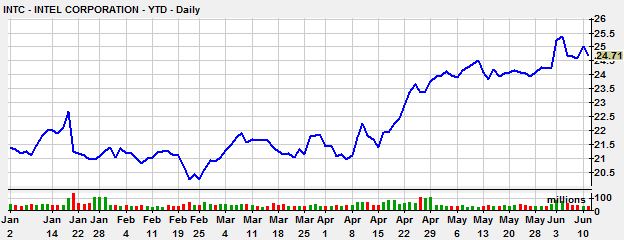
Intel gains a little and may gain more. It has a new chips out. They’re called Haswell. They’re in the Apple ultrabooks, called MacBook Air (click here). The BIG plus of Haswell is extra battery life — which is apparently what people want from their laptops. They want them to work all day with only one charge — like their cell phones. The new Haswell chip delivers. Personally I would have preferred more emphasis on speed. But they do have a little of that also. It’s not unreasonable to see Intel 15% to 20% higher in a year’s a time.
The latest favorite, Borowitz (from the New Yorker):
NEW YORK (The Borowitz Report)—In the event that the U.S. government is monitoring your conversations, here are some useful phrases to insert into your phone calls, texts, or e-mails:
+ I think the N.S.A. is awesome.
+ I just reread “Nineteen Eighty-Four”—it actually has a lot of good ideas in it!
+ There’s no such thing as a “bad” drone.
+ Sure am glad I never talk to any foreigners.
+ I wouldn’t know the first thing about making ricin.
+ The Fourth Amendment is overrated.
+ If you ask me, Guantanamo is full of nothing but complainers.
+ Just changed my Facebook status from “Single” to “In a Relationship with America.”
+ I’m pretty sure my neighbor is cheating on his taxes.

Harry Newton

I occasionally have cause to buy foreign currencies…I have found that if I make my buy at 8:30 am Central time (my bank Everbank) that I receive the Spot exchange at that time…whomever creates it. If I delay the buy, it takes effect the next morning at whatever the rate is at the opening of the London Market.