Printing presses for the U.S. dollar and the Euro roll. So rolls gold. It’s now at a new peak — reflected in this EFT:
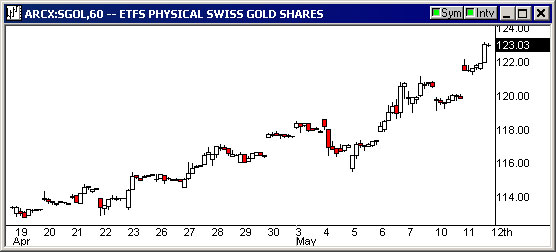
It smells like a boom (to be followed by the inevitable bust).
The fear is palpable. Huge bailout packages in Europe and the U.S. have debased the Euro and the dollar.
The only safe haven is gold. That’s the argument.
We all should own some gold. The easiest way to own gold is through one of the ETFs — SGOL, GLD, IAU and DGL. I prefer SGOL.
Should you even own shares? Many investors have abandoned the stockmarket altogether. They figure the odds are increasingly stacked against them. When they finally get something that begins to do well for them, they get zapped by a black swan — Greece, high frequency trading glitches, dumb government decisions (like ultra-low interest rates) and the new concept of “bets.” The word on Wall Street used to be “invest.” Now it’s “bet.” We make a bet on this company. We make a bet against sub-prime. Betting is gambling. Wall Street has truly become a casino. The house makes it — viz. Goldman Sachs. You and I don’t. Worst is the emergence of traders incentivized to take ridiculous risks — knowing if they succeed they’ll be the next “Paulson” lauded on TV. If they fail, the government will bail them out.
You and I can’t keep up with the traders and the machines. Should we even try? Remember the S&P 500 lost money for the ten years to the end of 2009. Everything else did better — even bank CDs.
With these thoughts, I was pleased to read Mark Cuban’s latest blog. Here it is. The man is intelligent (and rich).
What Business is Wall Street In? by Mark Cuban
My last two posts were designed to stimulate discussion. But lets talk the real problem that regulators, public companies, investor/shareholders and traders face. The problem is that Wall Street doesn’t know what business it is in. Regulators don’t know what the business of Wall Street is. Investor/shareholders don’t know what business Wall Street is in.
The only people who know what business Wall Street is in are the traders. They know what business Wall Street is in better than everyone else. To traders, whether day traders or high frequency or somewhere in between, Wall Street has nothing to do with creating capital for businesses, its original goal. Wall Street is a platform. It’s a platform to be exploited by every technological and intellectual means possible.
The best analogy for traders ? They are hackers. Just as hackers search for and exploit operating system and application shortcomings, traders do the same thing. A hacker wants to jump in front of your shopping cart and grab your credit card and then sell it. A high frequency trader wants to jump in front of your trade and then sell that stock to you. A hacker will tell you that they are serving a purpose by identifying the weak links in your system. A trader will tell you they deserve the pennies they are making on the trade because they provide liquidity to the market.
I recognize that one is illegal, the other is not. That isn’t the important issue.
The important issue is recognizing that Wall Street is no longer what it was designed to be. Wall Street was designed to be a market to which companies provide securities (stocks/bonds), from which they received capital that would help them start/grow/sell businesses. Investors made their money by recognizing value where others did not, or by simply committing to a company and growing with it as a shareholder, receiving dividends or appreciation in their holdings. What percentage of the market is driven by investors these days?
I started actively trading stocks in 1992. I traded a lot. Over the years I’ve written quite a bit about the market. I have always thought I had a good handle on the market. Until recently.
Over just the past 3 years, the market has changed. It is getting increasingly difficult to just invest in companies you believe in. Discussion in the market place is not about the performance of specific companies and their returns. Discussion is about macro issues that impact all stocks. And those macro issues impact automated trading decisions, which impact any and every stock that is part of any and every index or ETF. Combine that with the leverage of derivatives tracking companies, indexes and other packages or the leveraged ETFs, and individual stocks become pawns in a much bigger game than I feel increasingly less comfortable playing. It is a game fraught with ever increasing risk.
The Pimco (who I think are the smartest guys on the Street) guys talk about a new normal as it applies to today’s state of the world economy. I think just as important is the new normal as it applies to Wall Street. Wall Street is now a huge mathematical game of chess where individual companies are just pawns. This is money in the bank for the big players like Goldman, Morgan, etc. Why ? Because the game of chess is far too complicated for 99% of the institutions out there investing money. So to keep up, they turn to Goldman, Morgan and the like to invent products for them. “You don’t know how to play the housing boom, let us show you”. “You think the housing boom is about to crash, let us show you how to play that”. “You think that PIIGS are in trouble because they can’t print money to pay debt holders, let us create a product to allow you to play that game” The big houses have the best hackers in the business and they put together the games and sell them to the many, many institutions managing Billions and Billions of dollars. They are the ultimate Hackers selling their attacks to the highest bidder, regardless of which side they are on. That is a new normal.
Again, I’m not passing judgement one or the other. I’m just recognizing what is going on in the financial world today.
It’s rare for companies to go public these days. Just as rare for secondary offerings. The only thing that keeps me in the market is that most of the stocks (not all) pay dividends or some other sort of cash payout. For the first time in my life, I bought outside the United States. I bought Australia in a big way because it is becoming increasingly hard to find new domestic investments that are not influenced by the “hackers” and the games being played on a macro level. It’s hard to believe, but evaluating countries as an investment is now easier than evaluating companies . Even with all the unrest in Europe. Or maybe because of it.
So back to the original question. What business is Wall Street in ?
Its primary business is no longer creating capital for business. Creating capital for business has to be less than 1% of the volume on Wall Street in any given period. (I would be curious if anyone out there knows what percentage of transactions actually return money to a company for any reason). It wouldn’t shock me that even in this environment that more money flows from companies to the market in the form of buybacks (which i think are always a mistake), then flows into companies in the form of equity.
My 2 cents is that it is important for this country to push Wall Street back to the business of creating capital for business. Whether it’s through a use of taxes on trades, or changing the capital gains tax structure so that there is no capital gains tax on any shares of stock (private or public company) held for 5 years or more, and no tax on dividends paid to shareholders who have held stock in the company for more than 5 years. However we need to do it, we need to get the smart money on Wall Street back to thinking about ways to use their capital to help start and grow companies. That is what will create jobs. That is where we will find the next big thing that will accelerate the world economy. It won’t come from traders trying to hack the financial system for a few pennies per trade.
And solutions won’t come from bureaucrats trying to prevent the traders from hacking the system. The only certainty when bureaucrats step in is that the law of unintended consequences will smack us all in the head and the trader/hackers will find new ways to exploit the system that makes them big money and even more money for the big institutions that develop products for the other institutions that are desperate to play the game.
Regulators have got to start to recognize that traders are not investors and vice versa and treat them differently. Different regulations. Different tax structure. Different oversight. Individual investors and the funds that just invest in stocks and bonds are not going to crash the market. Big traders who are always leveraging up and maximizing the number of trades/hacks they make will always put the system at risk. We need to recognize that they do not serve much of a purpose other than to add substantial risk to the global economy. That their stated value add of liquidity does not compensate the US and World Economy nearly enough for the risk of collapse they introduce into the system.
Wall Street as a whole needs to be in the business of creating capital for companies and selling shares to investors who believe they are shareholders. The Government needs to create incentives for this business and extract compensation from the traders/hackers for the systemic failure level of risk they introduce.
There will be another crash, because there are too many players looking for the trillion dollar score. They can’t all win, yet how many do you think wouldn’t risk everything, even what is not theirs, for that remote chance to score big ? Put another way, there is zero moral hazard attached to any trade. So why wouldn’t traders take the biggest risk possible ?
Elizabeth Warren will be on CNBC tomorrow at 7:30 AM. She’s my favorite law professor. From Wikipedia:
In the wake of the 2008-9 financial crisis, she became the chair of the Congressional Oversight Panel created to investigate the U.S. banking bailout (formally known as the Troubled Assets Relief Program). In that role, she has provided a critical check on the U.S. Department of the Treasury and has been a leading advocate for accountability and transparency. Since 2007, she has advocated for the creation of a new Consumer Financial Protection Agency which is now being considered by the 111th United States Congress as bill HR 3126
The best sales line.
Alan, who was the best paid insurance salesman around, was talking to a prospect. “How much life insurance do you have?”
“$25,000,” came the reply.
“So,” said Alan, “how long do you think you can stay dead on that kind of money?”
Superior Logic
Mick and Paddy were walking home from the pub. Mick says to Paddy, ‘I can’t be bothered to walk all that way.’
‘I know,’ says Paddy, ‘but we’ve no money for a cab and we’ve missed the last bus home.’
‘We could steal a bus from the depot,’ Mick suggests.
They arrive at the bus depot and Mick tells Paddy to go in and get a bus while he keeps a look-out.
After shuffling around for ages, Mick shouts, ‘Paddy, what are you doing? Have you not found one yet?’
Paddy shouts back, ‘I cant find a No. 91’
‘Oh Jeysus Christ, ye tick sod, take the No. 14 and we’ll walk from the roundabout!’
A little Jewish logic.
+ Where there’s smoke, there may be smoked salmon.
+ Before you read the menu, read the prices. If you have to ask the price, you can’t afford it.
+ But if you can afford it, make sure you tell everybody what you paid.
+ No meal is complete without leftovers.
+ Jewish dietary law says pork may be eaten only in Chinese restaurants.
+ If it tastes good, it’s probably not kosher.

Harry Newton, who wondering about his inviolate 15% Stop Loss Rule and wonders if 8% isn’t more logical for today’s world? Getting us out of 90% of our common stocks might not be a bad idea.

Harry, gold worries me. Although “gold” itself may be a solid investment vehicle, if the price is overvalued and is a bubble waiting to pop, it's not a safe investment. And how does one assign a fair value to gold? I can't understand and evaluate gold like I can an actual necessary commodity or business. Gold has limited industrial use. You can't eat it when you're hungry. All the world's gold could disappear tomorrow and life would go on (financial chaos notwithstanding). The market valuation of gold appears to be purely subjective- driven largely by emotion and herd behavior. And that's dangerous for an investor.
I'll have some charts, etc on gold tomorrow. Don't dismiss gold. Remember it did better than stocks in the ten years to end-December 2009. That's a long time.
Excellent comments by Mark Cuban. The one elephant (trading) in the room is crowded by the other elephant (crony CEOs and rampant overpayment of executives at publicly-held companies.)
For example, in 2003, Dick Grasso got $139 million, which was the bulk of the profits of the NYSE. Nothing left for the stockholders. It always amazes me when I research a stock to find out exactly what the listed salaries of the C-level players are; for example, a 46-year-old CFO, Ms. Kathleen L. Quirk, at Freeport McMoran Copper and Gold, makes a base of $5 million. That's essentially a glorified accounting position. But the CEO there makes a base of $27 million and has actually a take-home this year of closer to $70 million.
Here's a list:
Name Fiscal Year Total
Moffett, James 21,477,100 – Chairman of the Board (retired CEO)
Adkerson, Richard 27,622,300 – CEO
Quirk, Kathleen 5,389,130 – CFO
Arnold, Michael 4,485,350 – Chief Administrative Officer
And that's just one company, one example. I can't believe that these individuals are making decisions in the company's best interest, when they have so much incentive to do what is fattening their own families for generations.
Hello Mr Newton
I still think that investing is a good way to grow one's wealth slowly. What the street markets and sell's to the public should be against the law. Buying shares in quality growth companies like PG,K,GIS as an example for the long run is the way to go. Think back to the first time you invested years ago and how much would you have made if you invested in one of those companies years ago and forgot about those shares for all those years.
Best to you
Vito
No question. PG, K, GIS have done well over the past ten years.But not extraordinarily.
That's my whole point boring is out everyone wants the hot action.
what's your growth per year on these stocks in recent years?
Harry — I believe that 8% is the stop loss that IBD (Investors Business Daily) and those who follow their trading system use. 8% will stop you out of many more trades. Sometimes this is good — sometimes not. I suggest trying each and seeing how you feel about the results. A stock bounces back from an 8% loss, especially a volatile one, but hardly ever from a 15% loss. 15 will get you out of the real duds every time, but 8% might create a lot of churn.
First, stop losses definitely work. You must have them. The tighter they are, the faster they'll throw you out — especially in volatile markets like we're having. IBD's 8% rule was created in calmer times. the good news is it's now cheaper to get in and out. $8 a trade at Fidelity, for example. But you've got to have the time. Time is the issue. And some days it's simply more interesting to play tennis or read a book than sit glued to the screen.