It’s all about earnings — long-term.
It’s all about Bernanke and the Fed — short-term.
Mr. Bernanke is printing money and using it to buy $85 billion of bonds every month. When that intention and action is clear, the market is happy and goes up. When it’s not, the market gets squirrely.
Today is a big day. This afternoon at 2:30 (when Chinese people go to the dentist — think about that for a moment) Mr. Bernanke will reveal his plans. The betting is he’ll say:
1. Interest rates will stay low.
2. The Fed will keep buying $85 billion of bonds each month.
3. The economy are getting better, but not enough to change 1. and 2.
Lately he hasn’t been as clear. This morning’s New York Times explained:
Mr. Bernanke contributed to the confusion by telling Congress last month that the Fed might begin to reduce the pace of its purchases this year – but might not – while avoiding any clear account of how the central bank would make such a decision.
Uncertainty about the Fed’s plans and its leadership has focused attention on the news conference that Mr. Bernanke plans to hold on Wednesday afternoon after the Federal Open Market Committee releases a policy statement. The Fed also will release economic projections by the 19 officials, which could help to explain the apparent momentum toward doing less by showing how quickly they expect the economy to grow and unemployment to decline.
“Federal Reserve officials believe that clear communication about policy intentions can help manage market expectations and so increase the effectiveness of monetary policy,” Kevin Logan, chief United States economist at HSBC, wrote to clients on Monday. “Lately, however, the policy makers appear to have muddled the message and so have created confusion rather than clarity on the policy outlook.” The news conference, he said, is a chance “to clarify.”
The confusion is costly. A recent survey of the 21 companies authorized to trade securities with the Federal Reserve Bank of New York, a list that includes most of the nation’s largest financial companies, found widespread agreement that uncertainty about the Fed’s plans was effectively tightening financial conditions. Interest rates on 10-year Treasuries, a benchmark for the Fed’s efforts to reduce borrowing costs, rose to 2.20 percent on Tuesday from a low of 1.66 percent at the start of May.
I have a piece from Business Insider below, which explains more.
I bought a little Intel yesterday. And then Walt Mossberg of the Wall Street Journal reviewed two laptops — the Apple MacBook Air and Sony’s Vaio Pro 13 –and concluded they both deliver all-day computing, which is a holy grail of sorts for the portable computer business. Both laptops run on Intel’s new chip called Haswell. For Mossberg’s review, click here. There is talk that Intel could hit $40 by 2016. It closed last night at $25.465. Nice thing about Intel — a 3.5% yield. For the Intel writeup, click here.
What’s safest for cash? Your bank account? Your brokerage account? In my bank?
+ Your bank account is only FDIC-insured to $250,000. If you have more, you could lose “the more” if your bank fails. Sixteen banks have failed this year. For the list, click here. The easiest way is to open accounts at many banks. You won’t earn anything, but you’ll sleep at night.
+ Everything in your brokerage account is safe because it’s “insured” and your brokerage company keeps your money separate and doesn’t use it (like banks do) — unless you have a margin account. Like most people.In which case your brokerage company could lose your money.
I have been obsessed with safety and have opened multiple online brokerage accounts, including one at TD Ameritrade, which I absolutely hate.
I’m not so worried now. I’m closing TD Ameritrade and will put the money and stocks into Fidelity, which I prefer.
The Fed speaks this afternoon. This is what Business Insider wrote this morning. You can skip it, since I summarized it above. But if you’re sleep-deprived this is a good soporific.
Your Ultimate Preview For The Most Anticipated Fed Announcement In A Long Time
The whole world has been anxiously waiting for this moment.
The Federal Reserve will wrap up its 2-day Federal Open Market Committee (FOMC) meeting on Wednesday.
At 2:00 PM ET, it will publish its FOMC statement as well as an update to its economic forecasts.
Then at 2:30 PM ET, Fed Chairman Ben Bernanke will hold a press conference, which will include a Q&A with economics reporters.
Expectations
Economists expect the Fed to announce no change in its benchmark interest rate target, which is currently at 0% to 0.25%. Furthermore, they expect no change in its quantitative easing (QE) program, which consists of the Fed buying $85 billion worth of bonds each month to keep interest rates low.
However, there is little agreement on when the Fed will begin to scale back its easy monetary policy.
Recently, there has been tons of speculation that the Fed will soon taper, or gradually reduce, QE. This has been the source of volatility in the global financial markets as real interest rates have finally started to make a big up-move.
“There is no direct way to quantify what the market is pricing in for the size of the Fed’s remaining asset purchases,” said Bank of America Merrill Lynch’s David Woo. But he added that “QE tends to push real yields lower but inflation breakevens higher (Chart 7).”
As such, everyone will listen very carefully for changes in language that may signal if and when tapering will begin.
In particular, the updated economic forecasts will scrutinized very carefully. Here’s the WSJ’s Jon Hilsenrath:
The evolution of these forecasts is a critical issue. Fed officials are unlikely at this meeting to change their $85-billion-per-month bond-buying program-launched to boost growth by pushing down long-term interest rates and pushing up asset prices, and spurring spending, hiring and investment.
But what they say about the economy will send important signals about what they expect to do in the future. If they maintain confidence in their economic forecasts, it could signal they think they’re on track to begin pulling back the program later this year.
Here’s what Wall Street’s top economists expect from the Fed tomorrow (emphasis added):
Goldman Sachs’ Jan Hatzius: “While Chairman Bernanke is likely to reiterate in the post-statement press conference that the QE tapering decision is data dependent, we expect him to dissuade markets from frontloading too much of the entire monetary tightening process-not just the end of QE but also the normalization of the funds rate-as soon as the committee takes the first step in that direction.”
Morgan Stanley’s Vincent Reinhart: “However, do not be too surprised to see some movement in the dots depicting the desired fed funds rate year-by-year. Relative to the majority call that the first rate move is in 2015, one participant or so might pull the date of first tightening forward in light of the vigor to spending in the face of fiscal headwinds. On the flip side, one or two might shift to 2016 given that inflation, which is very inertial, has moved so far below the Fed’s 2 percent goal. View the latter as a modest protest that market participants should not get too ahead of themselves in expecting tightening.”
Bank Of America Merrill Lynch’s Michael Hanson: “We expect the FOMC statement and revised forecasts to at least partially acknowledge the recent slowing in the data, and for Bernanke’s press conference remarks to be on net dovish. Still, we expect the Fed to leave the door open to tapering before year end. And the markets could interpret a neutral-sounding directive as a tacit endorsement of the repricing of Fed policy. Our base case remains that persistently low inflation and slower growth in Q2 and Q3 will delay any cut in the Fed’s monthly QE3 purchase pace until 2014.”
UBS’s Drew Matus: “Without a need to provide further details to market participants – the rise in yields has been manageable so far and the equity market is higher than it was at the time of the last FOMC meeting – we believe the Fed will choose to avoid “rocking the boat” rather than riling up complacent US markets. Although we believe the likely date for the initial taper remains Q1 2014, we do believe it is a close call for the Fed given the recent statements by Fed officials. The deciding factor for the timing of the initial taper will likely be the path of inflation. All else equal, continued disinflation would delay Fed actions to normalize policy.”
Deutsche Bank’s Carl Riccadonna: “We do not expect Mr. Bernanke to yet show confidence that the time to taper QE is near, but the most important aspect of his media Q&A will be whether he signals that an H2 taper remains plausible. Of course, he could go one step further by signaling if it was likely given the Fed’s updated economic projections, but we expect he will refrain from being so explicit given lingering uncertainty over the near-term economic outlook.”
Societe Generale’s Aneta Markowska: “The current state of affairs in the real economy suggests that the FOMC is unlikely to come to any new or different conclusions regarding the appropriate course for monetary policy. Economic data since the last FOMC meeting can only be described as lukewarm: not hot enough for the Fed to send a stronger tapering signal, and certainly not weak enough to even contemplate increasing the pace of asset purchases.”
High Frequency Economics’ Jim O’Sullivan: “While Mr. Bernanke is unlikely to back away from anything he said on May 22, we expect he will emphasize that any change in policy will be dependent on the data; that they are not ready to move yet; that tapering is not tightening, just less easing; that the rate of purchases could also be increased; and that actual tightening is still a long way away. He will likely also highlight the tameness in infla- tion; he does not want 2013 to be a repeat of 1994.”
Your children will not get a job, if they can’t spell. Common problems:
+ They’re. Their. There. They’re easy to get mixed up.
+ It’s. Its. It’s easy to confuse its choices.
+ Chickens. Not chicken’s. Nothing plural is spelled with ‘s. Apostrophe s is possessive. The chicken’s eggs are green.
+ Fewer than versus less than. We have fewer people. We have less weight. Fewer refers to numbers. Less refers to weight.
+ Dyeing. Should be dying. Unless they’re talking about adding color to material.
+ You did good. You did well. You’ll do better with well.
+ And in their writings, they use words that add nothing: But, however, although, though, moreover, and the worst, beginning a sentence with “and.”
My voice is a cry in the wilderness. Testing has destroyed grammar and spelling.
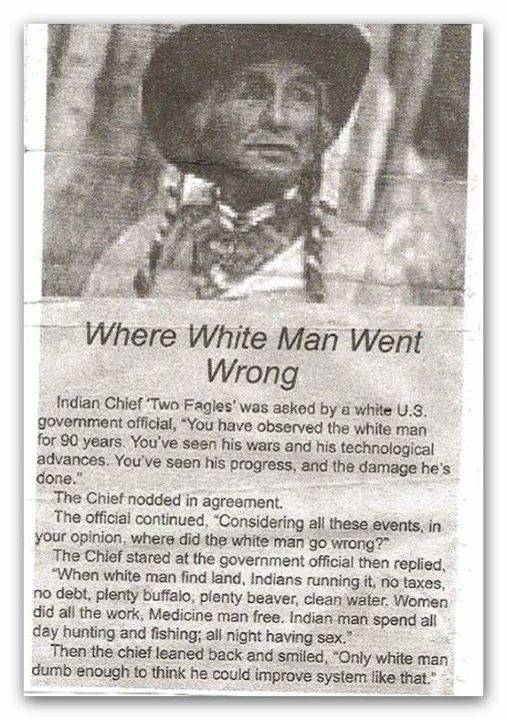
Old, but still cute. Where the white man went wrong.

Harry Newton whose favorite daughter Claire came to visit. This morning I put her on a train to Secaucus, New Jersey.

Once upon a time, Secaucus was the pig capital of the U.S. Every night trucks would arrive in Manhattan to collect left-over food from Manhattan’s restaurants. They would take it back to Secaucus and feed it to the pigs. Apparently the noise and smell of happy feasting pigs was too much for the upstanding residents of Secaucus. And now they use Secaucus as a place for legal depositions — or depos, as my daughter, the lady lawyer, calls them. Good advice: You don’t want to be on the receiving end of Claire’s depos.

Am I the only one who thinks WFC is running a mickey mouse bank?
“Chinese going to the dentist”…huh?
Bernarki are ideit. And dat just de beginning. Its clear: he worst ever.
As you said, your children cannot get a job with bad grammar also. Me and you know that. Them should also be better learned.
You come off quite the idiot, Lou.