I’m buying a little T-Mobile today. The company got remarkably good reviews in the latest cellphone carrier comparison survey in PC World magazine. Now it can’t be acquired (Justice Department ruling), the company is going all out — investing strongly, hiring new management, offering phones and service plans very differently (and cheaper) to the majors and pitching an Avis marketing campaign — we’re number two and trying harder (which they are — trying harder, that is). A friend is a big distributor for them — they call it an MVNO — and reports the new T-Mobile is a pleasure to work with and his customers are happy with their service. I’ll have a review on their service in a few days.
Nice chart?

I sold my Verizon shares yesterday. They owe a huge amount of money to Apple because of a commitment they made to sell iPhones. Their financials suck. Verizon’s, that is. From the Wall Street Journal’s web site:
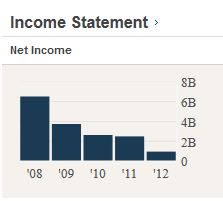
Verizon management is mired in old-telco landline thinking. No new products or services in eons. They keep raising their prices. Their monthly bills are incomprehensible. And their shares have been squirrely of late:

Apple will debut an iPhone 5S in the fall. It’s worth waiting for. A report by Business Insider shows a technologically improved phone — better camera, bigger battery, faster processor — but nothing dramatic. I want to buy an unlocked iPhone 5, slip in a SIM card from T-Mobile or one of its distributors (like Ultra Mobile) and dump Verizon which has gotten way too expensive.
Microsoft has cut the price of the Surface RT, its horrid tablet computer that’s supposed to fight Apple’s iPad. The new price is $350, down 30% from $499. Still not worth buying. For one, it can’t run Windows software. For two, it can’t run apps from the Apple store. For three, it doesn’t turn me on.
Sense from reader Capt Bill yesterday:
Ideas – I get mine from local exposure – The supplier shops for the auto industry for example – when they get busy and start hiring it’s pretty obvious the auto industry is gearing up. May be the Peter Lynch method but I’ve never read any of his thinking. 2006 I saw the national economy tanking a year ahead of the doo doo hitting the fan. Real estate in Fl & Oh were falling off miserably, yacht sales at HZO were falling and the press didn’t even notice – wasn’t long and the prices broke & the world almost ended – I got out in Jan. 07 and went to 6.375% c.d.’s and missed out on all the fun of ruptured markets. My recent adventures getting back in are stressful (always buying at the top) but everything is working nicely… MLP’s are the stars but my big oil folio is doing well as are healthcare – as core positions I’ve done very well with VWENX and a new one since January – sold out of VOHIX for VASVX – miss the triple tax free.
YOU seem to be more short term almost trader like in the last couple years – example you bailed out of GME way too early – I sold couple weeks ago with a gain of 85% – I’m still buy and hold oriented until the credit union gets some more 6% + c.d.’s then I’m baling out the other direction again.
Actually I was never in GME. I wish I had been. It has done well. It continues to do well.
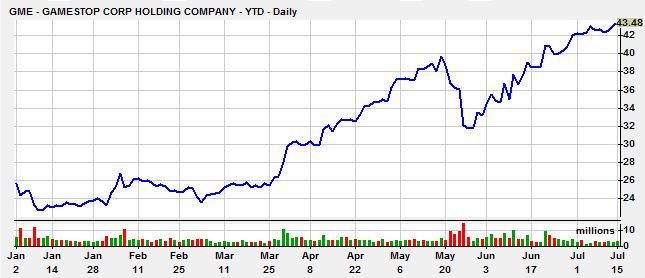
Gamestop is interesting. It fell 20% in May. Under my stop loss rule, I would have sold out. But it bounced back. Would I have bought back in? My rule on getting back in — If it rises by 15% and the fundamentals make sense, then I’m back in.
Stuff of life
+ Cordless phones need new batteries, occasionally. Good idea: replace them before the spouse complains. The best place to get them is from Batteries.com.
+ Everyone will bargain. Airlines. Hotels. Online stores. EBay sellers. Only humans can bargain. Try to speak to one.
+ Using Outlook? You need to “maintain” it — empty your deleted and spam emails, scanpst the Outlook.pst file, then compact the file. If you don’t do all this regularly, Outlook will run very very slowly and ultimately stop.
+ Budget Blinds does a handsome job. Their blinds cut heat and sun. Our local franchisee, Bob Poulin, did a superb job with ten blinds he just installed for us. Thank you, Bob.
+ Keep hitting the Save button. It’s an insurance against the disaster that has happened recently to all my friends — especially during the power glitches which happen in the summer.
+ Please back up your working files. Back them up to an external hard drive. Apricorn makes great ones. Do not trust backing up to the cloud. The cloud works but usually when you don’t need it. I use software called FreeFileSync.
+ Give away clothes and shoes you haven’t worn for 12 months. There are people who need your stuff. Mine goes to poor communities in the Dominican Republic.
On Wall Street, a culture of Greed Won’t Let Go. From today’s New York Times, and worth reading:
By Andrew Rose Sorkin Ethics. Values. Integrity.Wall Street firms spend a lot of time using those catchwords when talking about developing the right culture. Bank chief executives often discuss how much effort they devote to instilling a sense of integrity at their institutions. The firms all have painstakingly written codes of conduct, boasting, “Our integrity and reputation depend on our ability to do the right thing, even when it’s not the easy thing,” as JPMorgan Chase’s says, or, “No financial incentive or opportunity — regardless of the bottom line — justifies a departure from our values,” as Goldman Sachs says.
And yet a new report on industry insiders about ethical conduct, to be released on Tuesday, disturbingly suggests that Wall Street’s high-minded words may largely still be lip service.
Of 250 industry insiders from dozens of financial companies who responded to questions — traders, portfolio managers, investment bankers, hedge fund professionals, financial analysts, investment advisers, among others — 23 percent said that “they had observed or had firsthand knowledge of wrongdoing in the workplace.”
If that’s not attention-grabbing enough, consider this: 24 percent said they would “engage in insider trading to make $10 million if they could get away with it.”
As we approach the fifth anniversary of the onset of the financial crisis this September, it appears memories are shorter than ever. If the report is accurate, the insidious culture of greed is back — or maybe it never left.
The questions were posed last month by the law firm Labaton Sucharow at the behest of one of its partners, Jordan A. Thomas, a former assistant director and assistant chief litigation counsel in the enforcement division of the Securities and Exchange Commission. The results are a telling reminder of the continued challenges the industry faces, challenges that appear endemic.
While the results may not be scientific, they are stark. For example, 26 percent of respondents said they “believed the compensation plans or bonus structures in place at their companies incentivize employees to compromise ethical standards or violate the law.”
There is a view that the ethical problems come from the very top: 17 percent said they expected “their leaders were likely to look the other way if they suspected a top performer engaged in insider trading.” It gets even more troubling: “15 percent doubted that their leadership, upon learning of a top performer’s crime, would report it to the authorities.”
There is nothing acceptable about these responses.
Wall Street has a very real problem, whether the leaders of the industry want to believe it or not.
It is often said that it is unfair to paint an entire industry with a broad brush, and it is. There are clearly good people out there doing good work. A large majority falls in that category. But the numbers presented in the report reflect an unsettling reality that there may be more than just a few bad apples in the industry, too. It should be considered a red flag when insiders say this: “28 percent of respondents felt that the financial services industry does not put the interests of clients first.”
Perhaps oddly, the problem is most pronounced among the youngest employees in finance, the next generation of leadership on Wall Street.
Remember the question about whether an executive would commit insider trading for $10 million if there were no repercussions? Well, if you parse the numbers by seniority in the industry, respondents with under 10 years of experience were even more likely to break the law: 38 percent said they would commit insider trading for $10 million if they wouldn’t be caught.
That result is particularly striking since I would have expected the next generation of financiers to be the most interested in helping to build a new, anti-Gordon Gekko culture on Wall Street.
Virtually every top M.B.A. program in the country now teaches ethics classes, many of them required. In 2008, a coalition of students started the MBA Oath, a voluntary pledge among students to “create value responsibly and ethically.” So far, more than 6,000 students have signed the pledge.
And yet, the report and other anecdotal evidence suggest that whatever is being done both in the classroom and on the job is not enough. According to a controversial study called “Economics Education and Greed” that was published in 2011 by professors at Harvard and Northwestern, an education in economics surprisingly may be making the problem worse.
“The results show that economics education is consistently associated with positive attitudes towards greed,” the authors wrote. “The uncontested dominance of self-interest maximization as the primary (if not sole) logic of exchange, in business schools and corporate settings alike, may lead people to be more tolerant of what other people see as morally reprehensible.”
The problem is compounded by a trait shared by everyone, no matter their industry. “People predict that they will behave more ethically than they actually do,” according to a 2000 study led by Ann E. Tenbrunsel, a professor at Harvard. “They then believe they behaved ethically when they didn’t. It is no surprise, then, that most individuals erroneously believe they are more ethical than the majority of their peers.”
That may help explain why, in the Labaton Sucharow report, 52 percent said they “believed it was likely that their competitors have engaged in illegal or unethical activity in order to be successful.”
It may also explain why 89 percent of respondents “indicated a willingness to report wrongdoing” yet so few do.
As part of the Dodd-Frank financial overhaul law, the S.E.C. developed a $500 million whistle-blower program that pays 10 to 30 percent of penalties collected to the whistle-blower. The fund still has some $450 million in it, despite recent remarks by Stephen L. Cohen, associate director of the S.E.C.’s enforcement division, that we should expect bigger payouts soon. Mr. Thomas of Labaton Sucharow helped develop the whistle-blower program when he was at the S.E.C., and he now represents whistle-blowers.
“We are seeing a culture of silence,” he said. “There’s an unwillingness to come forward.”
Greed, for far too many, is still good, apparently. There’s still much work to be done before the catchwords become the culture.
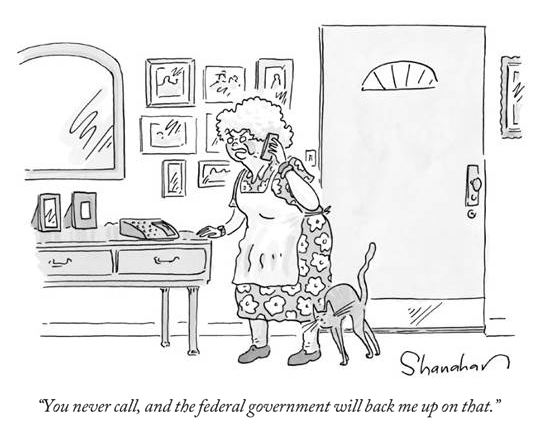
Favorite New Yorker cartoon this week.

Harry Newton who played tennis twice yesterday — a total of two hours — and biked a little. It’s crazy. The more exercise I do, the better I feel. Weird.

I don’t often agree with the New York Times, but your article from them says it all, and says it well. Wall Street money and greed tops all else. It’s a shame. And it harms business people everywhere by distorting the public perception of business people. Sorry, but we’re not all greedy and without ethics. Making our customers happy is our drive and we’re rewarded when we do. Apparently not so on Wall Street.
The Surface RT was such a bad idea on so many levels. So, they create this little tablet (it’s a god choice of hardware, actually), but it uses an ARM processor that is incompatible with Win 8 apps. Any apps have to be rebuilt / recompiled for the ARM processor. It’s a whole different platform.
Then they go and price it ‘at’ a comparable iPad. Again, the hardware is quite GOOD! It’s the choice of processor / software to run on it that was ill-conceived. There’s no compelling reason to switch from an iPad to an RT. The iPad has superior app support, an operating environment (iTunes, app store, iCloud, etc.). The RT is really a product with no problem or solution associated with it.
Then, (what was it) 6 months later, they release the Intel processor version (Surface Pro) which runs Win 8. Well, now there’s no damn reason for the RT any more, is there?
Reduce the price to $0, in my opinion. Then maybe some hacker kids can figure out how to put Android on it and turn it into a really good TV Remote…
Something’s seriously wrong with their thinking at MSFT.
May I publish your remarks in tomorrow’s column. You’re right on, in my opinion.
Preston Gralla has a piece in the latest Computerworld on what’s wrong at Microsoft. He thinks it’s the lack of an engineer at the top. It’s the July 15 issue. Email me if you want a copy.Thanks for commenting.
Surely! no problem.