The Wall Street Journal reports that the U.S. second-quarter GDP growth is revised up to 2.5% — which is better than a slap in the belly with a cold fish (bad Australian expression).
74.3% of statistics are made up on the spot. People will accept your made-up statistics if:
1. They seem plausible. You couldn’t say that 67% of people are women. It’s not plausible. But 50.13% is. Simple statistics, like 75% of… are generally not believable. But 75.1% is, and
2. No one has any better statistics to contradict you.
3. If they want to believe because it suits their ends, or most importantly, if they can use your statistic to justify something they want to do.
4. If your statistics are repeated often enough and in many diverse places by many sources. Statistics benefit by marketing.
Bloomberg reports this morning:
Oil retreated from a two-year high, gold declined and India’s rupee rebounded from a record low. European stocks climbed for the first time in four days, led by the biggest rally in Vodafone Group Plc (VOD) since 2008. “
“Why India is particularly vulnerable to the turbulence rattling emerging markets.” From The Economist.
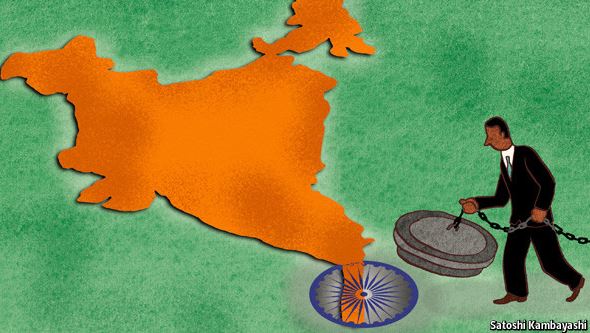
Click here.
I tour the local big Best Buy on Sixth and 23rd Street. I learned:
+ We’ll all be buying 4K Ultra HD TVs. They really are that good.
+ While Microsoft dithers, Google pushes. I saw a sign “The same TV, now with the power of Google.” Think BIG smartphone.
+ Big computer monitors really are cheap. You’d be crazy not to have several on your desk. Multiple big screes make doing your work so much easier.
+ The Kindle PaperWhite is the best way to read an eBook. It’s as low as $119. I liked it better than the Kindle Fire HD. Click here.
+ The Samsung “store” inside the Best Buy store is uninspiring. Its phones are locked down and impossible to play with. The 12-year old sales rep fawns over the Galaxy S4 with its long battery life and fast Qualcomm processor. It seems to be a nice phone. But everyone in New York (based on my subway observations) uses an iPhone.
Best Buy’s stock is now thoroughly over-priced:
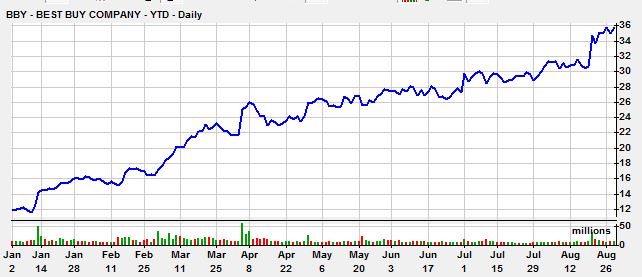
But it’s paying a dividend and allegedly yielding 1.9%. It’s actually money a little money and analysts are optimistic. From Bloomberg:
From Bloomberg:
Richard Schulze, Best Buy Co.’s founder and largest shareholder, informed the consumer electronics retailer that he plans to sell an undisclosed amount of its stock to diversify his assets and raise money.
Under the prearranged plan, Schulze can sell Best Buy stock between Oct. 1 and March 2014 at prevailing market rates, subject to minimum price thresholds, the Richfield, Minnesota-based company said yesterday in a securities filing. Schulze, 72, will have no control over the timing of the sale.
Shares of Best Buy have doubled in the past year after Chief Executive Officer Hubert Joly, who took charge in September, matched rivals’ online prices and cut annual costs by $390 million through Aug. 3. The company sold its 50 percent interest in a European smartphone joint venture with Carphone Warehouse Group Plc (CPW) for about $775 million.
“The guy’s net worth has doubled in the past year,” said Michael Pachter, an analyst at Wedbush Securities in Los Angeles. He rates Best Buy as underperform, the equivalent of a sell rating. “Why not take some off the table?”
If I were 72, I’d take some of the table also… Heck, I’m 71. I’d definitely take some off the table. Time to short it also?
This weekend is Labor Day. Everyone on Wall Street is in the Hamptons (on Long Island). They don’t want us to bomb the crap out of Syria. But they can’t do anything about. Hence, enjoy the miserable weather, the sky-high prices and watch more of the US Open on TV.
Syria. I have no idea what we’re trying to do. Except tell all Assad’s people to run to someplace safe before our bombs rain shock and awe. Here’s what Stratfor writes:
The U.S. administration appears to be going out of its way to leak to news outlets the details of an impending operation in Syria. This should be seen as a form of dialogue between the government and a war-weary American public. The message behind the leaks is that the United States intends to carry out a limited punitive strike — one in which some, but not all, high-value targets, including command and control facilities and delivery systems, will come under a barrage of Tomahawk cruise missiles and other guided missiles in an operation lasting less than a week.
The emphasis on a short operation is primarily intended to assuage the concerns of many Americans still skeptical of the need to militarily intervene in the Middle East for the third time in a decade. Though it won’t be said outright in a press release, the United States has little interest in delivering a deadly blow to the regime. If the United States breaks the regime, it will have a hard time dodging the cleanup, especially when jihadists operating in a weapons-rich environment will exploit the power vacuum in Damascus.
Instead, the primary intent behind a limited strike will be to deliver a message that Washington hopes will resonate well beyond Syrian borders: Ignoring U.S. ultimatums will carry consequence. U.S. President Barack Obama put U.S. credibility on the line when he declared the use of chemical weapons as his red line for action, and so action will follow.
But the type and timing of the action will also greatly affect the credibility of the message. The widely telegraphed limited strike plan for Syria is already conjuring up negative comparisons to Clinton’s 1998 cruise missile strikes in Sudan and Afghanistan that evidently did nothing to weaken al Qaeda, as well as Operation Desert Fox launched the same year to “degrade,” not eliminate, Iraq’s ability to manufacture weapons of mass destruction. This could well be another symbolic, albeit ineffective, foreign policy decision to demonstrate that the United States is doing something, even if that something isn’t much of anything.
Already struggling to convince the American public that the Syrian regime’s chemical attack deserves a military response, the president is also being challenged by his own schedule. Obama is set to leave Sept. 3 for Sweden, from which he will travel to Russia for the Sept. 5-6 G-20 summit. Unnamed White House officials talking to the press have speculated that Obama would like to have the operation wrapped up before he takes the trip, which is what has fueled rumors that the operation could begin as early as Thursday nightfall.
The U.S. military already has the assets in place for a limited strike, but the legal path to the strike is still bumpy. U.N. Secretary-General Ban Ki Moon is insisting that the United Nations be given the time — at least four days — to complete its investigation of the attack. The United States has been trying to convince the public that it has the evidence it needs to justify an attack and that the investigation itself is inconsequential. Russia has been condemning the United States for seemingly rushing into action without evidence and said that it will not consider a resolution in the U.N. Security Council until it sees the U.N. report on the attack. Even the United Kingdom, which introduced a resolution to the U.N. Security Council on Wednesday authorizing “necessary measures to protect civilians” in Syria and which would be playing a significant role in the operation itself, is now saying that it, too, would like to see the results of the investigation before taking action. Whether the delivery of the U.N. report can be accelerated is unclear at this point.
The United States does not necessarily want to invite criticism for taking a legal shortcut to military action, particularly when the United Kingdom is now assuming a more cautious legal stance in demanding a review of the investigation before a strike. At the same time, the U.S. administration has to worry about building, not to mention maintaining, public momentum for a military response to a chemical weapons attack that occurred a week ago. Unless further provocations by the Syrian regime are made, as days pass Obama’s struggle to build his case will grow.
The additional time could still be put to good use, however. The United States will try to use any extra time to build up coalition participation in an attack, though critical players like Turkey and Jordan that are highly prone to retaliation are already exhibiting signs of reluctance about getting more deeply involved. Most important, the United States will try to use any additional time to try to force a diplomatic solution that would have the ideal outcome of extricating Syrian President Bashar al Assad and avoiding a strike altogether.
For this ambitious outcome, the United States needs Russia. The Russians have a substantial intelligence footprint in Syria and relationships with the al Assad regime. Russia would thus be Syria’s primary diplomatic patron to help orchestrate an exit strategy for the Syrian president. Such an arrangement could still keep the military and intelligence apparatus intact and thus avoid creating a power vacuum in Damascus. Russia would also be able to preserve its influence in a post-al Assad regime, and the United States theoretically would be able to avoid another messy military entanglement in the Middle East. But the Russians would exact a high price for such a diplomatic bargain, and it’s not clear that a politically acceptable exit for al Assad would be possible. Al Assad would have a hard time trusting a negotiation knowing that he could be tried for war crimes. Instead, a more creative solution may be sought that aims at facilitating an Alawite coup against al Assad, but even that strategy comes with its share of obstacles.
The United States would need to pull back from the perception of a limited strike to telegraphing a much more devastating military campaign to influence al Assad to bend to an ultimatum. More military assets would also have to be moved into theater to try to bluff such an operation. This would come at the cost of upsetting the already carefully orchestrated public relations campaign the administration has been pursuing to convince the American public that its military response will be brief and limited in scope. The leaks so far may seem like they have all the answers of how and when the strike will take place, but there are still a number of constraints on all players that will ultimately shape this operation.
Why do I think this is funny? From this morning’s Business Insider:
Bloomberg’s Dawn Kopecki reports the Justice Department has joined the SEC in investigating whether JPMorgan illicitly hired candidates merely to gain business from their wealthy family members. She also lays out the broader predicament faced by the firm: “JPMorgan, led by Chief Executive Officer Jamie Dimon, 57, is contending with criminal investigations of its energy-trading and mortgage-backed securities operations. The firm also faces U.S. probes of its anti-money-laundering safeguards, foreclosures, credit-card collections, and $6.2 billion in losses last year on botched derivatives bets by a U.K. trader known as the London Whale.”
The situation is even uglier at two other financial firms: the chairman of Zurich Insurance resigned this morning after the company’s CFO committed suicide. And a Goldman Sachs managing director was indicted yesterday afternoon on rape charges.
Good reasons to own financial stocks?
Do I really care? How Apple is wasting its advertising dollars.

Favorite New Yorker cartoons from this week’s issue:
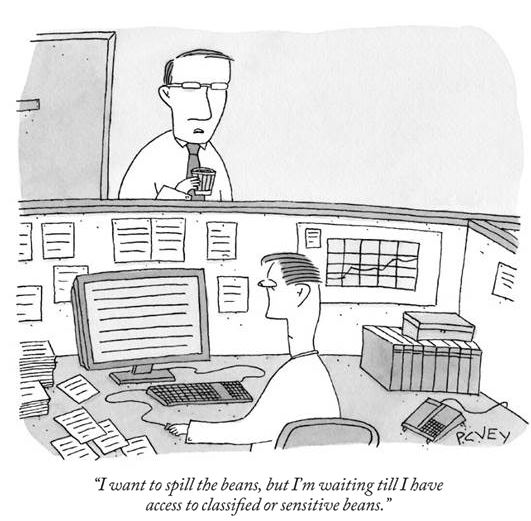
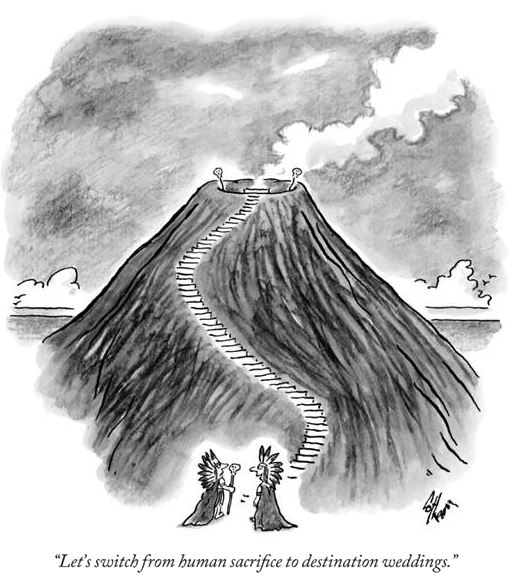

Harry Newton who’s happy. The eye doctor pronounced my cataract operation a success and said I could now resume my “normal” activities of washing my hair and “straining at stool.” Truly wondrous pleasures.
One of my erstwhile miserable private equity funds just gave me a $91,069 distribution, which wiped out the $75,000 loss in the market on Tuesday. Ah, the joys of diversification. Never underestimate them.
I watched Obama “I had a dream” speech yesterday. The original Martin Luther King speech was much better. Click here.

I’m in favor of blowing Syria off the map if it can help the U.S. economy. And I believe ultimately that war is very good for the economy. Of course, as an Australian, Harry will be surrendering once the war begins.
Can’t speak for Harry, but the Aussie’s have been side-by-side with us in every war and confrontation and have the casualties to prove it. Great people.
The U.S. has found a new country to bomb. News of the upcoming adventure in Syria pushed stocks lower yesterday.
The benchmark S&P 500 dropped 1.6% yesterday… its worst day since June. Oil touched a two-year high. European stocks reached their lowest low in six weeks. Gold reached its highest level since May.
With the Syria bombing campaign in mind, the investor asks, “How I can I ‘play’ the war for a profit?”
We have an unconventional idea for you…
But first, realize that in the greater scheme of things, the current crisis in Syria is nothing.
Yes, it’s a terrible human tragedy. Yes, we’d rather see everyone just get along. But the mainstream media is paid to hype things beyond belief. That’s what it’s doing with Syria right now. War sells. Crisis sells. The media does whatever it takes to scare the rubes.
Time to remind everyone of Colin Powell’s (last) sage advice: the Pottery Barn Rule – you break it, you own it. This is probably the main reason for not touching Syria. This place is a no-win situation, and it’s not possible for a ‘limited strike’ to leave anything positive behind. If you’re not ready to spend 8 years, a trillion dollars,and 3500 lives there, don’t even touch it.
http://en.wikipedia.org/wiki/Pottery_Barn_rule
My first day taking a statistics course in college, the professor told us that ‘Statistics prove that 99% of all statistics are false’.
Old saying “Statistics don’t lie, people lie using statistics”.