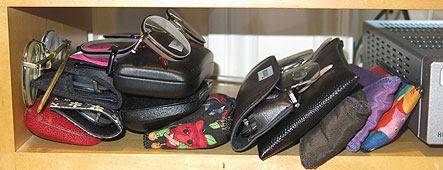
I woke up this morning, felt for my glasses. Then realized I didn’t them. Then I forlornly looked at the huge pile of now useless glasses.
And then I looked at myself in the mirror.
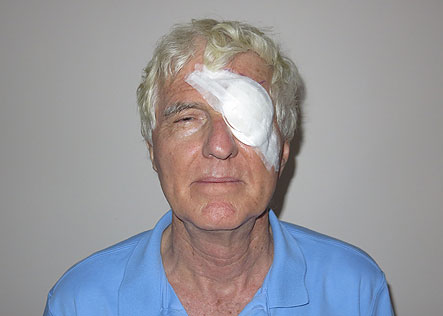
A truly awful sight. This cataract-removed eye took 12 hours of sleeping to recover from the Versed anesthetic, which didn’t work as well as the first eye.
The wrinkles are frightening. There has to be a better solution to ageing, though the alternative is probably worse.
Twitter’s coming. I hope Nasdaq doesn’t bungle. Goldman Sachs is the lead underwriter, which means I won’t get any, despite being a Goldman client. They give all their hot IPO offerings to their favorite clients who tend to be big trading institutions or CEOs of companies they’re pitching to bring public.
It’s five years after our last financial crisis, Hand Paulson and co. have produced a film called Five Years from the Brink. According to the film’s promo, “Paulson tells the complete story of how he persuaded banks, Congress, and presidential candidates to sign off on nearly $1 trillion in bailouts—even though he found the behavior that led to the crisis, and the bailouts themselves, morally reprehensible. Paulson also details (surprise, surprise) why another fiscal crisis is inevitable.”
HANK: Five Years From the Brink will launch exclusively on Netflix on September 16, 2013. You can watch a clip here.
BusinessWeek has devoted all of this week’s issue to Paulson, who doesn’t need the money, but may need some reputation rehabilitation.
To BusinessWeek’s credit, they closed their long dreary issue with an interview with my favorite financial author, Michael Lewis, whose wonderful book, The Big Short, has just reached 691,000 copies in the U.S. That doesn’t include Kindle or overseas sales. Don’t weap for Michael Lewis:
Was Lehman unjustly singled out when it was allowed to fail?
Lehman Brothers was the only one that experienced justice. They should’ve all been left to the mercy of the marketplace. I don’t feel, oh, how sad that Lehman went down. I feel, how sad that Goldman Sachs (GS) and Morgan Stanley (MS) didn’t follow. I would’ve liked to have seen the crisis play itself out more. The problem is, we would’ve all paid the price. It’s a close call, but I think the long-term effects would’ve been better.
What surprised you most while reporting on the crisis?
The realization that it had actually paid for everyone to behave the way they behaved. Working on The Big Short, I first thought of it as this bet, and there were winners and losers on both sides of the bet. In one sense there was—but on Wall Street, even the losers got rich. So that was the thing I couldn’t get out of my head: that failure was so well-rewarded. It wasn’t that they’d been foolish and idiotic. They’d been incentivized to do disastrous things.
Henry Paulson, the man behind the bank bailouts, recently said, “The root cause of every financial crisis is flawed government policies.” Is that fair?
Some of the government’s policies have been idiotic. But the idea that the story begins and ends with government policy is insane. Wall Street, all by itself, orchestrated the crisis by a web of deceit that was breathtaking. If Wall Street continues to operate in that spirit, I would argue that there’s almost nothing the government can do to prevent them from doing bad things. Incentives are at the bottom of it all. At the gambling end of Wall Street, the people who are making decisions are making decisions not with their money, but with other people’s money, [so] they themselves are not personally responsible.
The other things at the bottom of it all are core to the human condition—optimism, gullibility, greed, panic. Is there any way, finally, to prevent people from behaving this way?
Yeah, what can you do? Well, you can lessen the reward for behaving this way. You can punish people more for behaving in this way. Part of this story is the story of a moral problem, and the moral problem grows out of the change in the structure of Wall Street. When there were partnerships and people’s money was on the line … they were encouraged to behave in ways that were to the long-term benefit of the organizations they belonged to. Long-term behavior is just much different from short-term behavior—it encourages a different morality. And for several decades on Wall Street, the short-term sensibility has been encouraged and compensated very highly. So what you’ve got is a culture that is all about that. Whether they say it or not, that’s sort of the water in which the fish swim. I think as a result you have, basically, total neglect of social responsibility.
Is this related to wealth inequity, the 1 Percent?
It isn’t because of what people are worth. It’s because their incentive system has changed, [which has] changed the values of people who were there. I think that’s a big problem. And the result is that people don’t trust the system. Why would you? The cost of the mistrust is hard to measure, but it’s big. If you’d asked me [in 2008], is the reform process going to play itself out the way that it has, I’d have said, No way—there’s going to be a more drastic change in the system. But there hasn’t been. I don’t know what it takes, what other crises would have to come down the pipe.
Has Silicon Valley replaced Wall Street as the place for bright young people to make their millions?
My sense is that even though the financial crisis has lessened the appeal of the big Wall Street firm, it’s still appealing to kids in school, for the simple reason that unlike Silicon Valley, where you do have to know something to break in, the barriers to entry on Wall Street are quite low once you have the [Ivy League] credentials. If you’re a certain kind of kid who doesn’t actually know anything about anything, Wall Street is still a great place to go.
Are you able to sleep easier now, or are things as tenuous as ever?
I’m in an emotionally complicated position: The worse it gets, the better it is for me. In a weird way, the worst thing that could happen is for the financial sector to figure out how to behave.
“The worse it gets, the better it is for me”
Is there a particular threat you’ve identified that’s most likely to blow up next?
The answer is yes, but I can’t talk about it yet, because I’m in the middle of a book about it. It’ll come out next March.
And will that be before or after it erupts?
I can’t actually tell.
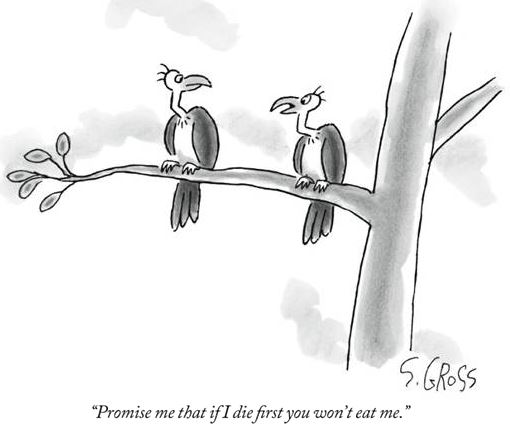
Favorite recent New Yorker cartoons:

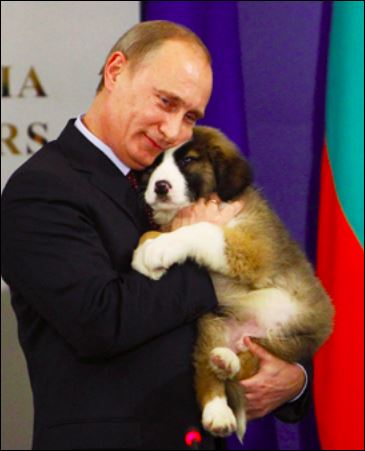
Favorite Putin picture. Apparently he’s already one of Russia’s richest. It seems the formula for success in business in Russia is simple: If you don’t want to be put in jail, you give him shares, planes and cars and houses. Lots of them. I don’t think this works here.
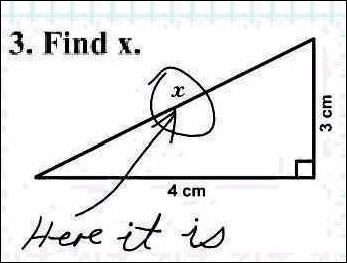
Students who drive teachers nuts.

Harry Newton who used to look like this. The BA distress buy worked out. It hit a 52-week high last night. The new Dow 30s are doing ok — Nike and FB. I bought a little PHM, LL ,TRIP and NLY. They’re dong poorly. But not enough to dump. Today should help. Futures seem to be strong. The eye doc is removing my bandage this morning. With two new eyes, I should stop bumping into things.
My friends: Please stop sending me articles that show how President Obama screwed up bigtime with Syria. Fortunately we didn’t get involved in another war. Be thankful for small mercies. Assad, who’s a wily fish, now wants us — as part of his deal to give up his chemical weapons — to stop sending arms to the rebels. An interesting chess game, this one. And an interesting mess Obama got himself into.

Did you have regular surgery or did you do laser? Hope it’s imporving.
Harry, hope your eye gets better quickly. Mine were easier, simply wearing a clear protector the first two nights. I got Crystalens (which has its own pitfalls). Which premium lense did you get? I assume you’d opt for the more expensive lense (which have more consequences!)
I got something from Alcon Labs in Texas called ACRSof IQ Model SN60WF Power. I have no idea if these are pricey or cheap. The doctor did what he felt comfortable with and I didn’t ask if they were the best or the cheapest. They’re starting to work. I can well with the eye from two weeks ago.
Thanks! Sounds like an excellent, fool-proof lense (within limits!). A friend will be selecting cataract lense shortly, and I’m trying to provide some guidance … steering away from Rezoom, Restor, & Crystalens which have their own problems (the surgeons never tell you about). I recall you requested computer reading, and glasses for distance. My Crystalens both started at about 20/40, then about 3-5 months out, one shifted to 20/25, and the other to 20/70 (hence, I can see far and near, just lucked out, I guess), i.e. the doc has not a clue as to what will be the final visual acuity, though he did say he could do a 5 minute Lazik touch-up (no-way, stay-away). All my friends with standard, mono-focal lense are happy; can’t say the same for the pricey, profitable options which are hit-or-miss.
I don’t know if it’s an old wives tale, but I heard you could go blind watching the stock ticker.
I hear there is one thing you can go blind from, also. It’s probably more fun than watching the ticker.
All that done with one eye? Good job, Harry! The good news is that in a couple of weeks you can take a GOOD New Photo!