If Congress shuts the Federal Government down, millions of Federal workers will not get paid during the shutdown.
One group will get paid, irrespective. You have one guess.
Congratulations. You guessed right. That group is our Senators and Congressmen and women.
Oh yes, they also aren’t subject to Obamacare. They have their own healthcare. It’s much better than yours and mine.
And we elected this bunch.
Sense may prevail. It looks like they will actually increase the debt ceiling and keep the government running – just in the nick of time. The debt ceiling was due to expire on Monday.
I’m guessing all this will be good for the market. And we might see some modest gains — and perhaps a big one when they finally pass the law to lift the debt ceiling.
I bought a little QCOM yesterday. It’s getting good analyst reviews for its technology and its continuing lead in the popular LTE fast cell data services.
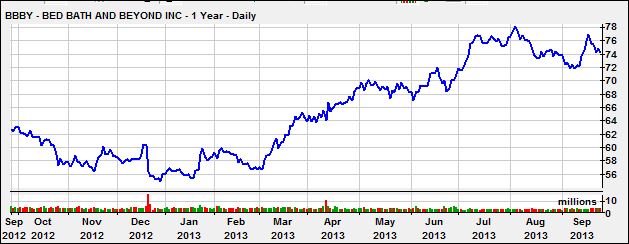
I sold a little BBY short. There’s heavy insider selling. One is selling because of “marriage dissolution.” Is that also called divorce? It’s hard to believe the stock is not due for a pullback. For more, click here.
Why didn’t I buy Bed, Bath and Beyond? I love the store. Susan loves the store. Everyone loves Bed, Bath and Beyond.
I missed it. What a moron. So easy to turn one’s head to: What impressed me today? Yet I didn’t play that Peter Lynch game. I should have.
My real estate friend had Autozone as a small tenant. Autozone wanted to negotiate a longer lease. My friend demurred. The lease had some silly provisions. Autozone’s lawyer agreed. The terms were silly. But they weren’t rewriting their standard lease because they were opening a new store every five or six days. At that point Autozone’s stock was $80. It’s now over $400. My friend missed it.
The lesson: You got to keep your eyes open.
Nothing affects your success (and your children’s success) more than education. The biggest revolution in education is something called MOOC — which stands for massive open online course. You take courses over the Internet and pay — typically — nothing. Your kids should take courses in computer science. But MOOCs now also offer courses in the humanities. Today’s New York Times has a super piece on MOOCs. It begins:
A Surge in Growth for a New Kind of Online Course.
ONLINE course work has been a staple of American higher education for at least a decade. But over the last few years, a new, more ambitious variant known as a MOOC — massive open online course — has challenged traditional assumptions of what an online course can be. MOOCs have exploded in that short time, redefining who can enroll in college courses, as well as where, when and even why people take online classes.
Available globally to hundreds of thousands of people at a time, these classes depend on highly sophisticated digital technology, yet they could not be simpler to use. Signing up takes less time than creating an iTunes account. You can create a user name and password and start exploring the rapidly expanding course offerings.
The major Web sites already provide dozens of courses, as diverse as basic calculus and European intellectual history. It is both new and experimental, and as much as MOOCs have evolved since beginning in recent years, enthusiasts expect many more changes. From an early focus on technical and scientific courses, for instance, offerings now include the humanities and social sciences.
While there are some significant differences among the major MOOC Web sites, they share several main elements. Courses are available to anyone with access to the Internet. They are free, and students receive a certificate of completion at the end. With rare exceptions, you cannot earn college credit for taking one of these courses, at least for now.
“For a decade, people have been asking, ‘How does the Internet change higher education,’ ” said Edward B. Rock, a law professor at the University of Pennsylvania who is the institution’s senior adviser on open course initiatives. “This is the beginning. It opens up all sorts of possibilities.”
Navigating the world of MOOCs begins with three major Web sites.
EdX
Harvard and the Massachusetts Institute of Technology created this nonprofit joint venture in May 2012. It has already offered dozens of courses in subjects as diverse as physics, computer science, engineering, literature, ethics, law, medicine and economics.
Twenty-nine universities have signed up to participate, including the University of California, Berkeley; the University of Texas, Austin; Georgetown; Cornell; the Berklee College of Music; the University of Toronto; and the University of Kyoto.
Courses are offered for a designated period of time, with lectures and reading assignments provided in weekly segments. Videos of lectures are generally augmented with exercises, quizzes, labs and simulators. Like other platforms, edX emphasizes interactivity.
You can audit a course — meaning you don’t take exams or do writing assignments — or you can fulfill all of the requirements to earn a certificate of completion.
Each course’s home page provides an estimate of how many hours a week the course will require. Workloads vary widely. A Global History of Architecture, an M.I.T. class, requires at least five hours a week. Introduction to Computer Science, Harvard’s traditional introductory course, asks online students to complete eight problem sets, each of which will take 15 to 20 hours, along with two quizzes and a final project.
Coursera
Two computer science professors at Stanford began this commercial venture in April 2012. The original partners were Stanford, Princeton, the University of Pennsylvania and the University of Michigan. Seventeen months later, Coursera has partnerships with 84 universities and offers more than 400 courses.
Yale, Duke, Wisconsin and the University of Chicago are among the participants, as are the University of Edinburgh and the École Polytechnique in France.
Because courses are free, Coursera hopes to generate revenue in other ways, like linking corporations with students who have learned specific skills. Coursera does not formally offer the option of auditing a class, but people certainly can. Anyone can simply watch the videos and do some, all or none of the reading and homework; you just would not receive a certificate at the end.
Like edX, Coursera emphasizes interactivity, both online and by helping to organize in-person study groups in cities around the world. There are also online discussion groups, peer-to-peer forums and peer assessments of writing assignments in some classes.
Among the 70 or so courses that began this month are Introduction to International Criminal Law; Linear and Integer Programming; and Exploring Beethoven’s Piano Sonatas. Courses run for a set length, with material provided each week. Some last four or five weeks, while many go for 12 to 15 weeks.
Udacity
This is also a commercial start-up. It was begun by several people, including another Stanford professor, in January 2012. Udacity’s offerings are more limited, with a strong emphasis on science, math and computer science. There is also a sprinkling of business, psychology and design courses. About 30 courses are available.
The courses do not start or end on specific dates and they do not follow a weekly pattern of lectures and assignments. They are entirely self-paced: You start whenever you like, and you work through the material as quickly or as slowly as you please.
On the home page of an introductory course in computer science, Professor David Evans of the University of Virginia encourages students to collaborate and explains how his MOOC class is different from a traditional course.
“We intersperse our video segments with interactive questions,” Dr. Evans writes. “There are many reasons for including these questions: to get you thinking, to check your understanding, for fun, etc. But really, they are there to help you learn. They are NOT there to evaluate your intelligence, so try not to let them stress you out.”
For the full article, click here.
Two articles you should read:
+ How Detroit spent billions of dollars extra from its pensions and got itself into its present mess. For total fiscal irresponsibility, this ranks right up there. Click here.
+ AIG CEO Robert Benmosche Compares Bonus Criticism to Lynch Mobs. An amazing story by Rolling Stone’s Matt Taibbi. Click here.
How Harry searches his laptop’s search.A reader asked. I use two pieces of software:
+ Lookeen searches my Outlook emails, contacts and calendar. It’s fast and accurate. Much better than the crap Microsoft provides with Outlook Click here.
+ Everything (that’s what it’s called) searches my hard drive for files. It finds files — not their contents. It’s ultra-fast. Pick it up here.
If you need to search the contents of every file on your hard drive, then you need dtSearch. It’s exhaustive, fabulous and ultra-fast. But it’s consuming of hard disk space. Click here.
European advertising is so much more fun. Here’s a coffee commercial. Click here.
Investment tip: Buy wood pulp! Congrats to Adobe for this wonderful ad. Click here.
How to know if your dog is involved in a political sex scandal.

Makes sense to me. New York Times report:
Navy Yard Killer Felt His Mind Was Under Electronic Attack
Aaron Alexis, the man who police say killed 12 people at the Navy Yard last week, believed his mind was being controlled by electromagnetic waves, officials said.

Harry Newton whose daughter Claire is visiting for a couple of days. She’s the best. And still young enough to laugh at Daddy’s bad jokes.

Much better article on how Detroit went bankrupt: http://www.freep.com/article/20130915/NEWS01/130801004/Detroit-Bankruptcy-history-1950-debt-pension-revenue
Harry,
I’m going to have to insist that you stop spewing garbage.
Thank you.
Not to defend, congress considering my distaste for most politicians on either side, but I can’t imagine their decision process changing even if their salary was under threat from the shutdown. Most of them
are pretty wealthy compared to the salary they earn in congress as well as completely ideological. I’m also not sure what you mean when you say they are not “subject to Obamacare”. Of course they are subject, it’s just that they already have health insurance so they aren’t in the situation where they need either get health insurance or face a fine/tax. This is the case for most government employees and probably most people reading this blog.
As for Bed, Bath, and Beyond (BBBY), besides personally enjoying the store (for what reason I don’t know), what is the difference between them and Best Buy (BBY) beyond the extra B in the ticker? You’ve disliked Best Buy from an investment perspective but they seem to very similar business models, financial ratios, and performance.