Big story about buyout firms chasing billions for the next round of private equity fund raises. I’ve been in these things, and sadly I’m still in them. They’ve all been a disappointment: The returns have been slow in coming and low in returns (in one case a total loss). Their big plus is in the fees they give their promoters, which is why I continue to like APO, BX and KKR.
Here’s a chart from a recent presentation by Bain Capital which shows my main complaint — the declining returns in this asset class. Please note, I’m not being critical of Bain. I happen to have their chart and I believe, it’s indicative:
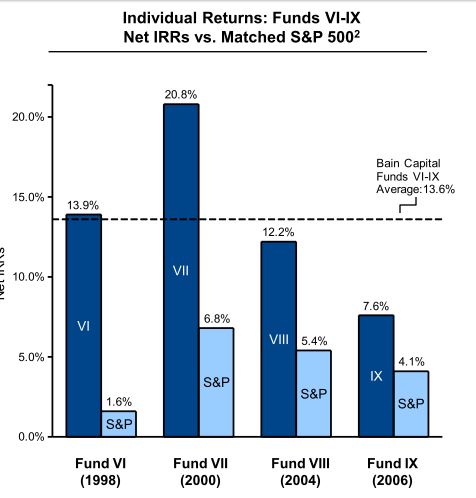
I wouldn’t pay much attention to the numbers they give for S&P returns. There’s something funny going on there. The S&P 500 does offer one huge advantage which these funds don’t: You can sell from one moment to another. If you try and sell your private equity fund investment, you’ll get a very painful haircut — like 50% of a depressed. Trust me. I tried.
The article was called “Buyout Firms Combing U.S. for Sky-High Sums to Invest.” Click here.
Apple is likely to move up this week. It introduces new stuff on Wednesday, including an iPad Mini with a retina screen which is what everybody and their uncle has been waiting for. Read “Tablet Makers Gear Up for Latest Skirmish.” Click here.
I once played consultant to business. If I told them what they believed, I was successful. If I told them something else, I got canned. Naively, I thought my job was to question their reality, introduce new idea — other why hire me? It worked for me in my own business because sometimes I listened to myself.
This was the best piece I read this weekend:
Why We Make Bad Decisions by Noreena Hertz, NYTimes.
LONDON – SIX years ago I was struck down with a mystery illness. My weight dropped by 30 pounds in three months. I experienced searing stomach pain, felt utterly exhausted and no matter how much I ate, I couldn’t gain an ounce.
I went from slim to thin to emaciated. The pain got worse, a white heat in my belly that made me double up unexpectedly in public and in private. Delivering on my academic and professional commitments became increasingly challenging.
It was terrifying. I did not know whether I had an illness that would kill me or stay with me for the rest of my life or whether what was wrong with me was something that could be cured if I could just find out what on earth it was.
Trying to find the answer, I saw doctors in London, New York, Minnesota and Chicago.
I was offered a vast range of potential diagnoses. Cancer was quickly and thankfully ruled out. But many other possibilities remained on the table, from autoimmune diseases to rare viruses to spinal conditions to debilitating neural illnesses.
Treatments suggested ranged from a five-hour, high-risk surgery to remove a portion of my stomach, to lumbar spine injections to numb nerve paths, to a prescription of antidepressants.
Faced with all these confusing and conflicting opinions, I had to work out which expert to trust, whom to believe and whose advice to follow. As an economist specializing in the global economy, international trade and debt, I have spent most of my career helping others make big decisions – prime ministers, presidents and chief executives – and so I’m all too aware of the risks and dangers of poor choices in the public as well as the private sphere. But up until then I hadn’t thought much about the process of decision making. So in between M.R.I.’s, CT scans and spinal taps, I dove into the academic literature on decision making. Not just in my field but also in neuroscience, psychology, sociology, information science, political science and history.
What did I learn?
Physicians do get things wrong, remarkably often. Studies have shown that up to one in five patients are misdiagnosed. In the United States and Canada it is estimated that 50,000 hospital deaths each year could have been prevented if the real cause of illness had been correctly identified.
Yet people are loath to challenge experts. In a 2009 experiment carried out at Emory University, a group of adults was asked to make a decision while contemplating an expert’s claims, in this case, a financial expert. A functional M.R.I. scanner gauged their brain activity as they did so. The results were extraordinary: when confronted with the expert, it was as if the independent decision-making parts of many subjects’ brains pretty much switched off. They simply ceded their power to decide to the expert.
If we are to control our own destinies, we have to switch our brains back on and come to our medical consultations with plenty of research done, able to use the relevant jargon. If we can’t do this ourselves we need to identify someone in our social or family network who can do so on our behalf.
Anxiety, stress and fear – emotions that are part and parcel of serious illness – can distort our choices. Stress makes us prone to tunnel vision, less likely to take in the information we need. Anxiety makes us more risk-averse than we would be regularly and more deferential.
We need to know how we are feeling. Mindfully acknowledging our feelings serves as an “emotional thermostat” that recalibrates our decision making. It’s not that we can’t be anxious, it’s that we need to acknowledge to ourselves that we are.
It is also crucial to ask probing questions not only of the experts but of ourselves. This is because we bring into our decision-making process flaws and errors of our own. All of us show bias when it comes to what information we take in. We typically focus on anything that agrees with the outcome we want.
We need to be aware of our natural born optimism, for that harms good decision making, too. The neuroscientist Tali Sharot conducted a study in which she asked volunteers what they believed the chances were of various unpleasant events’ occurring – events like being robbed or developing Parkinson’s disease. She then told them what the real chances of such an event happening actually were. What she discovered was fascinating. When the volunteers were given information that was better than they hoped or expected – say, for example, that the risk of complications in surgery was only 10 percent when they thought it was 30 percent – they adjusted closer to the new risk percentages presented. But if it was worse, they tended to ignore this new information.
This could explain why smokers often persist with smoking despite the overwhelming evidence that it’s bad for them. If their unconscious belief is that they won’t get lung cancer, for every warning from an antismoking campaigner, their brain is giving a lot more weight to that story of the 99-year-old lady who smokes 50 cigarettes a day but is still going strong.
We need to acknowledge our tendency to incorrectly process challenging news and actively push ourselves to hear the bad as well as the good. It felt great when I stumbled across information that implied I didn’t need any serious treatment at all. When we find data that supports our hopes we appear to get a dopamine rush similar to the one we get if we eat chocolate, have sex or fall in love. But it’s often information that challenges our existing opinions or wishful desires that yields the greatest insights. I was lucky that my boyfriend alerted me to my most dopamine-drugged moments. The dangerous allure of the information we want to hear is something we need to be more vigilant about, in the medical consulting room and beyond.
My own health story had a happy ending. I was finally given a diagnosis of a rare lymphatic vessel condition, and decided that surgery made sense. Not the five-hour surgical intervention that would have left me in bed recovering for more than three months, but a much less intrusive keyhole surgery with a quick recovery. I chose a surgeon who wasn’t overly confident. I’d learned in my research that the super-confident, doctor-as-god types did not always perform well. One study of radiologists, for example, reveals that those who perform poorly on diagnostic tests are also those most confident in their diagnostic prowess.
My surgery went well. The pain subsided, the pounds gradually came back on. I am now cured.
With brain switched on and eyes wide open, we can’t always guarantee a positive outcome when it comes to a medical decision, but we can at least stack the odds in our favor.
Noreena Hertz is a professor of economics at University College London and the author of “Eyes Wide Open: How to Make Smart Decisions in a Confusing World.” The article appeared in the Sunday Review of the New York Times.
Does anyone know how to get off LinkedIn? The site is seriously abusive of my privacy and has begun — by itself and without my permission — sending invitations to my friends. Does anyone know how to get off it?
Wonderful cartoons from this week’s New Yorker.
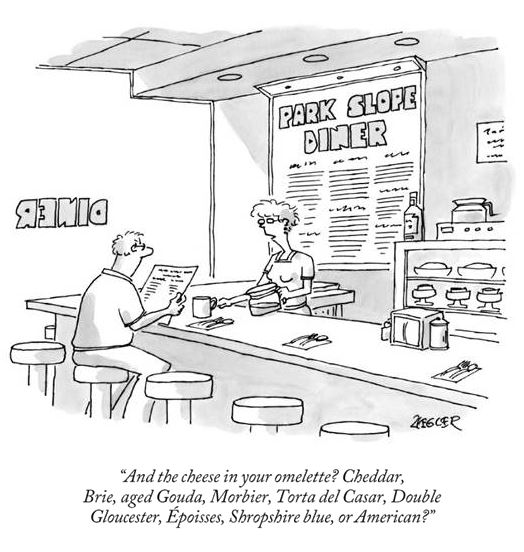


Old, but still wonderful.
An elderly couple were having dinner one evening when the husband reached across the table, took his wife’s hand in his and asked: “Martha, soon we will be married 50 years, and there’s something I have to know. In all of these 50 years, have you ever been unfaithful to me?”
Martha replied, “Well Henry, I have to be honest with you. Yes, I’ve been unfaithful to you three times during these 50 years, but always for a good reason.”
Henry was obviously hurt by his wife’s confession, but said, “I never suspected. Can you tell me what you mean by ‘good reasons’?”
Martha said, “The first time was shortly after we were married, and we were about to lose our little house because we couldn’t pay the mortgage. Do you remember that one evening I went to see the banker and the next day he notified you that the loan would be extended?”
Henry recalled the visit to the banker and said, “I can forgive you for that. You saved our home, but what about the second time?”
Martha asked, “And do you remember when you were so sick, but we didn’t have the money to pay for the heart surgery you needed? Well, I went to see your doctor one night and, if you recall, he did the surgery at no charge.”
“I recall that,” said Henry. “And you did it to save my life, so of course I can forgive you for that. Now tell me about the third time.”
“All right,” Martha said. “So do you remember when you ran for president of your golf club, and you needed 73 more votes?”

Harry Newton who had a totally wonderful weekend savoring the leaves in our neighborhood. Sample:

The key to photographing dark vibrant colors: Under-exposure by at least one stop. Use Photoshop to “auto-level” and sharpen your photo. The scene really looked like this. But the digital photo needed some digital help. Kodachrome was better.

Why We Make Bad Decisions by Noreena Hertz, NYTimes
Harry…this article really hit the nail on the head and very timely for me. I received a report on Friday that my PSA had jumped from negative 0.1 to 4.2 in less than a year following radiation and Lupron Depot hormone treatments. I was able to get an appointment with my Oncologist this morning. The article reminded me of when I had had to take charge of my own body, when my primary physician failed to diagnose my Advanced Prostate Cancer, and I found myself, after demanding to see a urologist, that I was in Stage 3 cancer with a Gleason of 8.
This morning my oncologist was concerned (I was in shock) that my PSA had gone so high so quickly. His initial reaction was to put me back on Lupron. No way will I ever do that if there is anyway to avoid it. I ask if there was anything new in the past 4 years…he came up with a couple alternatives. He then examined me and felt sure there was no more cancer in my prostate, although he was sure there was prostrate related cancer in my body somewhere. Previous bone scans were negative.
I ask if there wasn’t some way to find out where the cancer was in my body. He then came-up with a PET/CT (cat scan) procedure utilizing C11 Acetate nuclear injection. The procedure costs $3000.00 may or may not be covered by my insurance. I said schedule it.
Mayo does it only in Rochester for $7000.00. It seems the clinic must be in close proximity to the nuclear facility that produces the serum as it does not travel well…maybe not even across town. This is a new procedure that reportedly can spot cancers so small they do not show-up in a normal CT or bone scan.
Arizona Molecular Imaging Center http://www.azmolecular.com/
This is fascinating. Pls. keep us posted.
Harry, for the love of god, what are you doing in the stock market when it’s probably going to zero?
Why is it going to zero?
My favorite piece of news today… Facebook recently ended it’s ban on the posting of beheading videos on it’s website. However, topless pictures of women are still banned.
No wonder the world is falling apart!
After several attempts to “Opt-Out” of Linkeden I finally resorted to simply blocking any and all incoming messages, invitations and etc. I have not received one for pretty much the last year.
My hope was not to do this, since it uses up time and bandwidth downloading all the junk.
Closing Your Account
http://help.linkedin.com/app/answers/detail/a_id/63