Earnings season begins today. There are two schools of thought. Earnings are recovering, justifying higher stock prices. Or, after a 70% increase in 2009, we’re in a bubble and they’re coming down.
Bubble, bust or somewhere in between? My guess is somewhere in between — probably flat. I’m concerned by one single measure — the extraordinarily high P/Es on favorite stocks like Google (39) and Apple (33) and tech stocks like Cisco (25), Intel (51), and Microsoft (20). Of the 30 members of the Dow Jones index only one has a P/E in single digits — Merck at 9.9. The highest is Intel. The second highest is du Pont at 45.9.
The Economist believes we’re in a bubble. Their latest cover:
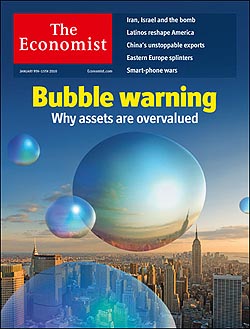
The magazine begins with an editorial — they call it a Leader. I’ve highlighted the juicy bits:
Bubble warning
Markets are too dependent on unsustainable government stimulus. Something’s got to give.
THE effect of free money is remarkable. A year ago investors were panicking and there was talk of another Depression. Now the MSCI world index of global share prices is more than 70% higher than its low in March 2009. That’s largely thanks to interest rates of 1% or less in America, Japan, Britain and the euro zone, which have persuaded investors to take their money out of cash and to buy risky assets.
For all the panic last year, asset values never quite reached the lows that marked other bear-market bottoms, and now the rally has made several markets look pricey again. In the American housing market, where the crisis started, homes are priced at around fair value on the basis of rental yields, but they are overvalued by almost 30% in Britain and by 50% in Australia, Hong Kong and Spain.
Stockmarkets are still shy of their record peaks in most countries. The American market is around 25% below the level it reached in 2007. But it is still nearly 50% overvalued on the best long-term measure, which adjusts profits to allow for the economic cycle, and is on a par with two of the four great valuation peaks in the 20th century, in 1901 and 1966.
Central banks see these market rallies as a welcome side- effect of their policies. In 2008, falling markets caused a vicious circle of debt defaults and fire sales by investors, pushing asset prices down even further. The market rebound was necessary to stabilise economies last year, but now there is a danger that bubbles are being created (see article below).
Forever blowing bubbles?
Aside from high asset valuations, the two classic symptoms of a bubble are rapid growth in private-sector credit and an outbreak of public enthusiasm for particular assets. There’s no sign of either of those. But the longer the world keeps its interest rates close to zero, the greater the danger that bubbles will appear—most likely in emerging markets, where growth keeps investors optimistic and currency pegs import loose monetary policy, and in commodities.
Central banks have a range of tools they can use to discourage the growth of bubbles. Forcing banks to adopt higher capital ratios may curb speculative excesses. As Ben Bernanke, chairman of the Federal Reserve, argued this week, the rise in American house prices could have been limited through better regulation of the banks. The most powerful tool, of course, is the interest rate. But central banks are wary of using it to pop bubbles because it risks crushing growth as well. And, with the world economy in its current fragile state, they are rightly unwilling to jack up interest rates now.
But even if governments judge that the risks posed by raising rates now outweighs that of keeping them low, investors still have plenty of reasons to worry. The problem for them is not just that valuations look high by historic standards. It is also that the current combination of high asset prices, low interest rates and massive fiscal deficits is unsustainable.
Interest rates will stay low only if growth remains slow. But if economies grow slowly, then profits will not rise fast enough to justify current share prices and incomes will not rise far enough to justify the prevailing level of house prices. If, on the other hand, the markets are right about the prospects for economic growth, and the current recovery is sustained, then governments will react by cutting off the supply of cheap money later this year.
It doesn’t add up
But the more immediate risks may be posed by fiscal policy. Many governments responded to the crisis by, in effect, taking the debt burden off the private sector’s balance-sheets and putting it on their own. This caused a huge gap to open up in government finances. Deficits in America and Britain, for instance, stand at more than 10% of GDP.
Most developed-country governments have managed to finance these deficits fairly easily so far. In the early stages of the crisis, investors were happy to opt for the safety of government bonds. Then central banks resorted to quantitative easing (QE), a polite term for the creation of money. The Bank of England, for example, has bought the equivalent of one year’s entire fiscal deficit. There are signs, however, that private-sector investors’ appetite for government debt may be just about sated, as they contemplate the vast amount of government bonds that are due to be issued this year and the ending of QE programmes. The yields on ten-year Treasury bonds and British gilts have both risen by more than half a percentage point since late November.
Investors (along with this newspaper) would like to see governments unveil clear plans for reducing those deficits over the medium term, with the emphasis on spending cuts rather than tax increases. But politicians are nervous about the likely reaction of electorates, not to mention the short-term economic impact of fiscal tightening, and are proving reluctant to specify where the cuts will be made.
Markets have already tested the ability of the weakest governments to bear the burden of their debt. Dubai had to turn to its wealthy neighbour, Abu Dhabi, for help. In the euro zone, doubts have been raised about the willingness of Greece to push through the required austerity measures. Electorates are likely to chafe at the cost of bringing down government deficits, especially if the main result is to repay foreign creditors. That will lead to currency crises and cross-border disputes like the current spat between Iceland, Britain and the Netherlands over the bill for compensating depositors in Icelandic banks (see article). Such disputes will lead to further outbreaks of market volatility.
Investors tempted to take comfort from the fact that asset prices are still below their peaks would do well to remember that they may yet fall back a very long way. The Japanese stock market still trades at a quarter of the high it reached 20 years ago. The NASDAQ trades at half the level it reached during dotcom mania. Today the prices of many assets are being held up by unsustainable fiscal and monetary stimulus. Something has to give.
The Economist explains in greater detail with a second, bigger article:
The danger of the bounce
Once again, cheap money is driving up asset prices.
THE opening of the Burj Khalifa, the world’s tallest building, in Dubai on January 4th had symbolic as well as architectural significance. Skyscrapers have long been associated with the ends of financial booms. The Empire State Building opened in 1931, two years after the Wall Street crash. The Petronas towers in Kuala Lumpur were unveiled in 1998, in the depths of the Asian crisis. Such towers are commissioned when money is cheap and optimism about economic growth is at its height; they are often finished when the champagne has gone flat.
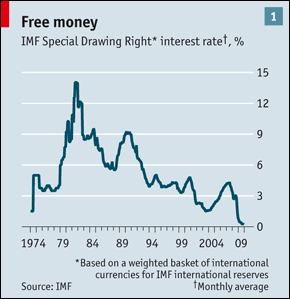
The past three decades have been good for skyscraper-building. The cost of borrowing money, in nominal terms, has fallen sharply (see chart 1). Small wonder that one bubble after another has appeared in financial markets, with the subjects of investors’ dreams ranging from emerging markets and technology stocks in the 1990s to residential housing in the decade just ended. Nor is it surprising, with money so cheap, that consumers and companies have indulged in regular borrowing sprees.
When investors borrow money in order to buy assets, they push prices even higher. But this also makes markets vulnerable to sudden busts, as investors sell assets to pay their debts. The credit crunch of 2007-08 was the result of this process, with the debts greater and the price swings more violent than at any time in the past 30 years.
Critics argue that central banks, by focusing on consumer- rather than asset-price inflation, have encouraged bubbles to grow by keeping interest rates too low. By intervening when markets fall, but doing little to curb them when they rise, they have offered investors a one-way bet.
Such critics are worried that, in their eagerness to bring the credit crunch to an end, the authorities may be making the same mistake again. Official short-term interest rates are below 1% in much of the developed world. Emerging markets, through their currency pegs, tend to import these easy-money policies, even though most of them are growing faster than the rich economies are.
Low rates have certainly persuaded investors to move money out of cash. Investors withdrew $468.5 billion from money-market funds in the course of 2009. The “carry trade”—borrowing in low-yielding currencies to invest in high-yielding ones—is back in full swing. The Australian dollar has been a popular beneficiary.
Equity markets have rebounded strongly: the MSCI world index is more than 70% higher than its March low. Even bigger gains were seen in emerging markets, with the Brazilian, Chinese and Indonesian bourses all more than doubling, in dollar terms, last year. Those rallies have by themselves helped boost economic sentiment and have brought to a halt the vicious spiral of 2008, in which falling markets forced investors to offload assets at fire-sale prices.
At the same time, in the English-speaking markets of America, Australia and Britain, the stabilisation of house prices has bolstered consumers’ balance-sheets. Again, low interest rates have been a crucial supporting factor.
Optimists argue that the markets are now in a sweet spot. The global economy is recovering, with most developed countries coming out of recession in the third quarter of 2009. The authorities, concerned about the fragility of the recovery, will be reluctant to raise interest rates in the near term. Thus investors have been given a licence to buy risky assets.
Spotting the signs
Is this policy approach creating yet another set of bubbles? Some, including Alan Greenspan, chairman of the Federal Reserve during the euphoria of the 1990s and early 2000s, believe that bubbles can be spotted only in retrospect. Others, such as Jeremy Grantham of GMO, a fund-management group, argue that they can be identified by a surge in prices (and valuations) to way above their previous trends.
In the model of market madness outlined by Hyman Minsky, a 20th-century American economist, and by Charles Kindleberger in his book “Manias, Panics, and Crashes”, bubbles start with a “displacement”—a shock to the financial system, perhaps in the form of a new technology such as railways or the internet. This provides the “narrative”—the rationale that persuades investors to join in. They start to believe that this time around things will be different and that asset prices can reach new heights.
The next stage is rapid growth in credit, which inflates the bubble. As investors borrow money to buy the asset in question, the resulting price rise makes the narrative more credible. At the peak, however, investors no longer pay much attention to fundamentals, buying simply on the belief that prices must rise further. This stage is marked by very high valuations and by popular enthusiasm for asset purchases—marked in the 1920s by shoeshine boys passing on share tips and in the early 2000s by the popularity of property programmes on television.
Eventually, like a Ponzi scheme, a bubble runs out of new buyers. Prices slump. “Euphoria” gives way to the final stage, “revulsion”—until the cycle can begin again.
How do today’s markets look in the light of that model? The best place to start is in the developed world. There has been a “displacement”, in that the credit crunch caused central banks to slash rates and led governments to unveil schemes to support banks, guarantee assets and allow budget deficits to soar. Whereas investors were highly risk-averse in late 2008, they have been encouraged to take their money out of cash and to invest in higher-yielding assets like equities and corporate bonds.
But although money is cheap, there has been no sign of the private-sector credit growth that marks bubble phases. Indeed, small businesses still complain that bank loans are hard to find. In the euro area, the broad measure of money supply has even fallen in the past 12 months. In America, broad money grew at an annualised rate of only 1.2% in the six months to November.
As further evidence that there is no bubble, bulls point to the relatively modest level of prospective price-earnings ratios; the MSCI world index is trading on a multiple of 14 based on prospective earnings in 2010, according to Société Générale, around the long-term average. However, prospective multiples can be very dependent on the optimism of the analysts who make the forecasts—and such analysts are in the business of selling shares.
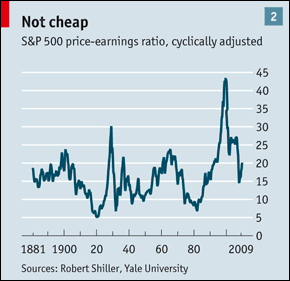
A better long-term measure is the cyclically adjusted price-earnings ratio, which averages profits over the previous ten years (see chart 2). On this measure, valuations are nowhere near the 2000 peak. They are, however, still pretty high by historical standards; Smithers & Co, a firm of consultants, reckons they are nearly 50% above their long-term average. Even now, after a dismal decade for shares, Wall Street is offering a dividend yield of only just over 2%, compared with a long-term average of 4.5%.
In housing, a measure based on rents shows that American prices are back to fair value but prices in Britain, France, Spain and Australia are all 30-50% above their historic averages. Low mortgage rates (and government schemes to head off foreclosures) have stopped prices falling to the lows of previous downturns.
That said, although prices remain higher than average, private investors have shown little of the enthusiasm they exhibited in past bubbles. Activity in the housing market is subdued. Investors withdrew $36 billion from developed-market equity funds in the course of 2009, according to EPFR Global, a data group.
Emerging optimism
More plausible candidates for bubble status can be found in emerging markets. The rally in the developed markets has been driven by relief that a second Depression has been avoided, rather than by any great optimism about a new era. But emerging-market exports have survived the crisis remarkably well. They were clobbered in late 2008, when the collapse of Lehman Brothers sent the corporate sector into shock and many businesses slashed their order books. Crucially, however, China experienced not much more than a mild slowdown and recovered to grow by around 8% in 2009.
As investors look to the future, emerging markets have many advantages over their developed rivals. One, plainly, is higher potential rates of economic growth. Another is that many emerging economies have stronger fiscal positions than their Western rivals; they are the creditors financing the American budget deficit.
The balance of power has already shifted. In 2003 the stockmarkets of America, Britain and Japan formed 73% of the value of the MSCI all-country index; by the end of 2009 this proportion was just 59%. Enthusiasts like Jerome Booth of Ashmore, a fund-management group, argue that this trend will continue, because emerging economies’ stockmarkets are underweighted in world indices, given their share of global GDP. As the world rebalances, Mr Booth argues, investors from emerging economies will increasingly want to channel their savings to their own markets, rather than financing Western governments. Western investors are already showing an interest in these markets: investors shifted $64.5 billion into emerging-market funds last year.
This optimism explains why emerging markets now trade at a premium (measured by the ratio of market prices to the accounting value of assets) over developed markets. In the past, such premiums have usually presaged a setback.
In addition, emerging markets are seeing much faster credit growth than their developed rivals. In China, for example, broad-money growth in the 12 months to November was almost 30%. Such growth is the logical result of pegging a currency to the dollar, and thus importing a monetary policy which may be right for America but which is too loose for the fast-growing Chinese economy. Some of that credit growth is leaking into asset markets. The Chinese premier, Wen Jiabao, said in late December that the government would use taxes and interest rates to stabilise the property market. House prices in Hong Kong are more than 50% above fair value, according to The Economist’s estimate. Though they are not yet back at 2007 valuations, it is easy to imagine that emerging markets will develop bubbles if a combination of low interest rates and pegged currencies continues.
Another area where a bubble might be developing is in gold. Gold is an unlikely cause of euphoria, given that investors use it as a bolthole when they worry about inflation, currency depreciation or financial chaos. But the metal has seen a speculative peak before, most notably in 1980, when its price touched $835 an ounce, before losing two-thirds of its nominal value over the next 20 years.
The main rationale for buying gold at the moment is that, in the face of the credit crunch, most governments would like to see their currencies depreciate to boost their exports. If paper money is being “debased”, that is bullish for gold, an asset that central banks cannot create more of and that is no one else’s liability.
The gold bugs may be right. But the price has already quadrupled from its low and suffers from no real valuation constraints; it has no yield or earnings against which to measure it, so it is hard to say when it is “expensive”. Dylan Grice, an analyst at Société Générale, has mischievously suggested that, if the Bretton Woods system (under which the Fed was obliged to exchange its stock of dollars for gold with other central banks) were operating today, bullion would trade at $6,300 an ounce.
An age-old problem
It seems likely that, if developed countries keep interest rates low for a long time, bubbles will emerge somewhere. The argument against tightening policy now is a strong one, given the fragile state of the economic recovery. But to central banks it always is, whether the economy is healthy or not.
It is hard to imagine any circumstances in which the authorities will have the foresight (or the courage) to prick a bubble. It cannot be done when the economy is weak. And when the economy is strong, as it was in the late 1990s, central banks argue that higher asset prices are justified (back then, by the productivity improvements brought by the internet). Central bankers tend to see higher asset prices as a validation of their policies and to shy away from “second guessing” the markets.
Ben Bernanke, the Fed’s chairman, argued in a recent speech that better regulation, rather than tighter monetary policy, would have been the key to pricking the American housing bubble in the past decade. Plans for preventing future bubbles may depend on controlling the banks, rather than setting the general level of interest rates. Higher loan-to-value ratios would avoid the excesses of subprime lending while higher capital ratios would prevent banks lending too much at the peak of the cycle.
If the authorities can do little to stop a bubble inflating, what can they do if markets suffer a further relapse? Interest rates cannot be reduced further and it is hard to see the markets tolerating even bigger budget deficits. That leaves quantitative easing (QE), the policy under which central banks create money to buy assets, usually government bonds. Even that may have its limits, if private investors decide to sell government bonds as fast as central banks try to buy them.
Bears argue that the global economy is already far too dependent on government stimulus. “Every basis point of [American] growth in [the third quarter] came from government stimulus, directly and indirectly,” says David Rosenberg of Gluskin Sheff, a Canadian asset-management firm. Schemes such as “cash for clunkers” temporarily boosted car sales but these quickly slipped again once government subsidies stopped. The latest example occurred when pending American home sales fell by 16% in November in anticipation of the end of a homebuyers’ tax credit (which has since been extended until the end of April).
These subsidies depend, in large part, on the ability of governments to fund huge deficits at relatively low cost. And that is perhaps the biggest issue of the moment.
A matter of life and debt
On the one hand, the gap between short-term interest rates and long-term bond yields is extraordinarily high. That allows banks, in particular, to borrow at low rates from the central banks and invest the proceeds in government debt; the same trick was used to rebuild bank profits in the early 1990s. Russell Napier, a market historian and an analyst at CLSA, a broker, thinks that purchases by a combination of Asian central banks and developed-world commercial banks are causing a bubble to develop in government-bond markets.
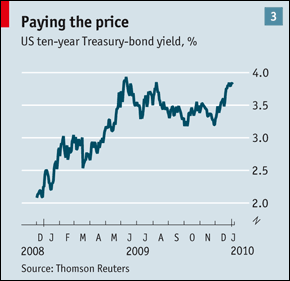
Investors may be looking to Asia for inspiration. Japan has run huge deficits for 20 years and still has ten-year bond yields of under 1.5%. If investors think the American economy is in for a similar period of stagnation, then Treasury-bond yields of almost 4% (see chart 3) look attractive.
On the other hand, some point to the huge growth in central banks’ balance-sheets and to the use of QE. This indirect monetisation of the budget deficit is, in their view, just another way of debasing the currency. The Fed’s entry for “total factors supplying reserve funds” has jumped from $942 billion in the week before the collapse of Lehman Brothers to almost $2.3 trillion. In Britain, the Bank of England’s QE programme has, in effect, financed the entire government deficit for one year.
But both the Fed and the Bank of England seem to be winding down their QE programmes and these may not be around to support bond prices next year. However, there is scant trace of any rapid reduction in budget deficits, at least in Britain and America. Governments that have attempted to tackle them, such as Ireland’s, have faced protests and strikes.
As a rule, governments find it far easier to increase their debt than to reduce it. In the absence of rapid economic growth, debt reduction usually means a period of austerity, a hard thing to swallow, especially when the creditors are foreign. Iceland’s president has just refused to approve a deal repaying debts to Britain and the Netherlands in the face of public opposition.
Governments also fear that premature fiscal tightening might only send the economy back into recession. That was the mistake made by the Roosevelt administration in 1937 and by the Japanese in 1997, when they raised the consumption tax.
Finance ministers may be unwilling to take unpopular courses of action until the rating agencies downgrade their debt or the market forces the issue, by pushing bond yields sharply higher. Already, there have been signs of market impatience with some countries, such as Greece, which have been slow to address the problem. Investors may eventually demand coherent strategies from the Americans and the British; Pimco, probably the most influential private-sector bond investor, said this week that Britain faced a cut in its credit rating without a credible debt-reduction plan.
The markets are beset by a series of contradictions. They are dependent on extraordinary amounts of government stimulus. But that stimulus is in turn ultimately dependent on the willingness of markets to finance governments at low rates. They should be willing to do so only if they believe that growth prospects are poor and inflation will stay low. But if they believe that, investors should be unwilling to buy equities and houses at above-average valuations. At some time—maybe in 2010—those contradictions will have to be resolved. And that will trigger another nasty bout of volatility.
WordPress reads better, I hope. Apparently WordPress defaults to dark gray type. Michael changed it to black. It should be easier to read. The only way to successfully paste into WordPress is through its HTML tag, which makes no sense. But it works, which makes sense. Software is not designed by people with commonsense.
Michael and I have a rule. The second time you do it, it takes three minutes. The first time? Well, that’s another story.
The piper plays.
As a piper, I play many gigs; sometimes weddings, but more often funerals. Recently I was asked by a funeral director to play at a graveside service for an old hermit who had lived by himself in a cabin in the woods as long as anyone could remember. He had no family or friends that anyone knew about, so the service was to be in an isolated area on a back-road in the hilly Nova Scotia countryside.
As I was not familiar with the area, I got lost. And being a typical man, I didn’t stop for directions. When I finally arrived an hour late, I saw that the funeral guy had evidently gone and the hearse was nowhere in sight.
There were only the diggers and crew left, and they were eating lunch. I felt badly and apologized to the men for being late. I went to the side of the grave opening and looked down. It appeared that the vault lid was already in place. I didn’t know what else to do, so I warmed up my bagpipes and started to play.
The workers put down their lunches and began to gather around. I played out my heart and soul for this old man who had no family or friends. I played like I’ve never played before for this lonely, reclusive man.
And as I started to play “Amazing Grace,” the workers began to weep. They wept, I wept, we all wept together. When I finished the song, I packed up my bagpipes and headed for my car. Though my head hung low my heart was full.
As I was opened the door to my car, I heard one of the workers say,
“Sweet mudder of Jesus, I never seen nuthin’ like dat before; and I been putting in septic tanks for twenty years.”

Harry Newton, who wonders if the Fed cares about you and me, normal people. Wouldn’t it be nice if we could leave a little money in a savings account (remember them?) and earn a decent return on our hard-earned savings? Wouldn’t it be nice if the Fed didn’t force us to gamble? Stocks, gold, distress. Yuch.
Your thoughts/comments?

Mr. Newton,
Things don't look good long term. Why is it that developing nations such as China and India have been around longer the the United States? Something wrong here!
please correct spelling error: the the is to be read as then the
Harry you are followed by more people than you know. First started listening to you with your Telecom book – made money way back then. Lost much of it and now am trying to build the portfolio back up again. Like you I have gotten older (67) and have faced tennis elbow from golf, along with my first false tooth, at a cost of $6,000. We both agree about Afghanistan and the rest of the Middle East, the present confusion in the market and government – and perhaps life in general. Any way, enjoy your comments each day along with your sense of humor. By the way have been in one Commercial Real Estate Reit (O) that has continued to do well through the past three years.
Re: Wouldn't it be nice…
Pam:
I still believe in slow, steady growth(2%?) over
raging, rollercoaster, ulcer-growing “stocks, gold, distress”.
Instead expending time on chasing investment apparitions, find an affordable, healthy occupation/hobby that offers you happiness.
Follow the KISS methodology.
Dwight:
When you have no debt, 2% return on your money looks pretty good.
You gamble when you have debt.
The answer is “Yes” and let me add some more wishes.
Wouldn't it be nice if we could invest and save without IRAs, 401Ks and income taxes?
Wouldn't it be nice if retail purchases did not include $.22 on the dollar of hidden business taxes?
Wouldn't it be nice to have a “free, no cost” real job stimulus package to attack jobs and capital (over $12 trillion off shore) into our country?
And there are many more “Wouldn't it be nice wishes too” like;
Eliminate the IRS
No regressive payroll taxes (Social Security and Medicare)
No capital gains tax or Federal estate tax
Greatly reduce the power to manipulate the tax code
And still collect the same amount of revenue for the Federal government with a simple, fair, transparent and progressive tax system.
There is an answer to all of these wishes, and more. It is called the FairTax. Learn more at http://www.fairtax.org
Dear Harry, Thank you for another excellent newsletter. The Economist article is very fine.
Did you read today's Paul Krugman op-ed column in the NYTimes? I found it excelent and would have one additional comment. The US spends too much on such things as our military, the spy agencies and all related spending such as our foreign bases and contractors.
I also want to thank you for your latest edition of your dictionary and your seet note which I truly value.