Cautious optimism. From BTIG:
With the third “big” week of earnings now complete, we feel even more comfortable in saying that earnings season, taken as a whole, has gone better than expected. Index sales growth moderated as a result of this week’s earnings, with the YOY change falling to roughly 3%, however EPS growth still stands at a healthy level, towards the upper end recent realized quarters. Sales growth stands modestly above estimates heading into earnings season while EPS growth is decidedly above as companies have not found it hard to earn bottom line growth in the face of slower top line growth. As it stands, the S&P 500 is trading at roughly 15x our 2014 EPS estimate ($117) and 14.5x the consensus estimate ($121).
Apple raves. Several sources wrote very positively on Apple, citing rising sentiment, upcoming world (especially China) and Christmas sales in the U.S. Fortune magazine quotes Legg Mason’s Bill Miller as Apple being his favorite stock.
I bought an Apple TV on Friday because I wanted to watch some Netflix over the weekend. But, after reading Apple TV reviews, I decided to return the Apple TV in favor of the new Roku 3. Think of it this way: Apple is for an all Apple household. Roku works better if you’re running Windows laptops, which I am. Roku also has access to more movie and media sources. They both cost the same — about $99.
Berkshire Hathaway’s results disappointed the analysts.A piece on Seeking Alpha this morning explained all:
The company reported operating income (which ignores gains and losses on derivatives and investments) of $2,228 per class A share (BRK.A), missing estimates of $2,400 while revenue beat by about $1 billion at $46.54 billion. The main weakness came at Berkshire’s insurance unit where its underwriting profits fell from $392 million last year to $170 million this year. Insurance companies, including the likes of AIG (AIG) and Metlife (MET) in general have reported disappointing third quarter results.
With the rush of hedge funds into the reinsurance sector, there have been reports that pricing has deteriorated significantly, making the business less profitable. Berkshire’s results appear to have been hit by this with reinsurance premiums dropping by 20% and an underwriting loss of $206 million from $102 million last year. GEICO also saw a decline in underwriting profits from $435 million to $307 million. Last year, Berkshire reported extremely strong underwriting results that were close to being unsustainable, making this an extremely difficult comp. However, I would continue to watch reinsurance results as underwriting profits may be depressed for a prolonged period thanks to the rash of new money. There likely needs to be a catastrophe that wipes out some of this fast money to restore the market to equilibrium.
Its non-insurance units performed exceptionally well, growing operating income by 12.5% to $2.78 billion. Burlington Northern profit growth did decelerate to 3% but margins remained strong. MidAmerican continues to perform well, growing 8% while Berkshire’s consumer businesses continue to benefit from a generally stronger U.S. economy, growing double-digits. Berkshire’s operating companies continue to perform well.
Turning to its balance sheet, equity Investments grew by roughly $3 billion in the quarter to $105 billion, which would suggest that Buffett has not initiated any major positions in the quarter (unless he was concurrently selling another) and follows his comments that the market is not nearly as attractive as it has been in the past few years. Shareholders’ equity has grown $20 billion to $211 billion or $85 per class B share. Buffett also remains awash in cash with $43 billion, well above his target of $25 billion, giving him ample ammunition to make an acquisition or major investment.
Based on these results, Berkshire looks poised to deliver strong results at its operating companies so long as the economy remains decent. I expect growth above 10% through next year as they’ve shown no sign of deteriorating. I do believe investors should watch insurance results carefully. GEICO’s results really broke trend and are out of step with other auto insurers who reported fine numbers. Auto figures can be especially fickle and transitory. Premium revenue was strong, and I expect underwriting profits to rebound in line with revenues. Reinsurance is more of a concern as profits could be stressed for the foreseeable future due to weak pricing. I do not expect much of a rebound in this unit given market fundamentals. I expect Berkshire’s non-insurance units to outperform its insurance units over the next year. Together with insurance close to flat and operating units up 10%, I would look for EPS of roughly $6.50 in 2014.
Given the strength of these units, I would assign a forward multiple of 15x, giving Berkshire’s operating business a value of $97. Berkshire has notes payable and insurance losses liable of $130 billion, against cash of $43 billion and investments of $166 billion. This gives Berkshire a net cash and investment position of $79 billion. Buffett has stated he likes $25 billion on hand in case of catastrophe losses, giving a net cash position for shareholders of $54 billion or $22 per share. Combined, Berkshire Hathaway is worth $119 per share, or 3% above current levels. I do not add the $25 billion in cash to the share price because it is necessary to operations, functioning like PP&E, and is included in the operating value of $97.
Berkshire remains marginally below its intrinsic value. Given the strong fundamentals of the company, I would be comfortable owning shares but would not initiate or add to a position here. The fact that this quarter “missed” expectations could overhang shares. Berkshire bulls should hope the results drag down shares so they could be bought cheaper when there is more margin of safety as the quarter does not undermine the bullish thesis underpinning this behemoth. Its operating units continue to perform exceptionally and it remains awash in cash and investment. This quarter confirms all is fine at Berkshire, though investors should watch the reinsurance unit, and I would look to add or initiate a position at $110 or lower.
The first comment on the site summed up my feelings:
I would think a “Buffet premium “should be included of at least 10%,which makes the stock a decent buy at present levels.
BRKA is my largest holding. I’m staying with it. I only wish I had bought it 30 years ago. Dumb me. Seeking Alpha piece is here.
Sometimes luck works. I bought Boeing because its battery problem had depressed the stock. “Buy when the blood flows.” Boeing came back quickly and has risen since. Now I know why: It’s Boeing’s new plane. Excerpt from this weekend’s BusinessWeek:
The new 777X model will boast the biggest engines ever put on a plane, a record wingspan that can be shortened by having the tips fold up after landing, and lower operating costs. Cramming all this cost-saving technology into a smaller plane that operates with two engines-rather than the four needed by jumbos-could herald an end to the race to build ever-larger jets that’s driven much of modern aircraft design.

The 777X will be the first twin-engine jet able to ply long-haul routes with payloads comparable to the larger jumbos. That’s likely to accelerate airlines’ shift away from mammoth, four-engine fuel-guzzlers such as Boeing’s latest 747-8 and Airbus’s (EADSY) double-decker A380. “My assumption is the 747 is dead, or will be dead in a year or two,” says Adam Pilarski, senior vice president at aerospace consultant Avitas. Like the 747 four decades ago, he says, the 777X is aimed at a market segment where it lacks a direct rival and “may have a very good run.”
The first model, the 777-9X, will be able to fly as far as 8,000 nautical miles with more than 400 passengers while burning 20 percent less fuel than the current 777, now the world’s biggest twin-engine jet. A second variant, carrying about 350 people, will follow and push the range past 9,400 nautical miles-far enough for a New York-Singapore nonstop flight. Experts expect airlines to approve. “It’s just very difficult to stop the compelling, strong economics of the big, long-range twin airplanes,” says John Plueger, president of Los Angeles-based jet lessor Air Lease (AL).
Apologies to Jimmy Chin. I got it wrong. I thought Chin was pushing SITO. In fact he owns no shares in SITO. He was quoting an investment newsletter that was pushing it.
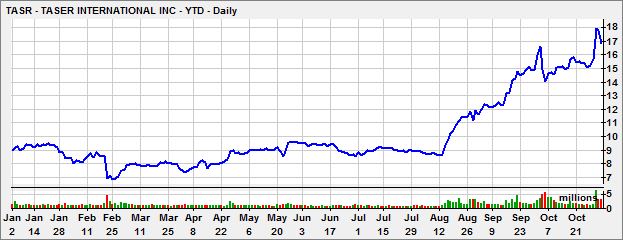
Jimmy does like TASR, which he bought on the basis that Taser was doing well with its AXON on-body camera system which it’s selling to police. The idea is that police record all their interactions. I believe they’re mandating cameras for cops in Great Britain. I bet we’ll make it law in many jurisdictions here — if we haven’t already (need more research). From Taser’s site:

TASR has exploded recently. There is talk of it hitting $25.
Debt bomb video. Cute. Click here.
Your taxpayer dollars at dubious work:
No Morsel Too Minuscule for All-Consuming N.S.A.
When Ban Ki-moon, the United Nations secretary general, sat down with President Obama at the White House in April to discuss Syrian chemical weapons, Israeli-Palestinian peace talks and climate change, it was a cordial, routine exchange.
The National Security Agency nonetheless went to work in advance and intercepted Mr. Ban’s talking points for the meeting, a feat the agency later reported as an “operational highlight” in a weekly internal brag sheet. It is hard to imagine what edge this could have given Mr. Obama in a friendly chat, if he even saw the N.S.A.’s modest scoop. (The White House won’t say.)
But it was emblematic of an agency that for decades has operated on the principle that any eavesdropping that can be done on a foreign target of any conceivable interest – now or in the future – should be done. After all, American intelligence officials reasoned, who’s going to find out?
From thousands of classified documents, the National Security Agency emerges as an electronic omnivore of staggering capabilities, eavesdropping and hacking its way around the world to strip governments and other targets of their secrets, all the while enforcing the utmost secrecy about its own operations. It spies routinely on friends as well as foes, as has become obvious in recent weeks; the agency’s official mission list includes using its surveillance powers to achieve “diplomatic advantage” over such allies as France and Germany and “economic advantage” over Japan and Brazil, among other countries.
Mr. Obama found himself in September standing uncomfortably beside the president of Brazil, Dilma Rousseff, who was furious at being named as a target of N.S.A. eavesdropping. Since then, there has been a parade of such protests, from the European Union, Mexico, France, Germany and Spain. Chagrined American officials joke that soon there will be complaints from foreign leaders feeling slighted because the agency had not targeted them.
James R. Clapper Jr., the director of national intelligence, has repeatedly dismissed such objections as brazen hypocrisy from countries that do their own share of spying. But in a recent interview, he acknowledged that the scale of eavesdropping by the N.S.A., with 35,000 workers and $10.8 billion a year, sets it apart. “There’s no question that from a capability standpoint we probably dwarf everybody on the planet, just about, with perhaps the exception of Russia and China,” he said.
Since Edward J. Snowden began releasing the agency’s documents in June, the unrelenting stream of disclosures has opened the most extended debate on the agency’s mission since its creation in 1952. The scrutiny has ignited a crisis of purpose and legitimacy for the N.S.A., the nation’s largest intelligence agency, and the White House has ordered a review of both its domestic and its foreign intelligence collection. While much of the focus has been on whether the agency violates Americans’ privacy, an issue under examination by Congress and two review panels, the anger expressed around the world about American surveillance has prompted far broader questions.
If secrecy can no longer be taken for granted, when does the political risk of eavesdropping overseas outweigh its intelligence benefits? Should foreign citizens, many of whom now rely on American companies for email and Internet services, have any privacy protections from the N.S.A.? Will the American Internet giants’ collaboration with the agency, voluntary or otherwise, damage them in international markets? And are the agency’s clandestine efforts to weaken encryption making the Internet less secure for everyone?
Matthew M. Aid, an intelligence historian and author of a 2009 book on the N.S.A., said there is no precedent for the hostile questions coming at the agency from all directions.
“From N.S.A.’s point of view, it’s a disaster,” Mr. Aid said. “Every new disclosure reinforces the notion that the agency needs to be reined in. There are political consequences, and there will be operational consequences.”
A review of classified agency documents obtained by Mr. Snowden and shared with The New York Times by The Guardian, offers a rich sampling of the agency’s global operations and culture. (At the agency’s request, The Times is withholding some details that officials said could compromise intelligence operations.) The N.S.A. seems to be listening everywhere in the world, gathering every stray electron that might add, however minutely, to the United States government’s knowledge of the world. To some Americans, that may be a comfort. To others, and to people overseas, that may suggest an agency out of control.
The C.I.A. dispatches undercover officers overseas to gather intelligence today roughly the same way spies operated in biblical times. But the N.S.A., born when the long-distance call was a bit exotic, has seen its potential targets explode in number with the advent of personal computers, the Internet and cellphones. Today’s N.S.A. is the Amazon of intelligence agencies, as different from the 1950s agency as that online behemoth is from a mom-and-pop bookstore. It sucks the contents from fiber-optic cables, sits on telephone switches and Internet hubs, digitally burglarizes laptops and plants bugs on smartphones around the globe.
Mr. Obama and top intelligence officials have defended the agency’s role in preventing terrorist attacks. But as the documents make clear, the focus on counterterrorism is a misleadingly narrow sales pitch for an agency with an almost unlimited agenda. Its scale and aggressiveness are breathtaking.
The agency’s Dishfire database – nothing happens without a code word at the N.S.A. – stores years of text messages from around the world, just in case. Its Tracfin collection accumulates gigabytes of credit card purchases. The fellow pretending to send a text message at an Internet cafe in Jordan may be using an N.S.A. technique code-named Polarbreeze to tap into nearby computers. The Russian businessman who is socially active on the web might just become food for Snacks, the acronym-mad agency’s Social Network Analysis Collaboration Knowledge Services, which figures out the personnel hierarchies of organizations from texts.
The spy agency’s station in Texas intercepted 478 emails while helping to foil a jihadist plot to kill a Swedish artist who had drawn pictures of the Prophet Muhammad. N.S.A. analysts delivered to authorities at Kennedy International Airport the names and flight numbers of workers dispatched by a Chinese human smuggling ring.
The agency’s eavesdropping gear, aboard a Defense Department plane flying 60,000 feet over Colombia, fed the location and plans of FARC rebels to the Colombian Army. In the Orlandocard operation, N.S.A. technicians set up what they called a “honeypot” computer on the web that attracted visits from 77,413 foreign computers and planted spyware on more than 1,000 that the agency deemed of potential future interest.
The Global Phone Book
No investment seems too great if it adds to the agency’s global phone book. After mounting a major eavesdropping effort focused on a climate change conference in Bali in 2007, agency analysts stationed in Australia’s outback were especially thrilled by one catch: the cellphone number of Bali’s police chief.
“Our mission,” says the agency’s current five-year plan, which has not been officially scheduled for declassification until 2032, “is to answer questions about threatening activities that others mean to keep hidden.”
The aspirations are grandiose: to “utterly master” foreign intelligence carried on communications networks. The language is corporate: “Our business processes need to promote data-driven decision-making.” But the tone is also strikingly moralistic for a government bureaucracy. Perhaps to counter any notion that eavesdropping is a shady enterprise, signals intelligence, or Sigint, the term of art for electronic intercepts, is presented as the noblest of callings.
“Sigint professionals must hold the moral high ground, even as terrorists or dictators seek to exploit our freedoms,” the plan declares. “Some of our adversaries will say or do anything to advance their cause; we will not.”
The N.S.A. documents taken by Mr. Snowden and shared with The Times, numbering in the thousands and mostly dating from 2007 to 2012, are part of a collection of about 50,000 items that focus mainly on its British counterpart, Government Communications Headquarters or G.C.H.Q.
While far from comprehensive, the documents give a sense of the agency’s reach and abilities, from the Navy ships snapping up radio transmissions as they cruise off the coast of China, to the satellite dishes at Fort Meade in Maryland ingesting worldwide banking transactions, to the rooftops of 80 American embassies and consulates around the world from which the agency’s Special Collection Service aims its antennas.
The agency and its many defenders among senior government officials who have relied on its top secret reports say it is crucial to American security and status in the world, pointing to terrorist plots disrupted, nuclear proliferation tracked and diplomats kept informed.
But the documents released by Mr. Snowden sometimes also seem to underscore the limits of what even the most intensive intelligence collection can achieve by itself. Blanket N.S.A. eavesdropping in Afghanistan, described in the documents as covering government offices and the hide-outs of second-tier Taliban militants alike, has failed to produce a clear victory against a low-tech enemy. The agency kept track as Syria amassed its arsenal of chemical weapons – but that knowledge did nothing to prevent the gruesome slaughter outside Damascus in August.
The documents are skewed toward celebration of the agency’s self-described successes, as underlings brag in PowerPoints to their bosses about their triumphs and the managers lay out grand plans. But they do not entirely omit the agency’s flubs and foibles: flood tides of intelligence gathered at huge cost that goes unexamined; intercepts that cannot be read for lack of language skills; and computers that – even at the N.S.A. – go haywire in all the usual ways.
Mapping Message Trails
In May 2009, analysts at the agency learned that Iran’s supreme leader, Ayatollah Ali Khamenei, was to make a rare trip to Kurdistan Province in the country’s mountainous northwest. The agency immediately organized a high-tech espionage mission, part of a continuing project focused on Ayatollah Khamenei called Operation Dreadnought.
Working closely with the National Geospatial-Intelligence Agency, which handles satellite photography, as well as G.C.H.Q., the N.S.A. team studied the Iranian leader’s entourage, its vehicles and its weaponry from satellites, and intercepted air traffic messages as planes and helicopters took off and landed.
They heard Ayatollah Khamenei’s aides fretting about finding a crane to load an ambulance and fire truck onto trucks for the journey. They listened as he addressed a crowd, segregated by gender, in a soccer field.
They studied Iranian air defense radar stations and recorded the travelers’ rich communications trail, including Iranian satellite coordinates collected by an N.S.A. program called Ghosthunter. The point was not so much to catch the Iranian leader’s words, but to gather the data for blanket eavesdropping on Iran in the event of a crisis.
This “communications fingerprinting,” as a document called it, is the key to what the N.S.A. does. It allows the agency’s computers to scan the stream of international communications and pluck out messages tied to the supreme leader. In a crisis – say, a showdown over Iran’s nuclear program – the ability to tap into the communications of leaders, generals and scientists might give a crucial advantage.
On a more modest scale, the same kind of effort, what N.S.A. calls “Sigint development,” was captured in a document the agency obtained in 2009 from Somalia – whether from a human source or an electronic break-in was not noted. It contained email addresses and other contact details for 117 selected customers of a Mogadishu Internet service, Globalsom.
While most on the list were Somali officials or citizens, presumably including some suspected of militancy, the document also included emails for a United Nations political officer in Mogadishu and a local representative for the charity World Vision, among other international institutions. All, it appeared, were considered fair game for monitoring.
This huge investment in collection is driven by pressure from the agency’s “customers,” in government jargon, not only at the White House, Pentagon, F.B.I. and C.I.A., but also spread across the Departments of State and Energy, Homeland Security and Commerce, and the United States Trade Representative.
By many accounts, the agency provides more than half of the intelligence nuggets delivered to the White House early each morning in the President’s Daily Brief – a measure of success for American spies. (One document boasts that listening in on Nigerian State Security had provided items for the briefing “nearly two dozen” times.) In every international crisis, American policy makers look to the N.S.A. for inside information.
Pressure to Get Everything
That creates intense pressure not to miss anything. When that is combined with an ample budget and near-invisibility to the public, the result is aggressive surveillance of the kind that has sometimes gotten the agency in trouble with the Foreign Intelligence Surveillance Court, a United States federal court that polices its programs for breaches of Americans’ privacy.
In the funding boom that followed the Sept. 11 attacks, the agency expanded and decentralized far beyond its Fort Meade headquarters in Maryland, building or expanding major facilities in Georgia, Texas, Colorado, Hawaii, Alaska, Washington State and Utah. Its officers also operate out of major overseas stations in England, Australia, South Korea and Japan, at overseas military bases, and from locked rooms housing the Special Collection Service inside American missions abroad.
The agency, using a combination of jawboning, stealth and legal force, has turned the nation’s Internet and telecommunications companies into collection partners, installing filters in their facilities, serving them with court orders, building back doors into their software and acquiring keys to break their encryption.
But even that vast American-run web is only part of the story. For decades, the N.S.A. has shared eavesdropping duties with the rest of the so-called Five Eyes, the Sigint agencies of Britain, Canada, Australia and New Zealand. More limited cooperation occurs with many more countries, including formal arrangements called Nine Eyes and 14 Eyes and Nacsi, an alliance of the agencies of 26 NATO countries.
The extent of Sigint sharing can be surprising: “N.S.A. may pursue a relationship with Vietnam,” one 2009 G.C.H.Q. document reported. But a recent G.C.H.Q. training document suggests that not everything is shared, even between the United States and Britain. “Economic well-being reporting,” it says, referring to intelligence gathered to aid the British economy, “cannot be shared with any foreign partner.”
As at the school lunch table, decisions on who gets left out can cause hurt feelings: “Germans were a little grumpy at not being invited to join the 9-Eyes group,” one 2009 document remarks. And in a delicate spy-versus-spy dance, sharing takes place even with governments that are themselves important N.S.A. targets, notably Israel.
The documents describe collaboration with the Israel Sigint National Unit, which gets raw N.S.A. eavesdropping material and provides it in return, but they also mention the agency’s tracking of “high priority Israeli military targets,” including drone aircraft and the Black Sparrow missile system.
The alliances, and the need for stealth, can get complicated. At one highly valued overseas listening post, the very presence of American N.S.A. personnel violates a treaty agreed to by the agency’s foreign host. Even though much of the eavesdropping is run remotely from N.S.A.’s base at Fort Gordon, Ga., Americans who visit the site must pose as contractors, carry fake business cards and are warned: “Don’t dress as typical Americans.”
“Know your cover legend,” a PowerPoint security briefing admonishes the N.S.A. staff members headed to the overseas station, directing them to “sanitize personal effects,” send no postcards home and buy no identifiably local souvenirs. (“An option might be jewelry. Most jewelry does not have any markings” showing its place of origin.)
Bypassing Security
In the agency’s early years, its brainy staff members – it remains the largest employer of mathematicians in the country – played an important role in the development of the first computers, then largely a tool for code breaking.
Today, with personal computers, laptops, tablets and smartphones in most homes and government offices in the developed world, hacking has become the agency’s growth area.
Some of Mr. Snowden’s documents describe the exploits of Tailored Access Operations, the prim name for the N.S.A. division that breaks into computers around the world to steal the data inside, and sometimes to leave spy software behind. T.A.O. is increasingly important in part because it allows the agency to bypass encryption by capturing messages as they are written or read, when they are not encoded.
In Baghdad, T.A.O. collected messages left in draft form in email accounts maintained by leaders of the Islamic State of Iraq, a militant group. Under a program called Spinaltap, the division’s hackers identified 24 unique Internet Protocol addresses identifying computers used by the Lebanese militant group Hezbollah, making it possible to snatch Hezbollah messages from the flood of global communications sifted by the agency.
The N.S.A.’s elite Transgression Branch, created in 2009 to “discover, understand, evaluate and exploit” foreign hackers’ work, quietly piggybacks on others’ incursions into computers of interest, like thieves who follow other housebreakers around and go through the windows they have left ajar.
In one 2010 hacking operation code-named Ironavenger, for instance, the N.S.A. spied simultaneously on an ally and an adversary. Analysts spotted suspicious emails being sent to a government office of great intelligence interest in a hostile country and realized that an American ally was “spear-phishing” – sending official-looking emails that, when opened, planted malware that let hackers inside.
The Americans silently followed the foreign hackers, collecting documents and passwords from computers in the hostile country, an elusive target. They got a look inside that government and simultaneously got a close-up look at the ally’s cyberskills, the kind of intelligence twofer that is the unit’s specialty.
In many other ways, advances in computer and communications technology have been a boon for the agency. N.S.A. analysts tracked the electronic trail left by a top leader of Al Qaeda in Africa each time he stopped to use a computer on his travels. They correctly predicted his next stop, and the police were there to arrest him.
And at the big N.S.A. station at Fort Gordon, technicians developed an automated service called “Where’s My Node?” that sent an email to an analyst every time a target overseas moved from one cell tower to another. Without lifting a finger, an analyst could follow his quarry’s every move.
The Limits of Spying
The techniques described in the Snowden documents can make the N.S.A. seem omniscient, and nowhere in the world is that impression stronger than in Afghanistan. But the agency’s capabilities at the tactical level have not been nearly enough to produce clear-cut strategic success there, in the United States’ longest war.
A single daily report from June 2011 from the N.S.A.’s station in Kandahar, Afghanistan, the heart of Taliban country, illustrates the intensity of eavesdropping coverage, requiring 15 pages to describe a day’s work.
The agency listened while insurgents from the Haqqani network mounted an attack on the Hotel Intercontinental in Kabul, overhearing the attackers talking to their bosses in Pakistan’s tribal area and recording events minute by minute. “Ruhullah claimed he was on the third floor and had already inflicted one casualty,” the report said in a typical entry. “He also indicated that Hafiz was located on a different floor.”
N.S.A. officers listened as two Afghan Foreign Ministry officials prepared for a meeting between President Hamid Karzai of Afghanistan and Iranian officials, assuring them that relations with the United States “would in no way threaten the interests of Iran,” which they decided Mr. Karzai should describe as a “brotherly country.”
The N.S.A. eavesdropped as the top United Nations official in Afghanistan, Staffan de Mistura, consulted his European Union counterpart, Vygaudas Usackas, about how to respond to an Afghan court’s decision to overturn the election of 62 members of Parliament.
And the agency was a fly on the wall for a long-running land dispute between the mayor of Kandahar and a prominent local man known as the Keeper of the Cloak of the Prophet Muhammad, with President Karzai’s late brother, Ahmed Wali Karzai, as a mediator.
The agency discovered a Taliban claim to have killed five police officers at a checkpoint by giving them poisoned yogurt, and heard a provincial governor tell an aide that a district police chief was verbally abusing women and clergymen.
A Taliban figure, Mullah Rahimullah Akhund, known on the United States military’s kill-or-capture list by the code name Objective Squiz Incinerator, was overheard instructing an associate to buy suicide vests and a Japanese motorbike, according to the documents.
And N.S.A. listened in as a Saudi extremist, Abu Mughira, called his mother to report that he and his fellow fighters had entered Afghanistan and “done victorious operations.”
Such reports flowed from the agency’s Kandahar station day after day, year after year, and surely strengthened the American campaign against the Taliban. But they also suggest the limits of intelligence against a complex political and military challenge. The N.S.A. recorded the hotel attack, but it had not prevented it. It tracked Mr. Karzai’s government, but he remained a difficult and volatile partner. Its surveillance was crucial in the capture or killing of many enemy fighters, but not nearly enough to remove the Taliban’s ominous shadow from Afghanistan’s future.
Mining All the Tidbits
In the Afghan reports and many others, a striking paradox is the odd intimacy of a sprawling, technology-driven agency with its targets. It is the one-way intimacy of the eavesdropper, as N.S.A. employees virtually enter the office cubicles of obscure government officials and the Spartan hide-outs of drug traffickers and militants around the world.
Venezuela, for instance, was one of six “enduring targets” in N.S.A.’s official mission list from 2007, along with China, North Korea, Iraq, Iran and Russia. The United States viewed itself in a contest for influence in Latin America with Venezuela’s leader then, the leftist firebrand Hugo Chávez, who allied himself with Cuba, and one agency goal was “preventing Venezuela from achieving its regional leadership objectives and pursuing policies that negatively impact U.S. global interests.”
A glimpse of what this meant in practice comes in a brief PowerPoint presentation from August 2010 on “Development of the Venezuelan Economic Mission.” The N.S.A. was tracking billions of dollars flowing to Caracas in loans from China (radar systems and oil drilling), Russia (MIG fighter planes and shoulder-fired missiles) and Iran (a factory to manufacture drone aircraft).
But it was also getting up-close and personal with Venezuela’s Ministry of Planning and Finance, monitoring the government and personal emails of the top 10 Venezuelan economic officials. An N.S.A. officer in Texas, in other words, was paid each day to peruse the private messages of obscure Venezuelan bureaucrats, hunting for tidbits that might offer some tiny policy edge.
In a counterdrug operation in late 2011, the agency’s officers seemed to know more about relations within a sprawling narcotics network than the drug dealers themselves. They listened to “Ricketts,” a Jamaican drug supplier based in Ecuador, struggling to keep his cocaine and marijuana smuggling business going after an associate, “Gordo,” claimed he had paid $250,000 and received nothing in return.
The N.S.A., a report said, was on top of not just their cellphones, but also those of the whole network of “buyers, transporters, suppliers, and middlemen” stretching from the Netherlands and Nova Scotia to Panama City and Bogotá, Colombia. The documents do not say whether arrests resulted from all that eavesdropping.
Even with terrorists, N.S.A. units can form a strangely personal relationship. The N.S.A.-G.C.H.Q. wiki, a top secret group blog that Mr. Snowden downloaded, lists 14 specialists scattered in various stations assigned to Lashkar-e-Taiba, the Pakistani terrorist group that carried out the bloody attack on Mumbai in 2008, with titles including “Pakistan Access Pursuit Team” and “Techniques Discovery Branch.” Under the code name Treaclebeta, N.S.A.’s hackers at Tailored Access Operations also played a role.
In the wiki’s casual atmosphere, American and British eavesdroppers exchange the peculiar shoptalk of the secret world. “I don’t normally use Heretic to scan the fax traffic, I use Nucleon,” one user writes, describing technical tools for searching intercepted documents.
But most striking are the one-on-one pairings of spies and militants; Bryan is assigned to listen in on a man named Haroon, and Paul keeps an ear on Fazl.
A Flood of Details
One N.S.A. officer on the Lashkar-e-Taiba beat let slip that some of his eavesdropping turned out to be largely pointless, perhaps because of the agency’s chronic shortage of skilled linguists. He “ran some queries” to read intercepted communications of certain Lashkar-e-Taiba members, he wrote in the wiki, but added: “Most of it is in Arabic or Farsi, so I can’t make much of it.”
It is a glimpse of the unsurprising fact that sometimes the agency’s expensive and expansive efforts accomplish little. Despite the agency’s embrace of corporate jargon on goal-setting and evaluation, it operates without public oversight in an arena in which achievements are hard to measure.
In a world of ballooning communications, the agency is sometimes simply overwhelmed. In 2008, the N.S.A.’s Middle East and North Africa group set about updating its Sigint collection capabilities. The “ambitious scrub” of selectors – essentially search terms – cut the number of terms automatically searched from 21,177 to 7,795 and the number of messages added to the agency’s Pinwale database from 850,000 a day to 450,000 a day.
The reduction in volume was treated as a major achievement, opening the way for new collection on Iranian leadership and Saudi and Syrian diplomats, the report said.
And in a note that may comfort computer novices, the N.S.A. Middle East analysts discovered major glitches in their search software: The computer was searching for the names of targets but not their email addresses, a rather fundamental flaw. “Over 500 messages in one week did not come in,” the report said about one target.
Those are daily course corrections. Whether the Snowden disclosures will result in deeper change is uncertain. Joel F. Brenner, the agency’s former inspector general, says much of the criticism is unfair, reflecting a naïveté about the realpolitik of spying. “The agency is being browbeaten for doing too well the things it’s supposed to do,” he said.
But Mr. Brenner added that he believes “technology has outrun policy” at the N.S.A., and that in an era in which spying may well be exposed, “routine targeting of close allies is bad politics and is foolish.”
Another former insider worries less about foreign leaders’ sensitivities than the potential danger the sprawling agency poses at home. William E. Binney, a former senior N.S.A. official who has become an outspoken critic, says he has no problem with spying on foreign targets like Brazil’s president or the German chancellor, Angela Merkel. “That’s pretty much what every government does,” he said. “It’s the foundation of diplomacy.” But Mr. Binney said that without new leadership, new laws and top-to-bottom reform, the agency will represent a threat of “turnkey totalitarianism” – the capability to turn its awesome power, now directed mainly against other countries, on the American public.
“I think it’s already starting to happen,” he said. “That’s what we have to stop.”
Whatever reforms may come, Bobby R. Inman, who weathered his own turbulent period as N.S.A. director from 1977 to 1981, offers his hyper-secret former agency a radical suggestion for right now. “My advice would be to take everything you think Snowden has and get it out yourself,” he said. “It would certainly be a shock to the agency. But bad news doesn’t get better with age. The sooner they get it out and put it behind them, the faster they can begin to rebuild.” …
For the full New York Times article on the NSA, click here.
Observations From My Trip To China. He doesn’t think it will collapse. Neither do I. At the end of the article:
I don’t think we’ve (America) has lost it. If you want to be an optimist about America, stand on your head. Our country looks so much better from the bottom up, than from the top down. What you see if you look at the country from the bottom up is that it is full of people who just didn’t get the word. They did not get the word that China is going to eat our lunch or that Germany is going to eat our breakfast and so they just go out and start stuff, and invent stuff and collaborate on stuff. If I were to draw a picture of America today it would be the Space Shuttle taking off. You’ve seen that picture — all that thrust coming from below. That’s all those people who didn’t get the word. But in our case, our booster rocket – Washington, DC – is cracked and leaking energy. And the pilots in the cockpit are fighting over the flight plan. As a result, we cannot achieve escape velocity to get into the next orbit — the next phase of the American Dream. We have all the attributes to succeed in the 21st century. If we could just fix the booster rocket and get the pilots to agree on a flight plan, we would just take off — we would separate ourselves from the rest of the world.
For the full article, click here.
Fun weekend New Yorker cartooon.


Harry Newton who a wonderful weekend changing all the clocks to daylight savings time. I actually got all the Lacrosse Technology automatic/wireless clocks to finally work. What a pain. Key: change their batteries every time the time changes, i.e. twice a year.
I upgraded the automatic email from this column. You should now receive the entire column by email. I didn’t spend three quarters of a billion dollars — allegedly what www.Healthcare.gov has cost, so far.

U.S Senator Dianne Feinstein’s Husband Selling Post Offices to Friends
This is a chapter excerpt from the new e-book by Peter Byrne
DiFi and the Blumpire
Senator Feinstein pressured the Postmaster General
Last December in San Francisco, a few score protestors made a loud
demonstration at the offices of Blum Capital Partners in North Beach to
protest the closure and sale of historic post offices. Escorted by
police on motorcycles, they marched downtown to U.S. Senator Dianne
Feinstein’s office. A common theme of the many speeches made that day
was that Feinstein had somehow gotten her husband’s firm the contract to
sell off the nation’s post offices. FactCheck.org checked the facts and
announced that there was no evidence of any conflicts of interest with
the CBRE contract.
FactCheck did not check many facts, however. It called the public
relations office at the Postal Service to learn that Feinstein did not
secure “a sweet deal” for CBRE. And FactCheck talked to Feinstein’s
press secretary, who insisted – as s/he always does – that the senator’s
wealth is “separate” from her husband’s wealth: a claim that is, in
fact, made nonsensical by California’s strong community property laws and common sense.
Factually, Feinstein, 80, is statutorily entitled
to 50 percent of any assets acquired by Blum after they were married.
Public records show that she and Blum co-own multiple dwellings in San
Francisco and Washington D.C. Their assets are reported to be worth as
much as $100 million. In fact, due to the complexity and size of Blum’s
multi-billion dollar business empire, Feinstein’s 2012 financial
disclosure report runs to 137 pages: By comparison, Senator Jay Rockefeller’s report is eight pages.
Some real facts
A native of San Francisco, Richard C. Blum, 77, has chaired the CBRE
real estate services conglomerate—valued at $6.8 billion—since 2001. His
privately owned investment firm, Blum Capital Partners, L.P. dominates
CBRE’s board of directors through its ownership of 6.9 percent of the
company’s shares, which were worth $380 million in March 2013.
CBRE board member Jane J. Su is a partner in Blum Capital.
CBRE board member Laura D. Tyson, former economic adviser to
President Bill Clinton, chairs the trustees of the Blum Center for
Developing Economies. The Center’s tax returns list its “non-profit”
purpose as, “Developing/leasing real property to non-profit
organizations at rates substantially below fair market value.”
Value Act Capital Master Fund, founded by a former Blum Capital Managing Partner, Jeffery W. Ubben, holds 6.5 percent of CBRE.
And Goldman Sachs, which has a long history of co-investing in projects with Blum, owns 6.6 percent of CBRE.
As influential players in the Democratic Party, as well as in the
Brookings Institution and the Council on Foreign Relations, Blum and
Feinstein flanked Barack Obama on stage while he was being sworn in as
president for his first term. But the Blumpire likes Republicans, too.
CBRE board member Frederick V. Malek is remembered for his leadership of
Richard Nixon’s Committee to Re-Elect the President and its bungled
burglary of the Watergate Hotel. In 2008, Malek co-chaired John McCain’s
campaign finance committee. CBRE board member Bradford M. Freeman was
active in both Bush-Cheney campaigns; he raises big money for
neoconservative politicians, including Richard Lugar, John Boehner, Rick
Santorum, and Mitt Romney.
No matter which party is in power: CBRE will have a political-in. And
inside the Beltway, political power translates into contracts,
contracts, and more contracts.
Let’s follow the money: According to CBRE filings with the Securities
& Exchange Commission, the company earned 5 percent ($325 million)
of its revenue from government agencies in 2012.
The leveraging of public funds for private profit has been the core
strategy of Blum’s business plan for decades. His privately-owned
investment firm, Blum Capital Partners, controls billions of dollars in
public employee pension fund capital that Blum regularly invests in his
own business deals. His state-subsidized ventures have included building
vastly over-budget municipal airports and tunnels and bridges;
manufacturing and selling high-tech weaponry for use in Iraq and
Afghanistan; developing and selling prosthetic limbs for soldiers
wounded in Iraq and Afghanistan; managing the federal government’s
multi-billion dollar real estate portfolio; and owning for-profit
colleges whose primary sources of revenue are federally guaranteed
student loans and grants authorized by Congress.
Not bad work, if you can get it.
And it turns out that Senator Feinstein, who chairs the Senate
Intelligence Committee, regularly mixes politics with business. From
2001 to 2005, Feinstein vetted and approved the awarding of $1.5 billion
in military construction contracts to two companies largely owned by Blum Capital Partners: Perini Corp. and URS Corporation.
Not only has Feinstein not recused herself from voting on federal
legislation that affects her family’s business empire, she is on record
as lobbying both the FDIC and the Postal Service of behalf of
CBRE-related deals. By way of ethical contrast, the Washington Post
has reported that Supreme Court Justice Joseph Alito regularly recuses
himself from weighing in on cases that even indirectly concern public
corporations in which he owns stock.
DiFi and the FDIC
In April 2009, The Washington Times revealed that Feinstein
had introduced legislation to route $25 billion to the Federal Deposit
Insurance Corporation (FDIC). A portion of these funds were targeted to
market foreclosed properties owned by failed banks. CBRE had
subsequently been awarded a $108 million FDIC contract to market these
foreclosed properties. The blogosphere went wild with accusations of
conflicts of interest. Part of the outrage was due to CBRE having
received higher than normal commissions and fees for its services.
In March 2012, the FDIC Inspector General released a redacted report
showing that CBRE had consistently overcharged the FDIC for its
services. The Inspector General found that eight percent of the CBRE
invoices that it had tested were overcharges. Extrapolated to the amount
disbursed under the contract, that adds up to $1.1 million in false
claims made by CBRE. Nonetheless, FDIC executives decided to not
ask CBRE to reimburse the government for the overcharges, asserting that
it would cost more to collect the money than it was worth. The FDIC did
not renew CBRE’s contract, however.
DiFi and El Toro
On the morning of July 8, 2005, the Investment Committee of Lehman Brothers Holdings, Inc. met on the 20th
floor of the investment bank’s Manhattan skyscraper. It approved a $252
million loan to Heritage Fields LLC, a real estate partnership composed
of Lennar Corporation, Cerberus Capital Management LP, Rockpoint Group
LLC, computer billionaire Michael Dell’s MSD Capital, and the public
pension funds for teachers in both New York and California.
Lennar is a major developer of California real estate. The Lehman
Brother’s loan financed buying the recently closed El Toro Marine Corps
Airstation near San Diego, where Lennar planned to build residential and
office space, once the 3,723-acre polluted site was made fit for human
habitation by the taxpayer. According to the confidential memorandum
prepared for the meeting (found in the Lehman Brother’s bankruptcy
filing), “due diligence” on the Lennar project was conducted by CBRE,
which “prepared an appraisal of the Project’s planned non-residential
uses.”
Fast-forward to 2007: the Postal Service is planning to build a mail
processing plant on a vacant 26-acre lot—for which it had paid $7.5
million—in the town of Aliso Viejo, near the El Toro project. Aliso
Viejo Mayor Carmen Cave writes to Feinstein, complaining that the plant
will be too noisy and polluting. Feinstein writes to Postmaster General,
John Potter, asking him to intervene:
“I would ask that you fully consider other alternative sites [for the
mail processing plant] within the region. I understand that the Postal
Service recently made some inquiries into whether there might be an
opportunity for the facility to be built on portions of the former El
Toro base being redeveloped by Lennar, but that it did not appear to be a
viable option. I would like to ask you to also inquire whether any of
the land still retained by the federal government at the former base
might be suitable and potentially at a significant cost savings than
Aliso Viejo.”
Feinstein did not tell Potter that CB Richard Ellis and CBRE
Consulting, Inc. were working closely with Lennar on a number of
military base redevelopment projects in California, including El Toro,
where Lennar was planning to build a commercial hub surrounded by
residences. No doubt, a postal facility would have fit in nicely as a
business anchor. After receiving Feinstein’s letter, Potter killed the
Aliso Viejo project and the $7.5 million plot of land went fallow.
Lennar’s $1.4 billion El Toro project stalled after Lehman tanked at
the onset of the subprime loan crash. A half-decade later, it is picking
up steam and, according to CBRE’s Website, “CB Richard Ellis has been
chosen to consult on the entire project as well as to provide brokerage
services.” In a remarkable synergy of events, CBRE is also brokering the sale of the abandoned Aliso Viejo lot.
Feinstein’s Communications Director Brian Weiss commented that,
“Senator Feinstein frequently communicates with federal officials on
behalf of California constituents and local officials.” Cave, however,
had said nothing about El Toro or Lennar in her letter to Feinstein.
DiFi emails
Emails between
Senator Feinstein’s aides and Postal Service staff obtained under FOIA
reveal that from mid-2011 through mid-2102, a Feinstein aide asked for
updates about which postal properties were slated to be sold (by CBRE,
of course). He also asked if historic place and environmental protection
laws can stop post office closures, even as CBRE was conducting the
historic place and environmental protection reviews for these same
properties.
“My boss is just curious,” wrote Feinstein staffer, David Hantman, to
Mary Ann Simpson of the Postal Service on May 24, 2012, regarding his
request for a list of post offices on the National Register of Historic
Places. Previously, he had asked if the National Environmental
Protection Act (NEPA) applied to post office closures. He now asked,
“Has Postal Service faced this [historic protection] argument from any
post offices being looked at for closure, and if so do you have any
info. I may be able to pass to Sen. Feinstein?”
Simpson wrote back that the Postal Service is “categorically
excluded” from having to comply with NEPA, even though the agency [CBRE,
in fact] would generate, “NEPA documentation [to] screen for
extraordinary circumstances and demonstrate consideration of
environmental impacts.” In the context of CBRE’s contract, Hantman’s
query is significant, as a legal challenge to the CBRE-brokered sales claims that the Postal Service is not exempt from these types of reviews.
In February, 2012, Hantman told Simpson: “My boss has asked for any
potential amendment ideas to the Postal Service reform bill. I’ve got a
few ideas that I wanted to run by you if you have a few minutes to
talk.” Legislative details inserted into postal bill amendments could
certainly have influenced CBRE’s business with the Postal Service,
especially in terms of whether post offices are exempt from complying
with NEPA and historic preservation laws.