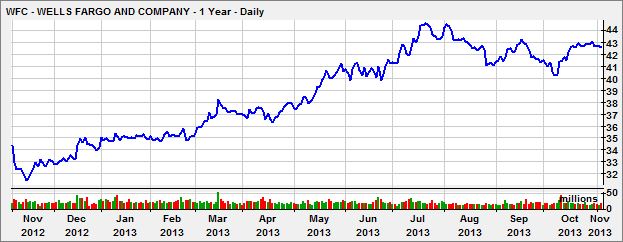
Are banks the ultimate Cockroach stock? Or do we just know too much about them? The only bank stock I own is Wells Fargo (WFC), which now looks as though it’s run its course and is ripe for selling.
Ditto for JPMorgan which I don’t own.
v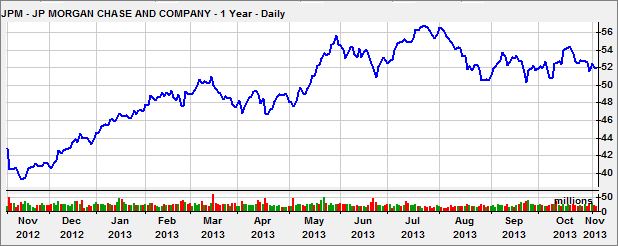
A reader send this famous quote by Henry Ford; “It is well enough that people of the nation do not understand our banking and monetary system, for if they did, I believe there would be a revolution before tomorrow morning.”
The punishment bills are piling up for our banks. To see what’s coming down the pike, read the latest Matt Taibbi:
Chase Isn’t the Only Bank in Trouble
I’ve been away for weeks now on a non-financial assignment (we have something unusual coming out in Rolling Stone in a few weeks) so I’ve fallen behind on some crazy developments on Wall Street. There are multiple scandals blowing up right now, including a whole set of ominous legal cases that could result in punishments so extreme that they might significantly alter the long-term future of the financial services sector.
As one friend of mine put it, “Whatever those morons put aside for settlements, they’d better double it.”
Firstly, there’s a huge mess involving possible manipulation of the world currency markets. This scandal is already drawing comparisons to the last biggest-financial-scandal-in-history (the Financial Times wondered about a “repeat Libor scandal”), the manipulation of interest rates via the gaming of the London Interbank Offered Rate, or Libor. The foreign exchange or FX market is the largest financial market in the world, with a daily trading volume of nearly $5 trillion.
Regulators on multiple continents are investigating the possibility that at least four (and probably many more) banks may have been involved in widespread, Libor-style manipulation of currencies for years on end. One of the allegations is that traders have been gambling heavily before and after the release of the WM/Reuters rates, which like Libor are benchmark rates calculated privately by a small subset of financial companies that are perfectly positioned to take advantage of their own foreknowledge of pricing information.
A month ago, Bloomberg reported that it had observed a pattern of spikes in trading in certain pairs of currencies at the same time, at 4 p.m. London time on the last trading day of the month, when WM/Reuters rates are released. From the article:
In the space of 20 minutes on the last Friday in June, the value of the U.S. dollar jumped 0.57 percent against its Canadian counterpart, the biggest move in a month. Within an hour, two-thirds of that gain had melted away.
The same pattern – a sudden surge minutes before 4 p.m. in London on the last trading day of the month, followed by a quick reversal – occurred 31 percent of the time across 14 currency pairs over two years, according to data compiled by Bloomberg. For the most frequently traded pairs, such as euro-dollar, it happened about half the time, the data show.
The recurring spikes take place at the same time financial benchmarks known as the WM/Reuters (TRI) rates are set based on those trades…
The Forex story broke at a time when the industry was already coping with price-fixing messes involving oil (the European commission is investigating manipulation of yet another Libor-like price-setting process here) and manipulation cases involving benchmark rates for precious metals and interest rate swaps. As Quartz put it after the FX story broke:
For those keeping score: That means the world’s key price benchmarks for interest rates, energy and currencies may now all be compromised.
Perhaps most importantly, however, there’s a major drama brewing over legal case in London tied to the Libor scandal.
Guardian Care Homes, a British “residential home care operator,” is suing the British bank Barclays for over $100 million for allegedly selling the company interest rate swaps based on Libor, which numerous companies have now admitted to manipulating, in a series of high-profile settlements. The theory of the case is that if Libor was not a real number, and was being manipulated for years as numerous companies have admitted, then the Libor-based swaps banks sold to companies like Guardian Care are inherently unenforceable.
A ruling against the banks in this case, which goes to trial in April of next year in England, could have serious international ramifications. Suddenly, cities like Philadelphia and Houston, or financial companies like Charles Schwab, or a gazillion other buyers of Libor-based financial products might be able to walk away from their Libor-based contracts. Basically, every customer who’s ever been sold a rotten swap product by a major financial company might now be able to get up from the table, extend two middle fingers squarely in the direction of Wall Street, and simply walk away from the deals.
Nobody is mincing words about what that might mean globally. From a Reuters article on the Guardian Care case:
“To unwind all Libor-linked derivative contracts would be financial Armageddon,” said Abhishek Sachdev, managing director of Vedanta Hedging, which advises companies on interest rate hedging products.
Concern over all of this grew even hotter last week with the latest Libor settlement, in which yet another major bank, the Dutch powerhouse Rabobank, got caught monkeying with the London rate.
Rabobank paid over a billion in fines to American, British, Dutch and Japanese authorities and saw its professorial CEO, Piet Moerland, resign as a result of the probe. The investigation revealed the same disgusting stuff all of the other Libor probes had revealed – traders and various other mid-level bank sociopaths laughing and joking about rigging rates and screwing customers all over the world. From the WSJ:
In a July 2006 electronic chat, an unidentified Rabobank trader was informed about the bank’s plans to set Libor “obscenely high” that day, according to an exchange cited by the Justice Department. The trader responded, “oh dear . . . my poor customers . . . . hehehe!!”
Here at home, virtually simultaneous to the Rabobank settlement, Fannie Mae filed a suit against nine banks – including Barclays Plc (BARC), UBS AG (UBSN), Royal Bank of Scotland Plc, Deutsche Bank AG, Credit Suisse Group AG, Bank of America, Citigroup and JPMorgan – for manipulating Libor, claiming that the mortgage-financing behemoth lost over $800 million due to manipulation of the benchmark rate by the banks.
And virtually simultaneous to that, JP Morgan Chase disclosed that it is currently the target of no fewer than eight federal investigations, for activities ranging from possible bribery of foreign officials in Asia to allegations of improper mortgage-bond sales to . . . the Libor mess. “The scope and breadth of risky practices at JPMorgan are mind-boggling,” Mark Williams, a former Federal Reserve bank examiner, told Bloomberg.
The point of all of this is that any thought that the potential Chase settlement might begin a period of regulatory healing for it and other Wall Street banks appears to be wildly mistaken. If anything, the scope of potential liability for all the major banks, particularly in these market-rigging furors, appears to be growing in all directions.
A half-year ago, it looked like the chief villains in the Libor mess at least were going to get away with writing relatively small checks. Back in March, a major private class-action suit filed by a gaggle of plaintiffs against the banks for Libor manipulation was tossed by a federal judge here in the southern District of New York on the seemingly preposterous grounds that a bunch of banks getting together to monkey with the value of world interest rates in this biggest-in-history financial collusion case was somehow now an antitrust issue.
The banks in that case humorously implied that the victims might have done better to sue for fraud instead of manipulation (“The plaintiffs, I believe, are confusing a claim of being perhaps deceived,” one bank lawyer put it, “with a claim for harm to competition”), and the judge seemed to agree.
Moreover, when the plaintiffs’ lawyers tried to make a point about the seemingly key fact that a series of governments had already concluded settlements with the banks for manipulating Libor, the judge – the Hon. Naomi Rice Buchwald – mocked the plaintiffs’ lawyers for trying to ride to civil victory on a wave of government settlements:
Wait a second. Your job here, as plaintiffs’ counsel, looking for whopping legal fees, is not to piggyback on the government. Indeed, the reason that there are statutes that provide plaintiffs’ counsel with attorney’s fees is a recognition that the government has limited resources.
The banks must have thought they’d hit the lottery, with this potentially deadly Libor suit suddenly stopped dead in its tracks by a grumpy federal judge with an apparent distaste for plaintiff lawyers who collect “whopping” legal fees. So the victims tried to take a different tack, appealing to a federal panel in an attempt to allow them to file their suits against the banks on a state-by-state level.
But then, in a seemingly fatal blow to the private claims, the U.S. Judicial Panel on Multidistrict Litigation ruled in favor of the banks, sending the case right back into the courtroom of the same judge who’d dumped on the plaintiffs’ lawyers and their “whopping fees.”
That was just a month ago, at the beginning of October, and back then it seemed like the banks might somehow escape the Libor mess with their necks intact.
Now, a month later, yet another bank has been forced to cough up a billion dollars for Libor manipulation, Fannie Mae has filed a major suit on the same grounds, and the Guardian Care Homes case is not only alive but looking like a threat to cancel billions of dollars’ worth of Libor-related contracts. Not only that, many of those same banks are being sucked into what potentially is an even uglier scandal involving currency manipulation.
One gets the feeling that governments in all the major Western democracies would like to sweep these manipulation scandals under the rug. The only problem is that the scale of the misdeeds in these various markets is so enormous that even the most half-assed attempt at regulation will cause a million-car pileup.
There’s simply no way to do a damage calculation that won’t wipe out the entire finance sector when you’re talking about pervasive, ongoing manipulation of $5-trillion-a-day markets. That’s the problem – there’s no way to do a slap on the wrist in these cases. If they’re guilty, they’re done.
Where to invest now? Courtesy Goldman Sachs. Their analysis is excellent. They do good work. But the result is heavy going. You should get some ideas from this 89-page paper. Give it time to load. It’s 4 megs. Enjoy. Click GS- Where to Invest Now.
Two services I really like:
+ If you use Microsoft Outlook, you must use Lookeen. It’s a plug-in that indexes your Outlook stuff — contacts, emails, calendar, tasks, attachments, etc. — and finds things instantly. It blows away Microsoft’s own miserable search. Download a Lookeen trial. Then buy the software. It’s really good. Bulletproof. Click here.
+ Cell phone monthly service for most of us is routinely $100 a month — no matter what plan you’re on. I have a $39 a month (which includes all taxes) alternative — Ultra Me. They resell T-Mobile and add a few neat wrinkles — like cheap overseas calling. Ultra Me’s data is ultra fast. They work fantastic in cities, not too good in the country-side. If your need is largely city calling and city data, these guys will serve you admirably. You’ll need to buy your own unlocked GSM phone — because Ultra Me provides only the SIM card and the service — think what you do in Europe. You can buy an unlocked iPhone from Apple and use it on Ultra Me. I’m using an HTC One. I prefer Apple phones to Android ones. Apple’s are easier to use. For Ultra Me click here.
Outsource Your Way to Success. Want to get ahead in life? Pay others to do the boring stuff. From the New York Times Magazine. Click here.
The worst thing, ever. According to my son, Michael, “I want to run away just reading it.” He doesn’t like the Indonesian snake massage, now available and popular among massage tourists:

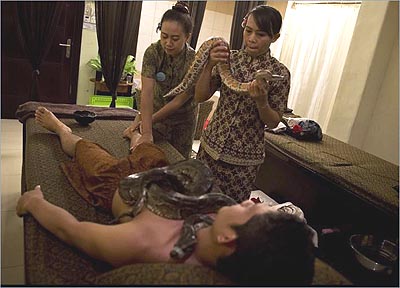
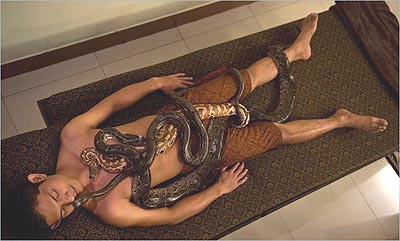
Before the 90-minute treatment, which costs 480,000 rupiah ($43), the snakes are taken out of the plastic boxes where they are kept and cleaned with antiseptic.
While many people who get the massage at the center, called Bali Heritage Reflexology and Spa, are thrill seekers or just looking for a new experience, a handful are trying to get over a life-long fear of snakes. Their mouths are also taped shut. Saves them flicking their tongues and freaking you completely out.
Finally a story on Yahoo that excites me. Read more here. here.
If you don’t like snakes, try this little test.
Read this question, come up with an answer and then scroll down to the bottom for the result. This is not a trick question. It is as it reads. No one I know has gotten it right.
A woman, while at the funeral of her own mother, met a guy whom she did not know. She thought this guy was amazing. She believed him to be her dream guy so much that she fell in love with him right there, but never asked for his number and could not find him. A few days later she killed her sister.
Question: What is her motive for killing her sister?
[Give this some thought before you answer, see answer below. This cute picture of Taylor Swift, one of the top earning female singers in the world, is purely for fill.
.
Answer:
She was hoping the guy would appear at the funeral again.
If you answered this correctly, you think like a psychopath. This was a test by a famous American Psychologist used to determine if one has the same mentality as a killer. Many arrested serial killers took part in the test and answered the question correctly. If you didn’t answer the question correctly, you are apparently not a psychopath, though, if you’re trying to pick stocks, I still worry about you.

Harry Newton who’s happy he sold his Tesla at a much higher price. Lesson: Keep your trigger finger well-oiled. When things look squirrelly or cockroachy, get out fast. It’s not unreasonable to own more WEN, MA, and V. I still like APO, BX and KKR. I’m still praying with QCOM. But oih, what a miserable flat performer.
My emailing of the day’s column is still a work in progress. Stay with me. Another $200 or $300 million more and I’ll have it solved and pretty. I’m beginning to have sympathy for the mess at www.HealthCare.gov.

XLF is down in the after hours market .
Harry, the partisan/economic comments by some of your readers relating to the election of a Democrat should not go unchallenged. Reality dictates that we are social creatures living in highly organized and complex societies, not mythical, solitary high plains drifters à la spaghetti westerns. The expenses for living in our social structures are high. The question is not whether we should or should not pay for our societies. The real question is whether we are getting a good return for what we pay.
Listen to this liberal piece of shit.
AS New York City becomes Detroit, I predict a boom property market in Florida.
$43 dollar massage in
Indonesia and by snakes no less, insane price.
This story won’t have a happy ending.
Jon…..define “happy ending”….
Every Ronald Reagan movie had a happy ending.
Hey Harry….I’ve got a idea for tomorrow’s column. Maybe you could have your wife take a video of you doing the Bill de Blasio “smackdown” dance….party on Harry your new mayor is going to be a gigantic disaster and I am going to love watching every minute of it.