The contemporary art market booms, while the stockmarket ebbs. The lesson is diversification clearly works.
The first mindblower about the auction world is the size of the commissions. They’re mindblowing. Take the top seller last night, Francis Bacon’s Three Studies of Lucian Freud.
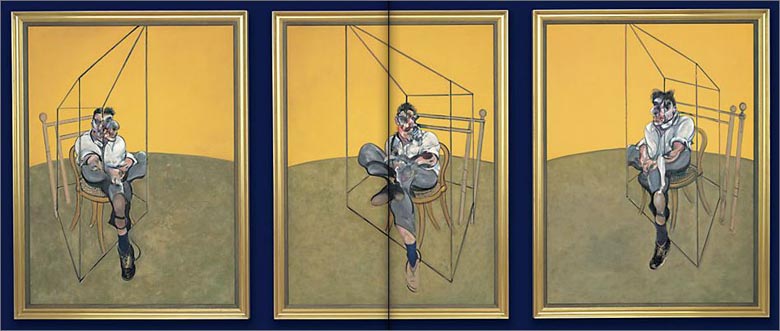
The “hammer price” was $127 million. That was the price I saw the auctioneer close the bidding at. This morning’s New York Times reported the price was actually $142.4 million. The difference of $15.4 million I’m guessing was Christie’s commission — 10.81%. I’m told that it can go as high as 25% on lower priced items. This seems to be one of those rare industries where they add the commission on after the price is struck. In real estate, for example, the seller pays the commission. In this business, the buyer pays it.
There are two major auction houses — Christies and Sothebys. The latter is doing just fine:
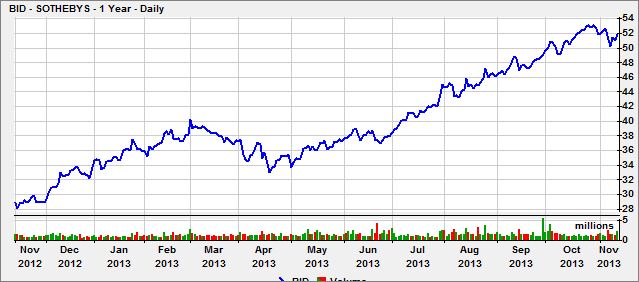
According to Wikipedia, Christies is an art business and a fine arts auction house, currently the world’s largest, with sales for the first half of 2012, some $3.5 billion. Much more now, I’m guessing. It is owned by Groupe Artémis, the holding company of François-Henri Pinault.
The New York Times had a big piece this morning on the auction:
At $142.4 Million, Triptych Is the Most Expensive Artwork Ever Sold at an Auction
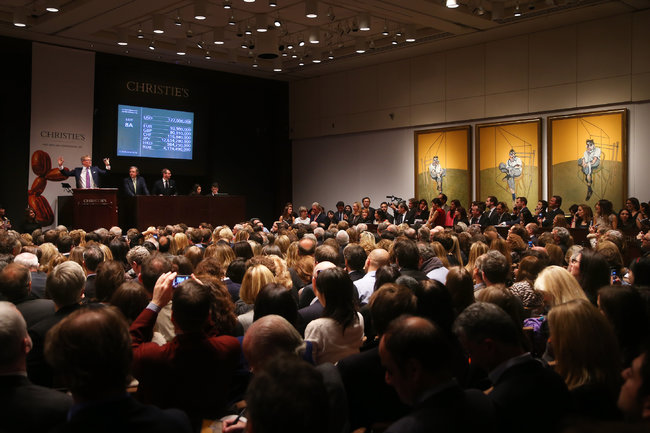
Seven bidders battled for 10 minutes over Francis Bacon’s “Three Studies of Lucian Freud.” The 1969 work in three parts, hanging on the wall, was purchased by a dealer’s unidentified client.
It took seven superrich bidders to propel a 1969 Francis Bacon triptych to $142.4 million at Christie’s on Tuesday night, making it the most expensive work of art ever sold at auction. William Acquavella, the New York dealer, is thought to have bought the painting on behalf of an unidentified client, from one of Christie’s skyboxes overlooking the auction.
The price for the painting, which depicts Lucian Freud, Bacon’s friend and rival, perched on a wooden chair, was more than the $85 million Christie’s had estimated. It also toppled the previous record set in May 2012 when Edvard Munch’s fabled pastel of “The Scream” sold at Sotheby’s for $119.9 million and broke the previous record for the artist at auction set at the peak of the market in May 2008, when Sotheby’s sold a triptych from 1976 to the Russian oligarch Roman Abramovich for $86.2 million.
When the bidding for “Three Studies of Lucian Freud” finally stopped, after more than 10 fraught minutes, the overflowing crowd in the salesroom burst into applause. Two disappointed bidders could be seen leaving the room. “I went to $101 million but it hardly mattered,” said Larry Gagosian, the super-dealer who was trying to buy the painting on behalf of a client. Another contender was Hong Gyu Shin, the director of the Shin Gallery on Grand Street in Manhattan, who said he was bidding for himself.
“I was expecting it to go for around $87 million,” Mr. Shin said. Although he explained that he collects mostly Japanese woodblock prints and old master paintings, he found the triptych by the Irish-born painter, who died in 1992, irresistible. “I loved that painting and I couldn’t control myself,” he said. “Maybe someday I’ll have another chance.”
For more than a month now, Christie’s has been billing the sale as a landmark event with a greater number of paintings and sculptures estimated to sell for over $20 million than it has ever had before. The hard sell apparently worked. Nearly 10,000 visitors flocked to its galleries to preview the auction. The sale totaled $691.5 million, far above Christie’s $670.4 million high estimate, becoming the most expensive auction ever. It outstripped the $495 million total set at Christie’s in May.
Of the 69 works on offer, only six failed to sell. All told, 10 world record prices were achieved for artists who, besides Bacon, included Christopher Wool, Ad Reinhardt, Donald Judd and Willem de Kooning.
The sale was also a place to see and be seen. Christie’s Rockefeller Center salesroom was standing room only, with collectors including Michael Ovitz, the Los Angeles talent agent; Aby Rosen, the New York real estate developer; Martin Margulies, from Miami; Donald B. Marron, the New York financier; and Daniel S. Loeb, the activist investor and hedge fund manager.
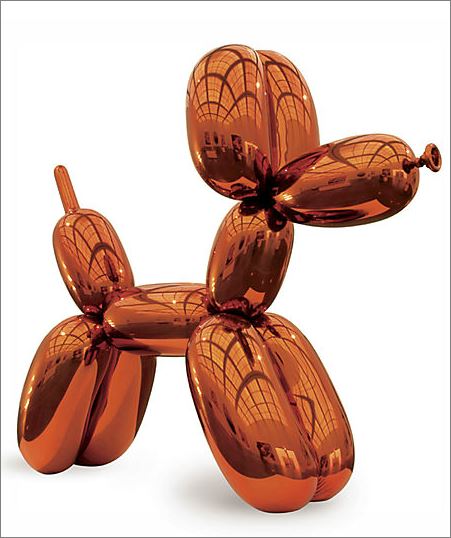
The Bacon triptych was not the only highflier. A 10-foot-tall mirror-polished stainless steel sculpture that resembled a child’s party favor, Jeff Koons’s “Balloon Dog (Orange)” sold to another telephone bidder for $58.4 million, above its high $55 million estimate, becoming the most expensive work by a living artist sold at auction. The pooch was being sold by Peter M. Brant, the newsprint magnate who auctioned the canine to raise money to endow his Greenwich, Conn., foundation. In the 1990s, Mr. Koons had created the sculpture in an edition of five, each in a different color. Four celebrated collectors own the others: Steven A. Cohen, the hedge-fund billionaire, has a yellow one; Eli Broad, the Los Angeles financier, owns a blue one; François Pinault, the French luxury goods magnate and owner of Christie’s, has the magenta version; and Dakis Joannou, the Greek industrialist, has his in red. Christie’s had estimated Mr. Brant’s sculpture would fetch $35 million to $55 million.
(Final prices include the buyer’s premium: 25 percent of the first $100,000; 20 percent of the next $100,000 to $2 million; and 12 percent of the rest. Estimates do not reflect commissions.)
Another strong price was set for a classic image in contemporary art history — Andy Warhol’s “Coca Cola [3],” one of only four paintings of a single Coca-Cola bottle that the artist made in 1961 and 1962. Jose Mugrabi, the New York dealer, bought the painting from S. I. Newhouse Jr. in 1986 and he was said to be selling it on Tuesday night. That painting made $57.2 million. It had been estimated to sell for $40 million to $60 million.
Three bidders went for Rothko’s “No. 11 (Untitled),” one of the artist’s abstract canvases, this one in an orange palette and created in 1957. It was being sold by the estate of Bruce J. Wasserstein, the financier who died in 2009. Christophe van de Weghe, a Manhattan dealer, bought the painting for $46 million, above its high $35 million estimate. Mr. van de Weghe also bought “Apocalypse Now,” a seminal painting by Mr. Wool, whose work is currently the subject of a major retrospective at the Guggenheim Museum. Bidding on behalf of a client, he paid $26.4 million for the painting. Created in 1988, the white canvas is filled with the words “Sell the House Sell the Car Sell the Kids,” a line from the Francis Ford Coppola movie of the same title. The painting belonged to David Ganek, the former New York hedge fund manager and Guggenheim board member. Mr. Ganek has since resigned from the board.
After the sale, Jussi Pylkkänen, chairman of Christie’s Europe and the evening’s auctioneer, noted how international the bidding was. Besides a healthy showing of American bidders, there were also a lot of potential buyers from Asia and Europe trying to get into the action. “There were more players from the New World than ever before,” he said, “and more people spending over $20 million.
“But,” he warned, in order to have such a successful sale, “you have to have the material.”
I was watching the auction on the Internet. Here are the hammer prices (that doesn’t include commission) of some of the pieces I liked and showed in yesterday’s column (click here):
Jeff Koons Balloon Dog $52 million.
Andy Warhol’s Coca Cola $51 million:

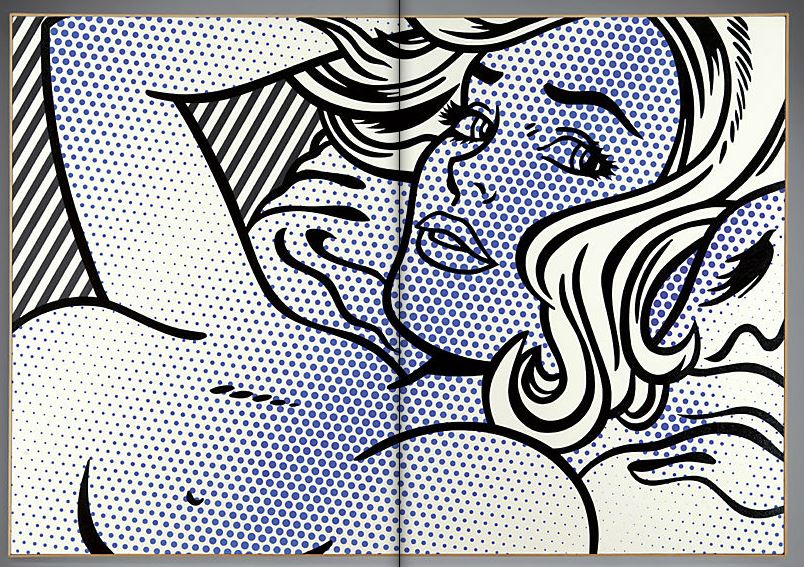
Roy Lichtenstein’s Seductive Girl $28 million.
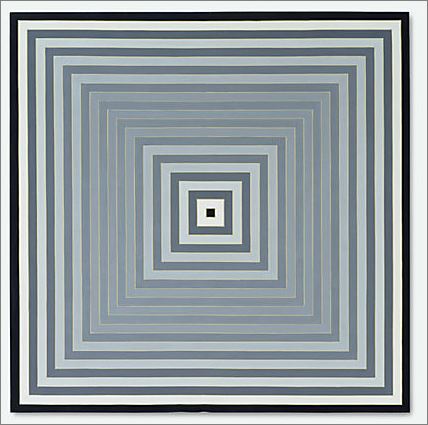
Frank Stella’s Pratfall $2.4 million:
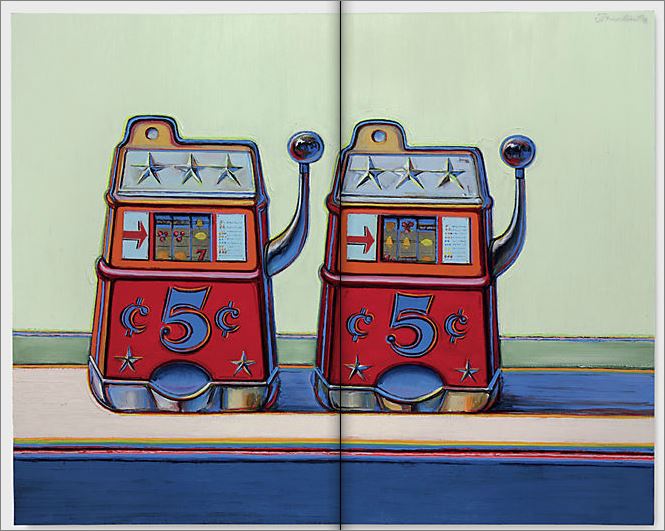
Wayne Thiebaud’s Two Jackpots $5.5 million.
I didn’t bid on any, though I really do like some of the art. I guess that’s the key to buying this stuff. You have to love it. This stuff is more pleasurable on your wall than share certificates from Amazon, or Netflix.

Harry Newton.
If you signed up for an email of every morning’s column, you may or may not get the column the way it appears on my web site. We’re still working on this. How my email is displayed on your computer or smartphone is a function of YOUR email client. It may screw up pictures, charts and images. I sent in HTML and every client interprets it differently. One key is to forward my email back to yourself. Also check your spam folder or your Promotions folder in the new, horrible Gmail. The only assured way of viewing all images on my site cleanly is to come to the site directly through your browser: www.InSearchOfThePerfectInvestment.com or www.TechnologyInvestor.com. Click here.

No wonder so many of my rich friends love Obama. When you see this, it’s hard not to join the crowds screaming tax the rich. And with the exception of Wayne Thiebaud, I’m not wild about the art. I do have a beautiful poster of hilly San Francisco streets by him.
No wonder so many of my rich friends love Obama. When you see this, it’s hard not to join the crowds screaming tax the rich. And with the exception of Wayne Thiebaud, I’m not wild about the art. I do have beautiful poster of hilly San Francisco streets by him.