I cannot get excited over Yahoo!, though I clearly should have. Its rise has been nothing short of phenomenal:
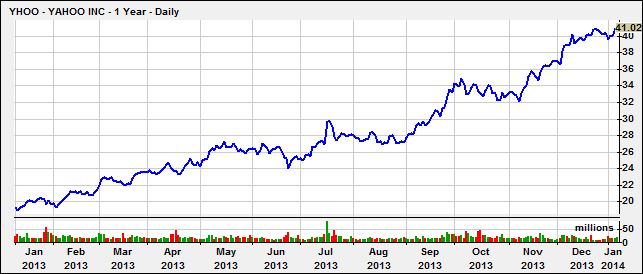
I am a geek. I judge technology companies by their appeal to me. I visit Yahoo! and find nothing — absolutely nothing new (or old) that appeals.
But, Wall Street does love motion — like lots of publicity and lots of takeovers (whether of dubious value or not). Yahoo’s new CEO, Marissa Mayer has delivered both in spades. One BIG PR was her purchase of Summly which she bought for $33 million from a 17-year old boy genius. Summly was a news service for busy people — like you and me. You got a headline and few words on a handful of news stories — all the news you ever wanted to keep you up to date, twice a day.
Mayer morphed Summly into Yahoo News Digest and invited everyone and their uncle to download Yahoo News Digest from the Apple AppStore. I did. I cannot believe anyone paid $33 million for this nonsense as technology innovation. If I figure it as $33 million for public relations, it was worth every penny. But not as a real product.
I received my eight headline stories from Yahoo News Digest this morning. And there I find a story on how “Mexican fishermen find cojoined gray whale calves.” You can watch a ridiculous video on Yahoo News Digest here.
Off course, there’s also all those delicious shares Yahoo own in Alibaba, which is going public some time soon. Aren’t they priced in yet?
I bet Ms. Mayer takes Yahoo! to $100. But it will be without me.
There’s a lesson here, somewhere.
I, Cringely’s Ten technology predictions for 2014. For those of you who don’t know Cringely, he’s an old-time, very talented reporter on technologies:
This column is mainly about business predictions for 2014 while the follow-up column will be more about products and technologies.
#1 – Microsoft gets worse before it gets better. Ford CEO Alan Mulally, who already owns a home in Seattle, announced just today that he is staying with Ford through 2014 and absolutely positively won’t be the next CEO of Microsoft. This firm statement is in contrast with his kinda-sorta firm denials before today. What this means to me is that Mulally was in hard discussions about the Microsoft job but walked away from the deal. Since there’s a clock ticking on Ballmer’s retirement someone will get the position but that someone will now probably be an insider, possibly Stephen Elop.
This is terrible news for everyone, even for the people who made it inevitable – Steve Ballmer and Bill Gates. Mulally would have taken the job had Ballmer and Gates resigned from the Microsoft board. They wouldn’t and so he didn’t, the result being more palace intrigue and behind-the-scenes micromanaging not to good effect. Whoever gets the top job won’t have the power to do what’s needed and probably won’t have the job for long.
Microsoft’s future lies in the enterprise and the quicker they get out of consumer products the better for the company, but a weak CEO won’t be able to move fast enough.
We’ll revisit this one next year when Mulally may again be on the short list.
#2 – IBM throws in the towel. Any minute some bean counter at IBM is going to figure out that it is statistically impossible for the company to reach its stated earnings-per-share goal of $20 for 2015. Cutting costs, buying revenue, repurchasing shares and short-changing both customers and employees no longer adds-up to enough financial power to get the job done. This will lead to a management crisis at Big Blue. On top of that throw half a dozen customer lawsuits over bungled projects and it doesn’t look good for the regime of Ginni Rometty.
Can she pivot? That’s the question. Rometty has been trying to follow her predecessor Sam Palmisano’s playbook but it isn’t working. She needs a new strategy. This is actually a great opportunity for both Rometty and IBM, but the second half of this prediction is they’ll blow it. Rometty and IBM will survive 2014 but it won’t be pretty.
#3 – Blackberry to Microsoft. Assuming Elop gets the top job at Microsoft (not at all a shoo-in) he’ll approach the enterprise play from a mobile angle and that means buying Blackberry. Microsoft will get enough patents from the deal to further enhance its revenue position in the Android market (you know Microsoft gets royalties from Android phones, right?). Redmond will get a great R&D facility in Waterloo and thousands of super-smart employees. I think this will happen, Elop or not. The only alternative purchasers are Intel and Qualcomm and I don’t see them doing it.
#4 – Intel does ARM, kinda. The idea that Intel would go back to building ARM processors is supposed to be a big deal but I don’t see it happening without some external push. Remember Intel has been down this route before, eventually selling its StrongARM operation to Marvell. What’s key here is that Apple needs to dump Samsung so they’ll force Intel to fab their A-series processors by threatening to stop buying desktop and notebook CPUs. It’s not as big a deal as it sounds except that Samsung will be losing its largest customer.
#5 – Samsung peaks. With Apple gone and Samsung phone margins eroding, what’s the company to do? 4K TVs aren’t it. Samsung needs to actually invent something and I don’t see that happening, at least not in 2014.
#6 – Facebook transforms itself (or tries to) with a huge acquisition. I wrote long ago that we’d never see Facebook in the Dow 30 Industrials. The company is awash in users and profits but they’ve lost the pulse of the market if they ever had it. Trying to buy their way into the Millennial melting data market Facebook offered $3 billion for Snapchat, which turned them down then rejected a $4 billion offer from Google. Google actually calculates these things, Facebook does not, so where Google will now reverse-engineer Snapchat, Facebook will panic and go back with the BIG checkbook – $10+ billion. If not Snapchat then some other overnight success. Facebook needs to borrow a cup of sugar somewhere.
#7 – Cable TV is just fine, thank you. Avram thinks cable TV will go all-IP. This is inevitable and in fact I wrote about it the first time at least eight years ago. Cable companies already make all their profit from Internet service so why do anything else? But not this year. That’s one for 2016. For the moment cable advertising is in resurgence and these guys aren’t going to make any significant changes while they are still making money. Look for more cable industry consolidation but nothing revolutionary. yet.
#8 – The Netflix effect continues, this time with pinkies raised. Hollywood is for sale. Nothing new there: Hollywood has always been for sale. Remember when it was Sony buying Columbia Pictures that was supposed to change entertainment forever? How did that work out? Now it’s Netflix blazing a new trail for content creation that threatens the old models except it doesn’t. Netflix knows from its viewer logs who likes what and can therefore make original programming that’s reliably popular. Amazon, in contrast, asks its users what they like and hasn’t been nearly as successful as Netflix at original content. Amazon will learn in time (they always do) but one of the things they’ll be learning is that people lie about what they like, though not about what they watch. Hollywood already knew that. Amazon doesn’t need to buy Netflix to learn this lesson, so I seriously doubt that Netflix is going to be in play. But Hollywood itself will very much be in play. in 2016.
#9 What cloud? The cloud disappears. My old friend Al Mandel once told me “The step after ubiquity is invisibility.” This means that once everyone has something it becomes a given and gains commodity status along with dramatically lowered profit margins. In the 240 suggested predictions I saw over the last few days from readers almost nobody used the word cloud. It has effectively become invisible. Every IT startup from here on will rely strongly on the cloud but it won’t be a big deal. Commoditization will have cloud providers competing mainly on price. This means there are unlikely to be any significant new entrants to this space. The cloud opportunity, such as it was, has come and gone.
#10 Smart cards finally find their place in America. I covered smart cards in Electric Money, my PBS series from 2001, yet they still aren’t popular in the USA. Smart cards, if you don’t know it, are credit or debit cards with embedded RFID chips that impart greater security though at a cost. They’ve been popular in Europe for 15 years but American banks are too cheap to use them.. or were. The Target data breach and others will finally change that in 2014 as the enterprise cost of insecurity becomes just too high even for banks Too Big to Fail.
What is it about the health care debate that makes people so crazy? That’s the question at the end of Matt Taibbi’s latest short piece on Obamacare. I reproduce the article below, because it summarizes my feelings on Obamcare also — see the bits I bolded.
A New Low in Health Care Rhetoric
I thought we’d heard it all when Sarah Palin compared having to pay taxes for someone else’s health care to slavery, but old friend and Ayn Rand devotee Megan McArdle may have one-upped her.
Like the legalization debate, which is meaningless to anyone who’s never actually been at risk of being arrested on a drug charge, health care reform is just another annoying tax-day line item if you’ve never had to worry about not being insured.
If you’re that kind of person, I guess it’s possible to forget that the whole point of even trying health care reform was to correct a proved-broken system that left a huge plurality of the population living for decades in a kind of permanent mental health crisis, with millions laboring under the stress of knowing that they might be one serious illness away from bankruptcy, foreclosure, even homelessness (and historically, this has been true even of people with insurance).
That would seem like an important problem to fix, but of course one has the right not to care about that if one chooses. And McArdle chooses. Her January 2nd column in Bloomberg, “Another Problem Obamacare Won’t Solve: Health Costs,” goes beyond saying the Affordable Care Act is inefficient and dysfunctional, and asserts that offering those millions of previously uninsured people the hope of coverage is of no benefit to anyone, even to them. Why? Apparently, because the poor and sick are going to stay that way no matter what us with-it healthy people do to try to help them.
The piece begins by taking on one of the sacred cows of health reform, promising to show that the ACA will not reduce the high costs of emergency room visits:
Does giving people health insurance help control costs?
Conventional wisdom holds that it should, by diverting them from expensive emergency room use to less-expensive visits to doctors and nurse practitioners. This argument was very popular with advocates for health reform in 2009, and it remains a sort of folk wisdom among educated people; I’ve heard some version of this argument in virtually every discussion I’ve had about health care in the last decade.
McArdle is leaning here on data from an investigation done in Oregon, in which a control group of 10,000 new Medicaid enrollees was monitored, beginning in 2008. The results of the study, released last Thursday in the journal Science, showed a 40 percent increase in ER visits among those new low-income enrollees during the control period. Megan couldn’t have been happier about the implications of this study:
Does giving people Medicaid drive ER usage up, or down?
The answer, it turns out, is “up.” People who got access to Medicaid used doctors more than people who didn’t. But they also used the ER more.
There’s a little bit of data-cherry-picking going on here. As the Washington Post noted a day after McArdle ran her piece, the surge in ER visits mostly took place right after the new enrollees got their insurance.
Subsequently, the situation improved, thanks to a program in which community health workers stationed at hospitals simply told people who showed up at the ER that they had the option to go to “less costly settings,” i.e. primary care doctors. As a result, ER visits soon began to decline. Wrote the Post’s Sarah Kliff:
Emergency-department spending decreased by 18 percent in Oregon’s Medicaid program, when the 2013 study period was compared to a 2011 benchmark . . . State health officials’ data show that much of the reduction has come from moving primary care outside the emergency department.
So to sum up: A whole bunch of people were handed health insurance in 2008 when the state of Oregon expanded its Medicaid enrollment. In the first few years after these people got insurance, they went to emergency rooms in large numbers, probably because they’d been living their whole lives in a system where the ER is the only place where they couldn’t be turned away for having no coverage/money.
Later, the state started posting the equivalent of health-care crossing guards in hospitals, whose entire job it was to explain to the low-income newly-insured that they could actually go to see a doctor somewhere outside of an emergency room without being thrown on the street. Shockingly, this resulted in a decrease in ER visits.
Still, that initial 40 percent surge in ER visits was undeniably significant, and it’s no surprise that health care opponents like McArdle jumped all over it. But in this case she went further, digging into other parts of the study.
Specifically, she pointed to data showing that the Oregon group didn’t show significant improvement in cholesterol, blood pressure and diabetes rates (although enrollees did show lower rates of depression).
Her take on this tiny initial sample of reform data: Just a few years into having access to primary care doctors, people are not healthier according to a few markers. Therefore, that proves it! Giving poor people health insurance achieves nothing.
After all, she argues, the low-income obese are not suddenly going to start running marathons, just because some doctor tells them to. They were obese in the first place for a reason!
Here’s how she put it:
Obamacare mostly solved a quite different problem: the fact that health insurance and health care are expensive. It probably isn’t going to lower costs, or dramatically alter mortality rates, or turn obese diabetics into marathoners. On the other hand, it probably will improve the financial stability of a lot of low-income households, while raising costs (and taxes) on the more affluent.
She went on:
As [MIT professor Amy] Finkelstein said to me: For an economist, insurance is a financial product, health insurance as much as life or auto insurance. Auto insurance probably doesn’t improve your driving much, but it does protect your assets if you’re in an accident.
Look, I’ve never been a fan of the Affordable Care Act. I thought it was a flawed bill, rushed into being for political reasons, that was destined to leave a huge chunk of our health care problems unsolved, in the process creating complex new burdens for taxpayers while preserving regulatory and financial handouts to the predatory health insurance industry.
So I get saying the ACA is expensive and won’t reduce costs. Thanks to the piles of subsidies they left in the bill and a slew of other problems, I might even agree.
But you’d have to be a complete sociopath to assert that expanding access to health care to millions of people doesn’t improve their health – and that the only tangible benefit of health care reform, in fact, will be taking money out of the pockets of hardworking taxpayers like yourself, and redistributing it to the incorrigibly unhealthy.
Apparently low-income Americans will have no problem taking money from the affluent – the law will improve their “financial stability” – but they won’t get healthier even with new access to doctors because, hey, having auto insurance doesn’t make you a better driver, right? (She’s wrong even within that metaphor – I think anyone who’s even been docked points for a speeding ticket has driven more slowly the next time out of the garage – but whatever).
This is sort of like that old argument that suffrage for blacks or women was pointless, because people like that wouldn’t know what to do with the vote. And if nobody’s getting healthier, well, then, the whole thing is just a waste of money. Specifically, Megan’s money. So why bother?
What is it about the health care debate that makes people so crazy?
All Lanes on George Washington Bridge Blocked by Chris Christie’s Ego
TRENTON (The Borowitz Report)-All lanes of traffic on the George Washington Bridge were blocked this afternoon by New Jersey Governor Chris Christie’s ego, traffic reports said.
Aerial images of the bridge showed traffic snarling for miles as Mr. Christie’s massive self-regard shut down all lanes on the upper and lower roadways. Tracy Klugian, a frustrated motorist attempting to head back to his home in Montclair, New Jersey, echoed the feelings of many drivers whose passage was blocked by the gargantuan ego: “First the polar vortex, and now this.”
A spokesman for the New York City Department of Transportation advised motorists to avoid the Governor’s ego by using the Lincoln and Holland tunnels “before Chris Christie remembers they’re there.”

Harry Newton who cannot believe banks like JPMorgan Chase. They’d prefer to pay fines than make their customers happy. To wit, from yesterday’s news:
To settle a barrage of government legal actions over the last year, JPMorgan Chase has agreed to penalties that now total $20 billion, a sum that could cover the annual education budget of New York City or finance the Yankees’ payroll for 100 years.
The latest hit to JPMorgan came on Tuesday, when federal prosecutors imposed a $1.7 billion penalty on the bank for failing to report Bernard L. Madoff’s suspicious activities to the authorities.
Yesterday one of their people proudly told me the story of the billionaire who regularly receives $27,000 checks but can’t deposit them by photo into his account at Chase because of Chase’s arbitrary limit of $25,000 on deposited checks. I ran up against this insane limit a few days ago and was told that the $25,000 limit was the limit because it was the limit and I could go pound sand.
I actually offered to put a million more into my Chase Private Client account. But they poohed-poohed my offer. (Clearly the billionaire had more money with them and he wasn’t getting an exception on the $25,000 check limit.) I’ll pen a letter to Jamie Dimon today pointing out the absurdities of their insane policy. You think he will answer? Nah! you think he will make an exception for me and the billionaire? Nah.
Remember banks 30 years ago? They had managers who got to know their customers and helped them on little things — like depositing checks and big things, like borrowing money. They developed relationships — profitable and enjoyable for both parties. Whatever happened?
Anyone know a little private bank with sane policies?

Harry and anyone else as rich as Harry…if you want to make electronic deposits you can do so at EverBank…this is one of my banks. If you will “scan” the check in and the email it to the bank they will accept deposits in excess of $100,000. once you are set-up and approved. They do have a $50,000. limit on cell phone deposits. If you want more info call Dianna at EverBank at 888-882-3837 and ask for her. Dianna is there until 6pm EST today and from noon to 9 pm EST tomorrow, Friday.
Harry —
1. Have you considered a member-owned credit union? They will not make commercial loans, or sometimes even loans for second homes, but they DO like to serve their members!
2. The Obamacare bill was fatally flawed because any form of tort reform was off the table. As in any business, if you want to reduce cost of product you reduce the overhead. But the legal issues and their huge overhead burden were “untouchable”.
3. At last week’s “Chaos in Communications” conference in Hamburg Germany, several speakers made reference to how “NSA loves Yahoo”. The discussions were big news in Der Spiegel and other European papers, but I don’t think such discussions are allowed in US domestic consumption. The implied or stated position is that Yahoo is (perhaps) overly-cooperative in giving access to users’ information. I concede that the news didn’t seem to impact the stock. Most amazing was a speech by Jacob Applebaum : Go to this link and scroll down: http://www.zerohedge.com/news/2013-12-30/how-nsa-hacks-your-iphone-presenting-dropout-jeep This video is an hour long. But, I guarantee you will be Mesmerized.
Obamacare won’t here here for long. Soon after the president leaves office it’ll be repealed.
Harry, have you given consideration to signing the Giving Pledge? The Giving Pledge was begun by Mr. and Mrs. Bill Gates several years ago to encourage the wealthy to give away all or nearly all of their wealth upon their deaths. Hundreds of wealthy individuals have signed the pledge. Do those already spoiled children of yours need to inherit Daddy’s money? Haven’t you done enough for them? Instead, that money from your web dictionary could go to help a farmer in Rwanda learn to plant crops, or a teacher in Zimbabwe get her degree. Think about it, Harry. Sign the Giving Pledge. Give back to the world. I can provide you details in a private email. I think you would make a wonderful addition to the Giving Pledge. What a story! Australian laborer moves to the U.S., makes it big, and then gives it all away to better mankind.
Say no, Harry. If you save one, one hundred more will show up. This world is not worth saving. Keep the money to yourself and your family.
I’m 61, retired and healthy. I’ve decided to take out a catastrophic plan for ~400/mo. However, my wife has potentially more serious issues. Her insurance went from $530/mo to $845/mo with less benefits and a higher deductible and a higher out of pocket. My 30 year old daughter decided not to take out insurance. Our doctor lowers the cost of an office visit by 30% if we don’t file though insurance. Our doctor says that one of the major increases in health costs over the last few years was the anticipation of the ACA going into effect and of course the preparation for it. It seems the ACA is in a death spiral. Young people aren’t signing up, which will raise the cost, which in turn, more people will decide to not sign up, with will raise the cost again and so forth. I think that those who tell us “all is well”, are just blowing smoke.
Well said, Scooter.
Smart “Credit Cards”…my new BankAmericard has a chip in it…I just used it over and over again in Europe with no problems…worked great and they do not charge a Foreign Exchange fee, plus you get 1-1/2 times open air miles. Many European businesses and toll gates will not accept credit cards without a chip. No gas can be purchased on Sundays without a chip. I have no love for Bank of America…but, I do like their Smart Card. Didn’t work when I stupidly inserted it into an ATM by mistake…they blocked the card, however, a quick SKYPE call got it back in service after untold security questions. My EverBank debit card worked at all ATMs with no ATM fees.
Thanks for the Taibbi reference. I would add that health insurance reform needed to be done one way or another for a long time and the ACA was the only bill that could have passed muster with our corporate insurance overlords. No way can we continue to pay 17% of our GDP (and rising) in health care. Will it work? I don’t know, but it’s a good start and will need to be tweaked and amended until it does.