Yes, how stupid? That was my thought as I slid out of bed this morning. All that money I had almost made on two stocks I’d been pushing — BX and APO. Why hadn’t I recognized their “bubble,” not been greedy and sold them? Then I looked at the charts …
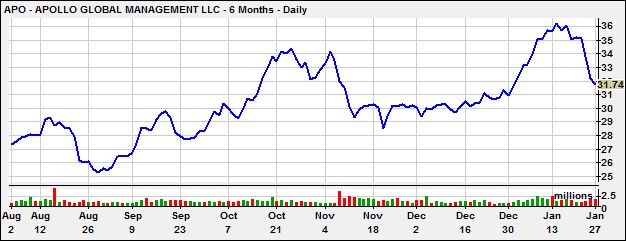
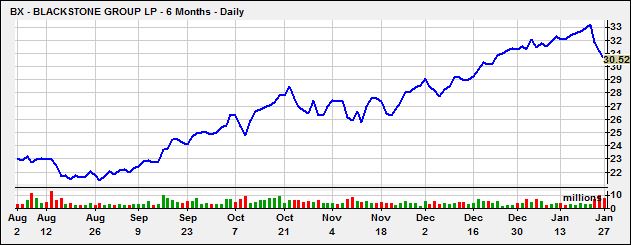
And I realized, it’s not easy. They didn’t do the spikey stuff the dotcoms did in 1999. And they didn’t hit my inviolate stop loss 8% rule. My pain was not the drop but the fact that I’d loaded up on the two shares and the daily dollar losses of the last few days were wearing on my tender psyche.
I am tempted to dump both of them, take my remaining (smaller) profits and say “Thank you.”
Meantime, the big lesson of 2014 is that diversification for an investor without control (i.e. I don’t run BX, APO or AAPL) is the only free lunch. And while I wasn’t looking, my muni bonds did spectacularly well during January. The ten year treasury yield dropped from 3% to 2.75%. That meant the price of bonds went up hugely.
You get a flavor of what happened in bonds from today’s Wall Street Journal article:
Bond Bears Enter Hibernation
U.S. Treasurys, U.K. Gilts and German Bunds Have Rallied in January
This wasn’t in the script. The big themes for 2014-accelerating growth in the developed markets, a U.S. Federal Reserve finally heading for the monetary exit and a search for yield on the part of investors-looked like they would deliver a bear market for government bonds. Yet U.S. Treasurys, U.K. gilts and German Bunds have rallied in January-and outperformed stocks into the bargain.
The moves have been sizable. In the U.S. and U.K. 10-year yields ended 2013 just above 3% but now stand at 2.77% and 2.81%, respectively; in Germany, 10-year yields are just above last summer’s lows at around 1.69%. The three bond markets are up between 1% and 1.6% this year, while U.S., German and U.K. stocks are in the red.
Clearly, the latest bout of emerging-market worries has added to the allure of traditional safe-haven securities such as Treasurys and is likely to prevent yields from rising quickly as long as it persists. But the rally in government bonds started much earlier in January.
The move in German yields is perhaps more understandably based on fundamental factors. Euro-zone inflation has fallen to worryingly low levels, and the European Central Bank is striking a consistently dovish tone. At the very least, there is no debate about whether the ECB will be tightening policy soon. That provides support for Bunds.
The move in Treasurys and U.K. gilts appears more related to how investors had set up their trades coming into this year. It seems most investors had decided yields were going higher, and had bet on that. But the early part of the year has offered somewhat more mixed data on the economic outlook than had been expected, leading some to curb those bearish bets.
In addition, yield curves had become very steep at the end of 2013, with the gap between two-year and 10-year yields reaching 2.5 percentage points in the U.S. That makes it difficult for longer-dated yields to rise much further unless investors fear that inflation will rise sharply or that central banks are losing credibility. With inflation subdued, it may be that for some investors-perhaps, for example, from Japan-a 10-year yield of 3% looks attractive.
Barring a full-blown emerging-market crisis, and as long as growth persists, government bond yields still look likely to head higher in the medium-term. After all, nominal growth in both the U.S. and U.K. could come in around the 4.5-5% level this year, and there is growing skepticism around the interest-rate guidance being offered by the Fed and the Bank of England.
But without a move higher in the short end of the yield curve, it may be difficult for 10-year yields to rise much beyond their December peaks. The defining factor for the bond market looks likely to be a struggle between central banks and markets over the path of short-term interest rates.
Should I sell my muni bonds now they’re worth more? No, because I live off their interest.
Should I put more money into muni bonds? Maybe.
Here’s a bond I was looking at this morning. It’s $107. It’s a triple tax-free (for me, living in New York). It’s paying 3.35% yield to the 2019 potential call. That’s when the issuer might decide to buy it back from me at $100 and avoid paying the 5% dividend they’re paying on the $100. If they don’t call it, the bond will pay 4.45% until its final death (also called maturity) in 2036.
I’m not earning as much as I used to, so the triple tax-free aspect isn’t as exciting as it once was. And I do think I should be able to do better than 8% in equities this year — what I’ll need to beat the 3.35% triple tax-free.
Investors’ quandary with Apple. Ever since Steve died, investors have been in several minds about Apple. My initial feeling was — It’s all over. Yet the stock skyrocketed, reaching over $700 at one point. But then people got the message that it was no longer the old creative Apple and it plummeted.
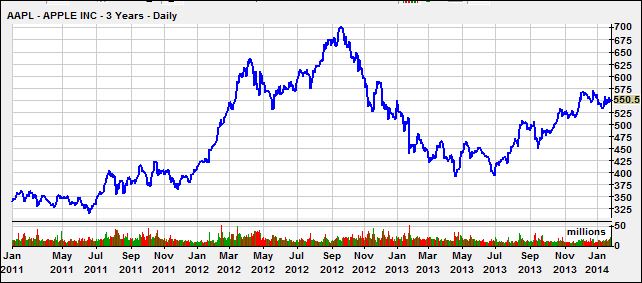
Then it came back. Along with the bounceback came unrealistic expectations. Last night’s earnings disappointed. After hours Apple’s stock crashed 8% or so. Today won’t be pretty. Yet, what Apple reported last night most other companies would kill for. And today all my friends will be looking to scoop up Apple shares “cheaply.” Personally I think the emotional energy spent on Apple by investors trying to time their entry and exit is wasted energy. Go play tennis. Go skiing. More rewarding.
Accept Apple is a different company. There will never be products again as game-changing as the iPod, the iPad or the iPhone. Steve is dead. The present Apple management, lacking Steve’s creativity, is into tweaking — making iOS prettier, making the iPhone bigger, etc.
That said it’s a perfectly fine company. It earns good money. The products have great margins. And it has plenty of money to pay normal and special (higher) dividends. Try these two facts:
- Apple in its quarter produced more revenues than did Google, Microsoft, and Intel combined, based on current Google estimates.
- Apple produced almost an entire year’s worth of net income for Google in a single quarter.
Those statements came from a long Seeking Alpha piece this morning which you should read. Click here. The Journal has a piece also. Click here.
This morning Apple looks like it will drop 7% to 8%. That seems overdone.
Cowboy story 1
A Texas cowboy walked into a crowded bar, waving his 1911 Colt 45 with an 8 shot clip, and yelled, “Who in here has been sleeping with my wife?”
A voice from the back of the bar yells: “You’ll need more ammo.”
Cowboy story 2
An old cowboy walks into a barbershop in Moose Jaw, Wyoming for a shave and a haircut. He tells the barber he can’t get all his whiskers off because his cheeks are wrinkled from age. The barber gets a little wooden ball from a cup on the shelf and tells the old cowboy to put it inside his cheek to spread out the skin.

When he’s finished, the old cowboy tells the barber that was the cleanest shave he’d had in years, but he wanted to know what would have happened if he had accidentally swallowed that little ball. The barber replied, “just bring it back in a couple of days like everyone else does”.

Harry Newton who heard about Colorado couple who divorced. He got the marijuana retail stores (called dispensaries in Colorado). She got the seeds and the kids. Colorado is about to issue muni bonds backed by the new marijuana taxes. The bonds will have a higher rating than those backed in eastern states by cigarette taxes. The marijuana bonds may carry a higher yield — simply because insurance companies and pension funds may steer away from buying them — at least initially. I can see the annual meeting and shareholder questions, “Just what was the board smoking?”

Only in America: cigarettes bad, marijuana good. At least that’s the PC view in Calif.
AS you know, I was a buyer of Apple at 430. I’m not going anywhere and sleep extremely well with that investment.
Harry, stop buying muni bonds from your broker. They rip off individual investors on either end of the trade. If you give me the bond cusip I’ll show you what a large financial institution would actually buy it for. Check out the closed end muni funds or, if you don’t like the idea of continuous reinvestment, check muni term trusts. You’ll get better yields than inidividual bonds for a variety of reasons. you’ll also be more diversified and have better liquidity when buying/selling.