How bad was yesterday’s 324 point decline in the Dow? Bad because it was BIG. But in the course of the history of the world? Let’s try something.
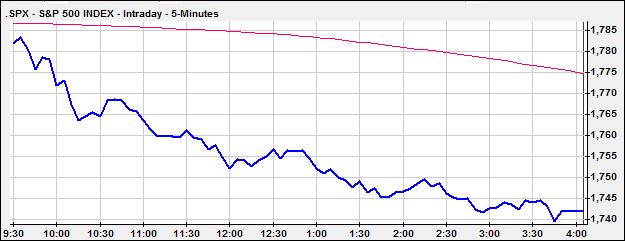
This was what the market did yesterday, compared to the 200-day moving average (in red). Looks totally awful and it was, if you were fixated on your screen.
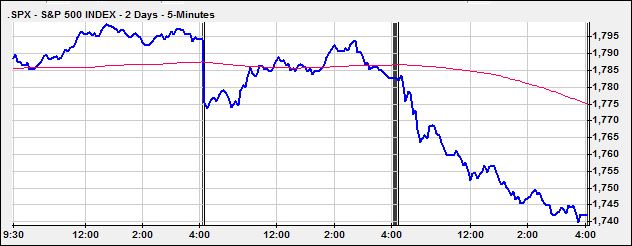
This is what it did over the past two days. Still pretty awful.
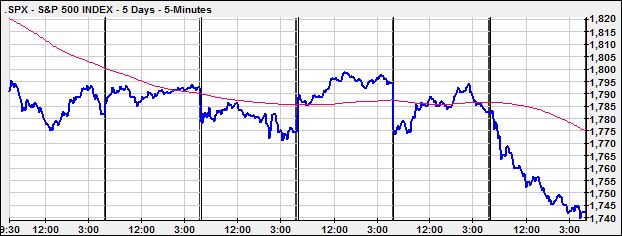
This is over the past five days. Stay with me.
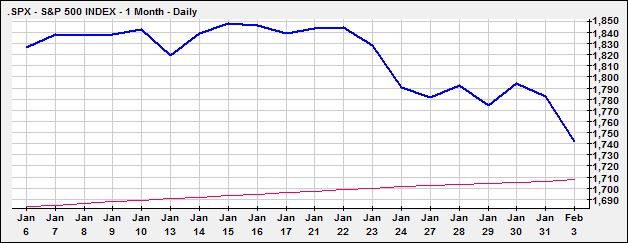
This is over the past month:
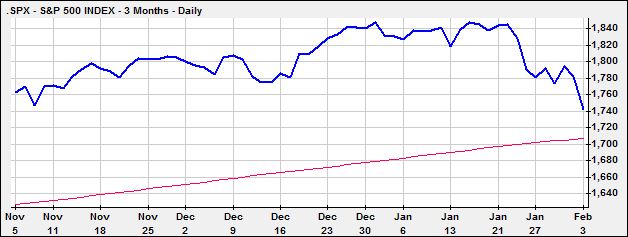
This is over the past three months:
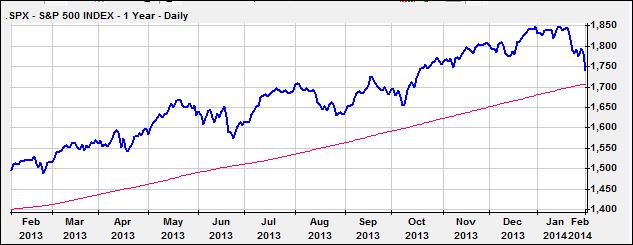
This over the past year. Not that awful.
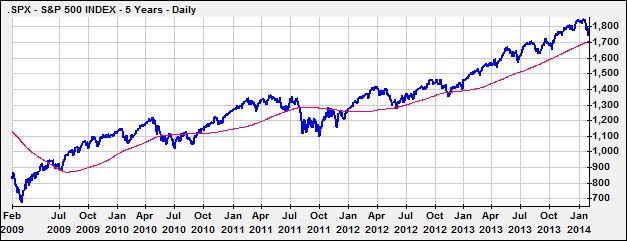
This over the past five years. Looking good, so far.
This is over the past ten years. You can see the plummet in 2008 because of the banking subprime mortgage crisis — The Great Recession.
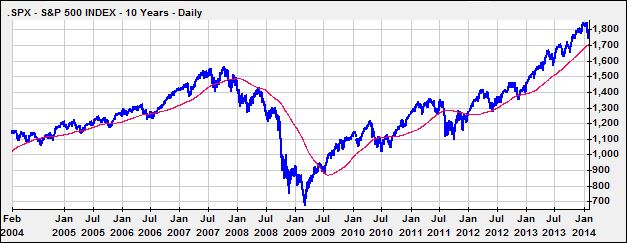
Are we in 2008 or are we experiencing a “blip.”
Last night Cramer offered up 10 reasons the markets are skittish:
1. Weak employment. Cramer said the markets are fretting (upcoming) Friday’s labor numbers. Two bad reports in a row and it’s game over. (The previous one was not good.)
2. Recession stocks. Cramer said the safety stocks that many investors turn to are losing ground, leaving them no place to hide.
3. Cult stocks. Even the “cult” stocks with sky-high valuations are feeling the heat, (e.g. Amazon)
4. Retail. Where have all the shoppers gone? First we thought it was a shift from soft goods to hard goods, then hard goods to online. Now we have no idea where they are. (Starbucks president reported an absence of buyers from the malls.)
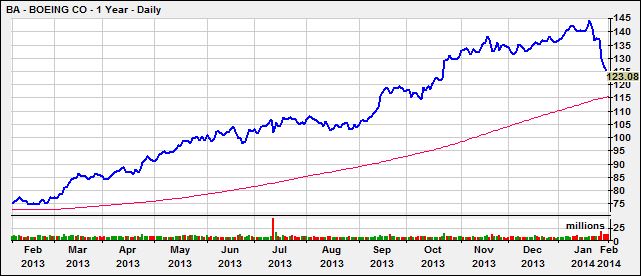
5. Aerospace. Investors are abandoning the aerospace stocks, even though there’s little to no evidence of a slowdown. (I sold out of Boeing. I’ll pick it back up soon.)
6. Our government. It’s clear the shutdown cost Americans big time, and with continued worries over Obamacare, food stamps, unemployment and the debt ceiling, Cramer said, it’s clear our government remains totally out of touch.
7. New Fed chief. Cramer said the markets need a steady Federal Reserve, but with a brand new chair that is proving difficult.
8. Emerging markets. The slowdown in the emerging markets is proving severe and the turmoil is being felt around the globe.
9. Commodities. Commodities are collapsing in price as the markets fear a sudden halt in China.
10. Earnings are meaningless. Investors are totally ignoring even the best earnings and sending stocks lower regardless.
Other reasons:
+ Institute for Supply Management (ISM) index came in at 51.3. While this does not indicate contraction, it is much lower than the last reading of 56.5 and below what was expected. The report also showed the largest one-month drop in new orders since 1980.
+ A bunch of respected market commentators have been, of late, very negative on the market — including VectorVest (called a “confirmed down” last Friday), Richard Russell and Harry Dent.
+ Margin debt being called in. No one should ever buy stocks on margin, but a lot of people do. And they buy a lot of stocks when the market is very high. In other words, they buy on margin at the peak of the market. Which is always a good sign that the market is about to crater. Here’s the chart:
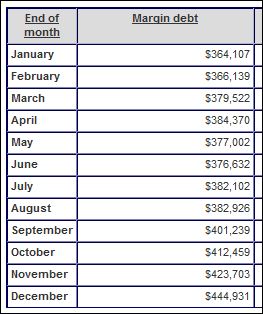
That’s billions. $444.9 billion — up a whopping 22.2% on the year. This chart comes from the NYSE. Click here.
What happens here is that stocks fall. Brokers call for more money. No one has the cash. They’re forced to sell. They sell the good stocks and the bad stocks. That causes the market to tumble. It forces more selling, and down we go.
As to where the market will go from here? The consensus seems to be that this downturn has not finished, despite what the buoyant futures say this morning.
Should you sell stock? Should you go short?
You need to dump stocks that are no longer working, whose earnings are yuchy, and who are in the wrong place (like IBM and T). And those that have broken through their 200-day moving average, e.g. Berkshire Hathaway.
Today, with futures up, might be a good time to get rid of our non-performers.
This is not easy. But, if you sell, you will have some cash, and be ready to pounce.
My friends are confused and not happy. It was so easy in 2013.
Two stocks worked for me yesterday: My IBM and AT&T shorts. I shorted T because of its erstwhile flat earnings and the present huge price war in wireless. I shorted IBM because I felt it was going nowhere. I am not alone in that belief. From long-time technology author, I. Cringley:
IBM sells Intel server business, company is doomed
IBM today sold its Intel server business to Lenovo, yet another example of Big Blue eating its seed corn, effectively dooming the company for the sake of short-term earnings. It’s a good move for Lenovo and an act of desperation for IBM.
Wall Street analysts may see this as a good move but then Wall Street analysts typically aren’t that smart. They’ll characterize it as selling-off a low-margin server business (Intel-based servers) to concentrate on a higher-margin server business (Z-series and P-series big iron) but the truth is IBM has sold the future to invest in the past. Little servers are the future of big computing. IBM needs to be a major supplier and a major player in this emerging market.
If you look at the technology used today by Google, Yahoo, and Amazon and many others you’ll see it is possible to operate a large enterprise on huge arrays of inexpensive Intel servers. For a fraction of the cost of an IBM z-Series (mainframe) or p-Series (mid-range UNIX) system, the equivalent compute power can be assembled from a modest number of low cost servers and the new software tools. IBM turned its back on this truth today by selling the Intel server business.
Maybe this wouldn’t matter if IBM was selling a lot of those higher-margin Z- and P-series machines, but from the look of their latest earnings statement I don’t think that’s the case. So they are selling a lower-margin business where customer are actually buying to invest in a higher-margin business where customers aren’t buying. Yeah, right.
Information Technology is entering a commodity era of computing. Mainframes, mid-range computers and servers are becoming commodities and IBM needs to learn how to operate in a commodity market. IBM needs to become the lowest cost, highest volume producer of commodity servers. Developing new million dollar Pure systems will not bring the business needed to IBM’s Systems and Technology group.
Somebody in Armonk has to know this, right?
IBM needs to embrace the new era of large arrays of inexpensive Intel Servers. IBM needs to adapt its mainframe and mid-range applications to this new platform. The world is moving in this direction. Selling the Intel server business is the exact wrong thing to do for the long term health of IBM.
Inexpensive servers do not necessarily have to be Intel based. IBM could become the leader of large arrays of inexpensive Power- and ARM-based servers. The market is moving to commodity processors. IBM needs to evolve too and be part of that future. But as today’s news shows, they aren’t evolving and won’t evolve. I fear the company is doomed.
More interesting than the SuperBowl.

Why yesterday wasn’t biking weather in New York City:

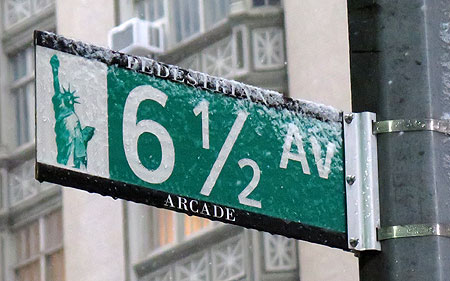
New street in New York City: It’s actually a pedestrian crossing on 57th Street between 6th and 7th Avenues. Weird.

Harry Newton who has written a living will, with instructions for his family, the crux of which is:
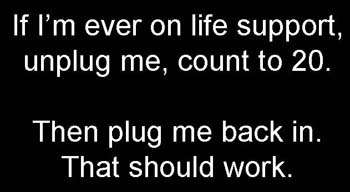
A friend recommended my kids count slowly. Nice friend.

Apparently I am not the only who threatened to use only Chase United Platinum or BankAmericard Travel card who do not charge foreign transaction fees…New in my Amex statement today…
Important Change to Your Account Terms
Important Notice Regarding Your Foreign Transaction Fee
The following is a summary of the change that is being made to your account terms. For more detailed
information, please see the reverse side of this page.
We will no longer charge Foreign Transaction fees for transactions made on your Card account on or after
May 1, 2014.
Revised Terms, as of May 1, 2014
Foreign Transaction Fee None
ID 10048
Cramer’s number 4 This explains it.
http://www.safehaven.com/article/32456/the-retail-death-rattle
Cramer?????? DON’T LISTEN TO cRAMER! The only thing worse is listening to Suze Orman & Dave ramsey.
please explain “buying short.” How does it work? You use a broker?
where did I say that nonsense?
I’m asking how to short a stock. I honestly have no idea. Is it like buying a stock? You call your broker and say I want to sell short at this price?